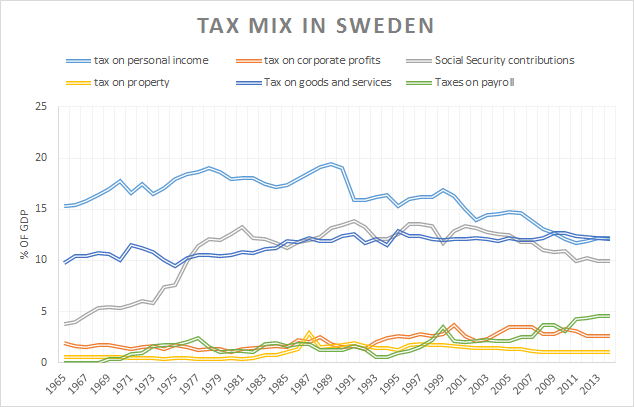
Source: OECD Stat.
Celebrating humanity's flourishing through the spread of capitalism and the rule of law
21 Mar 2016 Leave a comment
in economic history, public economics Tags: growth of government, size of government, Sweden
Source: OECD Stat.
10 Mar 2016 Leave a comment
in labour economics, labour supply Tags: Australia, British economy, Canada, Denmark, France, Germany, Japan, Sweden, taxation and labour supply, working hours
Them Continentals certainly are a bit work-shy especially the Nordics. All of them are pretty much afraid to put in a long week. Then again they do face rather high taxes on labour so what would you expect? The Japanese are still working themselves to death.
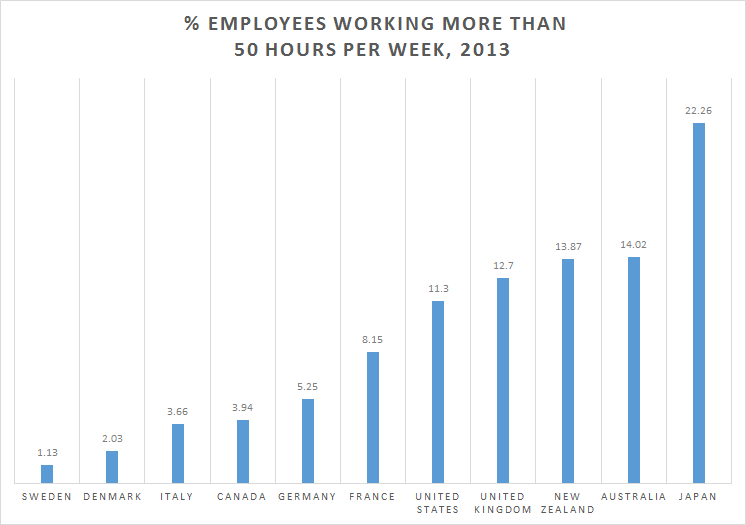
Data extracted on 09 Mar 2016 22:25 UTC (GMT) from OECD.Stat – OECD Better Life Index 2015.
05 Mar 2016 Leave a comment
in economics of love and marriage, fiscal policy, gender, labour economics, labour supply, law and economics, politics - Australia, politics - New Zealand, politics - USA, public economics Tags: Australia, British economy, Canada, Denmark, effective marginal tax rates, family tax benefits, family tax credits, France, Germany, in-work tax credits, Italy, poverty traps, rational irrationality, social insurance, Sweden, taxation and labour supply
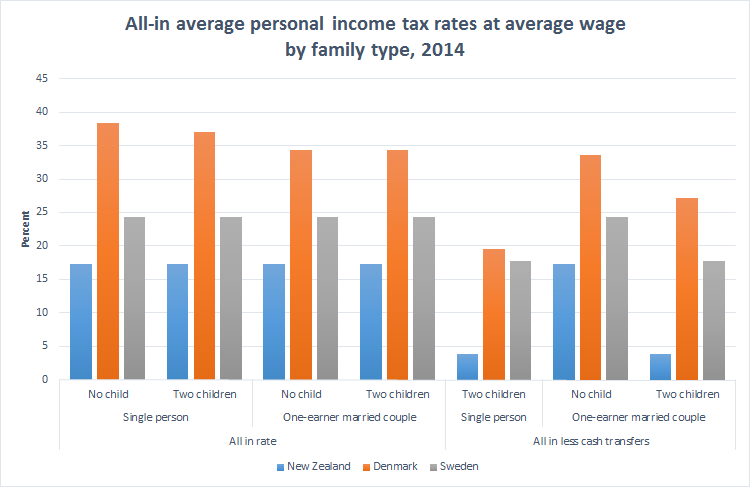
Some countries including New Zealand and Australia do not give ordinary families much of an incentive to earn more. Effective marginal tax rates on low income families is one of the few times that the Left discovers supply-side economics.
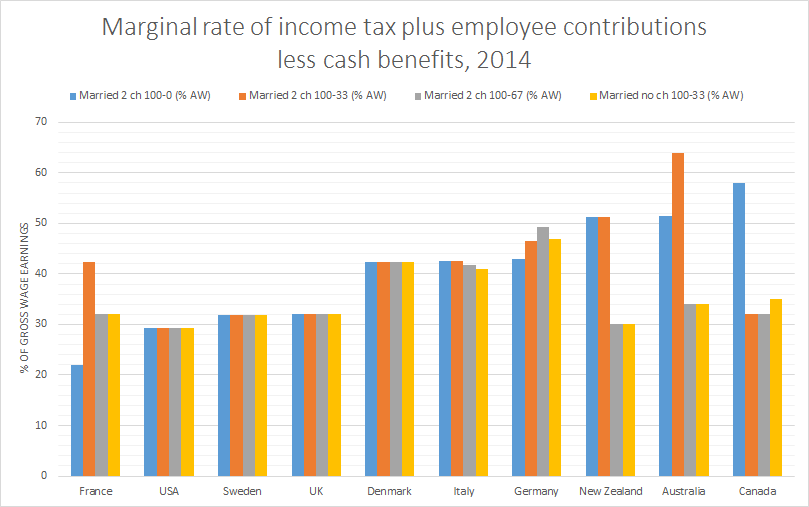
Source: Taxing Wages 2015 – OECD 2015.
05 Mar 2016 Leave a comment
in fiscal policy, politics - Australia, politics - New Zealand, politics - USA, public economics Tags: Australia, British economy, Canada, Denmark, family taxation, France, Germany, Italy, social insurance, Sweden, taxation and labour supply
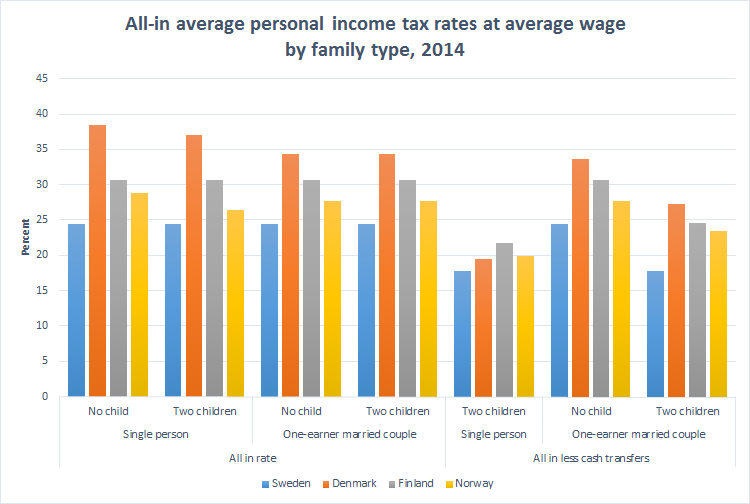
Those sensitive and caring northern European welfare states do tax families rather heavily even after accounting for family cash benefits.
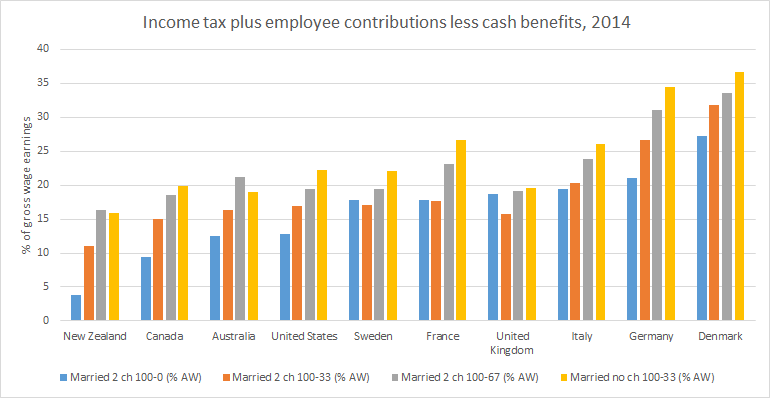
Source: Taxing Wages 2015 – OECD 2015.
04 Mar 2016 Leave a comment
in fiscal policy, politics - Australia, politics - New Zealand, politics - USA, public economics Tags: Australia, British economy, Canada, Denmark, France, Germany, Italy, social insurance, Social Security, Sweden, taxation and labour supply
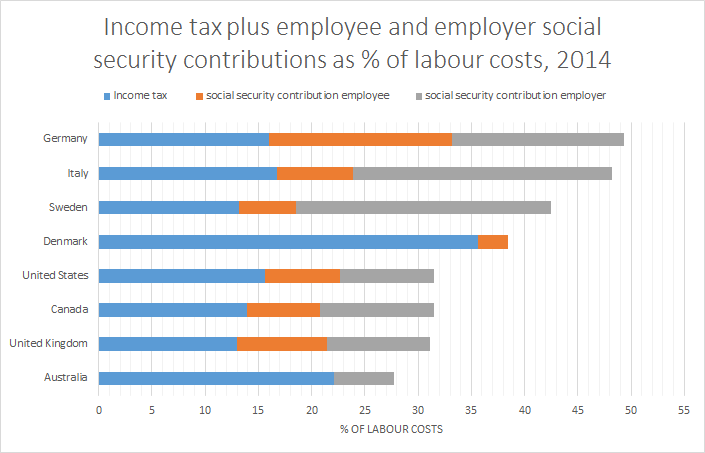
Those much admired northern European welfare states tax families and individuals much more than do the Anglo-Saxon welfare states.
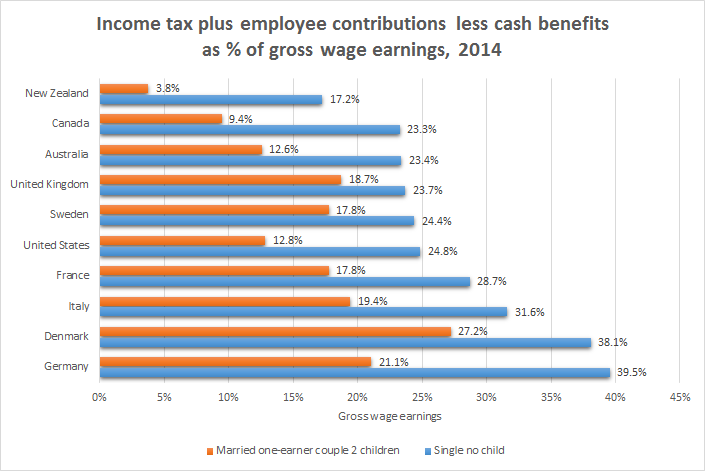
Source: Taxing Wages 2015 – OECD 2015.
04 Mar 2016 Leave a comment
in fiscal policy, politics - Australia, politics - New Zealand, politics - USA, public economics Tags: Australia, British economy, Canada, Denmark, Germany, Italy, social insurance, Social Security, Sweden, taxation and labour supply
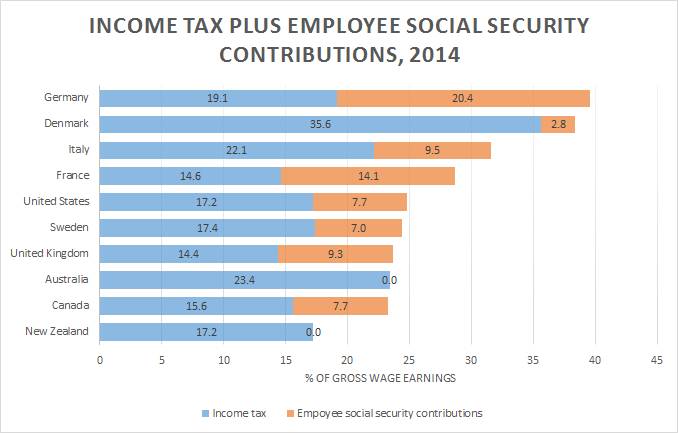
Source: Taxing Wages 2015 – OECD 2015.
03 Mar 2016 Leave a comment
in fiscal policy, public economics Tags: Australia, British economy, Canada, Denmark, Germany, Italy, social insurance, Social Security, Sweden, taxation and labour supply
25 Feb 2016 Leave a comment
in economic history, entrepreneurship, industrial organisation, politics - USA, survivor principle Tags: 2016 presidential election, billionaires, Denmark, entrepreneurial alertness, Finland, inherited wealth, Norway, superstar wages, superstars, Sweden
OK, Nordic billionaire population sizes might be small, but plenty more billionaires make their own money in neoliberal USA than in Bernie Sanders’ Utopia

20 Feb 2016 Leave a comment
in applied welfare economics, economics of regulation, fiscal policy, labour economics, politics - Australia, politics - New Zealand, politics - USA, welfare reform Tags: British economy, Canada, Denmark, Finland, France, Germany, Italy, Japan, Norway, social insurance, Sweden, welfare state
Mandatory and voluntary private social expenditure makes a big difference to the degree of social insurance in some countries but not others. The calculation of these numbers in purchasing power parity would be much more interesting.
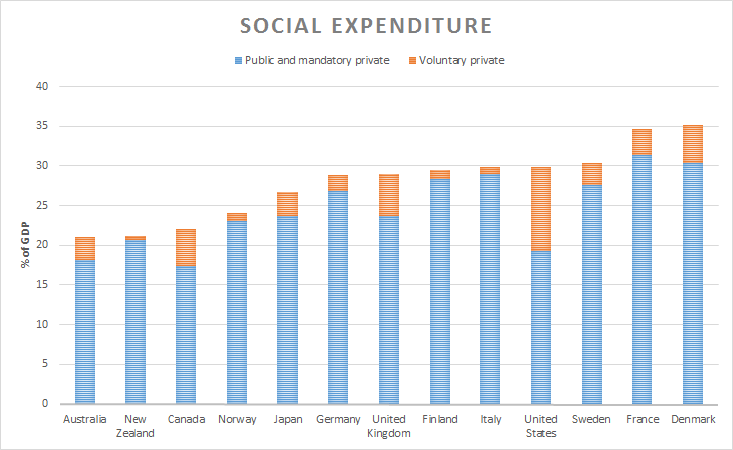
Source: OECD Income Distribution database.
20 Feb 2016 Leave a comment
in fiscal policy, income redistribution, labour economics, politics - Australia, politics - New Zealand, politics - USA, Public Choice, welfare reform Tags: British economy, Denmark, Finland, France, Germany, Italy, Japan, Norway, social insurance, Sweden, welfare state
Some welfare states are much more targeted. Australia has the most targeted welfare state in terms of public social benefits paid in cash to the bottom quintile (Q1) of income earners.

Source: OECD Income Distribution database.
12 Feb 2016 Leave a comment
in economic growth, economic history, fiscal policy, macroeconomics, politics - Australia, politics - New Zealand, public economics Tags: Australia, growth of government, lost decades, size of government, Sweden
I came across this data showing that New Zealand and Sweden had the same sized public sectors in the mid-1980s some years ago. The data could not be found again for a long time in the OECD statistical databases. One reason was the OECD changed its name to general disbursements.
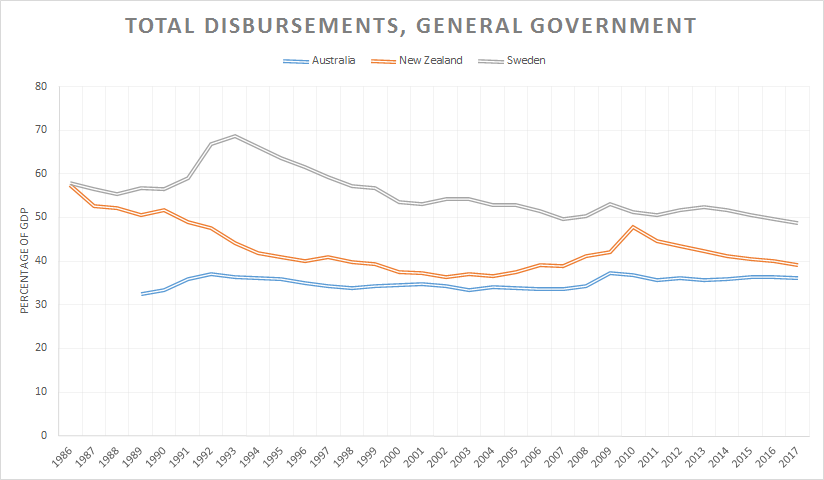
Data extracted on 12 Feb 2016 08:45 UTC (GMT) from OECD.Stat.
The size of the public sector in Australia has not changed much for 30 odd years. The public sector has been in a long decline in Sweden and New Zealand since peaks as a percentage of nominal GDP in the late 1980s and early 1990s respectively.
I know of no comments on the large size of the New Zealand public sector as measured by general government expenditure in the late 1980s. Its contribution to the stagnant economic growth of that time is worth exploring.
27 Jan 2016 Leave a comment
in politics - New Zealand, public economics Tags: Denmark, family tax credits, family taxation, in-work tax credits, Sweden, taxation and labour supply
25 Jan 2016 Leave a comment
in public economics Tags: Denmark, Finland, Norway, Sweden, taxation and labour supply
14 Jan 2016 Leave a comment
in economic history, politics - Australia, politics - New Zealand, politics - USA, public economics Tags: growth of government, Norway, size of government, Sweden
21 Nov 2015 2 Comments
in currency unions, economic growth, economic history, Euro crisis, fiscal policy, macroeconomics, politics - USA Tags: British disease, British economy, Eurosclerosis, France, sick man of Europe, Sweden, Swedosclerosis, Twitter left
The Washington Centre for Equitable Growth have joined the Wall Street Journal in falling for that dodgy OECD hypothesis about rising inequality holding back economic growth.
The chart below shows stark differences between egalitarian Sweden and France, and the more unequal UK since 1970 in departures from a trend growth rate of 1.9% in real GDP per working age person, PPP.
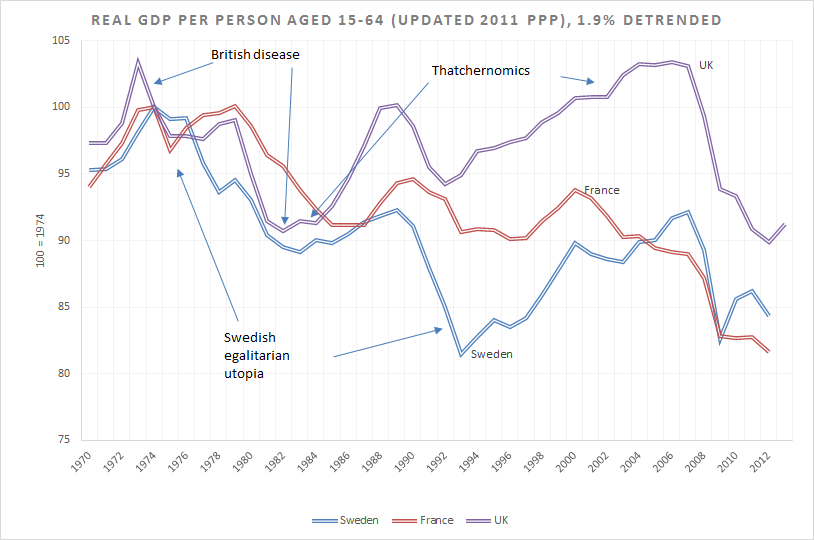
Source: Computed from OECD Stat Extract and The Conference Board. 2015. The Conference Board Total Economy Database™, May 2015, http://www.conference-board.org/data/economydatabase/
In the above chart, a flat line is growth at the same rate as the USA for the 20th century, which was 1.9% for GDP per working age person on a purchasing power parity basis. The USA’s growth rate is taken as the trend rate of growth of the global technological frontier. A falling line in the above chart is growth in real GDP per working age person, PPP, at below this trend rate of 1.9%; a rising line is above trend rate growth for that year.
Britain did very well, both under the neoliberal horrors of Thatcherism and the betrayals by Tony Blair of a true Labour Party platform. The UK grew at above the trend annual growth to 1.9% for most of the period from the early 1980s to 2007.
Neither France or Sweden, despite their egalitarian economies, kept up with the US growth rate since 1970. Under the OECD’s hypothesis, if France and Sweden had been more unequal, their trend growth rates would have been even more appalling since 1970.
Celebrating humanity's flourishing through the spread of capitalism and the rule of law
Celebrating humanity's flourishing through the spread of capitalism and the rule of law
Celebrating humanity's flourishing through the spread of capitalism and the rule of law
Celebrating humanity's flourishing through the spread of capitalism and the rule of law
Celebrating humanity's flourishing through the spread of capitalism and the rule of law
Celebrating humanity's flourishing through the spread of capitalism and the rule of law
A History of the Alt-Right
Econ Prof at George Mason University, Economic Historian, Québécois
Celebrating humanity's flourishing through the spread of capitalism and the rule of law
Scholarly commentary on law, economics, and more
Beatrice Cherrier's blog
Celebrating humanity's flourishing through the spread of capitalism and the rule of law
Celebrating humanity's flourishing through the spread of capitalism and the rule of law
Celebrating humanity's flourishing through the spread of capitalism and the rule of law
Why Evolution is True is a blog written by Jerry Coyne, centered on evolution and biology but also dealing with diverse topics like politics, culture, and cats.
Celebrating humanity's flourishing through the spread of capitalism and the rule of law
A rural perspective with a blue tint by Ele Ludemann
DPF's Kiwiblog - Fomenting Happy Mischief since 2003
Celebrating humanity's flourishing through the spread of capitalism and the rule of law
The world's most viewed site on global warming and climate change
Tim Harding's writings on rationality, informal logic and skepticism
A window into Doc Freiberger's library
Let's examine hard decisions!
Commentary on monetary policy in the spirit of R. G. Hawtrey
Thoughts on public policy and the media
Celebrating humanity's flourishing through the spread of capitalism and the rule of law
Politics and the economy
A blog (primarily) on Canadian and Commonwealth political history and institutions
Reading between the lines, and underneath the hype.
Economics, and such stuff as dreams are made on
"The British constitution has always been puzzling, and always will be." --Queen Elizabeth II
Celebrating humanity's flourishing through the spread of capitalism and the rule of law
Celebrating humanity's flourishing through the spread of capitalism and the rule of law
WORLD WAR II, MUSIC, HISTORY, HOLOCAUST
Undisciplined scholar, recovering academic
Celebrating humanity's flourishing through the spread of capitalism and the rule of law
Res ipsa loquitur - The thing itself speaks
In Hume’s spirit, I will attempt to serve as an ambassador from my world of economics, and help in “finding topics of conversation fit for the entertainment of rational creatures.”
Researching the House of Commons, 1832-1868
Articles and research from the History of Parliament Trust
Reflections on books and art
Posts on the History of Law, Crime, and Justice
Celebrating humanity's flourishing through the spread of capitalism and the rule of law
Exploring the Monarchs of Europe
Cutting edge science you can dice with
Small Steps Toward A Much Better World


Recent Comments