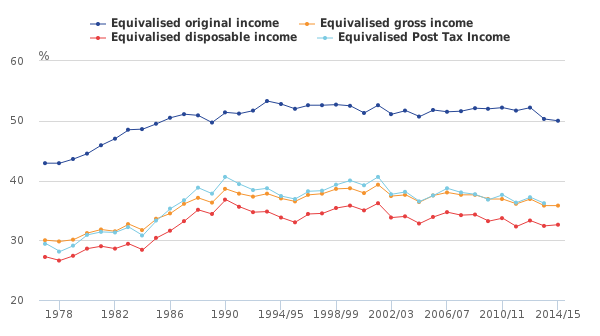
British top 1% really have dropped the ball, left labour surplus on the table
11 Jan 2017 Leave a comment
Deirdre McCloskey summarises Rawls and Nozick on unequal incomes
02 Jan 2017 Leave a comment
in applied price theory, applied welfare economics, comparative institutional analysis, constitutional political economy, development economics, economic history, Gordon Tullock, growth miracles, history of economic thought, James Buchanan, James Buchanan, labour economics, law and economics, poverty and inequality, property rights, Public Choice, Rawls and Nozick Tags: creative destruction, Deirdre McCloskey, industrial revolution, John Rawls, Robert Nozick, The Great Enrichment, The Great Escape, The Great Fact, top 1%, veil of ignorance, veil of uncertainty
Source: Review of Michael J. Sandel’s What Money Can’t Buy: The Moral Limit of Markets by Deirdre McCloskey August 1, 2012. Shorter version published in the Claremont Review of Books XII(4), Fall 2012 via Deirdre McCloskey: editorials.
Capitalism in the United States is ruthless—to the rich
27 Nov 2016 Leave a comment
in economic history, entrepreneurship, industrial organisation, poverty and inequality, survivor principle Tags: top 1%

The rise of a working rich in Australia
12 Oct 2016 Leave a comment
in economic history, human capital, industrial organisation, labour economics, labour supply, politics - Australia, poverty and inequality, survivor principle Tags: superstar wages, superstars, top 1%, top incomes
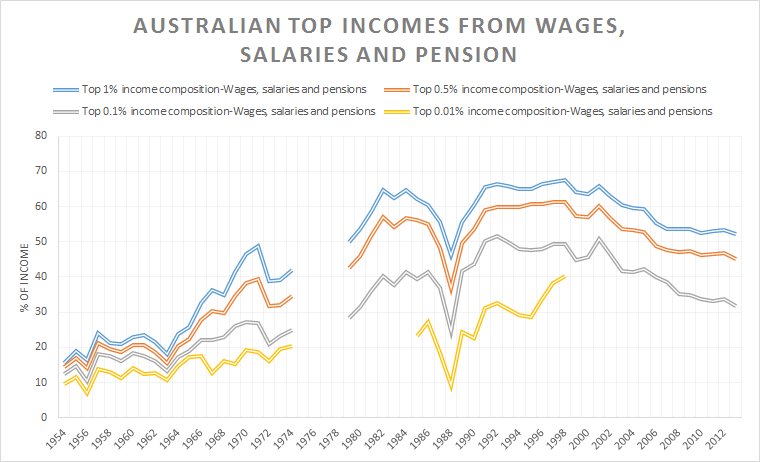
Source: The World Wealth and Income Database.
Lazy Australian top 0.1% only increased their income under @AustralianLabour
09 Oct 2016 Leave a comment
in economic history, industrial organisation, politics - Australia, poverty and inequality, survivor principle Tags: antimarket bias, entrepreneurial alertness, superstar wages, superstars, top 1%, top incomes
Australia’s top income earners are a lazy lot. The top 0.1% only ever had a rising income share under a Labor government in the 1980s. Even the top 1% had a pretty lean time until the 1990s.

Source: The World Wealth and Income Database.
What Wasn’t Said in “Wealth Inequality In America”
22 Sep 2016 Leave a comment
in applied welfare economics, politics - USA, population economics, poverty and inequality Tags: top 1%
How to show that unions & income inequality are unrelated when attempting to show a link
22 Sep 2016 Leave a comment
in human capital, labour economics, labour supply, politics - USA, unions Tags: superstar wages, superstars, top 1%
Fight for $15 tried to show a link between unions and rising income inequality but all it managed to show that unions went into decline several decades before inequality started to rise.
The Real “Truth About the Economy:” Have Wages Stagnated?
12 Sep 2016 Leave a comment
in applied welfare economics, economics, labour economics, poverty and inequality Tags: middle class stagnation, top 1%
% Australian top incomes from wages, salaries and pensions since 1954
19 Jul 2016 Leave a comment
in economic history, human capital, industrial organisation, labour economics, occupational choice, politics - Australia, poverty and inequality Tags: Australia, CEO pay, superstar wages, superstars, top 1%, top incomes
Australia has had a working rich for a long time now. Australian top income earners are top wage earners. They are athletes, celebrities, business executives and in the professions.
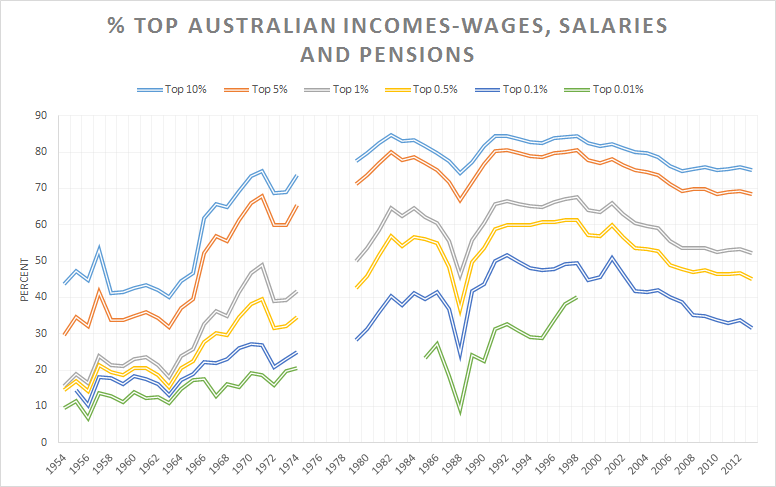
Source: The World Wealth and Income Database.
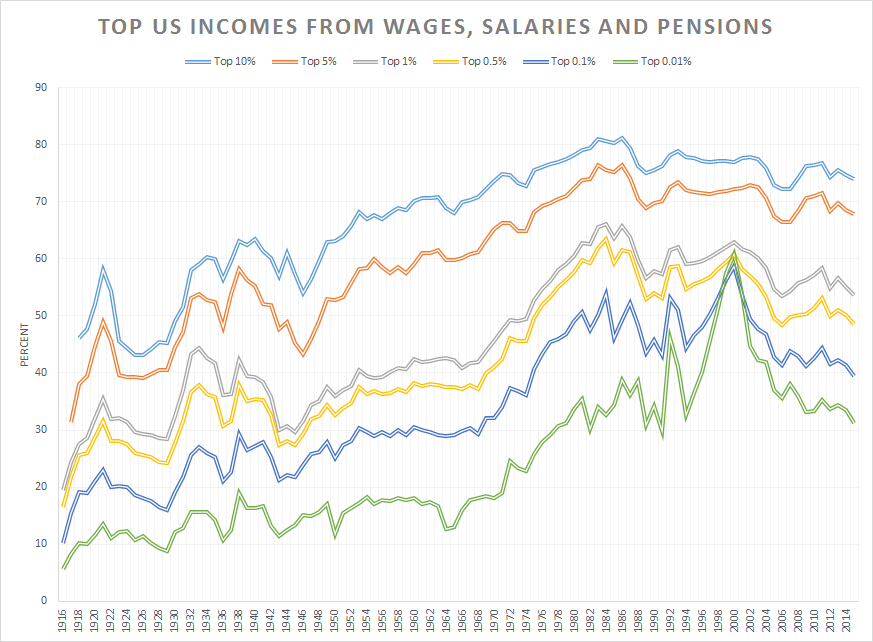
% US top incomes from wages, salaries and pensions, 1913 – 2015,
18 Jul 2016 Leave a comment
in applied welfare economics, economic history, human capital, industrial organisation, labour economics, occupational choice, politics - USA, poverty and inequality, survivor principle Tags: CEO pay, entrepreneurial alertness, superstar wages, superstars, top 1%, top incomes
The rich in the USA long ago became a working rich; most top incomes are from wages and salaries.
Source: The World Wealth and Income Database.
NZ top income earners as lazy as ever @MaxRashbrooke @CloserTogether
17 Jul 2016 Leave a comment
in economic history, human capital, labour economics, occupational choice, politics - New Zealand, poverty and inequality Tags: Leftover Left, pessimism bias, top 1%, top incomes, Twitter left
Max Rashbrooke was good enough to remind us that the 2013 update of New Zealand top income shares came online a few days ago.
As is well known to everyone except those obsessed with top income shares, New Zealand top income shares have not changed much since the late 1980s. They are now no higher than in the good old days when New Zealand was an egalitarian paradise in their eyes.

Source: The World Wealth and Income Database.
Do the Rich Pay Their Fair Share?
13 Jul 2016 Leave a comment
in politics - USA, public economics Tags: envy, superstars, taxation and entrepreneurship, taxation and investment, top 1%, top 10%
The Economist Crony Capitalism Index
08 Jul 2016 Leave a comment
in applied price theory, applied welfare economics, comparative institutional analysis, constitutional political economy, development economics, economics of bureaucracy, entrepreneurship, financial economics, growth disasters, growth miracles, industrial organisation, politics - USA, Public Choice, rentseeking, survivor principle Tags: crony capitalism, superstar wages, superstars, top 1%

…
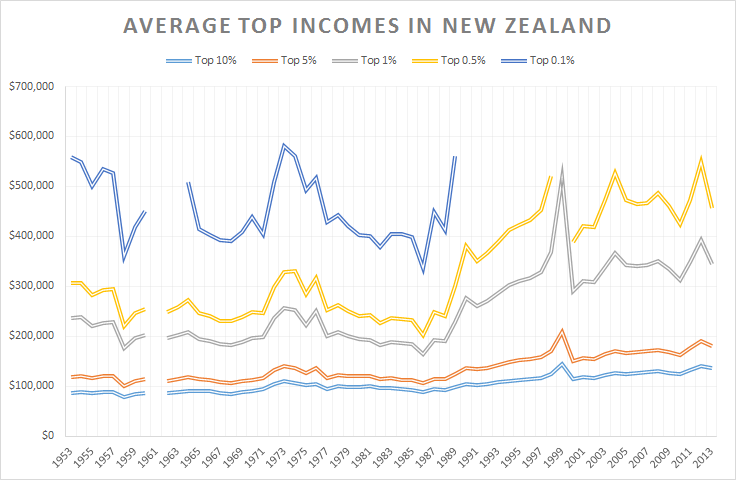
Average top incomes in New Zealand
05 Jul 2016 Leave a comment
in human capital, labour economics, labour supply, occupational choice, poverty and inequality Tags: creative destruction, entrepreneurial alertness, top 1%
The average top income in New Zealand is that of a professional, executive or entrepreneur.
Source: The World Wealth and Income Database.
 Utopia, you are standing in it!
Recent Comments