Celebrating humanity's flourishing through the spread of capitalism and the rule of law
09 Jun 2016 Leave a comment
in applied price theory, applied welfare economics, comparative institutional analysis, economic history, economics of education, economics of regulation, health economics, income redistribution, industrial organisation, international economics, politics - USA, Public Choice, public economics, rentseeking Tags: 2016 presidential election, antimarket bias, crony capitalism, living wage, pessimism bias, top 1%
01 Jun 2016 Leave a comment
in applied price theory, applied welfare economics, economic history, entrepreneurship, financial economics, human capital, labour economics, poverty and inequality, unions Tags: entrepreneurial alertness, inherited wealth, superstar wages, superstars, top 0.1%, top 1%
Of the 15 inheritance based billionaires, three are from the Walton family, two are the Koch brothers and another three are from the Mars family.
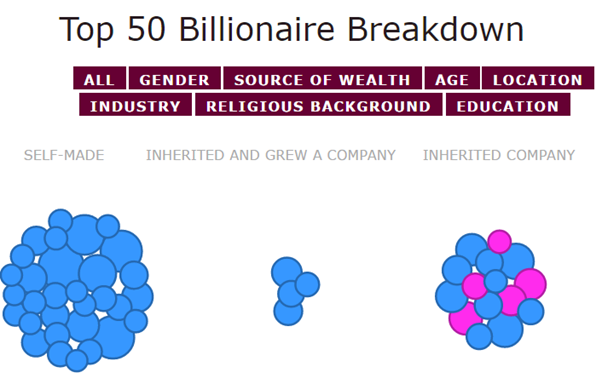
Source: The world’s top 50 billionaires: A demographic breakdown.
24 May 2016 Leave a comment
in economic history, entrepreneurship, human capital, industrial organisation, labour economics, labour supply, occupational choice, politics - USA, poverty and inequality Tags: entrepreneurial alertness, superstar wages, superstars, top 1%, top incomes
Looks like the Reagan Revolution coincided with the American rich going out to work for a living. They started earning most of their incomes from wages, salaries and pensions or from entrepreneurial income. The American rich are now working rich; top wage earners, not top income earners.
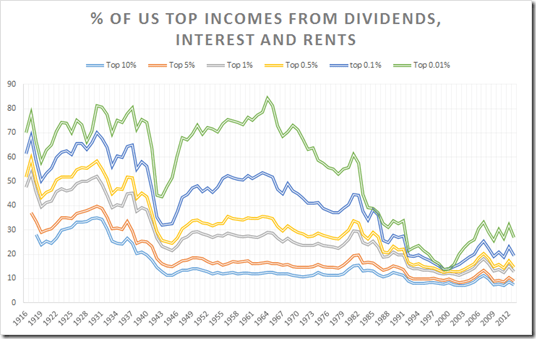
Source: The World Wealth and Income Database.
23 May 2016 Leave a comment
in applied price theory, applied welfare economics, economic history, entrepreneurship, human capital, industrial organisation, labour economics, labour supply, occupational choice, poverty and inequality, survivor principle Tags: entrepreneurial alertness, envy, superstar wages, superstars, top 1%, top incomes
Everybody from the top 10% to the top 0.01% have to work for their living these days with much of their income coming from wages.
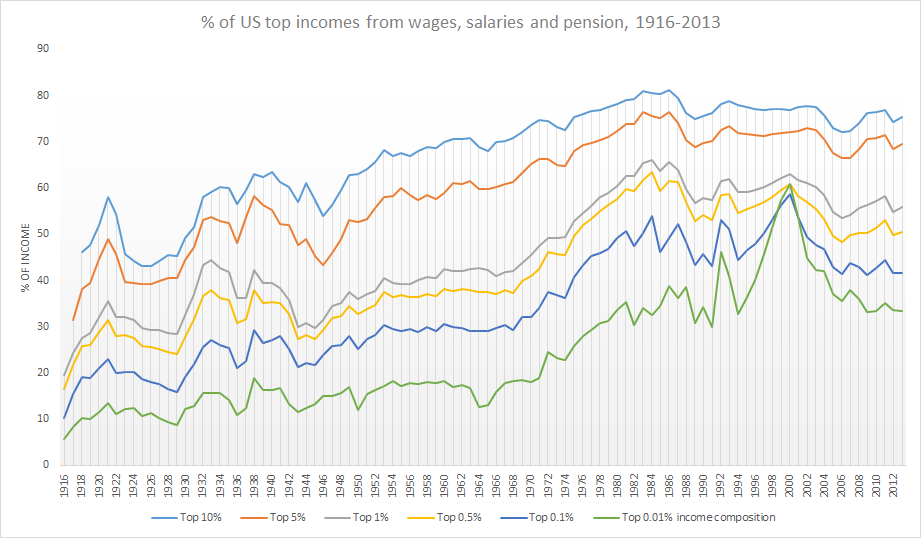
Source: The World Wealth and Income Database.
23 May 2016 Leave a comment
in applied welfare economics, comparative institutional analysis, economic history, economics of regulation, income redistribution, industrial organisation, politics - New Zealand, poverty and inequality, Public Choice, rentseeking Tags: child poverty, conspiracy theories, expressive voting, family poverty, Leftover Left, living standards, neoliberalism, Old Left, pessimism bias, rational irrationality, reactionary left, top 1%
New work by Chris Ball and John Creedy shows substantial *declines* in NZ inequality.
initiativeblog.com/2015/06/24/ine… http://t.co/f94fw4Bhae—
Eric Crampton (@EricCrampton) June 24, 2015
You really are still fighting the 1990 New Zealand general election if Max Rashbrooke makes more sense than you on the good old days before the virus of neoliberalism beset New Zealand from 1984 onwards.
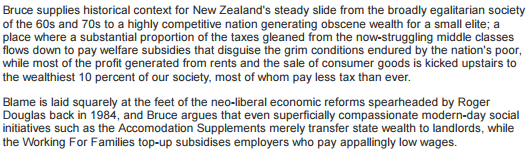
Source: Mind the Gap: Why most of us are poor | Stuff.co.nz.
Bryan Bruce in the caption looks upon the New Zealand of the 1960s and 70s as “broadly egalitarian”. Even Max Rashbrooke had to admit that was not so if you were Maori or female.
The present rate of technology adoption is nearly a vertical line —@blackrock https://t.co/3oS3YAI4ld—
Vala Afshar (@ValaAfshar) January 22, 2016
Maybe 65% of the population of those good old days before the virus of neoliberalism. were missing out on that broadly egalitarian society championed by Bryan Bruce.
As is typical for the embittered left, the reactionary left, gender analysis and the sociology of race is not for their memories of their good old days. New Zealand has the smallest gender wage gap of any of the industrialised countries.
The 20 years of wage stagnation that proceeded the passage of the Employment Contracts Act and the wages boom also goes down the reactionary left memory hole.
That wage stagnation in New Zealand in the 1970s and early 80s coincided with a decline in the incomes of the top 10%. When their income share started growing again, so did the wages of everybody after 20 years of stagnation. The top 10% in New Zealand managed to restore their income share of the early 1970s and indeed the 1960s. That it is hardly the rich getting richer.
08 May 2016 Leave a comment
in politics - New Zealand, public economics Tags: superstar wagers, superstars, top 1%, top incomes
07 May 2016 Leave a comment
in politics - New Zealand, public economics Tags: entrepreneurial alertness, Leftover Left, reactionary left, superstar wagers, superstars, top 1%
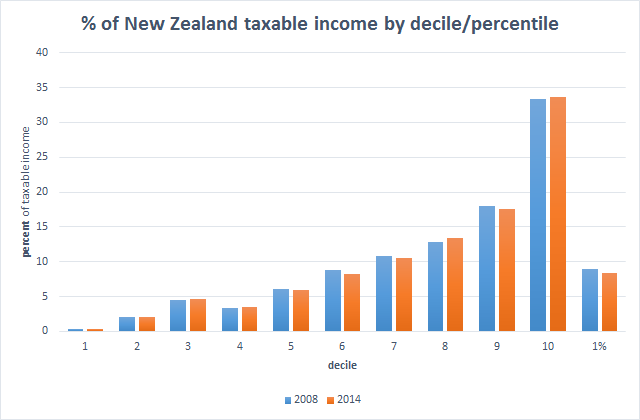
The share of incomes of the top 1% in New Zealand has not increased since the 1950s – they are just bone lazy at extracting labour surplus.
Veteran left-wing grumbler Max Rashbrooke was good enough to collect Inland Revenue Data data that show that getting even lazier under right-wing government elected in 2008. Their share of taxable income has dropped from 9% when labour lost power to 8.4% now. These figures exclude capital gains.
07 May 2016 Leave a comment
in applied welfare economics, discrimination, economic history, gender, labour economics, labour supply Tags: Canada, gender wage gap, middle class stagnation, reversing gender gap, top 1%, wage stagnation
05 May 2016 Leave a comment
in human capital, industrial organisation, labour economics, labour supply, occupational choice, survivor principle Tags: Apple, CEO pay, creative destruction, entrepreneurial alertness, Facebook, Google, Microsoft, superstar wages, superstars, top 1%, Twitter, Uber, Yahoo
I am surprised to see that Yahoo is in business much less competing for top talent. Microsoft is in decline too. Apple does not pay people as much as everybody else.
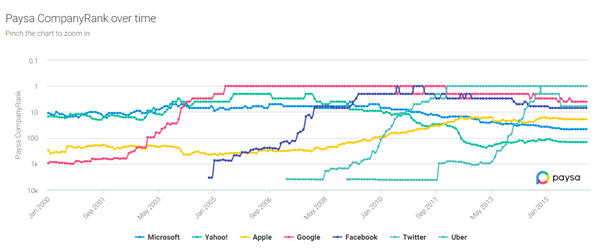
Source: Paysa Company Rank | Paysa.
Some other colours seem to duplicate so you will have to work out which is which by when they exploded in hiring top talent.
25 Apr 2016 Leave a comment
18 Apr 2016 Leave a comment
in fiscal policy, labour economics, labour supply, macroeconomics, poverty and inequality, public economics Tags: growth of government, income inequality, measurement error, Ricardian theory of budget deficits, Social Security, top 1%, wealth inequality
Markus Poschke and Barış Kaymak have just put out a paper arguing that increased social spending is a major driver of wealth inequality:
Another important and often overlooked third factor is the rise in the generosity of government transfers since 1960, mostly due to the expansion of public pensions (social security) and the introduction of public health insurance for the elderly (Medicare).
Combined spending on these two programs accounted for almost 9% of US GDP in 2010, up from less than 3% in 1960…
These government programmes tend to curb the need to rely on personal savings for retirement, especially among low and middle-income households, and might thus explain why their share in total wealth has declined.
This makes a good to good degree of sense. I have previously argued that using the arguments of Edward Prescott that it is not wise for people on ordinary income to save for their retirement when they can go down to the local Social Security office and claim an old age pension.
51% of nonretirees doubt they will receive Social Security… on.gallup.com/1NcwzEa #GallupDaily http://t.co/ZhKnHYtr1X—
(@GallupNews) August 13, 2015
It is even less wise to save that for retirement if those savings reduce your eligibility for an old age pension. Far better just to invest in a nicer house and pass it on to your children. Poschke and Kaymak note that measures of private wealth inequality miss these claims to old age pensions:
… statistics on wealth inequality that do not capture households’ claims on the public sector are incomplete and overstate top wealth shares.
This is not a new argument. Back when the Ricardian theories of budget deficits came to prominence and before that in debates on theories of the public debt, the more Keynesian sides of those arguments did argue that people were irrational for not including their old age pension entitlements under social security schemes in their calculations of their wealth.
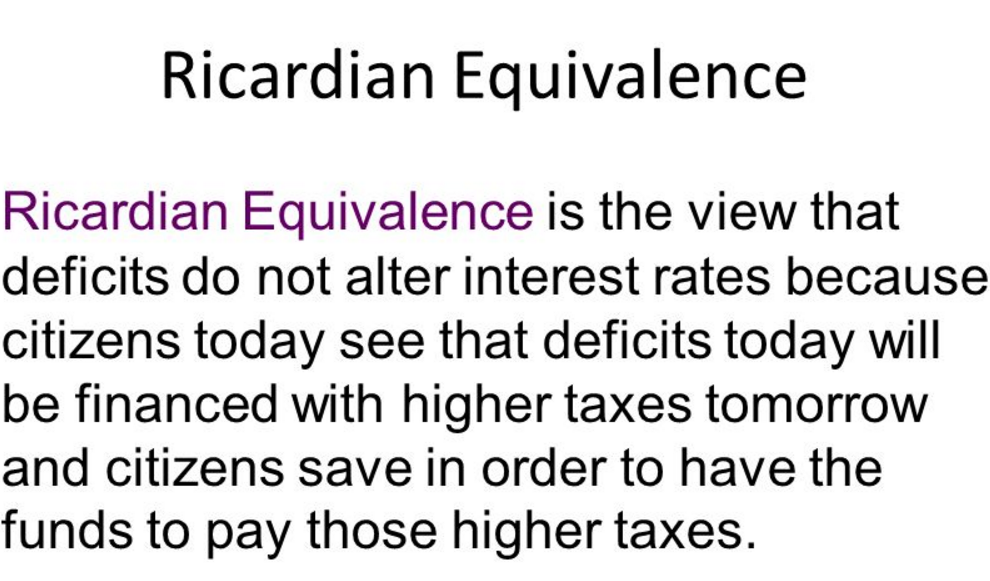
Some of their taxes were paying for their future old age pension and were another form of wealth rather than a tax. As such, taxpayers should regard this part of their taxes as investments and not cutting back their labour supply in response as they do to other taxes.
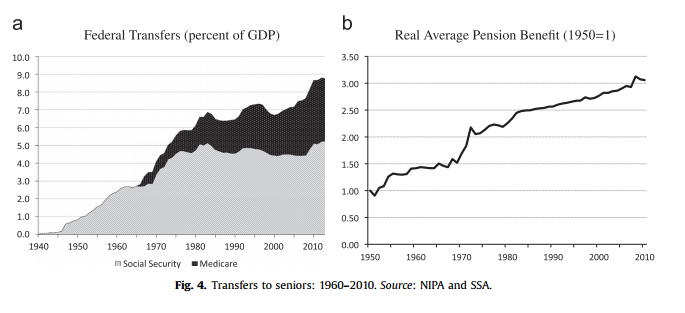
How much of the rise in wealth inequality is due to this failure to measure Social Security wealth as represented by old age pension entitlements? Their estimate is about 25%:
…technological factors play a dominant role not only for changes in income inequality, as is well known, but also for wealth inequality. As high-earning households save part of their additional income, their share of wealth also rises.
This channel accounts for about half of the total increase in wealth inequality. Tax cuts and the expansion of transfers each account for about half of the remainder…
While tax cuts encourage saving, larger transfers reduce saving incentives for retirement, in particular for low and middle income groups. This implies that these groups’ share of private wealth declines.
Note though that this is partly due to the fact that measures of private wealth inequality, like those compiled by Saez and Zucman, do not include claims to future government transfers, like social security, which constitute wealth for their owners.
26 Mar 2016 Leave a comment
in applied welfare economics, economic history, entrepreneurship, human capital, labour economics, poverty and inequality Tags: entrepreneurial alertness, superstar wages, superstars, top 0.1%, top 1%
Piketty and Saez (2003, updated) estimated the share of income held by the top 1% from 13 percent in 1991 to 23 percent in 2012. The new Bricker et al. research shows only a 7 percentage point increase to 18 percent in 2012. The share held by the super-rich, the top 0.1% has increased much at all.
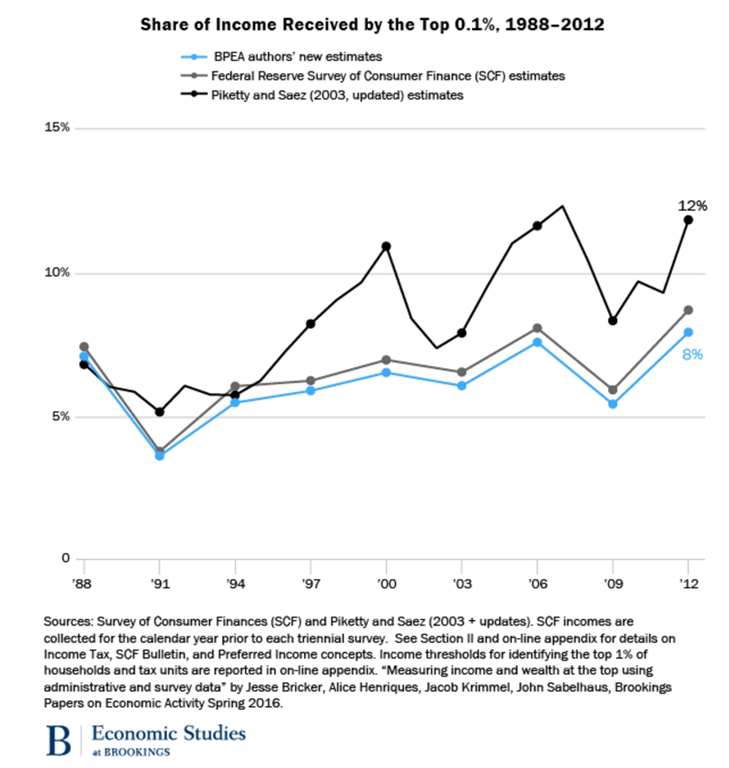
Source: Measuring income and wealth at the top using administrative and survey data via How super-rich Americans get that way is changing – AEI | Pethokoukis Blog » AEIdeas.

Source: Measuring income and wealth at the top using administrative and survey data via How super-rich Americans get that way is changing – AEI | Pethokoukis Blog » AEIdeas.
17 Mar 2016 Leave a comment
in applied welfare economics, economic growth, economic history, labour economics, poverty and inequality, unemployment Tags: antimarket bias, pessimism bias, rational irrationality, The Great Enrichment, top 1%

Source: Do inequality and poverty matter? | Pundit – Brian Easton (2016) .
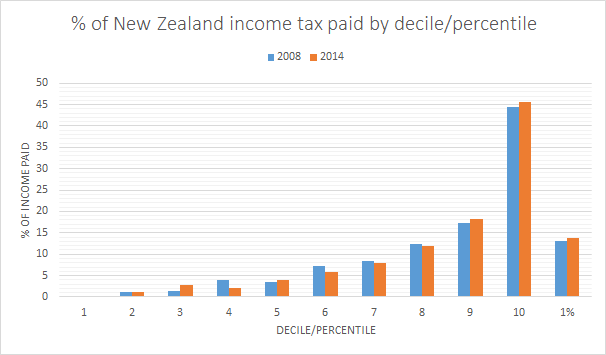
I will outsource to Brian Easton, the CTU, the CTU’s Bill Rosenberg and Closer Together Whakatata Mai – reducing inequalities because the continual correction of Max Rashbrooke on poverty and inequality is becoming tiring.
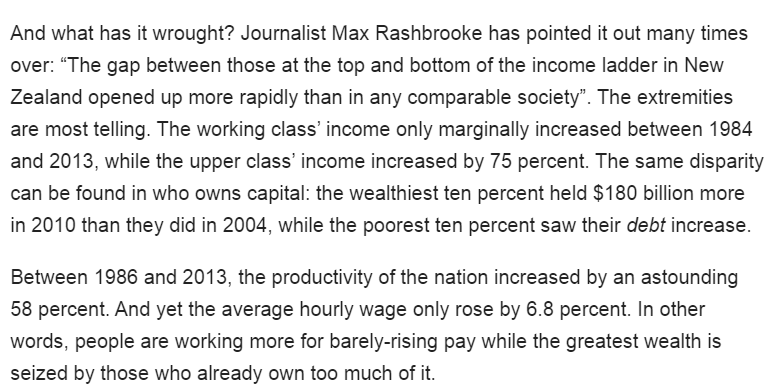
Source: Love in the time of crisis, James Robins, Wednesday, 16 March 2016, Newstalk NZ.
A brief history of inequality-from Treasury paper Fig4. Note Employment Contracts Act,GST,income tax,benefit cuts,WFF http://t.co/y4w3cUsgjD—
Bill Rosenberg (@WJRosenbergCTU) June 27, 2015
Inequality has not risen for at least 20 years as Bill Rosenberg tweeted. The rise in inequality in the late 1980s and early 1990s was followed by an employment boom that lasted to 2009.
Unemployment was as low as 3 1/2% for several years despite a large increase in labour force participation. Furthermore, the gender wage gap in New Zealand fell rapidly to now be the smallest in any industrialised country.
As the Facebook photos show, there has been strong income and wage growth despite the grizzling of the left. The return of income growth and wages growth after 20 years of real wage stagnation followed the economic reforms of the 1980s and the passage of the Employment Contracts Act in 1991.
As the CTU shows below, the economic reforms in the 1980s put an end to a sharp decline in the relative economic performance of the New Zealand economy.
17 Mar 2016 Leave a comment
in applied welfare economics, economic history, economics of education, entrepreneurship, human capital, labour economics, politics - New Zealand, poverty and inequality Tags: pension fund socialism, top 1%, Withering away of the proletariat
New Zealand working class is wealthier than the entire capitalist class. Their human capital, shown in the chart below as the human capital of the unskilled and non-degree workers, far exceeds the value of the physical capital stock of New Zealand.
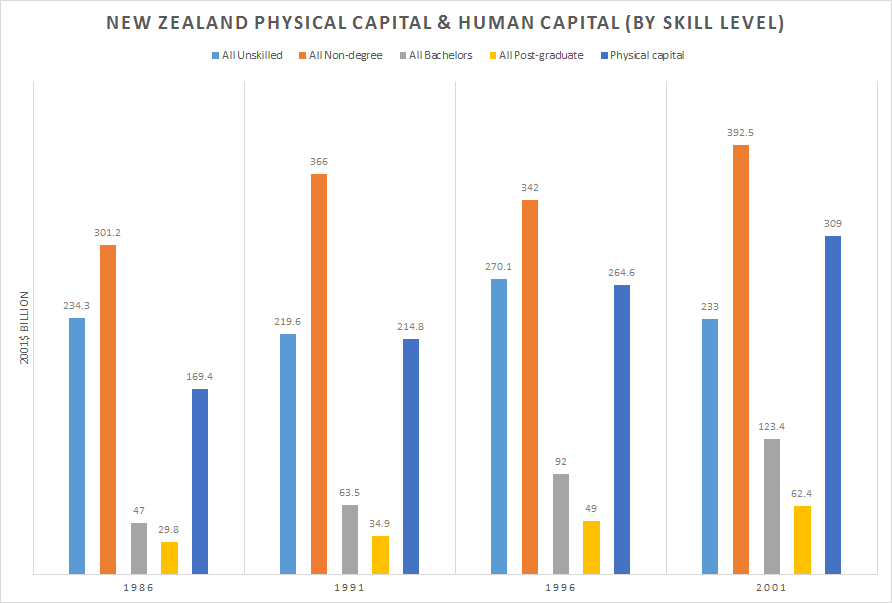
Source: Lˆe Thi. Vˆan Tr`ınh, Estimating the monetary value of the stock of human capital for New Zealand, University of Canterbury PhD thesis (September 2006).
Only part of this physical capital stock is owned by the capitalist class given we live in the era of pension fund socialism. About a 3rd of that physical capital stock is owner occupied homes.
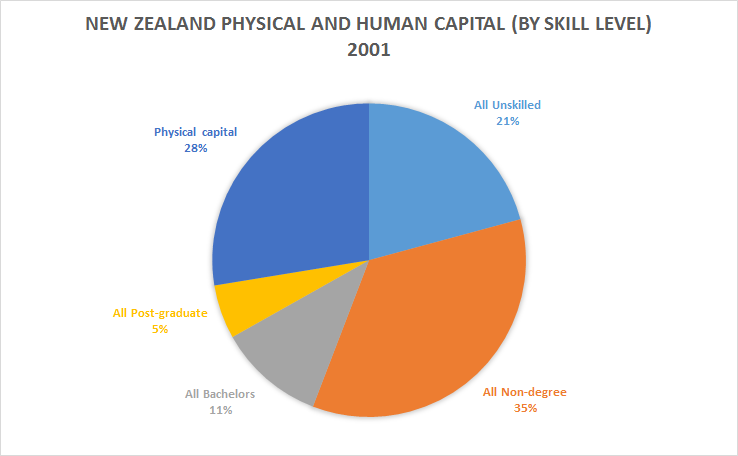
Source: Lˆe Thi. Vˆan Tr`ınh, Estimating the monetary value of the stock of human capital for New Zealand, University of Canterbury PhD thesis (September 2006).
The only reason that the share of unskilled and non-degree workers is in any way declining is the withering away of the proletariat. More and more people are joining the middle-class and going on to higher education.
Andrew Little is looking to update Labour's definition of the 'working class': stuff.co.nz/national/polit… http://t.co/AQ9mJL7CQf—
NZ Stuff Politics (@NZStuffPolitics) November 30, 2014
.
Celebrating humanity's flourishing through the spread of capitalism and the rule of law
Scholarly commentary on law, economics, and more
Beatrice Cherrier's blog
Celebrating humanity's flourishing through the spread of capitalism and the rule of law
Celebrating humanity's flourishing through the spread of capitalism and the rule of law
Celebrating humanity's flourishing through the spread of capitalism and the rule of law
Why Evolution is True is a blog written by Jerry Coyne, centered on evolution and biology but also dealing with diverse topics like politics, culture, and cats.
Celebrating humanity's flourishing through the spread of capitalism and the rule of law
Celebrating humanity's flourishing through the spread of capitalism and the rule of law
A rural perspective with a blue tint by Ele Ludemann
DPF's Kiwiblog - Fomenting Happy Mischief since 2003
Celebrating humanity's flourishing through the spread of capitalism and the rule of law
The world's most viewed site on global warming and climate change
Tim Harding's writings on rationality, informal logic and skepticism
A window into Doc Freiberger's library
Let's examine hard decisions!
Commentary on monetary policy in the spirit of R. G. Hawtrey
Thoughts on public policy and the media
Celebrating humanity's flourishing through the spread of capitalism and the rule of law
Politics and the economy
A blog (primarily) on Canadian and Commonwealth political history and institutions
Reading between the lines, and underneath the hype.
Economics, and such stuff as dreams are made on
"The British constitution has always been puzzling, and always will be." --Queen Elizabeth II
Celebrating humanity's flourishing through the spread of capitalism and the rule of law
Celebrating humanity's flourishing through the spread of capitalism and the rule of law
WORLD WAR II, MUSIC, HISTORY, HOLOCAUST
Undisciplined scholar, recovering academic
Celebrating humanity's flourishing through the spread of capitalism and the rule of law
Res ipsa loquitur - The thing itself speaks
Celebrating humanity's flourishing through the spread of capitalism and the rule of law
Researching the House of Commons, 1832-1868
Articles and research from the History of Parliament Trust
Reflections on books and art
Posts on the History of Law, Crime, and Justice
Celebrating humanity's flourishing through the spread of capitalism and the rule of law
Exploring the Monarchs of Europe
Cutting edge science you can dice with
Small Steps Toward A Much Better World
“We do not believe any group of men adequate enough or wise enough to operate without scrutiny or without criticism. We know that the only way to avoid error is to detect it, that the only way to detect it is to be free to inquire. We know that in secrecy error undetected will flourish and subvert”. - J Robert Oppenheimer.
The truth about the great wind power fraud - we're not here to debate the wind industry, we're here to destroy it.
Celebrating humanity's flourishing through the spread of capitalism and the rule of law
Celebrating humanity's flourishing through the spread of capitalism and the rule of law
Economics, public policy, monetary policy, financial regulation, with a New Zealand perspective
Celebrating humanity's flourishing through the spread of capitalism and the rule of law
Restraining Government in America and Around the World

 Utopia, you are standing in it!
Recent Comments