Peak China pic.twitter.com/1zpJLFMClO
— ian bremmer (@ianbremmer) November 2, 2015
Peak China
20 Nov 2015 Leave a comment
in development economics, population economics Tags: China, offsetting behaviour, one child policy, The fatal conceit, The pretence to knowledge, unintended consequences
The costs of solar energy to the environment are underestimated
13 Nov 2015 Leave a comment
in energy economics, environmental economics, global warming Tags: Big Solar, expressive voting, renewable energy, solar energy, unintended consequences
https://twitter.com/roomfordebate/status/662290426083328000

Source: The Costs of Solar Energy to the Environment – Room for Debate – NYTimes.com.
Chinese birth and death rates and the Chinese population since 1950
04 Nov 2015 Leave a comment
in development economics, growth disasters, growth miracles, labour economics, labour supply, population economics Tags: China, economics of fertility, one child policy, The fatal conceit, The pretense to knowledge, unintended consequences
Is the living wage a form of indirect sex discrimination?
03 Nov 2015 Leave a comment
in applied price theory, discrimination, gender, labour economics, Marxist economics, minimum wage, politics - New Zealand Tags: expressive voting, living wage, offsetting behaviour, rational irrationality, The fatal conceit, unintended consequences
The living wage will certainly be to the profit of incumbent workers at the time of the wage increase but that is provided that their employer stays in business. The introduction of a living wage will result in indirect sex discrimination because of the higher job turnover rates of women. Women also have shorter average job tenures than men in any particular job.
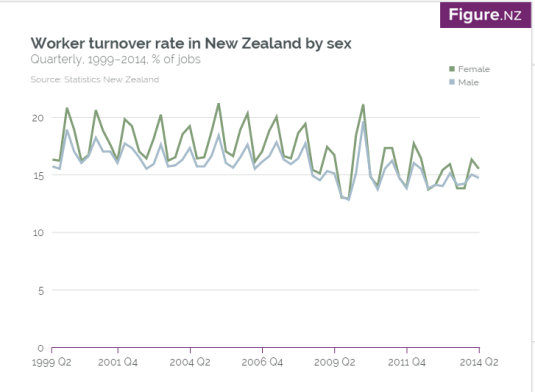
Source: Worker turnover rate in New Zealand by sex – Figure.NZ.
Any benefit premised on not quitting jobs discriminates against women because of their higher job quit rates. More women than men will have to quit living wage jobs because of motherhood and other changes in their personal circumstances. Isn’t that discrimination?
One in six workers change their jobs every year. That job turnover rate is higher among the workers with less human capital simply because both sides of the job match have less reasons to continue. A job quit or job layoff for a less skilled worker does not result as much of a loss of job specific and firm specific human capital than would be the case if the worker was more skilled with more firm-specific human capital.
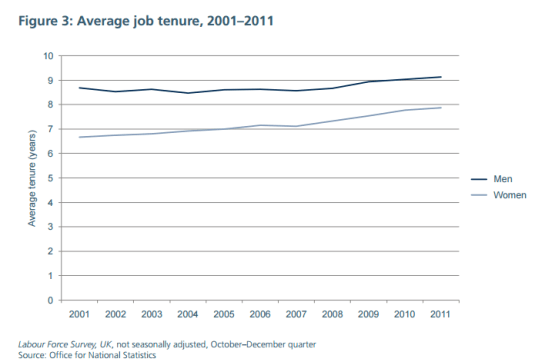
One of the iconic empirical facts of the labour market is job turnover rates are higher and job layoff rates are higher for less skilled workers. As workers acquire more job specific human capital, they are more reluctant to quit and their employer hesitate before laying them off. This is because of the firm specific human capital which both invested would have to be written off.
Women quit jobs more often than men, work part-time or switch between part-time and full-time work more often than men and enter and re-enter to the workforce because of motherhood and maternity leave. Women also tend to invest in more generalised, more mobile human capital. Women anticipate a more intermittent labour force participation and more spells of part-time work. As such, women have less reasons to invest in specific human capital if they anticipate leaving because of motherhood and either changing jobs more often are working part-time. If you are changing jobs more often, such as women do, investing in more general human capital and less in specific capital increases options when searching for vacancies.
Any benefit of the living wage will erode faster for women because they quit jobs at a higher rate than men. Is this indirect sex discrimination? This higher job turnover rate is driven by human capital investment strategies and career plans. The living wage, which privileges the incumbent workers at the time the living wage increases implemented, discriminates against female workers because they change jobs more often or are likely to quit sooner after the living wage was initially implemented.

The particular form of indirect sex discrimination at hand arises from the Golden Handcuffs effect of the living wage. Closer Together Whakatata Mai – reducing inequalities explain the Golden Handcuffs effect this way:
You may have noticed in the article it is actually the SAME people being paid the living wage (“all of them have stayed on as staff”). This is how labour markets can work if employers make different choices. If you look at the Living Wage employers – they haven’t hired a whole new set of people – they have invested in the people they already have. The world has not ended and many more people are happy and businesses and organisations are doing just fine.
Even the proponents of the living wage admit that a living wage increase will segment the labour market and create insiders and outsiders with the insiders paid more than what used to be called the reserve army in the unemployed by the same crowd of activists. A reduction in job turnover will increase unemployment durations because there are fewer vacancies posted every period.
Hopefully all the existing employees of the living wage employer are capable of the requisite up skilling they need to match their new productivity targets. Not everyone did well at school. One of the reasons workers on low wages are on those low wages because they perhaps didn’t do as well at school as activists who appointed themselves to speak for them. A harsh reality of life is 50% of the population have below-average IQs.
This up skilling answer to the cost to employers of a living wage increase is a variation of the standard policy response in a labour market crisis. That standard labour market policy response in crisis is send them on a course. Sending them on a course as a response to a crisis makes you look like you care and by the time they graduate the problem will probably have fixed itself. Most problems do. I found this bureaucratic response to labour market crises to repeat itself over and over again while working in the bureaucracy.
The reason was sending them on a course was so popular with geeks as yourself sitting at your desk as a policy analysis, minister or political activist all did well at university. You assume others will do well through further education and training including those who have neither the ability or aptitude to succeed in education. People don’t go on from high school to higher education for a range of reasons that include a lack of motivation to study or a simple lack of ability no matter how hard they try.

The living wage hypothesis about reduced turnover, up-skilling and greater motivation is a small example of the American company that decided to pay a minimum wage of $70,000 a year. Those workers who cannot earn as much of this elsewhere would never quit. Some of his better employers quit because they resented being paid the same as less productive employees. Hopefully, the minority shareholder suing his brother who is the CEO for offering that above market wage doesn’t end up bankrupting the company. As such, the incumbent workers’ fortunes are unusually closely tied to their existing employer if they are paying above the going rate in their industry and occupation.
I suppose you could hold on like grim death but women tend to have more reasons to move on than men if only because of pregnancy and motherhood. These golden handcuffs are of less value to them than to men. Younger workers are also less advantaged because many young New Zealanders take a overseas working holiday of several years, if not more. If they have a living wage job now that have to give up that advantage.
Workers who lack the labour productivity to earn a wage equivalent of the living wage elsewhere will never quit a living wage job, and will have a much reduced incentive to up-skill or seek promotion. There will be less internal reward for undertaking additional training or job responsibilities among low skilled is because the living wage will mean they will not get a wage rise. That wage rise is gobbled up by the living wage increase if you’re already a low-paid worker.
Naturally, as vacancies arise, recruits will be drawn from a much higher quality recruitment attracted by the higher wage at the living wage employer. The less skilled workers who don’t currently work for the living wage employer will miss out completely.
Did the New Zealand film industry just eat our lunch? By Jason Potts
01 Nov 2015 Leave a comment
in applied price theory, economics of media and culture, fiscal policy, industrial organisation, job search and matching, labour economics, labour supply, macroeconomics, politics - Australia, politics - New Zealand, Public Choice, rentseeking, survivor principle Tags: film subsidies, Hollywood economics, industry policy, offsetting behaviour, The fatal conceit, The pretense to knowledge, unintended consequences

James Cameron is going to film the next three instalments of the Avatar franchise in New Zealand. He promises to spend at least NZ$500 million, employ thousands of Kiwis, host at least one red-carpet event, include a NZ promotional featurette in the Avatar DVDs, and will personally serve on a bunch of Film NZ committees, and probably even bring scones, all in return for a 25% rebate on any spending he and his team do in the country (up from a 20% baseline to international film-makers) that is being offered by the New Zealand Government.
The implication that many media reports are running with is that this is a loss to the Australian film industry, that we should be fighting angry, and that we should hit back at this brilliantly cunning move by the Kiwi’s by increasing our film industry rebates, which currently are about 16.5% (these include the producer and location offsets, and the post, digital and visual effects offset) to at very least 30%. These rebates cost tax-payers A$204 million in 2012, which hardly even buys you a car industry these days.
So what are the economics of this sort of industry assistance? Is this something we should be doing a whole lot more of? Was the NZ move to up the rebate especially brilliant? First, note that James Cameron has substantial property interests in New Zealand already, so this probably wasn’t as up for grabs as we might think. But if that’s how the New Zealand taxpayers want to spend their money, that’s up to them. The issue is should we follow suit?
The basic economics of this sort of give-away is the concept of a multiplier “”), which is the theory that an initial amount of exogenous spending becomes someone else’s income, which then gets spent again, creating more income, and so on, creating jobs and exports and all sorts of “economic benefits” along the way.
People who believe in the efficacy of Keynesian fiscal stimulus also believe in the existence of (>1) multipliers. Consultancy-based “economic impact” reports do their magic by assuming greater-than-one multipliers (or equivalently, a high marginal propensity to consume coupled with lots of dense sectoral linkages). With a multiplier greater than one, all government spending is magically transformed into “investment in Australian jobs”.
So the real question is: are multipliers actually greater-than-one? That’s an empirical question, and the answer is mostly no. (And if you don’t believe my neoliberal bluster, the progressive stylings of Ben Eltham over at Crikey more or less make the same point.)
But to get this you have to do the economics properly, and not just count the positive multipliers, but also account for the loss of investment in other sectors that didn’t take place because it was artificially re-directed into the film sector, which no commissioned impact study ever does.
This is why economists have a very low opinion of economic impact studies, which are to economics what astrology is to physics.
What does make for a good domestic film industry then? Look again at New Zealand, and look beyond the great Weta Studios in Wellington, for Australia and Canada both have world-class production studios and post-production facilities. Look beyond New Zealand’s natural scenery, for Vancouver is an easy match for New Zealand and Australia pretty much defines spectacular.
No, the simple comparison is that New Zealand is about 20% cheaper than Australia and 30% cheaper than Canada. New Zealand has lower taxes, easy employment conditions and relatively light regulations (particularly around insurance and health and safety). It’s just easier to get things done there.
If Australia really wants to boost its film industry, it might look more closely at labour market restrictions (including minimum wages) and regulatory burden and worry less about picking taxpayer pockets and bribing foreigners.
This article was originally published on The Conversation in December 2013. Read the original article. Republished under the a Creative Commons Attribution No Derivatives licence.
The truth about gun free zones
25 Oct 2015 Leave a comment
in applied price theory, economics of crime, economics of regulation, law and economics Tags: expressive voting, gun control, gun free zones, meddlesome preferences, nanny state, offsetting behaviour, rational rationality, unintended consequences
The ups and downs of the Afghan war
23 Oct 2015 Leave a comment
in politics - USA, war and peace Tags: Afghanistan, unintended consequences, war against terror
https://twitter.com/ianbremmer/status/653888723034222592/photo/1
Rethinking Afghanistan (and then rethinking some more) http://t.co/uY7T6mUIUV—
ian bremmer (@ianbremmer) October 17, 2015
The only person who is safe in a gun-free zone is the man with a gun
04 Oct 2015 Leave a comment
in applied price theory, economics of crime, economics of regulation Tags: expressive voting, game theory, gun control, gun free zones, offsetting behaviour, rational ignorance, rational rationality, unintended consequences
RT @NZGreens @GreenpeaceNZ @KevinHague Allow Golden Rice Now
25 Sep 2015 Leave a comment
in development economics, economics of regulation, environmental economics, growth disasters, growth miracles, health economics Tags: child mortality, child poverty, economics of agriculture, extreme poverty, global hunger, global poverty, GMOs, golden rice, Greenpeace, infant mortality, Luddites, malnutrition, New Zealand Greens, unintended consequences
Good as Gold: Can Golden Rice and Other Biofortified Crops Prevent Malnutrition? ow.ly/QQ1VT #Harvard http://t.co/O3SwpGhsXD—
Golden Rice (@Golden_Rice) August 13, 2015
@nzlabour @FairnessNZ My first Parliamentary submission – opposing regulation of zero hours contracts
25 Sep 2015 1 Comment
in applied price theory, labour economics, labour supply, occupational choice, personnel economics, politics - New Zealand Tags: employment law, employment protection law, employment regulation, fixed costs of employment, Leftover Left, The fatal conceit, unintended consequences, zero hours contracts
This Labour Party link made it very easy for me to submit to the Select Committee of Parliament to oppose the Bill on regulating zero hours contracts. I oppose the Bill for the exact opposite reasons that the Labour Party opposes the Bill.
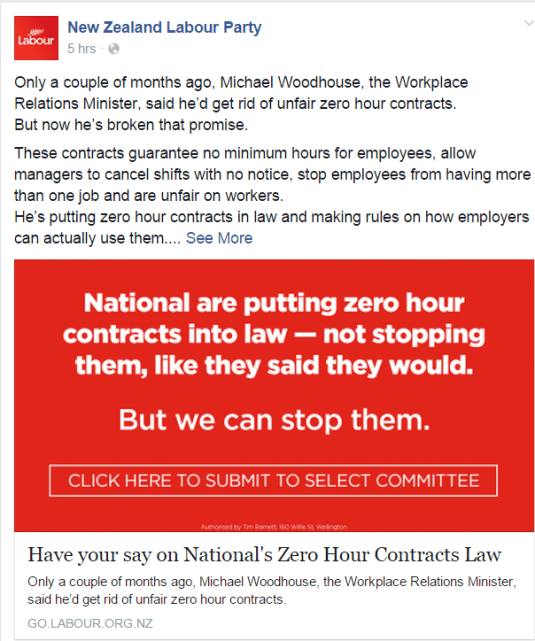
I encourage others to make a submission to Parliament as well opposing this draft amendment that will lower the wages of workers. My submission is as follows:
I do not support the proposed changes to the legislation governing zero hour contracts in the Employment Standards Legislation Bill. There should be no regulation of zero hours contracts.
Zero hours contracts is creative destruction at work in the labour market, sweeping away obsolete working time arrangements, mostly in the retail services sector. Plenty of new ways of working have emerged in recent years that include the proliferation of part-time work, temporary workers, leased workers, working from home, teleworking and sub-contracting. Employment laws were built on the now decaying assumption that workers had career-long, stable relationships with single employers.
Advance notice of work schedules is always known only to a minority of temporary and permanent employees in New Zealand, and there’s not much difference between that advance notice between temporary and permanent employees.
Critics overplay their hand if they suggest that somehow workers are very much disadvantaged and employers are holding all the cards. Job turnover and recruitment problems are a serious cost to a business. Workers will not sign zero hours contracts if they are not to their advantage.
Unless labour markets are highly uncompetitive with employers having massive power over employees, employers should have to pay a wage premium if zero-hour contracts are a hassle for workers.
The fixed costs of employment are such that you shouldn’t expect zero-hour contracts: you’ll typically do better with one 40-hour worker over two 20-hour workers because of these costs. Zero hour contracts would be most likely in jobs with low recruitment costs and where specialised training needs are low. Workers with low fixed costs of working will move into the zero-hour sector while those with higher fixed costs would prefer lower hourly rates but more guaranteed hours. Again, read lower here as meaning relative to what they could elsewhere earn.
Unless we have a good idea about why firms are moving to zero hours contracts, which we don’t, and why employees sign these contracts rather than work for other employers who offer more regular hours, meddling in these novel working time arrangements is risky.
Employers must pay a wage premium to induce in workers to sign zero hours contracts. This Bill seeks to deny workers the right to seek higher wages.
Feel free to use the above text as the basis for your own submission to Parliament.
Many conservationists are against effective rhino conservation
23 Sep 2015 Leave a comment
in applied price theory, development economics, entrepreneurship, environmental economics, growth disasters, growth miracles, law and economics, property rights Tags: Africa, agricultural economics, do gooders, economics of conservation, economics of endangered species, endangered species, expressive voting, Leftover Left, Twitter left, unintended consequences
https://twitter.com/ConversationUK/status/646227223716872197/photo/1
https://twitter.com/dlAfrican/status/646215227076292608
Capturing the economic value of wildlife for the benefit of wildlife. New in PERC Reports: bit.ly/1JHerwj http://t.co/yijFIChPDo—
PERC (@PERCtweets) September 13, 2015
How private ownership and trophy hunting saved the southern white rhino: bit.ly/1HhZy55 #WorldRhinoDay http://t.co/s4PudPwrrI—
PERC (@PERCtweets) September 22, 2015
Is sociology really irrelevant in policy debates?
03 Sep 2015 Leave a comment
in applied price theory, applied welfare economics, comparative institutional analysis, constitutional political economy, economics of bureaucracy, economics of media and culture, income redistribution, labour economics, occupational choice, Public Choice, rentseeking Tags: compensating differentials, evidence-based policy, media bias, offsetting behaviour, public intellectuals, sociology, The fatal conceit, The pretence to knowledge, unintended consequences
Is sociology really irrelevant in policy debates? @familyunequal does a better job with the #s blog.contexts.org/2015/01/25/soc… http://t.co/c4E25DTCmm—
(@SocImages) February 04, 2015
Best 2 Minimum Wage Cartoons
21 Aug 2015 Leave a comment
in labour economics, minimum wage, politics - Australia, politics - New Zealand, politics - USA Tags: antimarket bias, expressive voting, Leftover Left, offsetting behaviour, rational ignorance, rational irrationality, The fatal conceit, The pretense to knowledge, unintended consequences
Best 2 Minimum Wage Cartoons Ever, from Henry Payne, Updated for Seattle's $15 "Economic Death Wish" @HenryEPayne http://t.co/vatUzkHMss—
Mark J. Perry (@Mark_J_Perry) August 18, 2015
Does the minimum wage increase unemployment?
20 Aug 2015 Leave a comment
in labour economics, minimum wage, unemployment Tags: College premium, compensating differentials, education premium, evidence-based policy, offsetting behaviour, The fatal conceit, The pretence to knowledge, unintended consequences
https://twitter.com/MiltonFriedmanS/status/630956276554444800/photo/1
#Australia:highest minimum wage in OECD relative to purchasing power. Increases #youthunemployment #auspol #jobsearch http://t.co/HML9l2rD7R—
Bob Day (@senatorbobday) August 11, 2015
 Utopia, you are standing in it!
Recent Comments