On the inefficiency of fuel efficiency standards
17 Aug 2015 Leave a comment
in applied price theory, applied welfare economics, economics of regulation, energy economics, environmental economics Tags: fuel efficiency standards, offsetting behaviour, The fatal conceit, The pretense to knowledge, unintended consequences
If Someone Replaced Your Car with a Prius, Would You Drive More?
17 Aug 2015 Leave a comment
in applied price theory, energy economics, entrepreneurship, environmental economics, industrial organisation Tags: offsetting behaviour, The fatal conceit, The pretense to knowledge, unintended consequences
Analysing environmental benefits from driving electric vehicles
09 Aug 2015 Leave a comment
in applied welfare economics, energy economics, environmental economics, global warming, politics - USA, Public Choice, rentseeking Tags: coal power, electric cars, green rent seeking, hydroelectric power, nuclear energy, nuclear power, offsetting behaviour, The fatal conceit, The pretense to knowledge, unintended consequences
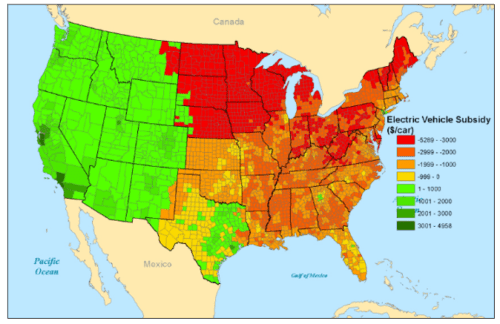
- The benefit is large and positive in many places in the west because the western electricity grid is relatively clean – primarily a mix of hydro, nuclear, and natural gas.
- The benefit is large and negative in many places in the east because the eastern electricity grid primarily relies more heavily on coal and natural gas.
via Economist’s View.
Unemployment rates and the minimum wage in the European Union
08 Aug 2015 Leave a comment
in Euro crisis, job search and matching, labour economics, macroeconomics, minimum wage, unemployment Tags: employment law, equilibrium unemployment rates, Eurosclerosis, expressive voting, labour market regulation, natural unemployment rate, offsetting behaviour, rational irrationality, unintended consequences
Minimum wage scenarios across the OECD
04 Aug 2015 Leave a comment
in labour economics, minimum wage, politics - USA, unemployment Tags: aggressive voting, antimarket bias, living wage, offsetting behaviour, rational ignorance, rational irrationality, The fatal conceit, The pretence to knowledge, unintended consequences
Does a higher minimum wage really reduce employment? econ.st/1gp4Jbs http://t.co/WGMZGLKHmI—
The Economist (@EconBizFin) July 30, 2015
The death toll in high-speed police chases
30 Jul 2015 1 Comment
in economics of crime, law and economics, transport economics Tags: crime and punishment, law and order, law enforcement, police, trade-offs, unintended consequences
High-speed police chases kill 330 people per year, one-third of whom are innocent bystanders: priceonomics.com/the-case-for-b… http://t.co/uFmzxgcplk—
Zachary Crockett (@zzcrockett) July 22, 2015
Rent control and housing quality
18 Jul 2015 Leave a comment
in economics of regulation, politics - USA, urban economics Tags: expressive voting, offsetting behaviour, rational ignorance, rational irrationality, rent control, The fatal conceit, The pretence to knowledge, unintended consequences
A living wage helps well-off households more!
10 Jul 2015 Leave a comment
in applied price theory, applied welfare economics, econometerics, income redistribution, politics - Australia, politics - New Zealand, politics - USA, Public Choice, rentseeking Tags: activists, British economy, British politics, do gooders, expressive voting, living wage, rational ignorance, rational irrationality, The fatal conceit, The pretence to knowledge, unintended consequences
Do Living Wage advocates realise it helps richer households more than poorer ones? My take: telegraph.co.uk/finance/budget… … http://t.co/YPTB6v7tSB—
Fraser Nelson (@FraserNelson) July 10, 2015

Kids Create Cafeteria Black Market To Bypass Food Nannies
30 Jun 2015 Leave a comment
in economics of crime, economics of education, economics of regulation, entrepreneurship, health economics, industrial organisation, law and economics, survivor principle Tags: black markets, economics of prohibition, entrepreneurial alertness, food, nanny state, police, The fatal conceit, unintended consequences

HL Mencken on the Harmful Digital Communication Bill
26 Jun 2015 Leave a comment
in applied price theory, applied welfare economics, comparative institutional analysis, constitutional political economy, economics of crime, economics of media and culture, economics of regulation, law and economics, liberalism, politics - New Zealand, Public Choice Tags: chilling effect, disorderly conduct, free speech, infotopia, Internet trolls, meddlesome preferences, nanny state, offsetting behaviour, The fatal conceit, The pretence to knowledge, unintended consequences
Banning Bottled Water: the Unintended Consequences.
26 Jun 2015 Leave a comment
in applied price theory, economics of regulation, health economics, politics - USA Tags: meddlesome preferences, nanny state, offsetting behaviour, The fatal conceit, The pretence to knowledge, unintended consequences
Starting in 2012, the University of Vermont began a process of requiring that all campus locations selling beverages provided 30% “healthy” beverages, and then that all locations phases out all sales of bottled water.
There were two hope: 1) reduced use of bottles, when bottled water was no longer available, and 2) that healthier beverages would be consumed.
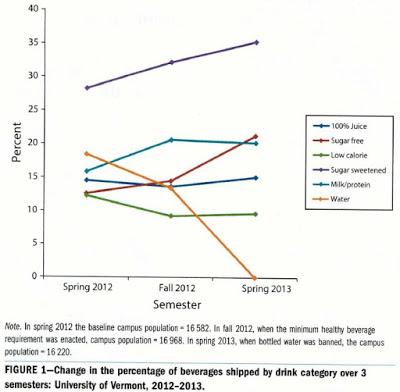
The orange line that drops to zero shows bottled water being phased out. The rising line at the top shows the rise in sugar-sweetened beverages. The red line in the middle that rises sharply shows the rise in sugar-free beverages.
via CONVERSABLE ECONOMIST: Banning Bottled Water: Unintended Consequences.
Gun-free zones an easy target for killers | John Lott
19 Jun 2015 1 Comment
in applied price theory, economics of crime, economics of regulation, law and economics, politics - USA Tags: game theory, gun control, John Lott, mass public shootings, offsetting behaviour, read killers, The fatal conceit, The pretence to knowledge, unintended consequences

The conservative case against capital punishment – George Will
15 Jun 2015 Leave a comment
in economics of bureaucracy, economics of crime, law and economics, politics - USA, Public Choice Tags: capital punishment, crime and punishment, criminal deterrence, The fatal conceit, The pretence to knowledge, unintended consequences
 Utopia, you are standing in it!
Recent Comments