From @EugeneSteuerle: Combined tax rates and creating a 21st century social welfare budget tpc.io/1GCdrYF http://t.co/aNRPqz5gAc—
Tax Policy Center (@TaxPolicyCenter) June 28, 2015
Creative destruction in hard disks
08 Jul 2015 Leave a comment
1981 http://t.co/V4ksgA8zvG—
Old Pics Archive (@oldpicsarchive) July 07, 2015
Are the rich getting richer, poor getting poorer as @MaxRashbrooke once again suggests?
08 Jul 2015 Leave a comment
in applied welfare economics, economic history, labour economics, politics - New Zealand, poverty and inequality, technological progress Tags: child poverty, family poverty, Leftover Left, Max Rashbrooke, The Great Enrichment, top 1%
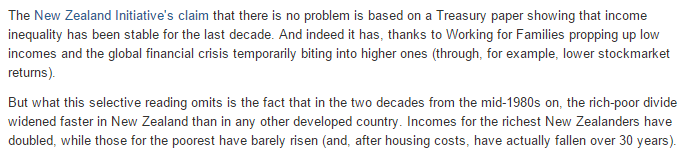
Max Rashbrooke has been at it again in the paper today.

Don’t these graphs show that everyone is richer in New Zealand than 30 years ago and there has been not much change in either child poverty or inequality for coming on for 20 years? The fall in child poverty started before the introduction of Working for Families.
Technological progress in the form of new goods and product upgrades are poorly captured in measures of living standards over time as is increases in life expectancies.
1993 vs 2013: http://t.co/tdnNqmRmcS—
History Pics (@HistoryPixs) January 08, 2014
HT: Suffer the little children – Inequality and child poverty – Closer TogetherCloser Together.
Electric cars may be worse polluters than gas-guzzling vehicles
08 Jul 2015 Leave a comment
in applied welfare economics, environmental economics, politics - USA, transport economics Tags: expressive voting, pollution, tokenism
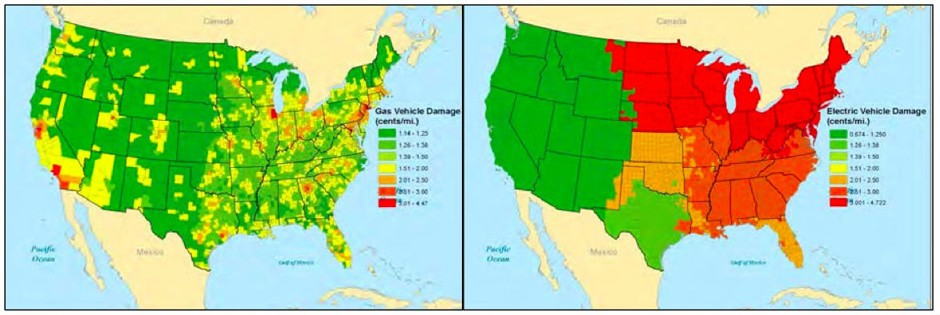
Environmental damage for EVs appears to be worse in the Midwest and Northeast, where the electricity grid tends to rely on coal power plants.
In places like LA, EVs produce less environmental damage because the city’s air shed traps pollutants from gas cars…
The key is where the source of the electricity all-electric cars. If it comes from coal, electric cars produce 3.6 times more soot and smog deaths than gas, because of the pollution made in generating the electricity,
via A New Analysis of U.S. Counties Shows Where Electric Vehicles Cause More Pollution Than Gas Cars – CityLab and CityLab shows how electric cars can be WORSE for the environment than gas-guzzling vehicles | Daily Mail Online.
Richer is greener: environmentalists are Environmental Kuznets Curve deniers
07 Jul 2015 Leave a comment
in applied price theory, applied welfare economics, development economics, economic growth, economic history, energy economics, environmental economics, growth disasters, growth miracles, health and safety, industrial organisation, international economics, labour economics, law and economics, liberalism, property rights, public economics Tags: healthier is wealthier, Japan, Kuznets environmental curve, richer is greener, richer is safer
The Kuznets environmental curve describes an empirical regularity between environmental quality and economic growth. Outdoor water, air and other pollution first worse and then improves as a country first experiences economic growth and development.

While many pollutants exhibit this pattern in the Kuznets environmental curve, peak pollution levels occur at different income levels for different pollutants, countries and time periods. John Tierney explains:
In dozens of studies, researchers identified Kuznets curves for a variety of environmental problems.
There are exceptions to the trend, especially in countries with inept governments and poor systems of property rights, but in general, richer is eventually greener.
As incomes go up, people often focus first on cleaning up their drinking water, and then later on air pollutants like sulphur dioxide.
As their wealth grows, people consume more energy, but they move to more efficient and cleaner sources — from wood to coal and oil, and then to natural gas and nuclear power, progressively emitting less carbon per unit of energy.
When I was living in Japan in the mid 1990s, they just completed a period of rapid operation of the Kuznets environmental curve. I was told by my professors at Graduate School that in the 1960s, cities and prefectures welcomed polluting industries because of the better paid jobs they offered. At that time, shipping companies used like to go to Tokyo because the pollution in Tokyo Bay was so bad that it would clean all the barnacles off their ships. That made them sail faster.

Japanese incomes and wages doubled over the course of the 1960s. The Japanese voter was now prepared to support stricter pollution standards and environmental controls.
Life expectancy is at an all time high: buff.ly/1ICraAi http://t.co/jgRqKy8LfQ—
HumanProgress.org (@humanprogress) June 28, 2015
In the early 1970s, the ruling LDP stole the long-standing environmental policies of their opponents in a big crack down on pollution because the country could now afforded them.
Poverty has plummeted in East Asia and the world. buff.ly/1NtIDyY http://t.co/SsY3sf3kyH—
HumanProgress.org (@humanprogress) July 01, 2015
Plenty of developing countries are democracies now. Their people could demand through the ballot box higher environmental standards and clean tap water but they don’t because of its cost to economic development.
These 4 nations are 50% of mankind. That's 3.5 billion people who are living longer. buff.ly/1Kle6mU #health http://t.co/949oqisMsL—
HumanProgress.org (@humanprogress) June 30, 2015
The environmental movement lives in a state of denial regarding the relationship between economic growth and environmental quality.
OECD Better Life Index correlates with GDP
But US lower than poorer countries
& NZL higher than richer countries http://t.co/yrTCnO1B0l—
Max Roser (@MaxCRoser) June 26, 2015
Why gender analysis is essential to empirical labour economics
07 Jul 2015 Leave a comment
U.S. wage growth doesn't look as weak when you account for benefit costs covered by employers on.wsj.com/1JJ2EmV http://t.co/s0tJutTjBy—
Nick Timiraos (@NickTimiraos) July 06, 2015
Can NZ double migrant investors and entrepreneurs from $3.5 billion to $7 billion at no cost to taxpayers!?
07 Jul 2015 Leave a comment
in applied price theory, applied welfare economics, comparative institutional analysis, economics of bureaucracy, entrepreneurship, income redistribution, industrial organisation, managerial economics, organisational economics, politics - New Zealand, Public Choice, public economics, rentseeking, survivor principle Tags: corporate welfare, entrepreneurial alertness, industry policy, industry targeting, The fatal conceit, The pretence to knowledge


I didn’t notice any discussion in the Cabinet paper of a government doing this before and whether their investment promotion efforts succeeded or not. This latest policy proposal cannot even count as evidence-based policy dreaming, much less a serious contribution to public policy.

Hoping to double incoming foreign investor and entrepreneur migration from $3.5 billion to $7 billion inside three years without spending any extra public money is breathless public policy making. I am sure lots of governments previously tried to get something for nothing.

It will be helpful if ministers pointed to where overseas governments have been successful in doubling foreign investment by simply reprioritising existing investment promotion efforts.

There are at least 2,500 national, provincial and city investment promotion agencies out. Some of them must have been subject to some sort of evaluation as to their success.

This overseas literature review would be in addition to the recent findings of the Ministry of Economic Development about the poor performance and perhaps futility of the foreign direct investment promotion by New Zealand Trade and Enterprise.
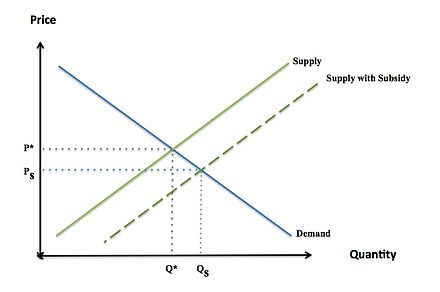
Imagine how much bigger a boost in foreign investor and entrepreneur migration lays before us if actual real new money was put on the table.
via beehive.govt.nz – Strategy targets international investors and Evaluation of NZTE investment support activities [929 KB PDF]
.
Why does 1% of history have 99% of the wealth?
07 Jul 2015 Leave a comment
in applied price theory, applied welfare economics, comparative institutional analysis, economic growth, economic history, liberalism Tags: Deidre McCloskey, The Great Enrichment, The Great Escape, The Great Fact
Why Greece joined the Euro
06 Jul 2015 Leave a comment
in applied price theory, applied welfare economics, budget deficits, business cycles, comparative institutional analysis, constitutional political economy, currency unions, economic growth, economic history, Euro crisis, fiscal policy, fisheries economics, global financial crisis (GFC), international economics, macroeconomics, Public Choice, rentseeking Tags: Euro sclerosis, Greece, insurance attacks, sovereign defaults, speculative attacks
The roots of Greece’s crisis are simple. Before Greece joined the Eurozone, investors treated it as a middle-income country with poor governance — which is to say, a credit risk.
After Greece joined the Eurozone, investors thought that Greece was no longer a credit risk — they figured, if push came to shove, other Eurozone members like Germany would bail Greece out. They were wrong.

Michael Dooley put forward a theory of speculative attacks on currencies as insurance attacks on currencies for emerging markets after the East Asian financial crisis:
First generation models of speculative attacks show that apparently random speculative attacks on policy regimes can be fully consistent with rational and well-informed speculative behaviour.
Unfortunately, models driven by a conflict between exchange rate policy and other macroeconomic objectives do not seem consistent with important empirical regularities surrounding recent crises in emerging markets. This has generated considerable interest in models that associate crises with self-fulfilling shifts in private expectations.
In this paper we develop a first generation model based on an alternative policy conflict. Credit constrained governments accumulate reserve assets in order to self-insure against shocks to national consumption. Governments also insure poorly regulated domestic financial markets.
Given this policy regime, a variety of internal and external shocks generate capital inflows to emerging markets followed by successful and anticipated speculative attacks.
We argue that a common external shock generated capital inflows to emerging markets in Asia and Latin America after 1989. Country specific factors determined the timing of speculative attacks. Lending policies of industrial country governments and international organizations account for contagion, that is, a bunching of attacks over time.
His model was not within the context of a currency union but his basic theory is correct.
There are speculative attacks on a currency or a bank run after foreign markets revises their estimates of the available central bank reserves and international lines of credit to bail out the banking systems and/or foreign debt.
Michael Dooley was dealing with the emerging economies of Southeast Asia and their official lines of credit that insure their foreign exchange liabilities and domestic banking system. Greece is about lines of credit for similar purposes to other European union member states.
via 12 charts and maps that explain the Greek crisis – Vox and The Most Important Graphs of 2011 – The Atlantic.
Creative destruction in popular consumer goods
06 Jul 2015 Leave a comment
in applied welfare economics, economic history, entrepreneurship, technological progress Tags: capitalism and freedom, creative destruction, entrepreneurial alertness, living standards
Globalisation & technological progress have led to some pretty spectacular, but beneficial long term price deflation http://t.co/QWxJ2rYHuq—
RBS Economics (@RBS_Economics) April 18, 2015
Matt Ridley on the Pope and The Great Fact
06 Jul 2015 Leave a comment
in applied price theory, applied welfare economics, development economics, economic history, economics of regulation, energy economics, entrepreneurship, environmental economics, financial economics, growth disasters, growth miracles, health economics, history of economic thought, human capital, industrial organisation, labour economics, liberalism, survivor principle Tags: doomsday prophecies, Matt Ridley doomsday prophets, Papal economics, The Great Enrichment, The Great Escape, The Great Fact
See which way the data points for yourself, like @mattwridley. buff.ly/1HsZxgx #health #progress http://t.co/B3KbUJOn05—
HumanProgress.org (@humanprogress) June 30, 2015
Moving Brad DeLong’s Time Machine behind John Rawls’ veil of ignorance
06 Jul 2015 Leave a comment
in applied welfare economics, constitutional political economy, economic history, Rawls and Nozick Tags: Brad Delong, Elizabeth Warren, good old days, John Rawls, The Great Enrichment, The Great Escape, The Great Fact, time machine, Twitter left
Brad DeLong set up a thought experiment to work out if we were better off than in the good old days. He asked how much money would you want to take with you if you had to step into a time machine to go back to some specific point in time and not be worse off for the trip in living standards and life expectancy. He was writing in 1995, talking about going back to 1895.

John Rawls asks a similar question by saying what type of society would you to agree to in a social contract if you’re behind a veil of ignorance. You didn’t know where you were going to be in society behind the veil of ignorance.

All you know you is you will be some random member of that society, at the top, bottom or somewhere in between.
…no one knows his place in society, his class position or social status; nor does he know his fortune in the distribution of natural assets and abilities, his intelligence and strength, and the like.
What social institutions would you agree in that society given you don’t know where you will be in it?
John Rawls also said that the society was fair if you didn’t mind showing up somewhere in it as a random member.

Let’s suppose a thought experiment which combines a time machine with a veil of ignorance:
- Alien proctologists from outer space take time off from kidnapping rednecks at closing time at pubs to kidnap you instead;
- After probing your nether regions, but before flying off to light years away where they came from without any further earthly contact they offer you the option of beaming back to where you came from but with a twist in time;
- You can beam back to be a random member of your current society or a random member of a society in the past of your choice; but
- Random reassignment to either the present or a past of your choosing are your only options as the alien kidnap victim.
Behind that inter-temporal veil of ignorance, would you choose to be a random member of your own society or prefer to beam back in time to before the ravages of neoliberalism destroyed the good old days?
Apparently, we not a cent better off compared to the 70s because all the income gains, every single cent, went into the pockets of the top 10%, if Senator Warren is to be believed in her recent Washington post op-ed:
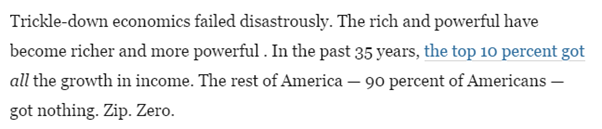
When you line up by Senator Warren to go into the time machine, remember to leave your iPhones and air points at the door.
Innovation is letting us accomplish more with less. Learn more: buff.ly/1LmtAZD #tech #progress http://t.co/e2kQlGu3NA—
HumanProgress.org (@humanprogress) June 22, 2015
Doing business in Russia and Italy – World Bank rankings compared
05 Jul 2015 Leave a comment
in applied price theory, applied welfare economics, comparative institutional analysis, economics of regulation, entrepreneurship, industrial organisation, international economics, law and economics, property rights, survivor principle Tags: doing business, Eurosclerosis, Italy, rule of law, Russia, transitional economies
Figure 1: Doing Business rankings, Russia and Italy, 2014
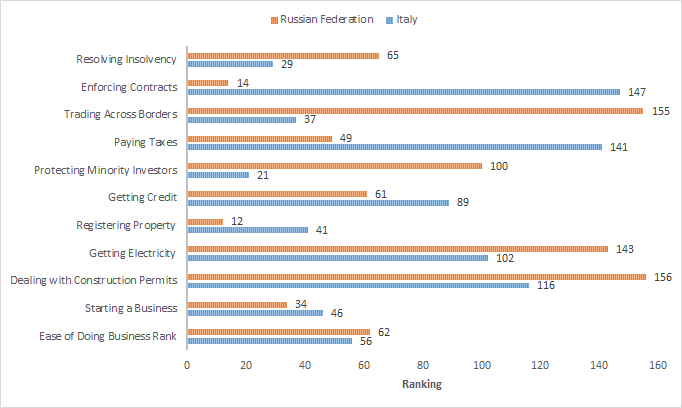
Source: World Bank Doing Business 2015.
It is rather disturbing that it is a lot easier to register property and enforce contracts in Russia than in Italy and far harder to pay your taxes in Italy. Once again, Italy’s saving grace is the ability to trade across borders Because of its membership of the European Union.
Legal systems and property rights in Greece and Russia – Index of Economic Freedom rankings compared
05 Jul 2015 Leave a comment
in applied price theory, applied welfare economics, comparative institutional analysis, constitutional political economy, development economics, economics of crime, economics of regulation, growth disasters, industrial organisation, law and economics, property rights Tags: capitalism and freedom, Greece, rule of law, Russia
Figure 1: Index of Economic Freedom rankings for legal systems and property rights, Greece, Russia and USA, 2012
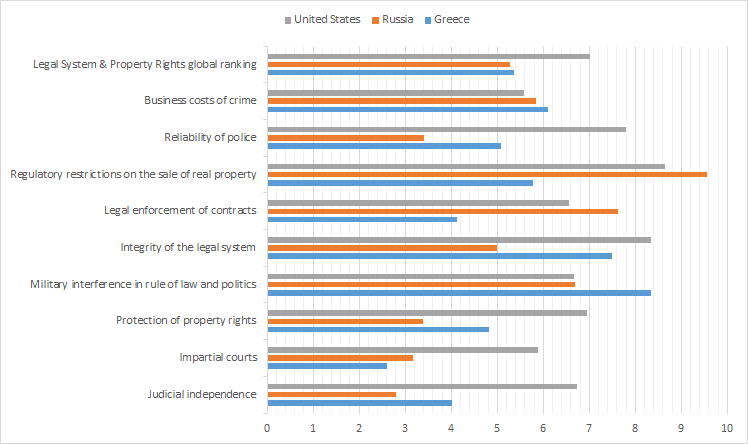
Source: Economic Freedom of the World – Annual Report 2014 | www.freetheworld.com.
Overall, there are not that many differences between Greece and Russia in the quality of their legal systems and property rights. Don’t go to the police in Russia and good luck trying to enforce contracts in Greece.
 Utopia, you are standing in it!
Recent Comments