Happy Birthday, F.A. Hayek!
(8 May 1899 – 23 March 1992) http://t.co/K431Kj9nok—
Screwed by State (@ScrewedbyState) May 09, 2015
FA Hayek on piecemeal analysis such as cost benefit analysis and evidence-based policy
09 May 2015 Leave a comment
in applied price theory, applied welfare economics, Austrian economics, comparative institutional analysis, constitutional political economy, economics of regulation, F.A. Hayek Tags: Constitution of Liberty, cost benefit analysis, evidence-based policy, offsetting behaviour, The fatal conceit, The pretence to knowledge, unintended consequences
Milton Friedman on evidence-based policy
27 Apr 2015 Leave a comment
in applied price theory, applied welfare economics, comparative institutional analysis, Milton Friedman Tags: evidence-based policy, offsetting behaviour, The fatal conceit, The pretence to knowledge, unintended consequences
Murphy’s Law of Economic Policy
26 Apr 2015 Leave a comment
in applied price theory, applied welfare economics, comparative institutional analysis, constitutional political economy, economic history, economics of bureaucracy, Public Choice, rentseeking Tags: Alan Blinder, evidence-based policy, expressive politics, free trade, protectionism, rational ignorance, rational irrationality, rent seeking
Greg Mankiw on one of the few things economists agree on: free trade. That's the problem. nyti.ms/1GrLisQ http://t.co/WrLuP3oBSW—
The Upshot (@UpshotNYT) April 25, 2015
The role of the courts in end of life choices for the terminally ill
26 Apr 2015 Leave a comment
in comparative institutional analysis, constitutional political economy, law and economics, politics - New Zealand, Public Choice Tags: assisted dying, assisted suicide, euthanasia, Justice Scalia
Lindsay Mitchell has a nice summary of the latest developments on an application to the High Court of New Zealand by a terminally ill patient for a declaration that her assisted suicide would not be unlawful and subject to the criminal law. This application currently before the court is specific to that individual and is crafted to claim that it will set no general precedent.
I’m with Justice Scalia when he argues that fundamental issues such as these should be decided by parliaments. As he says regarding general social change:
The virtue of a democratic system [with a constitutionally guaranteed right to free speech] is that it readily enables the people, over time, to be persuaded that what they took for granted is not so and to change their laws accordingly.
The amount of social change in the mid to late 20th century has been stunning. Yes, assisted dying years a passionate issue and some people are impatient, but again I believe Justice Scalia is right when he said:
We might have let the People decide. But that the majority will not do. Some will rejoice in today’s decision, and some will despair at it; that is the nature of a controversy that matters so much to so many. But the Court has cheated both sides, robbing the winners of an honest victory, and the losers of the peace that comes from a fair defeat. We owed both of them better. I dissent.
That importance of a fair defeat at the ballot box and in Parliament is important both to when and if a bill on end of life choice is passed, and to how quickly support opposition to that bill will be mobilised before such a bill even is put into the Parliamentary ballot of private member’s bills.
Nothing stirs up the impassioned (and most other people as well) more than depriving them of their right to support or oppose what is important to them through political campaigns and at an election. The losing side, we all end up on the losing side at one time or another, are much more likely to accept an outcome if they had their say and simply lost the vote at the election or in Parliament.

A decision by the High Court authorising assisted dying in some way does not offer the peace of a fair defeat where the votes are added up where your vote counted as much as mine and one side or the other lost as must always be in a democracy. That’s how majority rule works.
The last bill before the New Zealand Parliament to allow a death with dignity through an assisted suicide for the terminally ill was in 2003 and it failed by three votes: 60 votes to 57 votes.
It is not the role of the courts to hurry up the marshalling of those extra few votes to change the law to judicial action and dispensation. Again, when Scalia dissented on a parental rights case:
I have no reason to believe that federal judges will be better at this than state legislatures; and state legislatures have the great advantages of doing harm in a more circumscribed area, of being able to correct their mistakes in a flash, and of being removable by the people
As Justice Scalia explains, the purpose of the law is to slow the impassioned majority down, not speeding it up:
Judges are sometimes called upon to be courageous, because they must sometimes stand up to what is generally supreme in a democracy: the popular will.
Their most significant roles, in our system, are to protect the individual criminal defendant against the occasional excesses of that popular will, and to preserve the checks and balances within our constitutional system that are precisely designed to inhibit swift and complete accomplishment of that popular will.
Those are tasks which, properly performed, may earn widespread respect and admiration in the long run, but — almost by definition — never in the particular case.
The intervention in a court to grant that right before Parliament is willing to act will only mobilise opposition to any future private member’s bill because they have been denied the right to oppose it through normal democratic means. What are those normal democratic means? Scalia explains when discussing the right to an abortion:
The States may, if they wish, permit abortion on demand, but the Constitution does not require them to do so. The permissibility of abortion, and the limitations upon it, are to be resolved like most important questions in our democracy: by citizens trying to persuade one another and then voting.
Assisted suicide has had popular support for many decades in New Zealand. The reason political parties do not act is those who are against assisted suicide are passionately against it and will change their vote because of such a bill. Those who are for assisted suicide are unlikely to change their vote if a bill is not passed by Parliament.
 For these reasons regarding strong passionate minority opposition and weak majority support, the Labour Party’s new leader pressured a member of his caucus to withdraw a private member’s bill on end of life choice.
Similarly, the Green Party showed equal political cowardice in this matter. They don’t regard a death with dignity to be a priority for them, despite their alleged social liberalism and a willingness to champion the right to abortion in the most recent general election in 2014, which is a socially contentious issue.

The reason is a private member’s bill on abortion in New Zealand won’t get anywhere because the current compromise works – a point to which I shall return. A private member’s bill on end of life choice sponsored by a Green MP would attract too much political flak for the Green Party to handle.
The law has long acted to prevent, by force if necessary, suicide – including suicide by refusing to take appropriate measures necessary to preserve one’s life after the point at which life become unbearable. Justice Scalia argued that:
I believe in liberal democracy, which is a democracy that worries about the tyranny of the majority, but it is the majority itself that must draw the lines.
Whether the patient’s wishes to be honoured in this area is left to elected representatives to legislate. Justice Scalia asks
Are there, then, no reasonable and humane limits that ought not to be exceeded in requiring an individual to preserve his own life? There obviously are, but they are not set forth in the Due Process Clause.
What assures us that those limits will not be exceeded is the same constitutional guarantee that is the source of most of our protection – what protects us, for example, from being assessed a tax of 100% of our income above the subsistence level, from being forbidden to drive cars, or from being required to send our children to school for 10 hours a day, none of which horribles is categorically prohibited by the Constitution.
Our salvation is the Equal Protection Clause, which requires the democratic majority to accept for themselves and their loved ones what they impose on you and me.
The biggest threat to an End of Life Choice bill passing the New Zealand Parliament is judicial intervention in this charged social issue that will only mobilises the opponents of the very right the applicants to the court seek. Scalia again this time on the risks of the courts moving in advance of the popular will, and thereby poisoning the democratic process:
Leaving this matter to the political process is not only legally correct, it is pragmatically so. That alone… can produce compromises satisfying a sufficient mass of the electorate that this deeply felt issue will cease distorting the remainder of our democratic process.
As an example of the importance of democratic compromises in securing the votes in Parliament, there is a voluntary euthanasia bill currently before the Scottish Parliament. It has been stuck in committee for two years because it not only promises end of life choice, it also grants a right of euthanasia to those with progressive degenerative diseases.
By overreaching to progressive degenerative diseases, this Bill in the Scottish Parliament is bogged down because euthanasia as distinct from a death with dignity is a step too far from many members of Parliament willing to support end of life choice for the terminally ill such as provided for in the House of Lords Private Member’s Bill on end of life choice.

Any private member’s bill that does pass the New Zealand Parliament on end of life choice will be riddled with compromises and will have a genuine concern to prevent abuse and guard against questionable decisions made when judgements of the terminally ill is clouded in some way. No court in a single judgement can provide all those details and compromises.

The law attracts more than its share of reformers wanting to use the courts and judge-made law for political purposes. If you want to reform the world, do what we ordinary people have to do: change your vote, write to an MP, protest, donate to or even join a political party, or run for parliament.
The great strength of democracy is a small group of concerned and thoughtful citizens can band together and change things by mounting single issue campaigns or joining a political party and running for office and winning elections or influencing who wins.
Indeed, it is that very strength of democracy – small groups of concerned citizens banding together – is what is holding up legislating on an end of life choice. It is not that minorities are powerless and individuals are voiceless. Exactly the opposite.
Many people have passionate opinions for and against an End of Life Choice Bill. These opinions are taken into account by members of Parliament in fine detail depending on how voters will vote at the next election.
What can be undemocratic about members of Parliament paying attention to how a wide range of ordinary members of the community might vote if they disappoint them.
The key safeguard of minorities against the majority is their ability to block vote. Yes, those in the majority will be annoyed at the power of the minority to slow down the passage of a End of Life Choices Bill.
Yet on some other matter passionate to them those currently in the majority will one day or another end up in a minority. The rotation of power is common in democracies, and the worst rise to the top.
It is wise to design constitutional safeguards to minimise the damage done when those crazies to the right or left of you get their chance in office, as they will sooner or later rather than focus on the powers you and those that currently agree with you should have in your few days in which you fleetingly have a majority.
Too many policies and ideas of the one political party or another assume that they are the face of the future, rather than just another political party that will hold power as often as not and always for an uncertain time.
New Zealand Parliamentary elections are always close because of proportional representation. This makes reality of ending up in the minority again very quickly in a few years very real.
Yesterday’s majority of the vote sooner or later and often sooner than they expect will break off into different minorities on the next big issue of the day.
These newly formed minorities will use that same ability to band together as a minority to block vote to protect what they think is important and advance agendas they think are to be wider benefit despite the opinion of the current majority to the contrary. All reforms start as a minority viewpoint.
You can’t complain about democracy not working because it’s working precisely as it should: parliamentarians paying attention to a great number of people from all walks of life vote in light of how they as members of Parliament voted on specific issues that are important to them.
Maybe the European Union membership isn’t that bad after all, especially if you’re a former Eastern Bloc country
24 Apr 2015 Leave a comment
in applied price theory, applied welfare economics, comparative institutional analysis, constitutional political economy, development economics, growth disasters, growth miracles Tags: European Union, transitional economies
60 years ago North Korea was richer than the South
15 Apr 2015 1 Comment
in comparative institutional analysis, constitutional political economy, development economics, economic history, growth disasters, growth miracles Tags: capitalism and freedom, China, North Korea, South Korea


Where does democracy figure in the cycle of development thinking?
13 Apr 2015 Leave a comment
in comparative institutional analysis, constitutional political economy, development economics, growth disasters, growth miracles Tags: capitalism and freedom, democracy and freedom, IMF, ODA, rule of law, UN, World Bank
just brilliant: hype cycle for development ideas by @dalgoso http://t.co/UQX3tRHOBJ—
Laurence Chandy (@laurencechandy) January 03, 2014
Capitalism and freedom is noticeably missing from this survey of UN effectiveness
09 Apr 2015 Leave a comment
in comparative institutional analysis, constitutional political economy, development economics, growth disasters, growth miracles, Public Choice, rentseeking Tags: capitalism and freedom, overseas development assistance, UN
perceptions of the UN's impact from the development community http://t.co/k8XYisxGaK—
Laurence Chandy (@laurencechandy) October 07, 2014

It is not enough to say that the status quo is imperfect. It is important to offer alternatives.
04 Apr 2015 Leave a comment

Earth Hour celebrates ignorance, poverty and backwardness
29 Mar 2015 Leave a comment
in applied welfare economics, comparative institutional analysis, development economics, economics of media and culture, environmentalism, growth disasters, growth miracles, liberalism, Marxist economics, technological progress Tags: Earth Hour
Great Quote on Earth Hour, which Celebrates Ignorance, Poverty and Backwardness #HAH2015 aei.org/publication/ea… http://t.co/775bQhpiBs—
Mark J. Perry (@Mark_J_Perry) March 28, 2015
No one says this about economists
27 Mar 2015 Leave a comment
in applied price theory, applied welfare economics, Austrian economics, comparative institutional analysis, constitutional political economy, F.A. Hayek, liberalism, Public Choice, rentseeking Tags: evidence-based policy, offsetting behaviour, science and public policy, The fatal conceit, The pretence to knowledge, unintended consequences
Scientists dream about what could be.
Economists remind you of price tags and unintended consequences
The North–South theory of product life cycles
23 Mar 2015 Leave a comment
in comparative institutional analysis, entrepreneurship, industrial organisation, law and economics, managerial economics, organisational economics, property rights, survivor principle, theory of the firm Tags: entrepreneurial alertness, foreign direct investment, incomplete contracts, incomplete property rights, North-South product life cycle, product life cycles
Forecasts of the offshoring of service jobs, as an example, can be constituted into a theory of North-South product cycles. The North-South theory of the life cycle of products starts with their research and development and refinement by entrepreneurs in the advanced countries (the North) with some exporting (Grossman and Helpmann 1991a, 1991b). These innovations require resources to be invested with uncertain prospects of success. Entrepreneurs in the North compete to discover new technology-intensive products using the ample supply of R&D workers and human capital-rich workers in the industrialised countries (Grossman and Helpmann 1991a, 1991b).

As a new product matures and its production becomes more standardised, the bulk of its production can migrate to the less developed countries (the South) to take advantage of lower production costs, and these countries will become net exporters. In the South, entrepreneurs focus more on imitation. They invest resources in importing and learning the production processes developed and proven to be a success in the North (Grossman and Helpmann 1991a, 1991b).
The shifting of production of standardised products to lower-wage foreign locations will frequently be within the originating company via a foreign affiliate, because of uncertainties about property rights and contract enforcement institutions in the host countries, and only later to independent foreign firms (Antràs 2005). Within corporate hierarchies, the high-skilled managers in the developed countries will specialise in problem-solving and non-routine tasks. They will interact with middle managers and production workers in developing countries who perform the routine tasks (Antràs et al. 2006, 2008).
Contracts are typically incomplete either because they are difficult to write and/or because the court cannot enforce them. The World Trade Organization (2005, 2008) concluded that, for example, the location of offshored services depends on:
- labour costs,
- trade costs,
- the quality of institutions, particularly the legal framework,
- the tax and investment regime,
- the quality of infrastructure, particularly telecommunications, and
- skills, particularly language and computer skills.
Risks in contract negotiation and enforcement will influence which types of production is outsourced. Roughly one-third of world trade is infra-firm, and this intra-firm trade is concentrated in the capital-intensive industries because of the costs and risks of investing in contracting with arm’s-length suppliers (Antràs 2003). Considerations about R&D incentives, the availability of human capital and the quality of contract enforcement institutions weigh heavily on the development of new products and their initial and later locations of different stages of production.
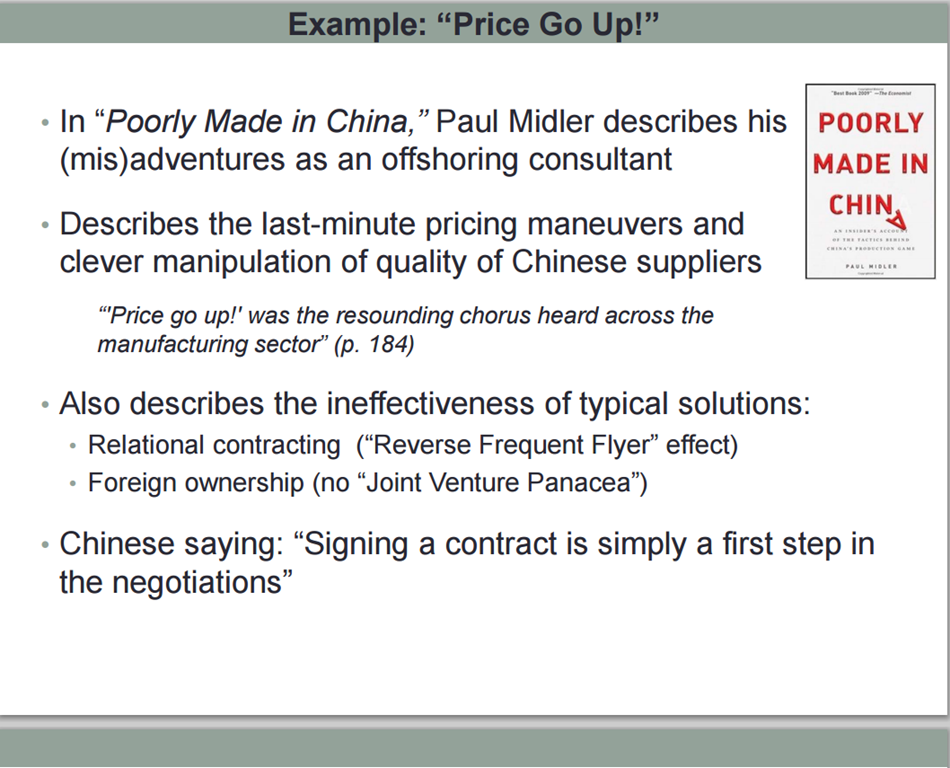
Products are initially developed in the highly industrialised countries because their sophisticated legal systems allow contracts to be enforced. Even then, in industrialised countries, the difficulties of writing and enforcing complicated contracts over the quality of new products early in the product life cycle encourages firms to make those products internally within the firm. Early in the product life cycle, if sub-contractors were used for key imports, there would have to be continual renegotiation of contracts contracts to incorporate new innovations and learning by doing. As Antras says:
Global production networks necessarily entail intensive contracting between parties located in different countries and thus subject to distinct legal systems0
As the new product standardises, and product quality in consequence becomes easier to measure and contract over, initially the innovating firm will sub-contract within the industrialised country but in time will import from developing countries. In the first instance, these imports may be from affiliates established in the developing country to ensure greater control of product quality through direct ownership of the factory. As Antras says:
Firms contemplating doing business in a country with weak contracting institutions might decide to do so within firm boundaries to have more control.
The size and shape of the firm is a direct response to mitigate the costs of contracting over quality that is hard to measure and which is constantly changing early in the product cycle. By assigning ownership rights to the party undertaking the more important investment in quality early in the product life cycle, entrepreneurs and innovators can minimise the losses caused by lack of enforceable contracts over quality when quality is changing rapidly as the firm moves through the product life cycle.

Boeing blamed the delays on the delivery of the Dreamliner on an unwillingness of sub-contractors to stand by their contractual obligations. In response, Boeing acquired some of the key sub-contractors to ensure that they delivered as promised. This is a classic operation of the theory of the firm where the entrepreneur brings within the firm what is too expensive to transact on the market because of difficulties in measuring quality and defining and enforcing property rights over what has been contracted.
Sales to locations with weak contractual enforcement are more likely to be cash in advance
22 Mar 2015 Leave a comment
in comparative institutional analysis, development economics, law and economics, property rights
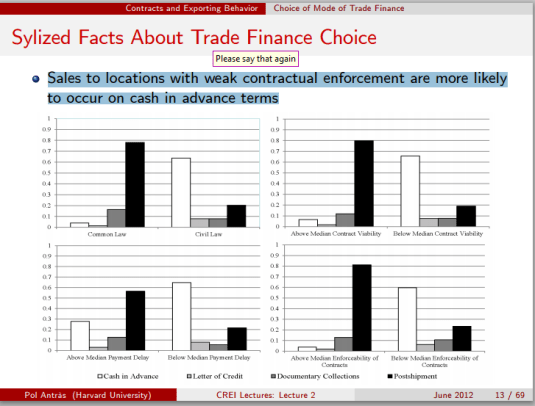
In another triumphant British Justice, trade credit is much more likely in common law countries and in countries with honest courts.
Sorry @WJRosenbergCTU the class war has been based on a measurement error! The real class enemy is the RMA and restricted land supply – updated again
21 Mar 2015 Leave a comment
in applied welfare economics, comparative institutional analysis, Marxist economics, politics - Australia, politics - New Zealand, politics - USA, poverty and inequality, urban economics Tags: Class war, Generation Rent, housing affordability, housing prices, land use regulation, RMA, Thomas Picketty, top 1%, wage stagnation
The other day, I replied to a rant by Bill Rosenberg about the decline in labour share of national income and its implications for income inequality and the great wage stagnation. The labour share of national income has dropped by at least 5% in most countries including New Zealand.

New data from the USA has found that the entire declining the value of the share of labour of national income is due to home ownership:
…the net capital share has increased since 1948, but when disaggregated this increase comes entirely from the housing sector: the contribution to net capital income from all other sectors has been zero or slightly negative, as the fall and rise have offset each other.
The capital share is rising because of the increased value of housing in countries with widespread home ownership. The concentration of capital ownership and wealth in the top 1% was a misplaced concern based on measurement error.
https://twitter.com/EconBizFin/status/581047721836060672
Piketty assumed the returns to capital were increasing across the entire economy. Rognlie found the trend to be almost entirely isolated to the housing sector. His 23 page long conference paper at the Brookings Institution started as a comment on a blog post on Marginal Revolution.

When Rognlie adjusted for the rapid depreciation inherent to investments in capital such as computer software, most of the rest of the increase in the capital share in recent decades in the USA and six other countries has came in housing.

A single sector such as housing is not the force that is shaping past and future of inequality as Piketty and others such as Bill Rosenberg in New Zealand have assumed. They attributed a growing share of income going to capital across the board as Tyler Cowan explains.
In the simplest version of the Piketty model, wealth grows more quickly than does the economy as a whole and thus the picture changes. The relative losers are no longer low earners but rather anyone who is not a capitalist. Any disparity is due not to their shortcomings in labour markets but rather to their lack of a high initial endowment.
The main driver of inequality is the tendency of returns on capital to exceed the rate of economic growth and company shares, businesses and other capital are owned by a narrow section of the community, and in particular by the top 1% of income earners. Trends in housing prices and the comings and goings of intangible capital is not part of that story.

Investment and depreciation of software and other intellectual property is not well handed, or even well measured in current national accounting systems as Edward Prescott has shown in a long research programme dating back 10 years. Intangible capital produced and owned by businesses is known to be big part of all investment in the economy but nearly all of it is recorded as an expense and therefore most is not part of GDP as currently measured.
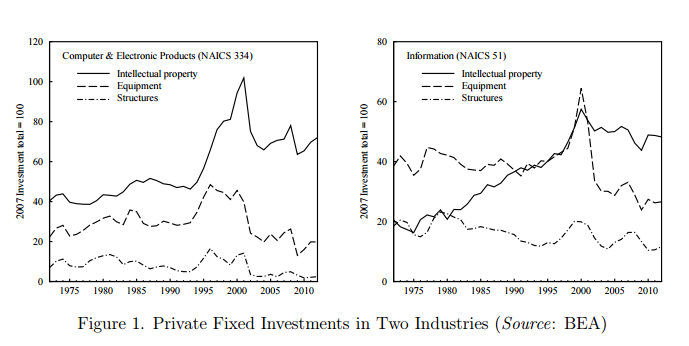
Source: Edward C. Prescott and Ellen R. McGrattan (2014)
Prescott estimated the value of intangible capital to be equal to about 60% of that of tangible capital in the US economy. Incorrect treatment of investment in intangible capital seriously underestimates investment, output, fluctuations in labour productivity and movements in the capital shares. The graph above shows that the recently introduced intellectual property classification in the US national accounts is both large and volatile relative to equipment and structures investments over the last 40 years. The graph below shows that including intangible capital completely changes the predictions of real business cycle models about trend US labour productivity in the 1990s.
Labor Productivity, for the Model, With and Without Intangible Investment (Real, Detrended) 1990-2003
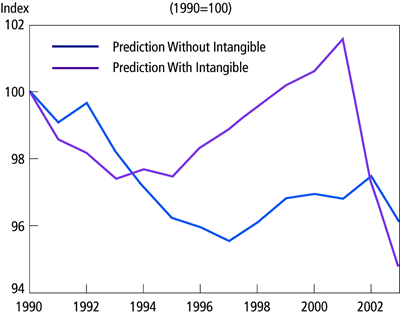
Source: McGrattan and Prescott, 2005, “Expensed and Sweat Equity,” Research Department Working Paper 636, Federal Reserve Bank of Minneapolis.
This depreciation adjustment for software investment is important because you can’t eat depreciation, as a shrewd observer noted. The rapid depreciation of software is depreciation – it cannot be redistributed from the top 1% to the downtrodden workers as some sort of income. Others have also earlier argued that Piketty’s claims rest on the recent increase in the price of housing.

The main reason for increases in the price of housing in New Zealand and elsewhere is restrictions on the supply of land by local councils. They are the real class enemy.

The metropolitan urban limit in Auckland increases land prices by 9 fold just inside that limit. As Tim Taylor said today:
The rise in capital income as a result of a long-term rise in land and housing prices across the high-income countries is a phenomenon that isn’t easily crammed into the usual disputes over whether capital owners are exploiting wage-earners.
The role of the housing sector and restrictions on land supply driving up housing prices in recent decades in shaping the future of inequality is perhaps underplayed given the many discussions of Generation Rent.

Housing affordability is a real crisis in New Zealand and many other countries with the younger generation no longer able to buy a house. They are condemned to decades of renting a house. They may never be able to afford a house on one income and perhaps two ordinary comes.
The future of inequality is between those who can and cannot afford a dream and a right for their parents and grandparents, which was to buy a house and pay the mortgage off within a couple of decades.

Young people used to buy a house shortly after leaving university and paid it off by their middle age when I was in my 20s and 30s. Back then, which was not all that long ago, ordinary workers could aspire to take out a mortgage and buy a house in the suburbs.

Unless there is a major deregulation of the supply of land in the big cities, home ownership for most in the community will really be a dream, rather than a dream of aspiration achieved by most by their 30s, if not often earlier through working and saving. The grandchildren of the baby boomers will become and perhaps already are Generation Rent.


Recent Comments