#JFK on @jeremycorbyn #toriesforcorbyn
10 Sep 2015 Leave a comment
in comparative institutional analysis, constitutional political economy, Marxist economics, Public Choice Tags: British politics, JFK, Leftover Left

Presidential election turnout by race
09 Sep 2015 Leave a comment
in constitutional political economy, politics - USA, Public Choice, rentseeking Tags: 2016 presidential election, civil rights, Democratic Party, racial discrimination, southern States, voting rights
Democracy in Africa
08 Sep 2015 Leave a comment
in constitutional political economy, development economics, economic history, growth disasters, growth miracles Tags: Africa, capitalism and freedom
Is sociology really irrelevant in policy debates?
03 Sep 2015 Leave a comment
in applied price theory, applied welfare economics, comparative institutional analysis, constitutional political economy, economics of bureaucracy, economics of media and culture, income redistribution, labour economics, occupational choice, Public Choice, rentseeking Tags: compensating differentials, evidence-based policy, media bias, offsetting behaviour, public intellectuals, sociology, The fatal conceit, The pretence to knowledge, unintended consequences
Is sociology really irrelevant in policy debates? @familyunequal does a better job with the #s blog.contexts.org/2015/01/25/soc… http://t.co/c4E25DTCmm—
(@SocImages) February 04, 2015
Expulsions of Jews across Europe during the Medieval & Early Modern periods
28 Aug 2015 Leave a comment
in constitutional political economy, economic history, income redistribution, law and economics, property rights, Public Choice, rentseeking Tags: anti-semitism, European history
Expulsions of Jews across Europe during the Medieval & Early Modern periods. http://t.co/4HKGlNCjou—
History Facts 247 (@historyfacts247) July 08, 2015
Bryan Caplan on why H.L. Mencken was right
22 Aug 2015 Leave a comment
in constitutional political economy, economics of information, Public Choice Tags: Bryan Caplan, H.L Mencken, rational ignorance, rational irrationality, voter demographics


@nzlabour @NZGreens There just isn’t no missing million out there hanging out for that hard-left clarion call @rsalmond
22 Aug 2015 1 Comment
in applied price theory, constitutional political economy, economics of information, politics - New Zealand, Public Choice Tags: British Labour Party, British politics, economics of advertising, Eric Crampton, expressive voting, false consciousness, Leftover Left, median voter theorem, New Zealand Greens, New Zealand Labour Party, rational ignorance, rational rationality
Rob Salmond has written a great blog this week on the ideological spectrum of New Zealand voters based on the New Zealand Election Study.

In the course of his blog he drove a tremendously big stake through the heart of the old left fantasy that if Labour or Greens goes left, a large block of voters not voting for them now or not voting at all (the missing million voters) will shake lose its false consciousness and follow you:
But “pulling the centre back towards the left” is massively, massively hard.
You win those people over by being relevant to them as they are, not by telling them they’re worldview needs a rethink. It is just basic psychology. Tell people they were right all along; they like you. Tell people they were wrong all along; they don’t.
And if you win a majority of centrists, you win. The New Zealand Election Study series records six MMP elections in New Zealand – the three where Labour did best among centrists were the three Labour won.
That’s another message from the academic study I quoted above – in Germany, Sweden, and the UK, the elections where the left did best among centrists were the elections where they took power. As their popularity among centrists declined, so did their seat share.
What is more disturbing for the old left fantasy of the missing million is voting for the Labour Party or Greens is correlated with ignorance rather than knowledge.
Furthermore, the more people know about economics, the less likely they are to vote for the left as Eric Crampton explains:
When they get to the polls, the ignorant are significantly more likely to support the Labour Party (4% increase in predicted probability for a standard deviation increase in ignorance) and significantly less likely to support the Green party (1% decrease in predicted probability) and United Future (0.5% decrease in predicted probability).
Understanding economics strongly predicted supporting National in 2005, which comes as little surprise: the National Party leader was former Governor of the Reserve Bank of New Zealand. A standard deviation increase in our “economic thinking” index correlates with a 5.7% increased probability of voting National, a 1.5% decreased probability of voting NZ First, and a slight decrease in the probability of voting United Future and Maori.
To make matters worse, Crampton found that joining political organisations does little to cure ignorance of politics or otherwise lead to a political awakening. Sometimes active political affiliation reduces ignorance, other times such organisational membership intensifies ignorance.
via Salmond on the centre | Kiwiblog and StephenFranks.co.nz » Blog Archive » Why the left wants everyone to vote.
Why did @jeremycorbyn never split from @UKLabour despite 30 years on the outer? #torysforcorbyn
21 Aug 2015 1 Comment
in constitutional political economy, politics - Australia, politics - New Zealand, politics - USA, Public Choice, rentseeking Tags: British general election, British politics, Leftover Left
If you think equality and fairness in Britain is important you should do this: labour.tw/1MH6f4M http://t.co/7gCDkX7fj5—
The Labour Party (@UKLabour) August 06, 2015
Jeremy Corbyn had 30 years to split from the Labour Party, which he voted against 25% of the time, establish his own party and receive the same reception presumably he would have got without needing to have to run for leader of the Labour Party.
Conservatism and nationalism destroy the Labour Party nickcohen.net/2015/06/02/con… http://t.co/ue0XzXTEFo—
Nick Cohen (@NickCohen4) June 02, 2015
The reasoning Corbyn never split from the Labour Party, and the reason why the left never splits from the Labour Party, is the left knows that it would get far fewer votes on its own rather than piggybacking on the right wing of that party.
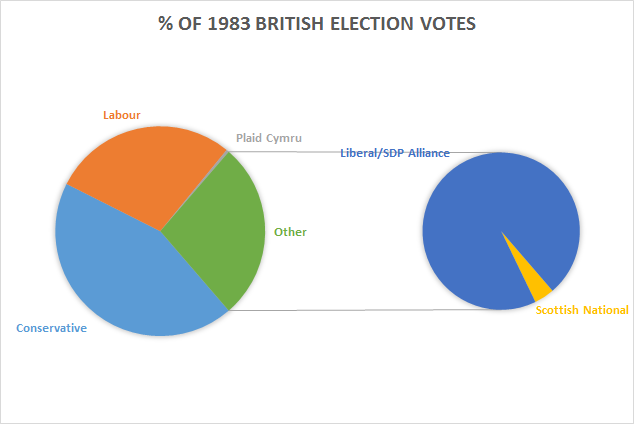
The right split from the British Labour Party in the early 1980s to form the Social Democratic party. The right-wing split from the Australian Labor Party at least four times over its history.
The left is never split from the New Zealand Labour Party because it knows that it could never get anywhere even under proportional representation without the image of being part of the traditional Labour Party, centre-left, social democratic, not socialist. Jeremy Corbyn and the rest of the left of British Labour are practising mild mannered entryism. By stealing the brand of the Labour Party, the left obtains far more power than it ever could standing on its own two feet as true believers.
Our vision is of an economy that works for all, provides opportunity for all and invests in all. #jeremy4leader http://t.co/59Gk9AN7Xf—
JeremyCorbyn4Leader (@Corbyn4Leader) July 22, 2015
The working hypothesis of the far left everywhere is if the Labour Party were to adopt hard left policies is many more votes.
Fabulous scenes wherever we go, but this picture of the Opera House in Newcastle is quite something. #voteCorbyn http://t.co/GzB96CjB7d—
JeremyCorbyn4Leader (@Corbyn4Leader) August 18, 2015
Labour would win many more votes because the offer of a genuine socialist alternative would shake voters loose of their false consciousness.

The left of the Labour Party never went out on its own to test that hypothesis because they knew in their hearts be lucky to not to lose their deposits.

This is despite the strong rise in third parties in British politics despite first past the post.

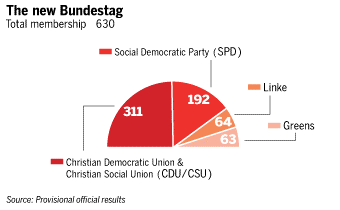
The remnants of the communist parties do well at elections in countries such as France, Germany (Linke or Left Party) and Japan and are in government in Greece.
- 53 communist and anti-capitalist parties have been elected worldwide to freely elected parliament in 39 countries.
- The Trots regularly get 4% in French presidential elections while the British SWP is still in the same league as the monster raving loony party.

The right wing of the Labour Party was willing to take its chances under first past the post voting in the House of Commons because it knew that a large part the electorate would vote for it in preference to the remnant of a left-wing run Labour Party.
The combination of these splitters from the British Labour Party and the Liberal party won 25% of the vote, two percentage points behind the British Labour Party.
Henry Hazlett on why economics is so difficult
20 Aug 2015 Leave a comment
in applied price theory, applied welfare economics, comparative institutional analysis, constitutional political economy, economics of bureaucracy, income redistribution, Public Choice, rentseeking Tags: antiforeign bias, antimarket bias, bootleggers and baptists, green rent seeking, Henry Hazlett, makework bias, methodology of economics, philosophy of economics
The depth and breadth of European colonization 1500-1900
19 Aug 2015 Leave a comment
in constitutional political economy, economic history, Public Choice, rentseeking Tags: age of empires, British empire, British imperialism, colonialism, imperialism
A map showing the depth and breadth of European colonization 1500-1900: thesocietypages.org/socimages/2015… http://t.co/37234ZzDfj—
(@SocImages) March 21, 2015
Why Is The NRA So Powerful
19 Aug 2015 Leave a comment
in applied price theory, constitutional political economy, economics of regulation, Public Choice Tags: competition for political influence, gun control, lobby groups, median voter theorem, rational ignorance, special interests, voter demographics
What does U.S. gun ownership really look like? Load up with #PollPosition’s @Johnnydontlike: bit.ly/1y2EMjX http://t.co/fn5EpM75U7—
(@PJTV) March 25, 2015


India and Pakistan became independent today
16 Aug 2015 Leave a comment
in constitutional political economy, development economics, economic history, growth disasters, Public Choice Tags: age of empires, British empire, India, Pakistan
This day in 1947 | India and Pakistan independent after some 200 years of British rule: timesmachine.nytimes.com/timesmachine/1… http://t.co/VfbpKayExM—
NYT Archives (@NYTArchives) August 15, 2015
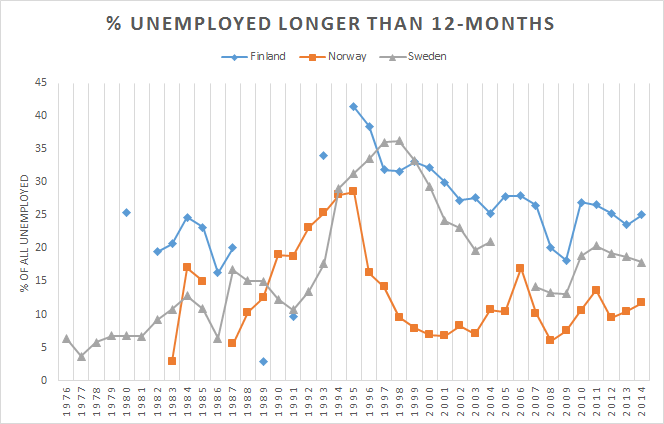
% of unemployment lasting longer than 12 months in Scandinavia since 1976
16 Aug 2015 Leave a comment
in applied welfare economics, business cycles, constitutional political economy, economic history, job search and matching, labour economics, labour supply, macroeconomics, Public Choice, unemployment Tags: borders, deployment subsidies, economics of borders, equilibrium unemployment rate, Finland, labour market programs, long-term unemployment, maps, natural unemployment rate, Norway, Scandinavia, search and matching, Sweden, unemployment durations
As I recall, most unemployed have been unemployed longer than 12 months in Sweden have to go on a labour market program. When they returned to unemployment after the program, the clock starts again. They are deemed to be freshly unemployed rather than adding to the previous spell with an interlude on a make work program. This makes Swedish long-term unemployment data rather unintelligible.
Source: OECD StatExtract.
Finland was recovering from its worst depression since the 1930s and the early 1990s when its data on long-term unemployment started to be continuous. This makes Finnish unemployment data rather difficult to interpret. Norway’s data for the long-term unemployed goes up and down a bit too much to be trustworthy without a background policy narrative.
Washington Supreme Court Fines State $100,000.00 Per Day For Legislature Failing To Fund Education
15 Aug 2015 Leave a comment
in constitutional political economy, law and economics, politics - USA, public economics Tags: constitutional law, rule of law, separation of powers
By Darren Smith, Weekend contributor
Nearly eleven months after holding the State of Washington in contempt for failing to provide an adequate funding plan for financing primary education in the state, the Washington Supreme Court issued an order fining the state $100,000.00 per day until the legislature satisfies the Court’s judgement in its landmark McCleary decision.
After three special sessions, the Legislature failed to provide a clear and fully funded plan. The Court acted, much to the chagrin of many of the state legislators. A few of which had some rather interesting solutions to address their failures to act.
View original post 1,375 more words
Unexpected kind word for Parliament House protesters @GreenpeaceNZ @RusselNorman @NZGreens @greencatherine
15 Aug 2015 2 Comments
in constitutional political economy, economics of crime, environmental economics, global warming, law and economics, liberalism, politics - New Zealand, Public Choice, Rawls and Nozick, rentseeking Tags: civil disobedience, climate alarmism, expressive voting, Greenpeace, John Rawls, Justice Scalia, Leftover Left, rule of law
PRESS RELEASE: Greenpeace Parliament Climbers Convicted of Trespass bit.ly/1DRfKMG #realclimateaction http://t.co/sxRokpwRNk—
Greenpeace NZ (@GreenpeaceNZ) August 13, 2015
The Greenpeace vandals who trespassed at Parliament, climbing up to put signs down the front in flagrant disregard of the most ample possible options for peaceful protest right outside at least had the integrity to plead guilty. That shows some sort of fidelity to law and an acknowledgement that what they did was a criminal offence.
John Rawls makes the point that the purpose of civil disobedience is not to impose your will upon others but through your protest to implore them to reconsider their position and change the law or policy you are disputing.
Rawls argues that civil disobedience is never covert or secretive; it is only ever committed in public, openly, and with fair notice to legal authorities. Openness and publicity, even at the cost of having one’s protest frustrated, offers ways for the protesters to show their willingness to deal fairly with authorities. Rawls argues:
- for a public, non-violent, conscientious yet political act contrary to law being done (usually) with the aim of bringing about a change in the law or policies of the government;
- that appeals to the sense of justice of the majority;
- which may be direct or indirect;
- within the bounds of fidelity to the law; and
- whose protesters are willing to accept punishment. Although civil disobedience involves breaking the law, it is for moral rather than selfish reasons; the willingness to accept arrest is proof of the integrity of the act.
Rawls argues, and too many forget, that civil disobedience and dissent more generally contribute to the democratic exchange of ideas by forcing the champions of dominant opinion to defend their views.
Legitimate non-violent direct action are publicity stunts to gain attention and provoke debate within the democratic framework, where we resolve our differences by trying to persuade each other and convince the electorate.
Too many acts of non-violent direct action aim to impose their will on others rather than peaceful protests designed to bring about democratic change in the laws or policies of the incumbent government. That ‘might does not make right’ is fundamental to the rule of law. As United States Supreme Court Justice Antonin Scalia said
The virtue of a democratic system [with a constitutionally guaranteed right to free speech] is that it readily enables the people, over time, to be persuaded that what they took for granted is not so and to change their laws accordingly..
Both sides passionately but respectfully attempt to persuade their fellow citizens to accept their views. Win or lose, advocates for today’s losing causes can continued pressing their cases, secure in the knowledge that an electoral loss today can be negated by a later electoral win, which is democracy in action as Justice Kennedy explains:
…a democracy has the capacity—and the duty—to learn from its past mistakes; to discover and confront persisting biases; and by respectful, rationale deliberation to rise above those flaws and injustices…
It is demeaning to the democratic process to presume that the voters are not capable of deciding an issue of this sensitivity on decent and rational grounds.
The process of public discourse and political debate should not be foreclosed even if there is a risk that during a public campaign there will be those, on both sides, who seek to use racial division and discord to their own political advantage. An informed public can, and must, rise above this. The idea of democracy is that it can, and must, mature.
Freedom embraces the right, indeed the duty, to engage in a rational, civic discourse in order to determine how best to form a consensus to shape the destiny of the Nation and its people. These First Amendment dynamics would be disserved if this Court were to say that the question here at issue is beyond the capacity of the voters to debate and then to determine.
John Rawls’ view that fidelity to law and democratic change through trying to persuade each other is at the heart of civil disobedience reflects the difference between the liberal and the left-wing on democracy and social change as Jonathan Chait observed this week:
Liberals treat political rights as sacrosanct. The left treats social and economic justice as sacrosanct. The liberal vision of political rights requires being neutral about substance.
To the left, this neutrality is a mere guise for maintaining existing privilege; debates about “rights” can only be resolved by defining which side represents the privileged class and which side represents the oppressed…
Liberals believe that social justice can be advanced without giving up democratic rights and norms. The ends of social justice do not justify any and all means.
How the left-wing and liberal visions of democracy are different nymag.com/daily/intellig… http://t.co/Qk5vS9SaV4—
Jonathan Chait (@jonathanchait) August 13, 2015

Recent Comments