#Africa is turning democratic.
From my project: bit.ly/1DkpYjW http://t.co/WX0sTQPTv9—
Max Roser (@MaxCRoser) July 26, 2015
Democracy in Africa
29 Jul 2015 Leave a comment
in constitutional political economy, development economics, growth disasters, growth miracles, Public Choice Tags: Africa, capitalism and freedom
62 years ago North and South Korea signed a truce
28 Jul 2015 Leave a comment
in applied price theory, applied welfare economics, Austrian economics, comparative institutional analysis, constitutional political economy, development economics, economics of bureaucracy, growth disasters, growth miracles, income redistribution, liberalism, Marxist economics, Public Choice, rentseeking Tags: collapse of communism, economics of central planning, failed states, North Korea, South Korea
https://twitter.com/TheEconomist/status/625658259861598209/photo/1
Truce is signed and the fighting ends in Korea on this day in 1953. nyti.ms/1D1Yswe http://t.co/O9a8iJgE99—
NYT Archives (@NYTArchives) July 27, 2015
Hong Kong and Venezuela compared
27 Jul 2015 Leave a comment
in applied price theory, applied welfare economics, comparative institutional analysis, constitutional political economy, development economics, economics of bureaucracy, growth disasters, growth miracles, income redistribution, Public Choice, rentseeking Tags: capitalism and freedom, Hong Kong, Latin American crony capitalism, Venezuela
Socialism works -Venezuela twice as rich as Hong Kong!
No, wait, that was in 1960. http://t.co/sqwVnMc19t—
Screwed by State (@ScrewedbyState) July 26, 2015
If Roe v Wade was to fall
26 Jul 2015 Leave a comment
in constitutional political economy, economic history, economics of media and culture, health economics, politics - USA, Public Choice Tags: abortion, constitutional law, expressive voting, median voter, rational ignorance, rational irrationality, social change
On abortion, the USA is split on pro-life versus pro-choice. State legislatures pass laws safe in the knowledge that they will be struck down the next day. they were playing to a grandstand made up of values voters.
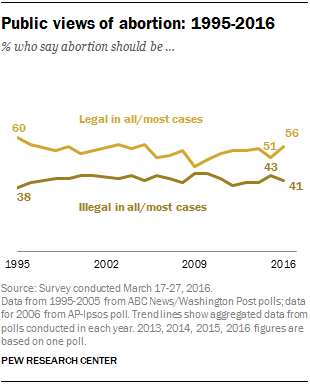
When the supreme court became a little vague on some procedural aspects of abortion law in the early 1990s, the state legislatures started showing much more restraint because the median voter would be annoyed.
Where Roe v. Wade to fall, some states would permit abortion, some would not. The Center for Reproductive Rights predicts that 21 states are likely to outlaw abortion immediately where Roe v. Wade to fall. This assessment is based not only on current law, but on the political makeup of the state legislatures. On the other hand, abortion is likely to remain legal in many states, according to these groups.
A key reason why self-funded candidates often falter
26 Jul 2015 Leave a comment
in constitutional political economy, economics of bureaucracy, politics - USA, Public Choice, rentseeking Tags: 2016 presidential election, campaign finance reform, campaign finance regulation, congressional elections


via Sometimes, Money Can’t Buy You Votes | FiveThirtyEight and Four Ways To Fund A Presidential Campaign | FiveThirtyEight.
Democracy is not untrammelled majority rule
26 Jul 2015 Leave a comment
in constitutional political economy, liberalism, Public Choice Tags: Bill of Rights, constitutional law, free speech, rule of law
British voting patterns by religion
25 Jul 2015 Leave a comment
in constitutional political economy, Public Choice Tags: 2015 British election, British politics, voter demographics
Ben Clements of @BritRelNumbers on voting behaviour by religion in #GE2015 using BES data
brin.ac.uk/news/2015/reli… http://t.co/NKVlt3xarY—
BritishElectionStudy (@BESResearch) July 23, 2015
Murray Rothbard on the falling popularity of Pope Francis
25 Jul 2015 Leave a comment
in applied price theory, applied welfare economics, comparative institutional analysis, constitutional political economy, economic history, economics of bureaucracy, economics of education, economics of regulation, economics of religion, energy economics, environmental economics, income redistribution, industrial organisation, international economics, Murray Rothbard, politics - Australia, politics - New Zealand, politics - USA, Public Choice, rentseeking, survivor principle Tags: antiforeign bias, antimarket bias, Catholic social thought, climate alarmism, expressive voting, global warming, makework bias, Pope Francis, rational ignorance, rational irrationality, voter demographics


@jeremycorbyn should welcome #toriesforcorbyn as shy Labour voters coming home to the long-awaited hard left policies
23 Jul 2015 1 Comment
in constitutional political economy, Marxist economics, Public Choice Tags: British Labour Party, British politics, expressive voting, Leftover Left, rational irrationality, shy Labour voters

Jeremy Corbyn has done it. The working hypothesis of the far left everywhere is if the Labour Party were to adopt hard left policies, they would win many more votes.

The new votes include shy Labour voters parking their vote with the Tory party pending the call home to a true Labour Party.

They are parking their votes with other parties because they are fed up with a middle of the road Labour Party, such as the Blairite Labour Party. They are withholding their vote as punishment until the Labour Party returns to its roots and adopts hard left policies.
Our vision is of an economy that works for all, provides opportunity for all and invests in all. #jeremy4leader http://t.co/59Gk9AN7Xf—
JeremyCorbyn4Leader (@Corbyn4Leader) July 22, 2015
Rather than accept that their day has come, the left of the Labour Party is deeply suspicious of Tory party supporters wanting to join the Labour Party in anticipation of voting in hard left leadership in their current leadership election. What’s going on?

What seems to terrify the Labour Party is its old dream coming true: a large number of Tory party voters switching their support to Labour and joining the Labour Party because it might adopt hard left policies and a hard left leader who makes Michael Foot look like a pussycat.
Labour party members, please think before you vote for Jeremy Corbyn gu.com/p/4aqvd/stw http://t.co/U5hz02ahgd—
Comment is free (@commentisfree) July 22, 2015
What is more jarring than the fear of the Labour Left having its dreams come true is the Left of the British Labour is not showing against any insight into the genuine enthusiasm that the Tory party has for Jeremy Corbyn winning the election as leader of the Labour Party
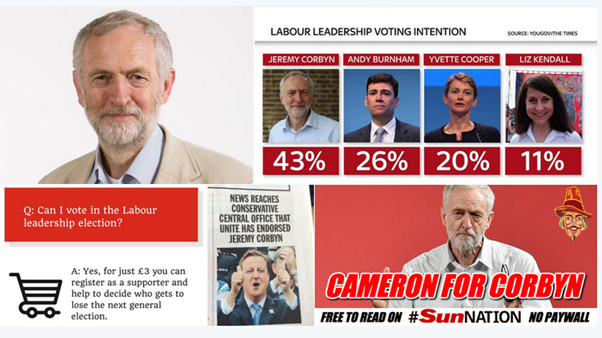
There is no misdirection here or double play. The Tory party wants Jeremy Corbyn to be elected leader of the Labour Party.
Time for a re-run of this classic? http://t.co/Pwqyn00cQo—
James Bartholomew (@JGBartholomew) April 14, 2015
The Liberal Democratic party must see their resurrection coming in the form of Jeremy Corbyn as do UKIP in terms of making inroads into working-class labour electorates.

There are left-wing and fairly left-wing people who do vote for the Tory party and the LDP, but there’s not that many of them, and overall they only make up about 15% of the British electorate, and a small part of the left-wing vote not voting for left-wing parties.
It would seem more reasonable to follow the median voter theorem and go for those in the centre because there are plenty of them and only minor modifications of your platform are required to win their votes.
Anti-establishment candidate with fringe views draws huge crowds in sure-fire guarantee of electoral success http://t.co/P7waxqUXrR—
Alex Wickham (@WikiGuido) August 03, 2015
Why is the far left chasing with these shy Labour voters when there are plenty more middle of the road voters willing to vote for them in 2015 in the right circumstance?
…while the average UKIP or Tory voter is well to the right of Labour there are many Conservative and UKIP supporters who are in the centre ground and whose votes Miliband cannot afford to write off. For example, nearly four in ten UKIP supporters and 16% of Conservative voters place themselves on the centre point or to the left of centre.
The 35 heroes of #toriesforcorbyn
23 Jul 2015 Leave a comment
in constitutional political economy, Marxist economics, Public Choice Tags: British Labour Party, British politics, Leftover Left
MPs nominations for Leader of the Labour Party – 35 MPs required
| Burnham – 68 |
Cooper – 56 |
Corbyn – 35 |
Kendall – 40 |
|
Ian Lavery |
Jess Phillips |
Jon Trickett |
Tristram Hunt |
|
Steve Rotheram |
Diana Johnson |
Clive Lewis |
Phil Wilson |
|
Rachel Reeves |
Khalid Mahmood |
John McDonnell |
Stephen Timms |
|
Dan Jarvis |
Sharon Hodgson |
Michael Meacher |
John Woodcock |
|
Michael Dugher |
David Hanson |
Ronnie Campbell |
Mike Gapes |
|
Debbie Abrahams |
Shabana Mahmood |
Diane Abbott |
Wes Streeting |
|
Owen Smith |
Steve Pound |
Kelvin Hopkins |
Margaret Hodge |
|
Karl Turner |
Helen Goodman |
Richard Burgon |
Toby Perkins |
|
Emma Lewell-Buck |
Helen Jones |
Dennis Skinner |
Alison McGovern |
|
Yvonne Fovargue |
Kevan Jones |
Grahame Morris |
Stephen Doughty |
|
Kevin Brennan |
Chris Bryant |
Frank Field |
Siobhain McDonagh |
|
Luciana Berger |
Seema Malhotra |
Kate Osamor |
Ann Coffey |
|
Barbara Keeley |
Kate Green |
Cat Smith |
Gavin Shuker |
|
David Crausby |
Vernon Coaker |
Dawn Butler |
Pat McFadden |
|
Yasmin Qureshi |
John Spellar |
Jeremy Corbyn |
Ivan Lewis |
|
Lisa Nandy |
Paula Sherriff |
Chi Onwurah |
Simon Danczuk |
|
Andrew Gwynne |
John Healey |
Sarah Champion |
Chuka Umunna |
|
Lucy Powell |
Daniel Zeichner |
Emily Thornberry |
Stephen Twigg |
|
Graham Jones |
Ian Austin |
Sadiq Khan |
Emma Reynolds |
|
David Anderson |
Jim Cunningham |
Huw Irranca-Davies |
Jonathan Reynolds |
|
Conor McGinn |
Karen Buck |
Louise Haigh |
Gisela Stuart |
|
Anna Turley |
Lyn Brown |
Jo Cox |
Paul Flynn |
|
Keir Starmer |
Steve McCabe |
Imran Hussein |
Nick Smith |
|
Pat Glass |
Liam Byrne |
David Lammy |
Chris Evans |
|
Stephen Hepburn |
Virendra Sharma |
Rebecca Long-Bailey |
Kevin Barron |
|
Paul Farrelly |
Judith Cummins |
Margaret Beckett |
Jenny Chapman |
|
Bill Esterson |
Ruth Cadbury |
Jon Cruddas |
Jim Dowd |
|
Peter Dowd |
Marie Rimmer |
Gareth Thomas |
Fiona MacTaggart |
|
Harry Harpham |
Andy Slaughter |
Tulip Siddiq |
Steve Reed |
|
Rob Flello |
Geraint Davies |
Rushanara Ali |
Joan Ryan |
|
Rachael Maskell |
Fabian Hamilton |
Rupa Huq |
Barry Sheerman |
|
Justin Madders… |
Geoffrey Robinson… |
Andrew Smith |
Angela Smith… |
Source: Who’s backing whom and who did endorsers vote to be leader in 2010? | LabourList.
The Rahn curve explained
23 Jul 2015 Leave a comment
in comparative institutional analysis, constitutional political economy, income redistribution, politics - Australia, politics - New Zealand, politics - USA, Public Choice, public economics Tags: Director's Law, growth of government, laffer curve, optimal tax theory, Rahn curve, size of government


Recent Comments