Maggie Thatcher on the Greek crisis
17 Jul 2015 Leave a comment
in applied welfare economics, budget deficits, comparative institutional analysis, constitutional political economy, currency unions, economic growth, economic history, economics of regulation, Euro crisis, fiscal policy, income redistribution, macroeconomics, Marxist economics, Public Choice, rentseeking Tags: Greece, growth of government, Margaret Thatcher, size of government
Latin American populism versus the East Asian Tigers
17 Jul 2015 Leave a comment
in comparative institutional analysis, constitutional political economy, development economics, economics of bureaucracy, growth disasters, growth miracles, income redistribution, Public Choice, rentseeking Tags: East Asian Tigers, Latin American populism
Growth paths of #LatAm & the Caribbean the South East Tigers: wrld.bg/NCtLt #RiseoftheSouth http://t.co/IFuUOWldox—
World Bank Pubs (@WBPubs) May 31, 2015
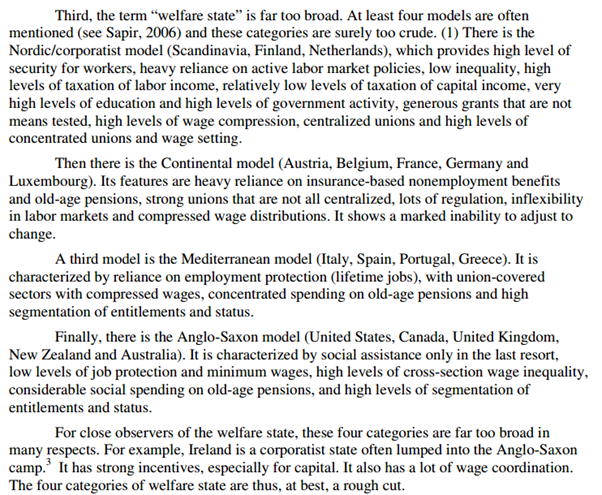
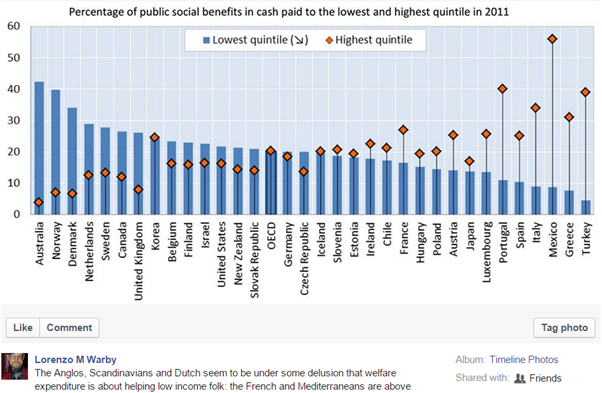
James Hackman and the four types of welfare state
16 Jul 2015 Leave a comment
in constitutional political economy, income redistribution, Public Choice, rentseeking, welfare reform Tags: Director's Law, James Hackman, social insurance, welfare state
And the rich got richer, who cares
16 Jul 2015 Leave a comment
in applied price theory, applied welfare economics, Austrian economics, comparative institutional analysis, constitutional political economy, development economics, economic history, economics of bureaucracy, economics of education, economics of regulation, economics of religion, energy economics, entrepreneurship, environmental economics, financial economics, growth disasters, growth miracles, income redistribution, industrial organisation, international economics, labour economics, labour supply, liberalism, poverty and inequality, Public Choice, rentseeking, survivor principle, transport economics, urban economics Tags: Deirdre McCloskey, entrepreneurial alertness, The Great Enrichment, The Great Escape, The Great Fact, top 1%
"The rich got richer, true. But…" —@DeirdreMcClosk buff.ly/1Imdv4o http://t.co/M3ERx3JTIn—
HumanProgress.org (@humanprogress) June 28, 2015
Should Majorities Decide Everything?
15 Jul 2015 Leave a comment
in comparative institutional analysis, constitutional political economy, economics of bureaucracy, income redistribution, liberalism, Public Choice, rentseeking Tags: constitutional law, expressive voting, median voter theorem, Mike Munger, rational ignorance, rational irrationality, tyranny of the majority
Members of Congress spend a ton of time fundraising
14 Jul 2015 Leave a comment
in constitutional political economy, politics - USA, Public Choice, rentseeking Tags: campaign finance reform, campaign finance regulation, lobbying, special interests


Global poverty is in free fall – what does Oxfam have to say about what caused this?
14 Jul 2015 Leave a comment
in applied welfare economics, comparative institutional analysis, constitutional political economy, development economics, economic history, economics of bureaucracy, growth disasters, growth miracles, liberalism, Marxist economics, Public Choice Tags: extreme poverty, global poverty, ODA, overseas aid, Oxfam, professional activists, professional do-gooders, The Great Escape, The Great Fact
The world is getting better all the time, in 11 maps and charts vox.com/2015/7/13/8908… http://t.co/cBbN4L0dqF—
Vox (@voxdotcom) July 13, 2015
Flags of the British Empire
13 Jul 2015 Leave a comment
in constitutional political economy, economic history, Public Choice Tags: age of empires, British empire, British imperialism, British justice, capitalism and freedom, imperialism, rule of law, the common law
Flags of the British Empire. http://t.co/feiKPR3BnK—
History Facts 247 (@historyfacts247) July 04, 2015
William Easterly on the Tyranny of Experts and the Forgotten Rights of the Poor
13 Jul 2015 Leave a comment

Only one poll number says anything meaningful about 2016
11 Jul 2015 Leave a comment
in constitutional political economy, economic history, politics - USA, Public Choice Tags: 2016 presidential election, voter demographics
Right now, only one poll number says anything meaningful about 2016. My @monkeycageblog post: washingtonpost.com/blogs/monkey-c… http://t.co/BJ7ixc5m0W—
Patrick J. Egan (@Patrick_J_Egan) July 10, 2015
Why is Labour so staunch on its left-wing policies – the voters must come to them – but opportunistic on race?
11 Jul 2015 Leave a comment
in constitutional political economy, international economics, law and economics, politics - New Zealand, property rights, Public Choice, rentseeking Tags: antiforeign bias, antimarket bias, left-wing populists, New Zealand First, New Zealand Labour Party, political opportunism, racism, rational ignorance, rational irrationality, right-wing populists, traditional labour voter, working class Tory
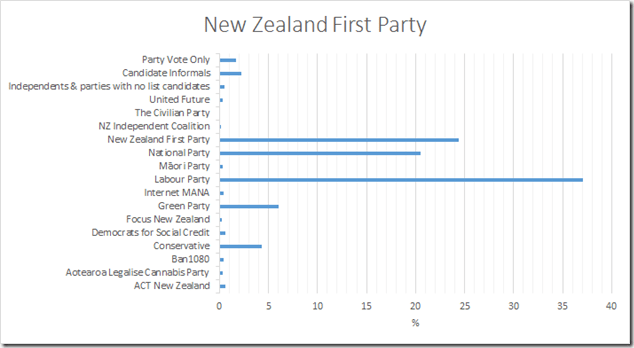
Figure 1: who won the electorate vote of New Zealand First party voters, 2014 New Zealand election
Source: Electoral Commission.
New Zealand First vote splitting data in Figure 1 suggests many more Labour voters vote New Zealand First than for the National Party with their electorate votes.
1/3rd of voters who gave their party vote to New Zealand First voted Labour with their electorate vote. This compares to one in five New Zealand First voters who gave their electorate vote to the National Party.
The Labour Party can win back some traditional Labour voters by borrowing populist policies from New Zealand First and its ageing leader such as prohibiting foreigners from buying New Zealand land.
Who mentioned Shane Jones?
In politics we don't pull our punches, unless you've got one of the world's best in town! http://t.co/Xiz2l36btg—
Winston Peters (@winstonpeters) August 08, 2013
Market segmentation in the London newspaper market
11 Jul 2015 Leave a comment
in constitutional political economy, economic history, economics of media and culture, entrepreneurship, industrial organisation, Public Choice, survivor principle Tags: British elections, British politics, consumer sovereignty, creative destruction, entrepreneurial alertness, expressive voting, London newspapers, market selection, media bias, product differentiation, rational ignorance, rational irrationality, The meaning of competition
The truth about the press and power? Readers, not editors, decide elections. @RobertdgSmith specc.ie/1c58mAr http://t.co/Vhit9P9iM7—
Fraser Nelson (@FraserNelson) May 06, 2015
Boris Yeltsin took office as the first elected President of Russia this Day 1991
10 Jul 2015 Leave a comment
in constitutional political economy, economic history, Marxist economics, Public Choice Tags: capitalism and freedom, collapse of communism, Russia
On 10 July 1991, Boris Yeltsin took office as the first elected President of Russia. #OTD http://t.co/8462T7mCJB—
History Facts 247 (@historyfacts247) July 10, 2015


Recent Comments