https://twitter.com/MaxCRoser/status/581244277080092674


Celebrating humanity's flourishing through the spread of capitalism and the rule of law
15 Apr 2015 1 Comment
in comparative institutional analysis, constitutional political economy, development economics, economic history, growth disasters, growth miracles Tags: capitalism and freedom, China, North Korea, South Korea
13 Apr 2015 Leave a comment
in comparative institutional analysis, constitutional political economy, development economics, growth disasters, growth miracles Tags: capitalism and freedom, democracy and freedom, IMF, ODA, rule of law, UN, World Bank
just brilliant: hype cycle for development ideas by @dalgoso http://t.co/UQX3tRHOBJ—
Laurence Chandy (@laurencechandy) January 03, 2014
11 Apr 2015 Leave a comment
in constitutional political economy, election campaigns, politics - Australia, politics - New Zealand, Public Choice
The latest counting in the New South Wales Legislative Council election shows the ease in which ordinary citizens can form a political party and be elected to Parliament when there is federalism and an upper house elected by proportional representation.
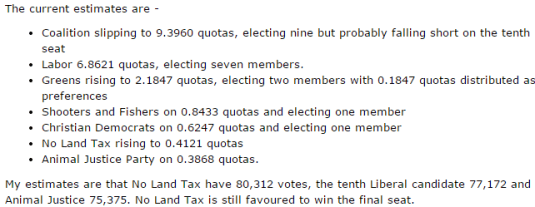
Five of the six Australian states have an upper house. In four of those states, the electoral system is proportional representation, with results in the election of many small parties.
In Tasmania, my home state, the Legislative Council as single member constituencies with two or three vacancies filled every year but is full of independents elected the six-year terms. The political parties having no chance of getting candidates elected in front of them. The Tasmanian voters simply don’t vote for party candidates in the Legislative Council elections. Out of 15 members, there is one Liberal Party member, and two members from the Labour Party
In the current New South Wales Legislative Council election, the favourite to win the last seat, and with it the balance of power in the upper house is a previously unheard of No Land Tax party. The Shooters and Fishers party is electing another member this year in New South Wales. The Christian Democrats also have two members.
In Victoria, the Australian Sex Party finally got a candidate elected to the upper house late last year through the courtesy of proportional representation.
Other small parties in the Victorian Legislative Council are the Shooters and Fishers Party with two members, the Democratic Labour Party with one member and a party of never heard of, Vote 1 Local Jobs, with the last seat. These small parties share the balance of power.
The South Australian Legislative Council includes two members from the No Pokies Party, two members from the Family First Party, and one from the Death with Dignity party. Again, this motley crew shares the balance of power.
Western Australian Legislative Council has a government majority, but there is one member from the Shooters and Fishers Party.
The crossbench in the Australian Senate is made up of eight independents and small parties. Several Australian senators on the crossbenchers are completely mad and ignorant; in one certain case, as thick as two short planks. This doesn’t harm, in the case of Jackie Lambie, her chances of being re-elected to the Senate for Tasmania for another six-year term in 2019. A number of Tasmanian voters, including members of my family, value her honesty, though they do admit she is not very bright and is rather rough around the edges.
The strength of democracy lies in the ability of small groups of concerned and thoughtful citizens to band together and change things by running for office and winning elections. That is how new Australian parties such as the ALP, the country party, DLP, Australian democrats and Greens changed Australia. One Nation even had its 15 minutes of fame. Most of these parties started in someone’s living room, full of concerned citizens aggrieved with the status quo.
In Australian elections in recent years, about a quarter of the electorate do not give their vote in upper house selections to the major parties: the Labour Party, the Liberal Party and the Australian Greens. That is fertile ground for small parties to flourish.
So fertile ground is the Australian Senate that the big parties want to change the election system to make it harder for the small parties to swap preferences to get elected through proportional representation and make it much harder to register a political party in the first place.
As would be expected, the far left parties get nowhere in the upper houses of the Australian State parliaments, despite the benefits of proportional representation and preferential voting. These upper houses are filled with small parties from both the left and the right, populist parties all, but the battle cry of socialism just doesn’t resonate with the Australian electorate.
Same thing happened in New Zealand in its recent parliamentary elections. New Zealand has no upper house, but does have proportional representation for the House of Representatives.
A pre-existing hard left party well-funded by a millionaire with an agenda to avoid extradition to the USA got 1.2% of the party vote, but it lost its electorate seat and so is out of Parliament since late last year’s general election.
10 Apr 2015 Leave a comment
in constitutional political economy
Those poor possums at Greenpeace have had their Indian bank accounts frozen by the Indian government. In common with many countries, including New Zealand and the USA, India regulates the domestic political activities of foreigners. It is alleged Greenpeace failed to disclose the source of its funding.
Really don’t know what to make of this. Seeking moral advice and guidance, I turned to the Green Party of New Zealand. They are very much against foreign donations to domestic politics, believing elections are for citizens, not foreigners. The screen snapshot below is of the Green’s policy in campaign finance.

I’m yet to see a press release from Greens welcoming this assertion of Indian political sovereignty. Don’t hold your breath.
09 Apr 2015 Leave a comment
in comparative institutional analysis, constitutional political economy, development economics, growth disasters, growth miracles, Public Choice, rentseeking Tags: capitalism and freedom, overseas development assistance, UN
perceptions of the UN's impact from the development community http://t.co/k8XYisxGaK—
Laurence Chandy (@laurencechandy) October 07, 2014
09 Apr 2015 Leave a comment
in constitutional political economy, development economics, growth disasters, growth miracles
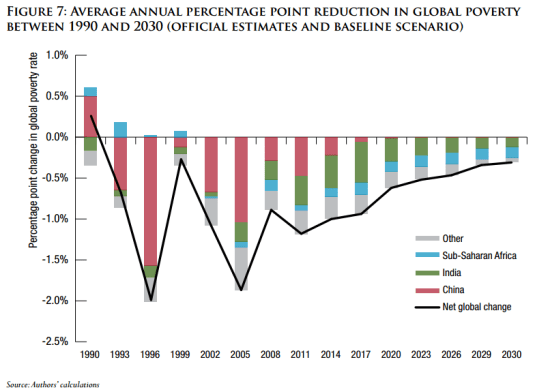
Via The Final Countdown: Prospects for Ending Extreme Poverty by 2030 (Report) | Brookings Institution.
08 Apr 2015 Leave a comment
in constitutional political economy, development economics, growth disasters, growth miracles
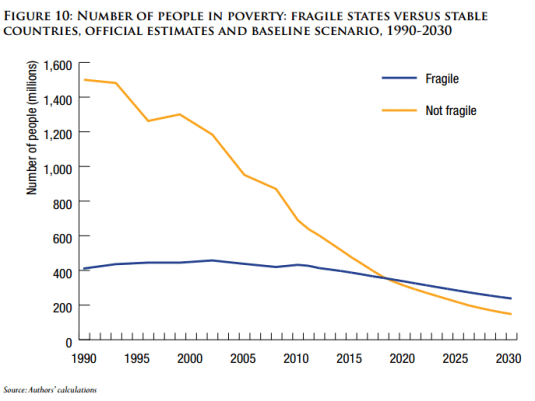
Via The Final Countdown: Prospects for Ending Extreme Poverty by 2030 (Report) | Brookings Institution.
06 Apr 2015 Leave a comment
in constitutional political economy, development economics, growth disasters, growth miracles, Public Choice Tags: Africa, capitalism and freedom, free elections, second turnover
After Nigeria, 19 incumbent African leaders have been defeated at the polls. Ever. (ht @calestous) http://t.co/nRdeFYS122—
ian bremmer (@ianbremmer) April 02, 2015
31 Mar 2015 Leave a comment
in constitutional political economy, politics - Australia, politics - New Zealand, Public Choice, public economics, taxation Tags: Geoffrey Brennan, James Buchanan, tax reform
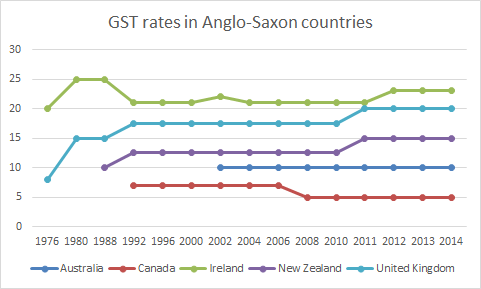
The GST increased from 10 to 15% in New Zealand; more than doubled in the UK; but GST rates were stable or went up and down in the remaining Anglo-Saxon countries.
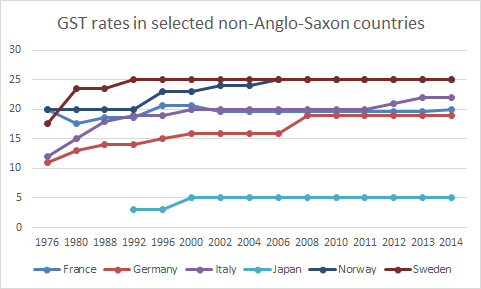
As for a selection of other non-Anglo-Saxon countries , Brennan and Buchanan were right. Tax reforms such as a broad-based consumption tax leads to higher taxes through time.
ICYMI: How does Australia's GST compare with other nations? ab.co/1eBsdrS #factcheck http://t.co/QFP05xonEB—
ABC Fact Check (@ABCFactCheck) July 31, 2015
The GST (goods and services tax) in Europe is known as the value added tax (VAT).
Source: OECD Tax Database – OECD.
29 Mar 2015 Leave a comment

27 Mar 2015 Leave a comment
in applied price theory, applied welfare economics, Austrian economics, comparative institutional analysis, constitutional political economy, F.A. Hayek, liberalism, Public Choice, rentseeking Tags: evidence-based policy, offsetting behaviour, science and public policy, The fatal conceit, The pretence to knowledge, unintended consequences
Scientists dream about what could be.
Economists remind you of price tags and unintended consequences
12 Mar 2015 Leave a comment
in constitutional political economy, Public Choice Tags: Israel, Knesset, Middle-East politics

the coalition is a result of a move last year to increase the minimum number of votes a party needs to secure a place in the 120-seat Knesset, Israel’s parliament.
Some saw that change as an attempt to oust small Arab parties, but instead it prompted the fragmented and fairly powerless Arab leadership to unite under the banner of the Joint List.
Celebrating humanity's flourishing through the spread of capitalism and the rule of law
Celebrating humanity's flourishing through the spread of capitalism and the rule of law
Celebrating humanity's flourishing through the spread of capitalism and the rule of law
Celebrating humanity's flourishing through the spread of capitalism and the rule of law
Celebrating humanity's flourishing through the spread of capitalism and the rule of law
Celebrating humanity's flourishing through the spread of capitalism and the rule of law
Celebrating humanity's flourishing through the spread of capitalism and the rule of law
Celebrating humanity's flourishing through the spread of capitalism and the rule of law
A History of the Alt-Right
Econ Prof at George Mason University, Economic Historian, Québécois
Celebrating humanity's flourishing through the spread of capitalism and the rule of law
Scholarly commentary on law, economics, and more
Beatrice Cherrier's blog
Celebrating humanity's flourishing through the spread of capitalism and the rule of law
Celebrating humanity's flourishing through the spread of capitalism and the rule of law
Celebrating humanity's flourishing through the spread of capitalism and the rule of law
Why Evolution is True is a blog written by Jerry Coyne, centered on evolution and biology but also dealing with diverse topics like politics, culture, and cats.
Celebrating humanity's flourishing through the spread of capitalism and the rule of law
A rural perspective with a blue tint by Ele Ludemann
DPF's Kiwiblog - Fomenting Happy Mischief since 2003
Celebrating humanity's flourishing through the spread of capitalism and the rule of law
The world's most viewed site on global warming and climate change
Tim Harding's writings on rationality, informal logic and skepticism
A window into Doc Freiberger's library
Let's examine hard decisions!
Commentary on monetary policy in the spirit of R. G. Hawtrey
Thoughts on public policy and the media
Celebrating humanity's flourishing through the spread of capitalism and the rule of law
Politics and the economy
A blog (primarily) on Canadian and Commonwealth political history and institutions
Reading between the lines, and underneath the hype.
Economics, and such stuff as dreams are made on
"The British constitution has always been puzzling, and always will be." --Queen Elizabeth II
Celebrating humanity's flourishing through the spread of capitalism and the rule of law
Celebrating humanity's flourishing through the spread of capitalism and the rule of law
WORLD WAR II, MUSIC, HISTORY, HOLOCAUST
Undisciplined scholar, recovering academic
Celebrating humanity's flourishing through the spread of capitalism and the rule of law
Res ipsa loquitur - The thing itself speaks
In Hume’s spirit, I will attempt to serve as an ambassador from my world of economics, and help in “finding topics of conversation fit for the entertainment of rational creatures.”
Researching the House of Commons, 1832-1868
Articles and research from the History of Parliament Trust
Reflections on books and art
Posts on the History of Law, Crime, and Justice
Celebrating humanity's flourishing through the spread of capitalism and the rule of law
Exploring the Monarchs of Europe


Recent Comments