Parliament debates the Sustainable Development Goals today. But how did the MDGs fare? bit.ly/1gbcH6W http://t.co/r12PKVmPzK—
Commons Library (@commonslibrary) September 10, 2015
How did the MDGs fare?
27 Sep 2015 Leave a comment
in comparative institutional analysis, constitutional political economy, development economics, economic history, growth disasters, growth miracles Tags: do gooders, MDG, ODA, overseas aid, United Nations
RT @NZGreens @GreenpeaceNZ @KevinHague Allow Golden Rice Now
25 Sep 2015 Leave a comment
in development economics, economics of regulation, environmental economics, growth disasters, growth miracles, health economics Tags: child mortality, child poverty, economics of agriculture, extreme poverty, global hunger, global poverty, GMOs, golden rice, Greenpeace, infant mortality, Luddites, malnutrition, New Zealand Greens, unintended consequences
Good as Gold: Can Golden Rice and Other Biofortified Crops Prevent Malnutrition? ow.ly/QQ1VT #Harvard http://t.co/O3SwpGhsXD—
Golden Rice (@Golden_Rice) August 13, 2015
The Great Fact in China
25 Sep 2015 Leave a comment
in development economics, economic history, growth disasters, growth miracles Tags: China, The Great Fact
In 1980, the average American was 42x wealthier than the average Chinese. Now it's 4x wapo.st/1j6YcDc http://t.co/7afGdDf6mp—
Ana Swanson (@AnaSwanson) September 22, 2015
Pope Francis versus The Great Fact
23 Sep 2015 Leave a comment
in applied price theory, development economics, economic history, growth disasters, growth miracles, Marxist economics Tags: capitalism and freedom, Catholic Church, extreme poverty, global poverty, Pope Francis, The Great Fact
Most powerful defense of #capitalism by @DeirdreMcClosk ow.ly/Swgsg
@JimPethokoukis @AEIecon @PrudentiaMag http://t.co/sznhzAl2TS—
AEI on Campus (@AEIonCampus) September 22, 2015
How can we eradicate #poverty by 2030? @Winnie_Byanyima wef.ch/1QvSVPW #development http://t.co/reBsT24BU3—
World Economic Forum (@wef) September 24, 2015
If Economists Are So Smart, Why Is Africa So Poor?
23 Sep 2015 Leave a comment
in constitutional political economy, development economics, economic history, growth disasters, growth miracles

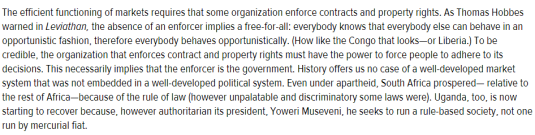
Source: Stephen Haber, Douglass C. North, and Barry R. Weingast If Economists Are So Smart, Why Is Africa So Poor? | Hoover Institution
How many more golden years can we expect
23 Sep 2015 Leave a comment
in development economics, growth disasters, growth miracles, health economics Tags: ageing society, demographic crisis, life expectancies, The Great Escape
Life expectancy is on the rise, but not all of those years will be golden econ.st/1LBVyS5 http://t.co/YHTUPETk1q—
The Economist (@ECONdailycharts) August 26, 2015
Many conservationists are against effective rhino conservation
23 Sep 2015 Leave a comment
in applied price theory, development economics, entrepreneurship, environmental economics, growth disasters, growth miracles, law and economics, property rights Tags: Africa, agricultural economics, do gooders, economics of conservation, economics of endangered species, endangered species, expressive voting, Leftover Left, Twitter left, unintended consequences
https://twitter.com/ConversationUK/status/646227223716872197/photo/1
https://twitter.com/dlAfrican/status/646215227076292608
Capturing the economic value of wildlife for the benefit of wildlife. New in PERC Reports: bit.ly/1JHerwj http://t.co/yijFIChPDo—
PERC (@PERCtweets) September 13, 2015
How private ownership and trophy hunting saved the southern white rhino: bit.ly/1HhZy55 #WorldRhinoDay http://t.co/s4PudPwrrI—
PERC (@PERCtweets) September 22, 2015
Economic impact of global warming: new evidence
18 Sep 2015 1 Comment
in applied welfare economics, development economics, environmental economics, global warming, growth disasters, growth miracles, politics - Australia, politics - New Zealand, politics - USA Tags: climate alarmism, global warming, Richard Tol
A nice summary of the latest research showing that once again the welfare cost of climate change is small except under the most extreme scenarios.

2% of national income is not something to declare a national emergency over unless you are in a very poor country.
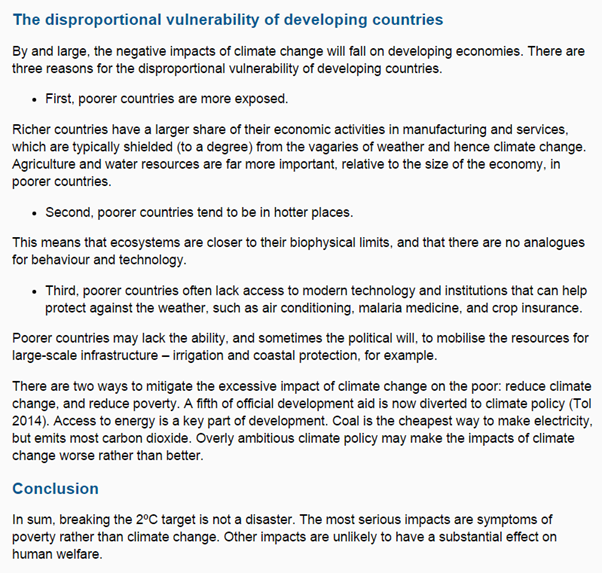
Richard Tol also mentions that there has only been 27 studies of the economic costs of climate change:
Twenty-seven estimates is a thin basis for any conclusion. Researchers disagree on the sign of the net impact; climate change may lead to a welfare gain or loss. At the same time, researchers agree on the order of magnitude. The welfare change caused by climate change is equivalent to the welfare change caused by an income change of a few percent.
- That is, a century of climate change is about as good/bad for welfare as a year of economic growth.
As Tol wrote elsewhere, the reason why there are so few studies of the welfare cost of global warming is governments and bureaucracies do not like the small numbers they yield so they pre-emptively do not fund such research.
Few economists work full-time on the economics of climate change as their research results are too moderate to win repeat business and further research grants. Importantly, there is vicious criticism of what you say. Much better to just work on other topics.
One of the great tactical victories of the climate activists, I resisted the temptation to call them climate alarmists, is they keep going on about the science is settled and whether you are accepting the scientific results.
I have long argued let the science be settled, only the economics matters. The climate change activists do not want to talk about the economics that much except for the estimates by that political hack Lord Stern. Lord Stern has been on the losing side of history ever since he wrote a bad review of PT Bauer’s Dissent on Development where he said:
Dissent on Development is not a valuable contribution to the study of development.
The Stern Review puts the costs of unmitigated climate change at 5–20% of GDP (now and forever). The Fifth Assessment Report of the Intergovernmental Panel on Climate Change (IPCC) finds differently.

HT: Lorenzo M Warby
No Generation Rent in #Nihon – real housing prices in #Japan and #SouthKorea since 1975
16 Sep 2015 Leave a comment
in development economics, economic history, growth miracles, urban economics Tags: Generation Rent, housing affordability, housing prices, Japan, land supply, land use planning, NIMBYs, South Korea, zoning
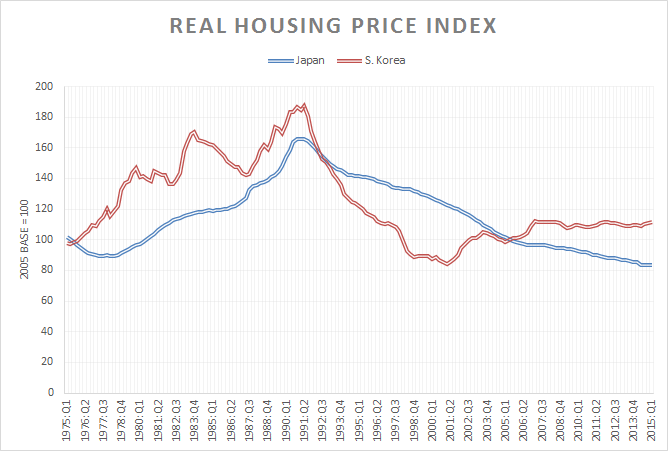
Source: International House Price Database – Dallas Fed
Note: The house price index series is an index constructed with nominal house price data. The real house price index is an index calculated by deflating the nominal house price series with a country’s personal consumption expenditure deflator.
The Great Escape by continent
14 Sep 2015 Leave a comment
in development economics, economic history, growth disasters, growth miracles, health economics Tags: Africa, child mortality, China, India, infant mortality, life expectancies, South America, The Great Escape
'The world is getting better all the time, in 11 maps and charts' – bit.ly/1M7W4Xr http://t.co/slB6oStjFq—
Max Roser (@MaxCRoser) July 14, 2015
The Great Escape in Chinese infant mortality was stunning
11 Sep 2015 Leave a comment
in development economics, economic history, growth disasters, growth miracles, health economics, Marxist economics Tags: child mortality, China, global poverty, infant mortality, stream poverty, The Great Escape
China's infant mortality rate fell 85% since 1970, nearing the U.S. rate. buff.ly/1g7eLNk #health http://t.co/b9eno1jk6X—
HumanProgress.org (@humanprogress) September 08, 2015
How is the population bomb going?
10 Sep 2015 Leave a comment
in development economics, economic history, growth disasters, growth miracles, health economics, population economics Tags: population bomb
The Great Escape actually accelerated after the GFC
10 Sep 2015 Leave a comment
in development economics, economic history, global financial crisis (GFC), growth disasters, growth miracles, health economics, labour economics, macroeconomics, poverty and inequality Tags: child poverty, extreme poverty, global poverty, India, The Great Escape, The Great Fact
In 1993, >30% of India's urban population lived in extreme poverty. In 2011? Only 13%. buff.ly/1iutlQA http://t.co/238hsW2aeF—
HumanProgress.org (@humanprogress) September 09, 2015
The Great Fact – undernourishment in developing countries (under the jackboot of neoliberalism)
10 Sep 2015 Leave a comment
in development economics, economic history, growth disasters, growth miracles, health economics Tags: capitalism and freedom, extreme poverty, global hunger, The Great Escape, The Great Fact


Recent Comments