https://twitter.com/historyfacts247/status/618510934030610432
Expansion of global empires, 1492-2008
10 Jul 2015 Leave a comment
in economic history Tags: age of empires, colonialism, imperialism
Boris Yeltsin took office as the first elected President of Russia this Day 1991
10 Jul 2015 Leave a comment
in constitutional political economy, economic history, Marxist economics, Public Choice Tags: capitalism and freedom, collapse of communism, Russia
On 10 July 1991, Boris Yeltsin took office as the first elected President of Russia. #OTD http://t.co/8462T7mCJB—
History Facts 247 (@historyfacts247) July 10, 2015
Newspaper bias just ain’t what it used to be
10 Jul 2015 Leave a comment
in economic history, economics of media and culture, entrepreneurship, industrial organisation, Public Choice Tags: British elections, creative destruction, expressive voting, London newspapers, media bias, rational ignorance, rational irrationality, red scares
Here's the Daily Mirror's polling day advice from days when it was more fair and balanced (h/t Guido) http://t.co/GJ5CNGMoRj—
Fraser Nelson (@FraserNelson) May 07, 2015
Has Bruce Ackerman just said the dumbest thing ever said?
10 Jul 2015 Leave a comment
in economic history, economics of media and culture Tags: Berlin wall, Cold War, collapse of communism, East Germany, fall of the Berlin wall, German unification, Germany, Greece, public intellectuals, West Germany

Traffic Jam near the Brandenburg Gate as East Germans move into West Berlin after the fall of the Berlin Wall, 1989. http://t.co/hVWT9Mwh4L—
Vexy Vox (@Vexyvox) November 14, 2014
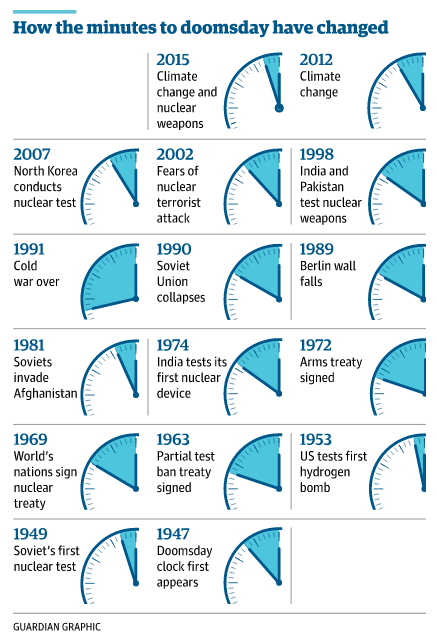
Financial crises surprisingly common, but few countries close their banks
10 Jul 2015 Leave a comment
in business cycles, currency unions, economic history, economics of regulation, Euro crisis, financial economics, global financial crisis (GFC), law and economics, macroeconomics, monetary economics, property rights Tags: bank runs, banking crises, banking panic, financial crises, Greece, sovereign default
Financial crises surprisingly common, but few countries close their banks pewrsr.ch/1NQyz2P #Greece http://t.co/pK0sfB49Ka—
PewResearch FactTank (@FactTank) July 09, 2015
Satellite relay TV started this day, 1962
10 Jul 2015 Leave a comment
in applied welfare economics, economic history, economics of media and culture, entrepreneurship, technological progress Tags: creative destruction, entrepreneurial alertness, innovation
10 July 1962: The 'Telstar' Communications satellite was launched. It was the beginning of satellite relayed TV. http://t.co/6kW3aAAEpF—
History (@HistoryTime_) July 10, 2015
Creative destruction in Internet diffusion
10 Jul 2015 Leave a comment
in economic history, economics of media and culture, entrepreneurship Tags: cell phones, Digital poverty, entrepreneurial alertness, Internet, mobile phones, technology diffusion
Mobile broadband could reach saturation even faster than the mobile phone before it econ.st/1LJ3mhy http://t.co/2809LNCWwZ—
The Economist (@ECONdailycharts) May 27, 2015
It is Nikola Tesla’s birthday
09 Jul 2015 Leave a comment
in economic history, economics of media and culture, entrepreneurship Tags: creative destruction, entrepreneurial alertness, Nikola Tesla
It is Nikola Tesla's birthday. His 1926 description of today's smartphone is truly remarkable http://t.co/AAkeSsWfpl—
paulkirby (@paul1kirby) July 10, 2015
The Great Fact: the rise of the middle class in developing countries
09 Jul 2015 Leave a comment
China pulled 203m into the middle class from 2001-11; more than half the global gain of 385m pewrsr.ch/1LSs6Wz http://t.co/DiskvneykJ—
Rakesh Kochhar (@RakeshKochhar) July 08, 2015
Real and Pseudo-Financial Crises, the Chinese share market crash and Anna Schwartz
09 Jul 2015 Leave a comment
in economic history, financial economics, fiscal policy, international economics, macroeconomics, monetarism, monetary economics Tags: Anna Schwartz, bank runs, banking panics, China, contagion, evidence-based policy, financial crises, financial stability, inflation targeting, international systemic risk, Michael Bordo, monetary history, pseudo financial crises, pseudo international systemic risk
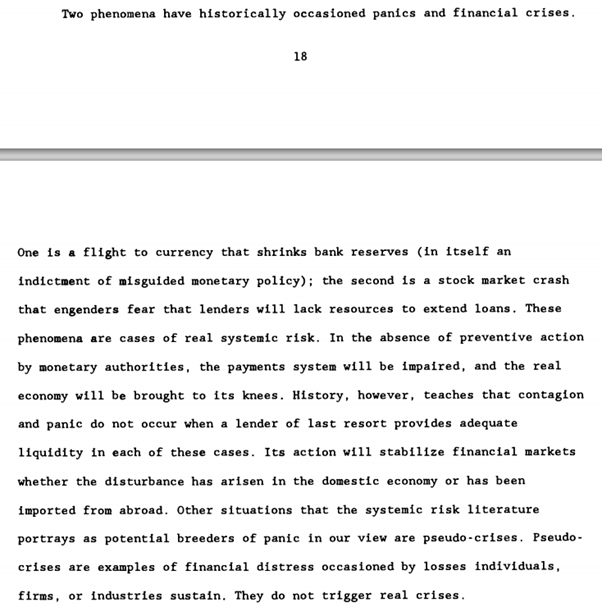
If we could take time out from the breathless journalism about the Chinese stock market, which some people may have heard of before this week, it’s crash should be seen through the lens that Anna Schwartz developed in 1987 of a pseudo financial crisis and a financial crisis.
This is why so many Chinese companies are suspended bloom.bg/1UA7TbA http://t.co/5awEt6B23u—
Bloomberg Business (@business) July 08, 2015
Her paper is written at the same time as the 1987 stock market crash. On financial crises, Anna Schwartz said:
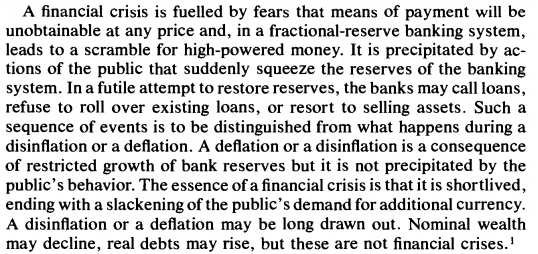
As for those pseudo financial crises, she said:
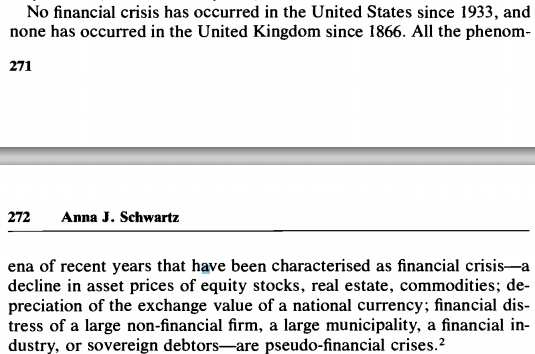
Schwartz’s principal concern with regard to pseudo financial crisis was:
proposals to deal with pseudo-financial crises is the perpetuation of policies that promote inflation and waste of economic resources
As we are talking about the Chinese stock market, Anna Schwartz also wrote about the concepts of real systemic international risk and and pseudo international systemic risk.
Once again, and as with pseudo financial crises and real financial crises, what distinguishes real systemic international risk and pseudo international systemic risk is a threat to the payment system. The threat of bank runs, which can easily be eliminated through lender of last resort facilities:
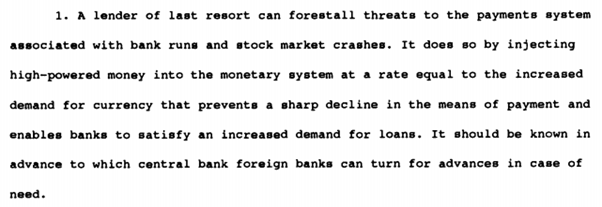
As always it is about the security of the payments system – of avoiding bank runs, not private losses:
The lesson for the day is that when people start panicking about the economy or the stock market or international markets, don’t go to a macroeconomist for advice, go to a monetary historian. They have seen it all before.

Has NZ child poverty doubled as @MaxRashbrooke said?
09 Jul 2015 1 Comment
in applied welfare economics, economic history, economics of regulation, labour economics, law and economics, politics - New Zealand, poverty and inequality, property rights Tags: Auckland urban limit, child poverty, Director's Law, expressive voting, family poverty, family tax credits, in-work tax credits, land use planning, median voter theorm, rational ignorance, rational irrationality, RMA, top 1%, working for families
Lindsay Mitchell put me onto a quote by veteran grumbler Max Rashbrooke that the child poverty rate doubled in New Zealand:
In a system where income goes disproportionately to the already well-off, ordinary workers are missing out on the rewards of their efforts, to the tune of billions of dollars a year. Welfare benefits, cut by a quarter in 1991 and increased just 8 per cent in the last budget, are far too low to meet people’s basic needs.
The result is a doubling of child poverty and the return of childhood diseases unknown in most developed countries – a national embarrassment, as one researcher described it.
Poverty, income and inequality data is collected in loving detail by Brian Perry every year for the Ministry of Social Development.
Figure 1: % child poverty in New Zealand (before and after housing costs), 60% 1998 median constant value, 1982 – 2013
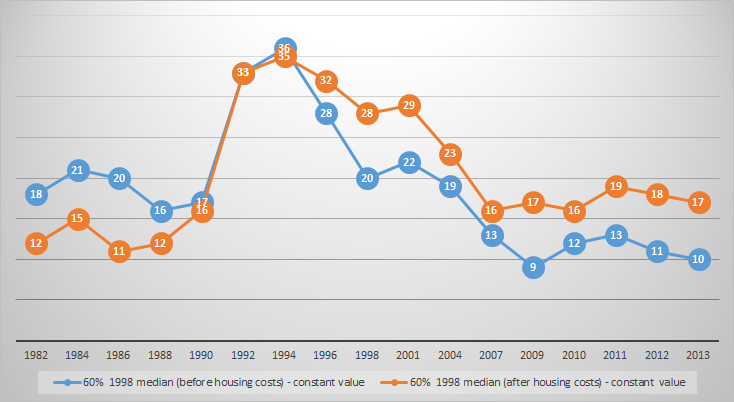
Source: Bryan Perry, Household incomes in New Zealand: Trends in indicators of inequality and hardship 1982 to 2013. Ministry of Social Development (July 2014), Tables F.6 and F.7.
The only thing noticeable in the downward trend in child poverty in New Zealand since its doubling with the sharp recession in 1990 with double-digit unemployment rates is child poverty stop falling shortly after in-work family tax credits were introduced in the form of Working for Families in 2005.
New QV figures show Auckland house prices are up a massive 16.1% on last year, now estimated to reach $1m by Aug '16. http://t.co/DwAU79ozCy—
New Zealand Labour (@nzlabour) June 09, 2015
There was a break in trend in the long decline in child poverty as soon as in-work family tax credits were introduced in New Zealand. I’m sure this is a coincidence because, as Brian Perry said when discussing the introduction of Working for Families in 2005:
The 2004 to 2007 period was the only one in the 25 years to 2007 in which the incomes of low- to middle-income households grew more quickly than those of households above the median.
The real killer in New Zealand in terms of poverty and inequality are housing costs. Housing costs are wholly under the control of government through its control of the supply of land, which is restricted at the behest of the parties of the left.
Figure 2: real equivalised household incomes (before and after housing costs): changes at the top of lowest income decile, New Zealand, 1982 to 2013

Source: Bryan Perry, Household incomes in New Zealand: Trends in indicators of inequality and hardship 1982 to 2013. Ministry of Social Development (July 2014), tables D.2 and D.4.
Figure 2 shows that real equivalised household income after housing costs has not grown and in fact has fallen for the bottom 10% of the income distribution in New Zealand.

It is the left-wing parties who oppose measures to reduce housing costs and and increase the supply of land through reforms to the Resource Management Act and the relaxation of the Auckland metropolitan urban limit.

Labour and the Greens are in effect keeping the poor poor to win middle-class votes.
Figure 3: real equivalised household incomes (before and after housing costs): changes at the top of the top, middle and lowest lowest income deciles, New Zealand, 1982 to 2013
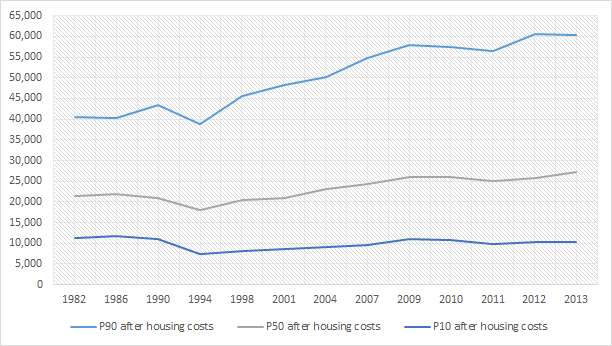
Source: Bryan Perry, Household incomes in New Zealand: Trends in indicators of inequality and hardship 1982 to 2013. Ministry of Social Development (July 2014), tables D.2 in D.4.
Figure 3 shows that those in the middle and higher deciles, a political territory rich in swinging voters, are still doing well after housing costs. The parties of the left are collaborating with a middle-class home owning voter while betraying the working class and its aspirations from home ownership and quite simply affordable housing costs when they rent.
The increases for all groups may be understated by the inability of living standards measures to adequately account for new goods, product upgrades and rising life expectancies.
The growth of federal taxes in America in the 20th century
09 Jul 2015 Leave a comment
in economic history, politics - USA, public economics Tags: growth of government, size of government
Creative destruction in hard disks
08 Jul 2015 Leave a comment
1981 http://t.co/V4ksgA8zvG—
Old Pics Archive (@oldpicsarchive) July 07, 2015
A tale of Italy’s two economies
08 Jul 2015 Leave a comment
in economic history, macroeconomics Tags: Eurosclerosis, Italy
A tale of Italy's two economies econ.st/1L0EqAX http://t.co/Yhvpd4d6Fz—
The Economist (@EconEconomics) May 18, 2015
Are the rich getting richer, poor getting poorer as @MaxRashbrooke once again suggests?
08 Jul 2015 Leave a comment
in applied welfare economics, economic history, labour economics, politics - New Zealand, poverty and inequality, technological progress Tags: child poverty, family poverty, Leftover Left, Max Rashbrooke, The Great Enrichment, top 1%
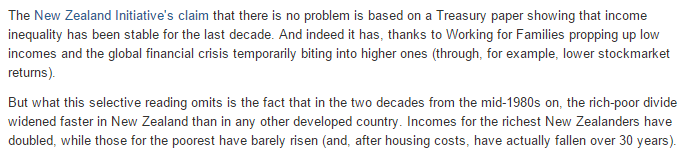
Max Rashbrooke has been at it again in the paper today.

Don’t these graphs show that everyone is richer in New Zealand than 30 years ago and there has been not much change in either child poverty or inequality for coming on for 20 years? The fall in child poverty started before the introduction of Working for Families.
Technological progress in the form of new goods and product upgrades are poorly captured in measures of living standards over time as is increases in life expectancies.
1993 vs 2013: http://t.co/tdnNqmRmcS—
History Pics (@HistoryPixs) January 08, 2014
HT: Suffer the little children – Inequality and child poverty – Closer TogetherCloser Together.


Recent Comments