From Adam Ozimek: The economic value of the cars being made has climbed substantially through the years. As a result, real value added and industrial production — two different ways of measuring actual output — are now at all-time highs. And this: What about jobs? The auto industry today employs 1 million workers. Between 1950 and […]
In our textbook, Modern Principles, Tyler and I contrast basic U.S. labor law, at-will employment—where employers may terminate workers for any reason not explicitly illegal (e.g., racial or sexual discrimination), without notice or severance—with Portugal’s “just cause” regime, which requires employers to prove a valid reason, give advance notice, pay severance, and endure extensive regulatory […]
The United States has produced about twice as many unicorns (private startups valued at $1B+) as China and more than four times as many as the European Union. These numbers reflect deep institutional and cultural advantages in the U.S. startup ecosystem. Table: Number of Unicorns Created Since ~1990 Region Cumulative Unicorns United States ~1,950 China…
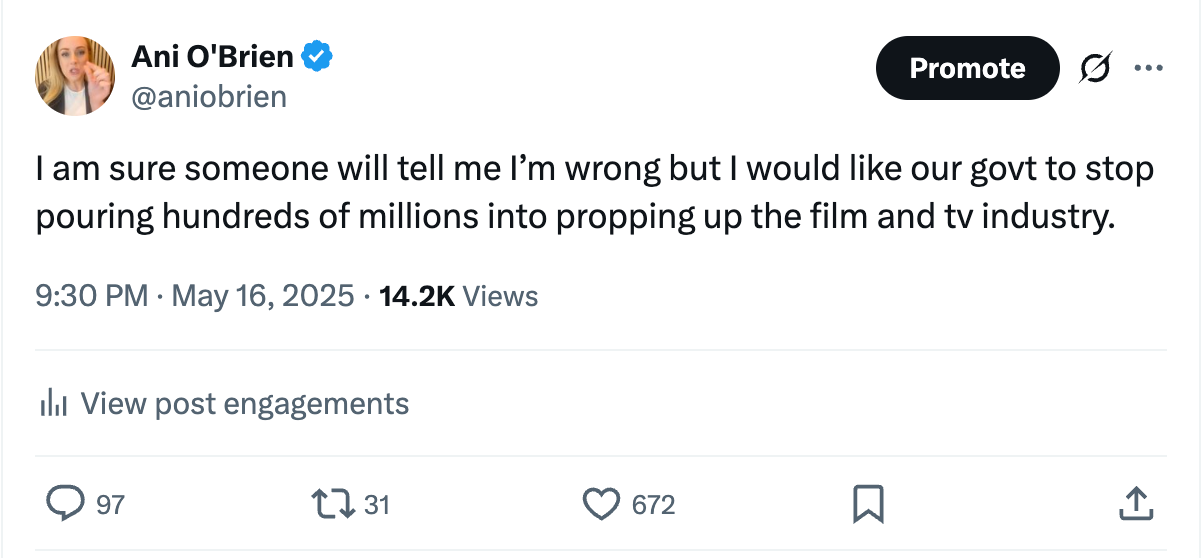
Ani O’Brien writes – On Friday night, having imbibed a few wines I strayed onto X to unwisely engage in some (slightly drunk) opinion sharing. I tweeted:
TweetNicholas Bloom, Kyle Handley, André Kurmann, and Philip A. Luck revisit the “China Shock.” Two slices: Our research investigates the extent to which the opposing trends in manufacturing and services job growth are related. Our findings reveal that local labor markets more exposed to Chinese import competition experienced larger manufacturing job losses. But these losses…
California’s refining capacity is collapsing—not because demand has disappeared, but because it is being deliberately dismantled by regulatory fiat. The recent announcement that Valero Energy will idle or shutter its Benicia refinery by 2026 isn’t just a business decision. It’s the calculated result of a hostile policy environment designed to punish traditional energy producers until they either leave the state or fall into government hands.
Leasing companies have gambled that second hand values for EVs would be as strong as for conventional cars. It is a gamble that could cost them billions.
Eric Crampton writes – The pendulum theory of politics suggests that policies often swing from one extreme to another without finding a balanced middle ground. Consider New Zealand’s supermarkets. Current regulations have made it near-impossible for new large-scale grocers to enter the New Zealand market.
It appears that Trump wants to repeat the mistakes of the 1930s with a global trade war. That is going to be very bad news for workers, consumers, taxpayers, manufacturers, farmers, and exporters. But there are two bits of good news. At least for small slices of the populations First, lobbyists will get rich as […]
Chris Trotter writes – What does India want from New Zealand? Not our dairy products, that’s for sure, it’s got plenty of those. Indeed 45 percent of the Indian population are small-scale farmers, most of them running a few head of cattle – not to eat, you understand – but to milk. If it once […]
TweetHere’s a note to the Highland County Press. Editor: Commerce secretary Howard Lutnick asserts that NAFTA allowed U.S. automobile producers to “screw” American auto workers by shifting auto-industry production to Mexico and Canada (“Trump Cabinet members: Tariff plans are working; tariffs could eliminate federal income tax for those earning less than $150,000,” March 20). Mr.…
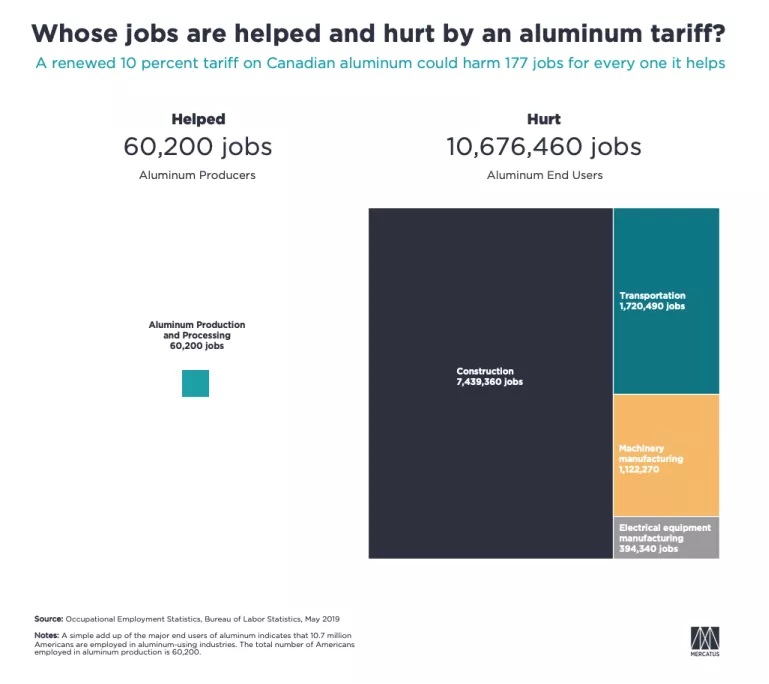
I shared a “Trade 101 for Trumpies” presentation last month in hopes of educating people about the foolishness of protectionism. Perhaps it should have been a remedial class because the president has just announced another increase in taxes on steel and aluminum from Canada. This is insanely bad economic policy for the simple reason that […]
TweetHere’s a letter to USA Today. Editor: Defending Pres. Trump’s aluminum tariffs, Peter Navarro focuses exclusively on the effects of these tariffs on U.S. aluminum producers (“Trump tariffs will save American jobs and level the playing field,” Feb. 28). He points out what no serious defender of free trade denies, namely, that punitive taxation of…
Under current law, any US companies considering a merger or acquisition that is above $125 million in size must first report it to the government. The most recent data for 2023 says that 1,805 such transactions were reported in 2023, which was a relatively low number for recent years. In 2021 and 2022, for example,…
BP’s green pivot has backfired spectacularly, hammering profits and leaving the company vulnerable to a hedge fund siege, writes Jonathan Leake in the Telegraph.
Why Evolution is True is a blog written by Jerry Coyne, centered on evolution and biology but also dealing with diverse topics like politics, culture, and cats.
“We do not believe any group of men adequate enough or wise enough to operate without scrutiny or without criticism. We know that the only way to avoid error is to detect it, that the only way to detect it is to be free to inquire. We know that in secrecy error undetected will flourish and subvert”. - J Robert Oppenheimer.


 Utopia, you are standing in it!
Recent Comments