Corbyn has, for all his life, opposed the only means of securing peace either in Europe or anywhere else. He is against trade agreements, the European Union and NATO. Bernie Sanders is equally as misguided.
Corbyn and Sanders thinks you can make peace just by talking with people. Peace is made by trading with hostile countries to make them depend on you for their prosperity as well as yours. By growing rich through free trade, it’s in no ones interest to go to war or have poor relations with each other or each other’s friends.
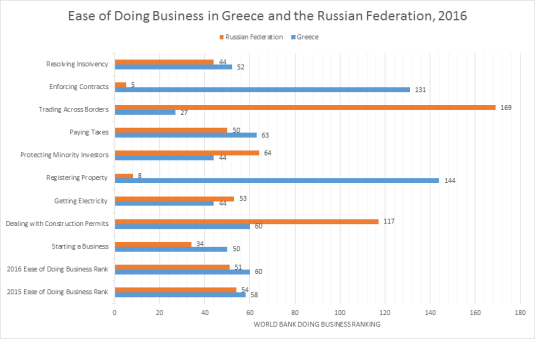
The only clear advantage Greece has on Russia as a place to do business is trading across borders because of European Union membership. Russia is a dog of a place to get things across borders. Greece has dropped two places overall ranking as a place to do business while Russia climbed 3 places in the World Bank 2016 Doing Business rankings as compared to their 2015 Doing Business rankings.
In 2016, Russia has considerable strengths as compared to Greece in a number of other areas of doing business such as enforcing contracts, registering property and starting a business. Russia is even a slightly better place to pay taxes than Greece! Russia’s World Bank Doing Business ranking for trading across borders has not changed between 2015 and 2016.
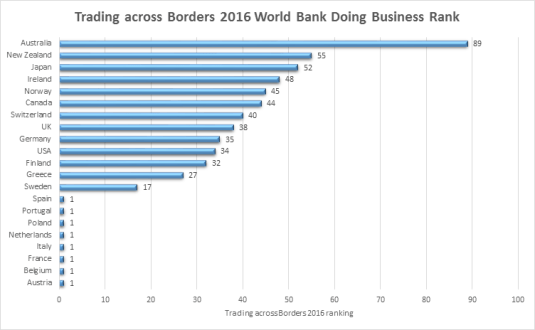
Australia is certainly a dog of a place when it comes to trading across borders and the same pretty much goes for New Zealand. Continental European Union members who are next to each other have a good run when it comes to trading across borders. Germans seem to manage to stuff that up nonetheless.
Australia and New Zealand get a poor rating because of border charges for a processing of customs documents. In Continental Europe, where there are no border controls for land crossings between EU members, these border compliance costs obviously do not apply nor is there any waiting at border checkpoints.
It is time for the environmental movement to face up to the fact that there never will be an international treaty to restrain carbon emissions. The practical way to respond to global warming is healthier is wealthier, richer is safer. Faster economic growth creates more resources for resilience and adaptation to a changing environment.
Good grief, the architect of "the pivot to Asia" opposes TPP? In her book she praised the deal! http://t.co/9XDiv0btzM— Ryan Lizza (@RyanLizza) October 07, 2015
One of my policy essays for my Masters of Public Policy Degree in Japan was on the social clauses of the GATT. I described the labour and environmental clauses is a new form of colonialism.
My classmates were government officials from all around Asia, more than 20 countries. As they spoke English as a second language, they were pleased to learn of a new way of describing social clauses in trade agreements in English.
A Filipino friend had a blunter way of referring to social clauses in trade agreements: “the whites are back, telling us what to do”.
Jane Kelsey in a television interview said she opposes the reductions in sovereignty in trade agreements that result from investor-state dispute settlement (ISDS) provisions because they limit the democratic choices of future governments.
If so, she must oppose environmental and labour standards in trade agreements and, more importantly, binding the hands of future governments with climate treaties. All international treaties are about restrictions on sovereignty.
Environmental and labour clauses in trade agreements and climate treaties all limit the powers of governments to legislate on environmental and employment law in accordance with the will of the people as expressed in the most recent election and change of government. Power to the people.
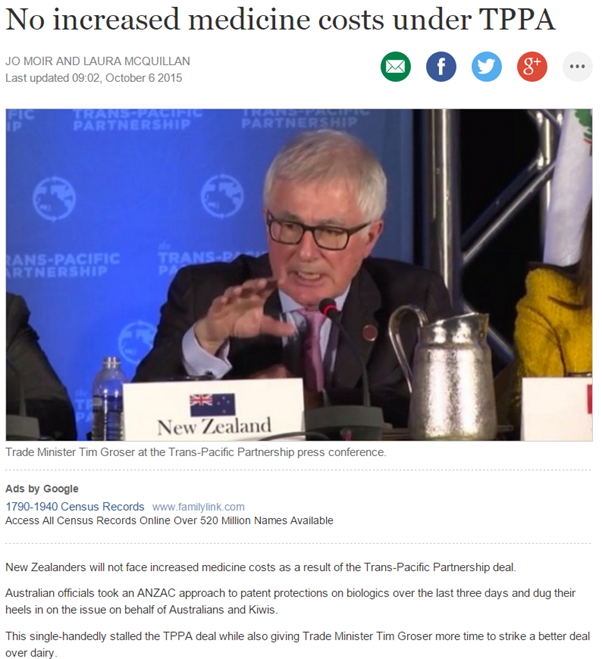
Jane Kelsey would do better focusing on those parts of the TPPA deal that lowers the net value of the deal such as those extending the term of patents over the drugs. All international treaties are about trade-offs.
The next best arguments James Shaw made were xenophobia about foreign investment in land and some vast conspiracy theory regarding endangered dolphins.
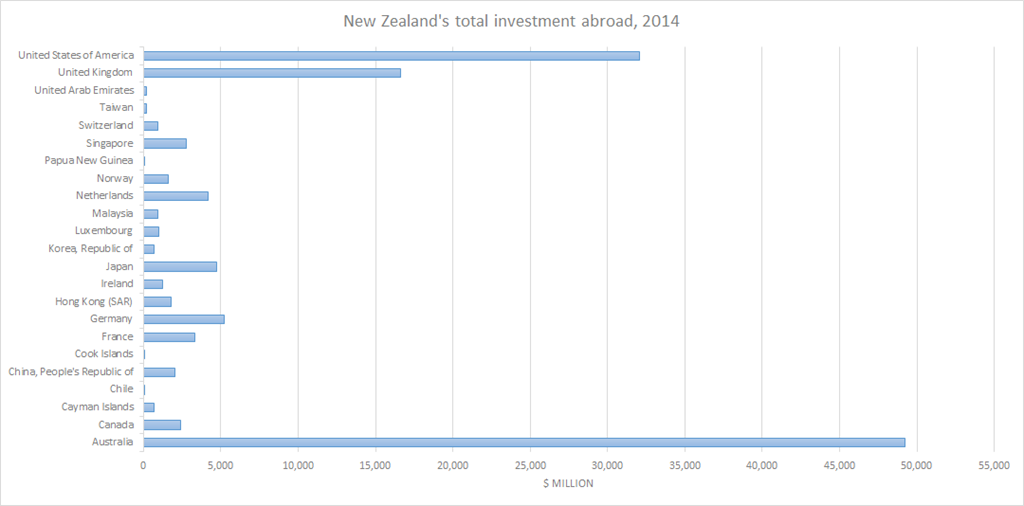
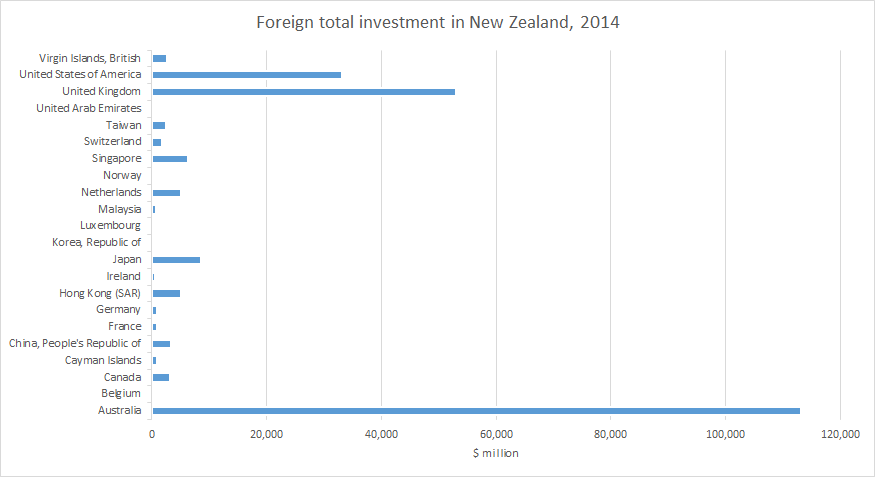
When your next best argument is foreigners are coming to buy up all our land, you are playing from a weak populist hand. About half of million New Zealand born live in other countries.
About 80% of these live in Australia, the great majority as residents rather than as citizens. These New Zealanders living in Australia and elsewhere need protection under international agreements to ensure they are not the victim of populist outbreaks against the sale of land to foreigners.
Source: Statistics New Zealand.
In addition, if a foreigner wants to pay over the odds for my house I am glad to separate a fool from his money.
Source: Statistics New Zealand.
New Zealand has a strong interest in protecting the rights of its own expatriates as well as New Zealand foreign investors to buy land in other countries. As David Friedman explains:
Much more commonly, [economic imperialism] is used by Marxists to describe–and attack–foreign investment in “developing” (i.e., poor) nations. The implication of the term is that such investment is only a subtler equivalent of military imperialism–a way by which capitalists in rich and powerful countries control and exploit the inhabitants of poor and weak countries.
There is one interesting feature of such “economic imperialism” that seems to have escaped the notice of most of those who use the term. Developing countries are generally labour rich and capital poor; developed countries are, relatively, capital rich and labour poor. One result is that in developing countries, the return on labour is low and the return on capital is high–wages are low and profits high. That is why they are attractive to foreign investors.
To the extent that foreign investment occurs, it raises the amount of capital in the country, driving wages up and profits down. The effect is exactly analogous to the effect of free migration. If people move from labour-rich countries to labour-poor ones, they drive wages down and rents and profits up in the countries they go to, while having the opposite effect in the countries they come from.
If capital moves from capital-rich countries to capital-poor ones, it drives profits down and wages up in the countries it goes to and has the opposite effect in the countries it comes from. The people who attack “economic imperialism” generally regard themselves as champions of the poor and oppressed.
To the extent that they succeed in preventing foreign investment in poor countries, they are benefiting the capitalists of those countries by holding up profits and injuring the workers by holding down wages. It would be interesting to know how much of the clamour against foreign investment in such countries is due to Marxist ideologues who do not understand this and how much is financed by local capitalists who do.
A single labour market in Europe? Chart shows labour costs in some countries 10 times higher than in others http://t.co/HEzvsSoCPb— paulkirby (@paul1kirby) September 14, 2015
Currently New Zealand small refugee quota of 750 is under review. Chances of that been increased to 1000 are reasonable. If people are trying to open the floodgates to millions of people as potential refugees of climate change, if Greenpeace’s own alarmist rhetoric about global warming is to be believed, Greenpeace only strengthens the hand of the anti-immigration and xenophobic parties such as New Zealand First and within the National Party caucus.
Not everyone is a worthy cause, particularly those who make vexatious legal claims that were always going to fail in court. The High Court, the Court of Appeal and the Supreme Court all ruled that it is not their place to expand the scope of the international refugee convention to cover those displaced by climate change. As the Court of Appeal ruled
No-one should read this judgment as downplaying the importance of climate change. It is a major and growing concern for the international community. The point this judgment makes is that climate change and its effect on countries like Kiribati is not appropriately addressed under the Refugee Convention.
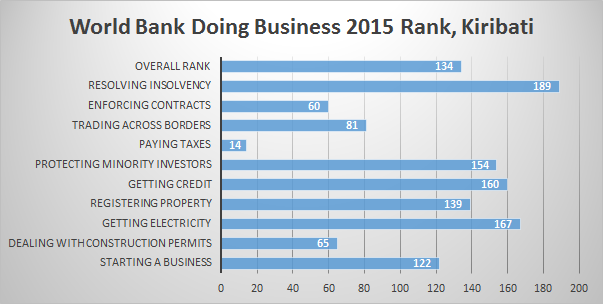
Kirabati can do a lot more to help itself rather than looking to others to solve its problems. It is ranked 133rd in the World Bank’s Doing Business database. This means it can do a lot to help its own development, which strengthens its resilience against climate change and rising sea levels. In the High Court, Priestley J observed:
The economic environment of Kiribati might certainly not be as attractive to the applicant and his fellow nationals as the economic environment and prospects of Australia and New Zealand. But he would not, if he returns, be subjected to individual persecution…
The appellant raised an argument that the international community itself was tantamount to the “persecutor” for the purposes of the Refugee Convention. This completely reverses the traditional refugee paradigm. Traditionally a refugee is fleeing his own government or a non-state actor from whom the government is unwilling or unable to protect him. Thus the claimant is seeking refuge within the very countries that are allegedly “persecuting” him.
Kiribati’s Human Development Index value for 2012 is 0.629—in the medium human development category—positioning the country at 121 out of 187 countries and territories. The rank is shared with Indonesia and South Africa. Kiribati is not unusually poor if it is similar in human development index ranking is to Indonesia and South Africa. Since 1980, Kiribati life expectancy at birth has increased from 55 years to 68 years. Average years of schooling is nearly 8 years and expected years of schooling for their children is now 12 years.
Why Evolution is True is a blog written by Jerry Coyne, centered on evolution and biology but also dealing with diverse topics like politics, culture, and cats.
“We do not believe any group of men adequate enough or wise enough to operate without scrutiny or without criticism. We know that the only way to avoid error is to detect it, that the only way to detect it is to be free to inquire. We know that in secrecy error undetected will flourish and subvert”. - J Robert Oppenheimer.



 Utopia, you are standing in it!
Recent Comments