How do trade imbalances affect the #economy? buff.ly/1e32Dg9 http://t.co/8TsPbxXlvf—
MRUniversity (@MRevUniversity) June 10, 2015
The balance of payments always balances
11 Jun 2015 Leave a comment
in international economics Tags: balance of payments, capital account surpluses, current account deficits, economic fallacies
The market erodes discrimination
01 Jun 2015 Leave a comment
in applied price theory, discrimination, economic history, entrepreneurship, international economics Tags: entrepreneurial alertness, racial discrimination, sex discrimination
Great excerpt on #immigration as #development from @bill_easterly's Tyranny of Experts @AlexNowrasteh @m_clem http://t.co/5eruOdEcGm—
David Bier (@myfreesociety) May 09, 2014
Sovereign defaults are mainly a Latin American thing
29 May 2015 1 Comment
in international economics Tags: Argentina, Greece, international economic law, Latin America, sovereign defaults
#Dailychart: Nine of the top ten sovereign debt defaulters are from Latin America econ.st/UDi8B1 http://t.co/s0jb2yh5PN—
The Economist (@ECONdailycharts) July 31, 2014
What should be the Green Party case for free trade
23 May 2015 Leave a comment
in international economics, politics - Australia, politics - New Zealand, war and peace Tags: Left-wing hypocrisy, New Zealand Greens
Why America refuses to sign climate treaties that don’t include the BRICs
12 May 2015 Leave a comment
in environmental economics, global warming, international economic law, international economics Tags: climate alarmism, climate treaties, free riding, game theory, global warming
Hypocritical Greens betray NZ sovereignty to US court decision but oppose investor state dispute settlement on sovereignty grounds
10 May 2015 Leave a comment
in defence economics, economics of crime, international economic law, international economics, International law, law and economics, politics - New Zealand, politics - USA Tags: foreign policy, free trade agreements, green hypocrisy, green party, investor state disputes settlement, national security, preferential trading agreements, war against terror
The Greens are happy to betray New Zealand’s sovereignty to a US court where New Zealand’s side of the story was not heard, New Zealand was not a litigant, New Zealand was not named in the proceedings and New Zealand had not agreed to waive its sovereign immunity under US law.
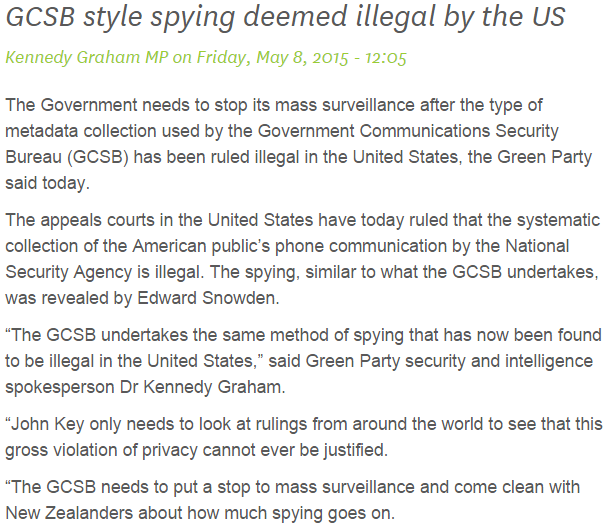
The Greens on the other hand are hysterical about the prospect of New Zealand voluntarily submitting to investor state disputes settlement through an international treaty. International treaties normally are about trading in sovereignty: you give up some form of sovereignty return for something you value more.
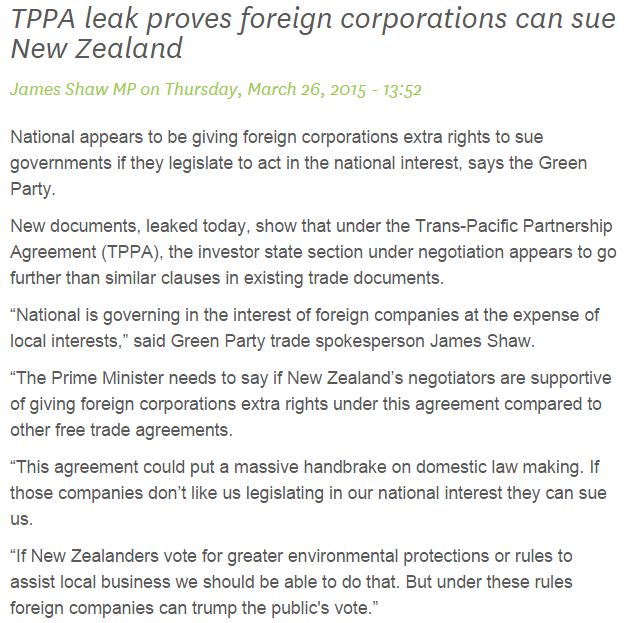
It is thoroughly hypocritical of the Greens to argue the New Zealand should bow down to a foreign court when that court rules in a way that it favours its ideological agenda but refuse to support the principle of international arbitration in circumstances where that may advance New Zealand’s national interests.
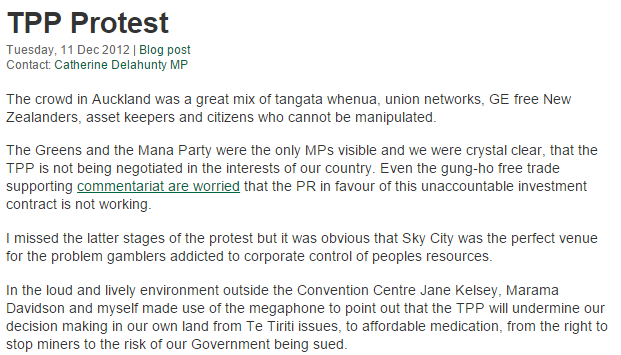
At a minimum, New Zealand itself chose to give up its sovereignty if it agrees to investor state dispute settlement in a trade agreement. The decision was not imposed by a foreign court where it was not heard nor was a party.


Of particular concern to the Greens is international arbitration could "trump the public’s vote vote". New Zealand has repeatedly elected parties that support the alliance with America, and support a robust security and intelligence policy, including electronic surveillance as part of the war on terror.
The last week of the 2014 general election campaign was dominated by the Government Security Communications Bureau and its cooperation with the National Security Agency and the extent to which New Zealand security services engaged in electronic surveillance in New Zealand and abroad.
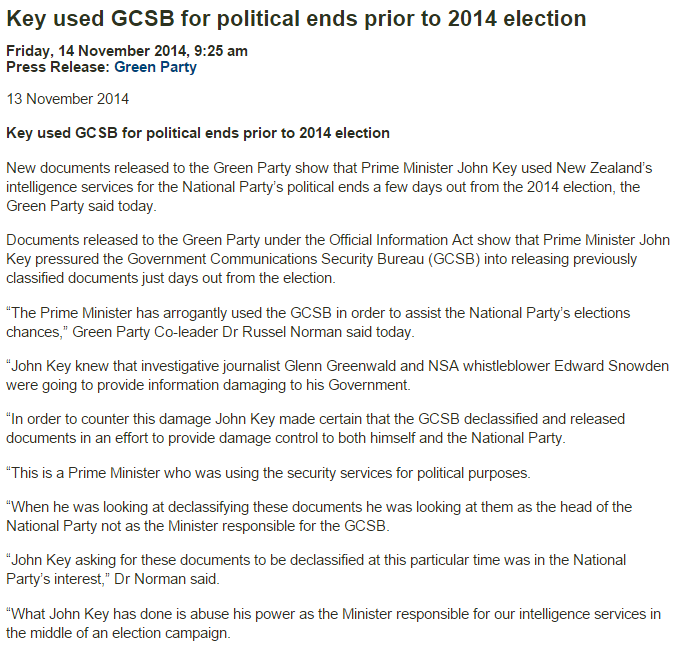
The Greens want to subvert that democratic decision that has been repeated over many New Zealand elections about national security and foreign relations to defer to an American court when New Zealand didn’t even appear as a party.

The US Court of appeal was deciding an issue of statutory interpretation of the Patriot Act. There was no constitutional issues at hand.
The Patriot Act expires in a month unless it is extended. Congress has ample opportunity to amend the renewed law to overturn the appeal court’s decision for the future operation of its security and intelligence laws.
The Greens want a Court of Appeal interpretation of the American Patriot Act to extend to New Zealand without a vote of the New Zealand people or the parliament having any say on whether to give up New Zealand’s sovereignty or waive sovereign immunity in American courts.
.
Senator Warren made a good case against Investor-State Dispute Settlement in the TPP
09 May 2015 Leave a comment
in economic history, economics of regulation, entrepreneurship, industrial organisation, international economic law, international economics, law and economics, politics - Australia, politics - New Zealand, politics - USA, property rights Tags: Australian productivity commission, free trade agreements, investor state disputes settlement, Leftover Left, preferential trade agreements, Senator Elizabeth Warren, Twitter left
In the Washington Post a few months ago, Senator Elizabeth Warren made a balanced case against investor state dispute settlement, not only in the Trans-Pacific Partnership. But in any trade agreement.
Apart from a few rushes of blood in rhetoric to appeal to her base, she made reasoned arguments, good use of history, and put up constructive alternatives to what she was criticising. Furthermore, she put forward arguments that appealed to every point in the political spectrum. The Left over Left critics of investor state disputes settlement clauses in trade agreements in New Zealand never do that.
She echoed arguments I have made the at investor state disputes settlement clauses have no place in trade agreements between liberal democracies.
Liberal democracies have independent courts and honest politics where everyone gets a fair go. That means sometimes you’re on the losing side of politics, but you as free to persuade the majority that they are mistaken. That is democracy in action: sometimes you win, sometimes you lose and there is an election in a few years where you can get another go.
New Zealand has a Closer Economic Relations Agreement with Australia. One provision is a requirement that in most cases New Zealanders are treated the same as Australians under Australian law.
To explain this, some years ago, a New Zealand television production company successfully sued the Australian television regulator to have New Zealand made television shows recognised as Australian content under the 50% Australian content regulations for free-to-air television in Australia.
Note the New Zealand business sued in the Federal Court of Australia and won. They had their day in court.
Senator Warren makes the point that if a business in the USA is unhappy with a regulation, they can challenge by normal democratic and legal means, which investor state disputes settlement undermines:
If a foreign company that makes the toxic chemical opposes the law, it would normally have to challenge it in a U.S. court. But with ISDS, the company could skip the U.S. courts and go before an international panel of arbitrators. If the company won, the ruling couldn’t be challenged in U.S. courts, and the arbitration panel could require American taxpayers to cough up millions — and even billions — of dollars in damages.
Senator Warren also provides a good history of the emergence of investor state disputes settlement and the relevance of that history to contemporary developments:
But after World War II, some investors worried about plunking down their money in developing countries, where the legal systems were not as dependable. They were concerned that a corporation might build a plant one day only to watch a dictator confiscate it the next. To encourage foreign investment in countries with weak legal systems, the United States and other nations began to include ISDS in trade agreements.
Investor state disputes settlement were indeed created to protect businesses that did not have robust democracies and legal systems. Would be international investors in one of these countries were promised international redress if there was a coup, a takeover of their investments or some other unforeseen negative impact because sovereign risk.
She then asked why are these provisions in trade agreements with liberal democracies where they have no relevance:
Those justifications don’t make sense anymore, if they ever did. Countries in the TPP are hardly emerging economies with weak legal systems. Australia and Japan have well-developed, well-respected legal systems, and multinational corporations navigate those systems every day, but ISDS would pre-empt their courts too.
Senator Warren also makes a good point that investor state disputes settlement undermines competition between legal jurisdictions and the rewards for having a sound legal system:
…to the extent there are countries that are riskier politically, market competition can solve the problem. Countries that respect property rights and the rule of law — such as the United States — should be more competitive, and if a company wants to invest in a country with a weak legal system, then it should buy political-risk insurance.
Political risk is is an entrepreneurial opportunity for the insurance market. The World Bank’s Multilateral Investment Guarantee Agency provides insurance to those investing in developing countries against expropriation (including indirect expropriation), as well as acts of war and terrorism. Export Finance schemes of many governments offer political risk Insurance. Anyone who travels in the less safe countries of the world routinely buys travel insurance.
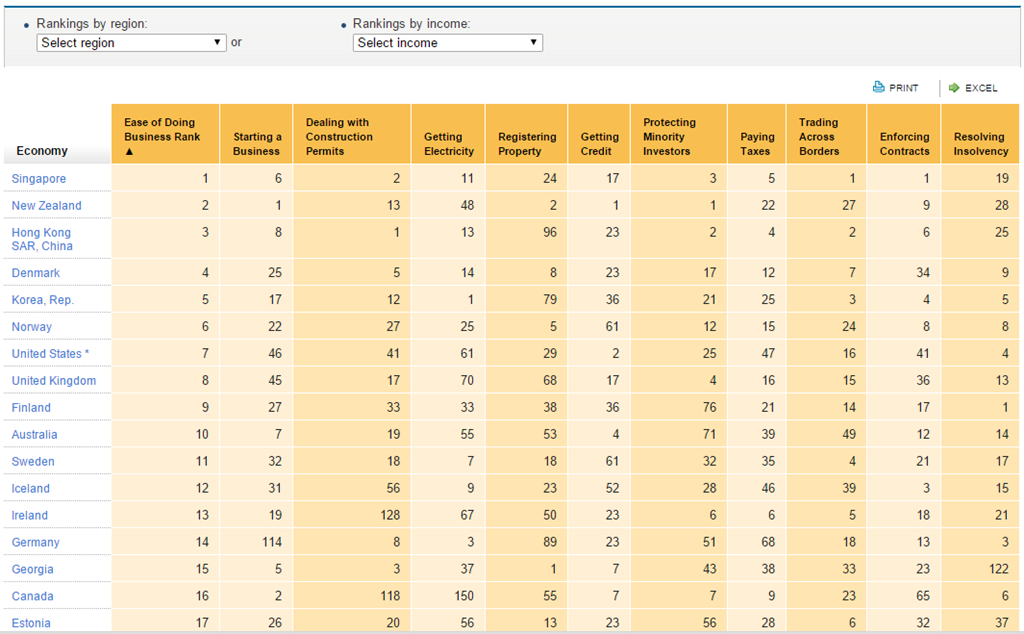
The World Bank puts out an annual index on ease of doing business in every country of the world so foreign investors can’t say they won’t warned of the risks they were taking for the profits they sought.
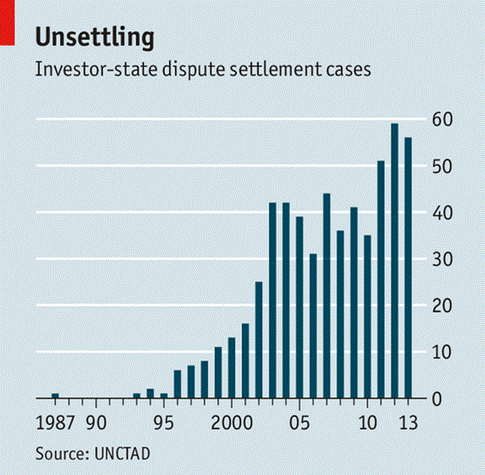
Investor state disputes that were indeed referred to international arbitration used to be rare. Now they are more common as Senator Warren explains:
From 1959 to 2002, there were fewer than 100 ISDS claims worldwide. But in 2012 alone, there were 58 cases.
Recent cases include a French company that sued Egypt because Egypt raised its minimum wage, a Swedish company that sued Germany because Germany decided to phase out nuclear power after Japan’s Fukushima disaster, and a Dutch company that sued the Czech Republic because the Czechs didn’t bail out a bank that the company partially owned. U.S. corporations have also gotten in on the action: Philip Morris is trying to use ISDS to stop Uruguay from implementing new tobacco regulations intended to cut smoking rates.
In a response to Senator Warren’s op-ed, Gary Clyde Hufbauer said:
…only 13 ISDS cases have been brought to judgment against the United States. The United States has not lost a single case.
Why? Because the United States does not expropriate private property without compensation, and the United States does not enact arbitrary or discriminatory laws against foreign firms. Contrary to what the Senator implies, American taxpayers have not had to cough up millions and even billions of dollars in damages. They have not had to cough up anything.
The best part of Senator Warren’s op-ed is when she appeals to all points of the political spectrum based on arguments that do indeed appealed to them:
Conservatives who believe in U.S. sovereignty should be outraged that ISDS would shift power from American courts, whose authority is derived from our Constitution, to unaccountable international tribunals. Libertarians should be offended that ISDS effectively would offer a free taxpayer subsidy to countries with weak legal systems. And progressives should oppose ISDS because it would allow big multinationals to weaken labour and environmental rules.
Senator Warren did make a good case against investor state disputes settlement, particularly between liberal democracies. Foreign investors should take their chances in domestic politics and the courts like the rest of us. They’ve invested in a liberal democracy with independent courts, honest politicians and a commitment to a market economy.

Investor state disputes settlement clauses in trade agreements allow foreign investors to sue the host country for laws, policies, or court decisions they find objectionable. This gives foreign investors more rights than local investors; more influence than local citizens. That is contrary to equality before the law, which is the essence of liberalism.

The point that the Twitter Left rarely makes against investor state disputes settlement, and Senator Warren goes a way towards making is the shield offered by investor state disputes settlement clauses against predatory, corrupt governments in underdeveloped countries, many of which were socialist kleptocracies, has become a sword against regulations that arise in any liberal democracy that were sought and obtained through normal democratic means.
The Australian Productivity Commission held a public inquiry into regional and bilateral trade agreements in 2010. The commission specifically addressed investor state disputes settlement in its subsequent report:
1. There does not appear to be an underlying economic problem that necessitates the inclusion of ISDS provisions within agreements. Available evidence does not suggest that ISDS provisions have a significant impact on investment flows.
2. Experience in other countries demonstrates that there are considerable policy and financial risks arising from ISDS provisions.
The Productivity Commission concluded that investor state dispute settlement provisions are just not worth bargaining coin:
Nor, in the Commission’s assessment, is it advisable in trade negotiations for Australia to expend bargaining coin to seek such rights over foreign governments, as a means of managing investment risks inherent in investing in foreign countries. Other options are available to investors.
The Australian Productivity Commission was quite right to question the advantages of setting up a preferential legal system for anyone:
…a bilateral arrangement with Australia to provide a ‘preferential legal system’ for Australian investors is unlikely to generate the same benefits for that country than if its legal system was developed on a domestic non-preferential basis.
To the extent that secure legal systems facilitate investment in a similar way that customs and port procedures facilitate goods trade, there may be a role for developed nations to assist through legal capacity building to develop stable and transparent legal and judicial frameworks.
When the Left over Left usually argues against investor state disputes settlement provisions they get so carried away with the conspiratorial rhetoric that they overlook a much better argument.
Investor state disputes settlement provisions are bad deal from liberal democracies. Liberal democracies with the rule of law, a market economy and private property rights offer ample protections to any foreign investor.

In trade agreements with less democratic countries, the need for reciprocal promises may not be worth the price when there are other options for investment protection, such as political risk insurance.
The question must be asked as to who lobbies for these agreements considering how much is opposition they provoke, and how useful they are as a mobilisation tool for the Twitter Left in their relentless campaign against lower prices and higher living standards.
Maybe joining Euroland isn’t that bad after all
08 May 2015 Leave a comment
in business cycles, currency unions, development economics, Euro crisis, global financial crisis (GFC), growth miracles, international economics, macroeconomics, monetary economics Tags: Eastern Europe, Euroland, European Union, Eurosclerosis, transitional economies
#Dailychart: How "New Europe" has fared on its tenth birthday econ.st/1fwOg33 http://t.co/AvkCqHmzAf—
The Economist (@ECONdailycharts) May 01, 2014
The history of Mexican sovereign debt
08 May 2015 Leave a comment
in financial economics, international economics, law and economics, politics - USA Tags: bond markets, Mexico, sovereign debt, sovereign default
Cinco de Mayo celebrates Mexico's victory in a battle sparked by debt. Could it happen again? econ.st/1JNWd1f http://t.co/xN47SVYxZN—
The Economist (@EconBizFin) May 05, 2015
Democrat voters are turning against the idea of lower prices for ordinary families
29 Apr 2015 Leave a comment
in applied price theory, applied welfare economics, international economics, politics - USA, Public Choice, rentseeking Tags: antiforeign bias, expressive voting, rational ignorance, rational irrationality, voter demographics
As America inches towards a big trade deal with Asia, Obama faces a showdown with his party econ.st/1JJMJAE http://t.co/6qmt9GegWF—
The Economist (@EconBizFin) April 27, 2015
Company tax rates around the world
24 Apr 2015 Leave a comment
in international economics, politics - Australia, politics - New Zealand, politics - USA, Public Choice, public economics Tags: company tax rate, tax competition
Oil, gas and trade potential of the Artic
23 Apr 2015 2 Comments
in energy economics, international economics Tags: Artic
More evidence of mass kidnapping of environmental activists
08 Apr 2015 Leave a comment
in environmental economics, environmentalism, international economic law, international economics, International law, law and economics, politics - Australia, politics - New Zealand, politics - USA Tags: green hypocrisy, ozone layer
/cdn0.vox-cdn.com/uploads/chorus_asset/file/3577778/ozone_composite.0.png)
Why aren’t they in the streets celebrating the recovery of the ozone layer, pursuant to an international treaty negotiated by the Reagan administration that banned CFCs as soon as they were not required any longer in developed countries:
International efforts to control the gases, particularly among developed countries, began to occur in the mid-1980s as new information appeared that strengthened the link between CFCs and the deterioration of stratospheric ozone. This increased the expected benefits of international action.
At the same time, domestic political opposition began to diminish when Du Pont announced they would no longer make CFCs. A reason for Du Pont’s attitude change was that European firms had increased their share of the CFC market, and in response Du Pont had developed CFC substitutes.
Accordingly, since international controls on CFCs provided them a competitive advantage, Du Pont announced that they would no longer make CFCs and the company lobbied the U.S. Congress for international regulation.
Under the 1987 Montreal Protocol, world leaders agreed to phase out CFCs, and eventually the hole in the ozone layer stopped expanding. In 2014, a UN assessment found that the ozone layer is just now starting to heal — and should be back to its 1980 levels by 2050 or so.
Immigration to the USA since 1820
06 Apr 2015 Leave a comment
in economic history, international economics, labour economics, labour supply, politics - USA Tags: economics of immigration
The origin of immigrants to the US since 1820
Source: bit.ly/1xjTubs http://t.co/km98cdAvTO—
Max Roser (@MaxCRoser) March 19, 2015
 Utopia, you are standing in it!
Recent Comments