Feminism vs. Truth on the gender pay gap
30 Jan 2016 Leave a comment
in discrimination, gender, human capital, labour economics, labour supply, occupational choice Tags: gender wage gap
The only thing more expensive than going to uni is not going
29 Jan 2016 Leave a comment
in economic history, economics of education, human capital, labour economics
@greencatherine @cjsbishop zero US, UK & Swiss gender pay gaps for single women
22 Jan 2016 Leave a comment
in discrimination, economics of love and marriage, gender, human capital, labour economics, occupational choice, politics - New Zealand Tags: asymmetric marriage premium, family wage gap, gender wage gap
If victory is a zero gender wage gap, some countries have achieved it already for single female workers and long ago according to the data charted below is from the Luxembourg Income Study.
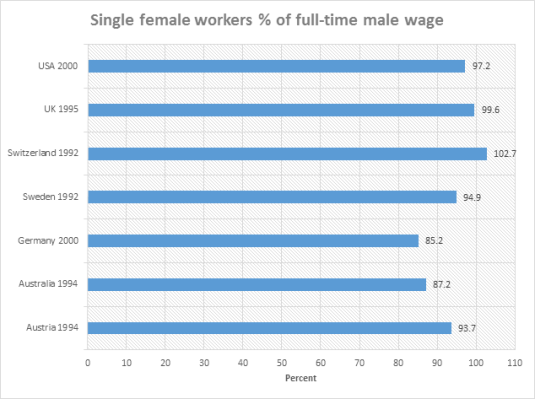
Source: IZA World of Labor – Equal pay legislation and the gender wage gap from the Luxembourg Income Study.
Discrimination cannot explain why the gender wage gap for single female is tiny relative to the family wage gap. As Solomon Polachek explains:
…the wage gap for married workers is between three and 30 times greater compared with single workers.
Employers cannot be to blame for the large difference between the single female worker gender wage gap and the family wage gap.
Aside from explaining why employers only discriminate against married women, you must explain how employers managed to find out which female applicants are married so they can discriminate against them.
Without that vital information on the marital status of female applicants and the presence and number of children as well is their spacing, the vast male chauvinistic conspiracy responsible for the glass ceiling and the sticky floors against promotion does not get off the ground.
How do employers actually pay married women less? Advertising jobs that pay women less has been unlawful for decades. Yet another hurdle to overcome for the vast male chauvinistic conspiracy.
Women move between the large number of jobs as do men accumulating human capital as they go? Somehow employers, including female owned firms, must sabotage the accumulation of human capital by married women as soon as they have children but without paying them lessen in their current jobs or advertising jobs that pay married women less.
The main drivers of the gender wage gap are unknown to employers such as:
- whether the would-be female recruit or employee is married,
- whether their partner is present,
- how many children they have,
- how many of children are under 12, and
- how many years are there between the births of their children.
These are the main drivers of the gender wage gap – all of which are factors totally unknown to employers and of no relevance to them in making a profit.
Most explanations of the gender wage gap centre around human capital. In anticipation of time outside of the workforce for motherhood, women self-selecting to occupations that penalise career interruptions less.
Women invest in human capital that is more general, human capital that is more mobile between jobs and into spells of part-time work. Women anticipate home time after they have children so they invest in human capital that depreciations at a slower rate during career interruptions. Women also invest less overall in new capital because they expect to spend less time in the labour market.
All of these investments are made by women themselves in anticipation of motherboard rather than employers somehow paying them less after they marry and have children.
The solution to closing the family wage gap requires radical biological changes in who has children. There are more radical changes required than this because mothers actually like babies and enjoy spending time with them rather than going to work.
Equally challenging is the required changes in the dating market. There is an average age difference between boyfriends and girlfriends and husbands and wives of 2 to 3 years. As the husband or boyfriend is a few years older, he has usually accumulated more human capital and is more likely to be at a critical career point for promotion.

Because the husband or boyfriend is 2 to 3 years older, it pays off well in terms of the father investing more in market-related human capital and the mother devoting more time to childcare.
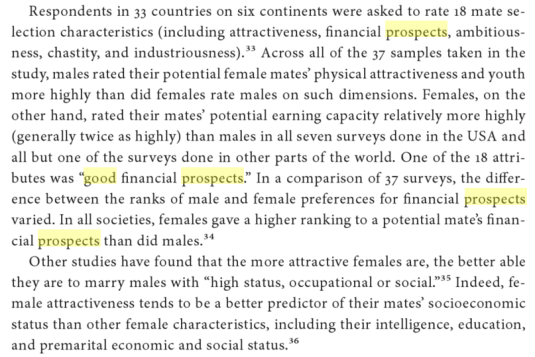
Another major driver of the gender pay gap is the dating market as identified by Richard McKenzie. He pointed out that evolutionary psychology has found that in every culture one of the factors of influencing pairing off in the dating market is that the boyfriend or husband must have good prospects although this preference is weakening over this last century.
One of the reasons for the increase in single parents is that low-paid men are not as inviting prospects as long-term boyfriends or husbands is a few generations ago. There are too few good men.
University educated couples are not called power couples for nothing – their earning power is this stunning compared to going it on your own. The emergence of power couples means that less educated women may prefer to stay single and raise children on their own rather than marry what is left in the marriage pool.
Because of the requirement among women across all cultures that husbands to be must have good prospects, men have an extra incentive to invest in human capital and work harder and longer hours because of the gender specific payoff in the marriage market.
Men will also take more risks than women because risky jobs carry wage premiums. That risk premium is topped up in the mating market terms are marriage prospects because of the higher wages. Women get a wage premium for taking risky jobs but less of a payoff in the mating market for the higher wages. There is an evolutionary psychology explanation for the family wage gap.

All in all, a key requirement for the closing of the family wage gap and what little is left of the gender wage gap is women drop their standards in terms of who they choose as boyfriends and husbands. Not very likely.

The Gender Gap: What the World Economic Forum got wrong
15 Jan 2016 Leave a comment
in discrimination, gender, human capital, labour economics, labour supply, occupational choice Tags: gender wage gap
Non-cognitive skills by socioeconomic quintile
13 Jan 2016 Leave a comment
in economics of education, human capital
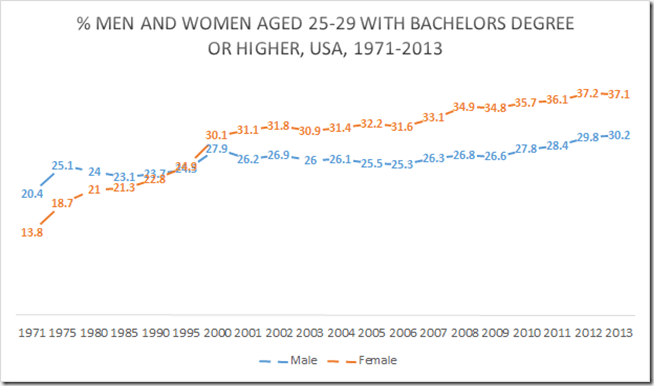
Percentage of American men and women aged 25 to 29 with bachelors degree or higher, 1971 – 2013
13 Jan 2016 1 Comment
in discrimination, economic history, economics of education, gender, human capital, labour economics Tags: College premium, education premium, graduate premium, reversing gender gap
The gender gap in higher education reversed in the year 2000
More on the reversing gender pay gap or men getting their comeuppances?
10 Jan 2016 Leave a comment
in discrimination, economic history, gender, human capital, labour economics, labour supply, occupational choice, politics - USA Tags: gender wage gap, middle class stagnation, reversing gender gap, wage stagnation
The rise of the Canadian working super-rich – composition of top 0.1% incomes since 1946
09 Jan 2016 Leave a comment
in applied welfare economics, economic history, human capital, labour economics, poverty and inequality Tags: Canada, superstars, superstore wages, top 0.1%, top incomes
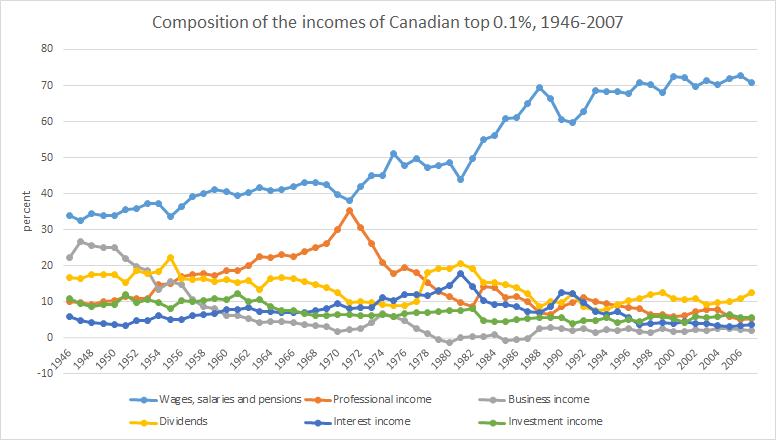
Source: The World Wealth and Income Database.
Did the rich get richer under Rogernomics? New Zealand top income shares since 1921
09 Jan 2016 Leave a comment
in applied welfare economics, economic history, human capital, labour economics, politics - New Zealand, poverty and inequality Tags: Leftover Left, superstar wages, superstars, top incomes
Apart from a bump in the late 80s, the top income earners in New Zealand really are not doing much better than they were in the 1950s or 1920s. The rich are not getting richer in New Zealand. They are just holding their own.
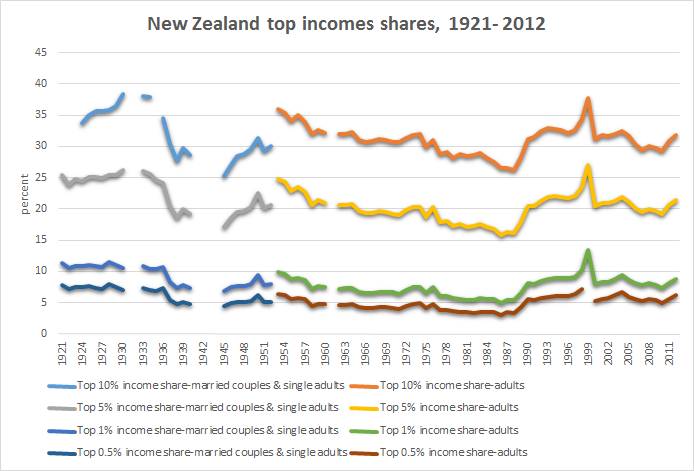
Source: The World Wealth and Income Database.
The rise of the Canadian working rich – composition of top 1% incomes since 1946
08 Jan 2016 Leave a comment
in applied welfare economics, economic history, human capital, labour economics, poverty and inequality Tags: Canada, superstar wages, superstars, top 1%, working rich
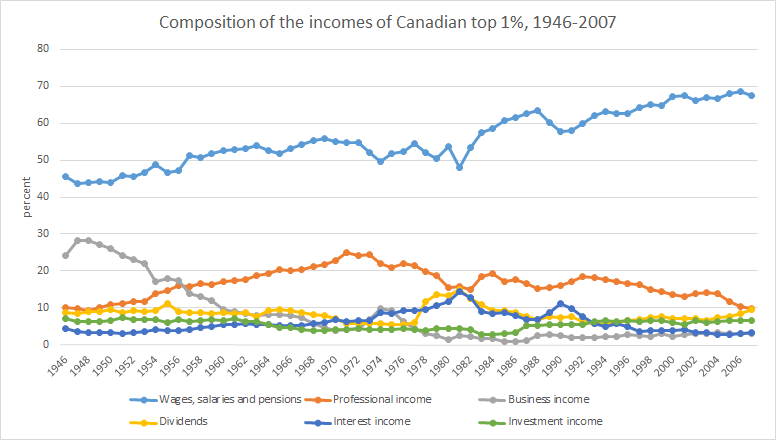
Source: The World Wealth and Income Database.
The rise of the working rich in Australia – top income compositions since 1954
08 Jan 2016 Leave a comment
in economic history, human capital, labour economics, politics - Australia, poverty and inequality Tags: Australia, superstar wages, superstars, top incomes, working rich
Over the course of the post-war period top incomes in Australia turned into top wage earners. It is unfortunate that information is not available on the extent to which business incomes make up the balance of top incomes as distinct from dividend incomes.
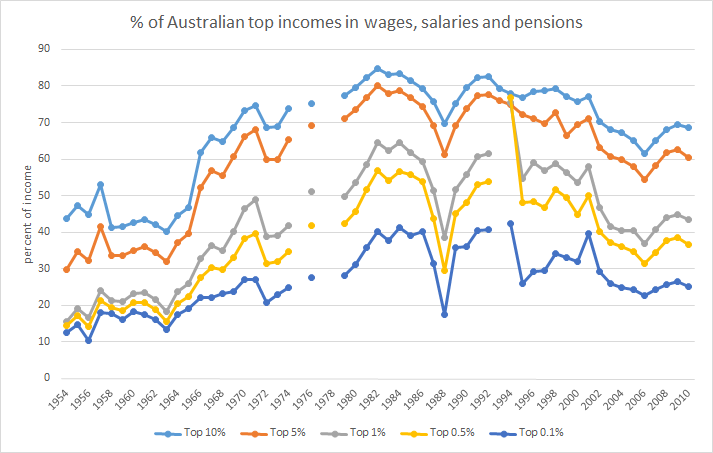
Source: The World Wealth and Income Database.
Loury and McWhorter tackle the racial mismatch hypothesis and Affirmative Action
23 Dec 2015 Leave a comment
in discrimination, economics of education, human capital, labour economics Tags: affirmative action, racial discrimination
Do they have academic tenure anymore?
23 Dec 2015 Leave a comment
in economics of education, human capital, labour economics, managerial economics, occupational choice, organisational economics, personnel economics Tags: academic tenure, compensating differentials, occupational choice
https://twitter.com/mileskimball/status/541219532032212993/photo/1
Academic Deadlines phdcomics.com/comics.php?f=1… http://t.co/tazByBNUzI—
Jorge Cham (@phdcomics) August 01, 2015
Time spent writing your thesis.
**Need a graduation gift? Visit phdcomics.com/store http://t.co/PJNbG3C7PY—
Jorge Cham (@phdcomics) May 01, 2015


Recent Comments