Questions for @grantrobertson1 on the #UBI @JordNZ
30 Mar 2016 1 Comment
in labour economics, labour supply, politics - New Zealand, poverty and inequality, welfare reform Tags: flat rate tax, New Zealand Labour Party, top tax rate, universal basic income
Labor Party finance spokesman Grant Robertson yesterday ruled out an income rate tax of 50% to fund a Universal Basic Income. Labour is considering a Universal Basic Income. It released a background paper for that purpose as part of its Future of Work Commission.

Source: Taxpayers’ Union rubbishes Universal Basic Income idea | Stuff.co.nz.
Questions arise as to how the Labour Party will fund its Universal Basic Income after ruling out a tax rate of 50%. As Brain Easton said:
Many advocates put the UMI forward without doing the sums. Those who do find that the required tax rates are horrendous or the minimum income is so low that it is not a viable means of eliminating poverty. Among the latter are New Zealanders Douglas, Gareth Morgan and Keith Rankin.
The Labour Party’s background paper already has said that the Universal Basic Income proposed by the Morgan Foundation is insufficient because many beneficiaries and all retirees will be much worse off. They receive much more in income support under the existing welfare state and they would under a Universal Basic Income of $11,000 per adult as proposed by the Morgan Foundation.
The solution proposed by the Labour Party is a supplemental income transfers to ensure no one is worse under a Universal Basic Income. This will greatly increase the cost of a Universal Basic income in comparison to the Morgan Foundation proposals.
https://twitter.com/grantrobertson1/status/711758860659240960
A series of questions come to mind that the Labour Party and its finance spokesman Grant Robinson must answer if they are to go anywhere with a Universal Basic Income;
- Is not the point of a Universal Basic Income to replace the welfare state, not supplement it?
- How will the Labour Party fund its Universal Basic Income plus the supplemental income transfers without introducing a $8 billion tax on capital income (including the family home) as in the Morgan Foundation’s proposals?
- The Universal Basic Income proposed by the Morgan Foundation requires $13 billion in extra taxes ($8 billion from taxing capital and $5 billion from a 30% flat-rate income tax) so how much more to that will Labour need for a Universal Basic Income plus supplemental income transfers?
- What is the maximum top marginal income tax rate that Labour will consider to fund a Universal Basic Income?
- Will the Labour Party’s Universal Basic Income be funded by a flat rate income tax or a progressive income tax system?

Source: How we pay for a universal basic income – Whiteboard Wednesday.It would have been my first point
@garethmorgannz’s #UBI finishes the job on #GenerationRent @JordNZ
29 Mar 2016 Leave a comment
in fiscal policy, labour economics, labour supply, macroeconomics, politics - New Zealand, population economics, poverty and inequality Tags: Edward Prescott, New Zealand superannuation, old age pensions, social insurance, timing inconsistency, universal basic income, welfare state
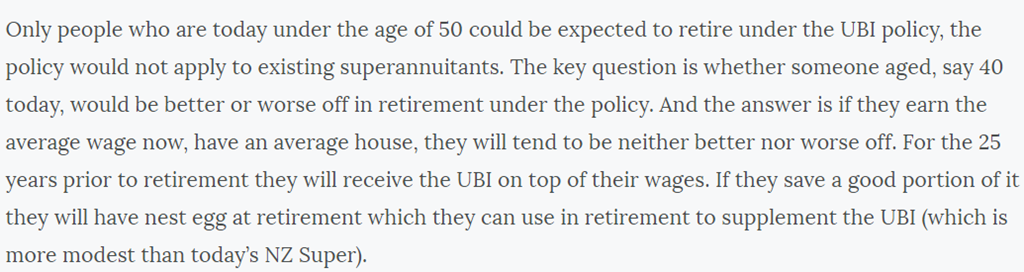
Gareth Morgan revealed today a hitherto unnoticed design feature in his Universal Basic Income of $11,000 per annum. It will be phased in over a long time. That will mean that Generation Rent will continue to pay taxes to fund a universal old age pension for their parents and grandparents, but will not be fortunate enough to receive that themselves.
Source: Morgan Foundation (2016) Taxpayers Union Critique of the UBI just bonkers – again
They are not left of their own devices. Generation Rent is expected to save the Universal Basic Income they receive over their working lives to avoid living in poverty in their retirement. Does not strike me as a political winner.
The Morgan Foundation does not understand the implications of time inconsistency for retirement savings policy:
- Which is better? Save for your retirement through the share market or save to own your own home and then present yourself at the local social security office to collect your taxpayer funded old-age pension?
- Under this fine game of bluff, you bleed the taxpayer in your old age and pass on your debt-free home to your children.
This strategy of not saving much for retirement is rational for the less well-paid. The family home is exempt from income and asset testing for social security. If you lose you bet, sell your house and live off the capital. For ordinary workers, this is a good bet. The middle class might prefer to live in a more luxurious retirement.
For ordinary workers, whose wages are not a lot more than their old age pension from the government, a government funded pension is a good political gamble. The old-age pension for a couple in New Zealand is set at no less that 60% of average earnings.
Edward Prescott argues for compulsory retirement savings account albeit with important twists because it is otherwise irrational for many to save for their retirement against the background of a welfare state:
The reason we need to have mandatory retirement accounts is not because people are irrational, but precisely because they are perfectly rational — they know exactly what they are doing.
If, for example, somebody knows that they will be cared for in old age — even if they don’t save a nickel — then what is their incentive to save that nickel? Wouldn’t it be rational to spend that nickel instead?
…Without mandatory savings accounts we will not solve the time-inconsistency problem of people under-saving and becoming a welfare burden on their families and on the taxpayers. That’s exactly where we are now.

The gender pay gap, adjusted and unadjusted, USA, UK, Australia, Germany and France
26 Mar 2016 Leave a comment
in discrimination, econometerics, gender, human capital, labour economics, labour supply, occupational choice Tags: gender wage gap
https://twitter.com/adchamberlain/status/712647716229111808
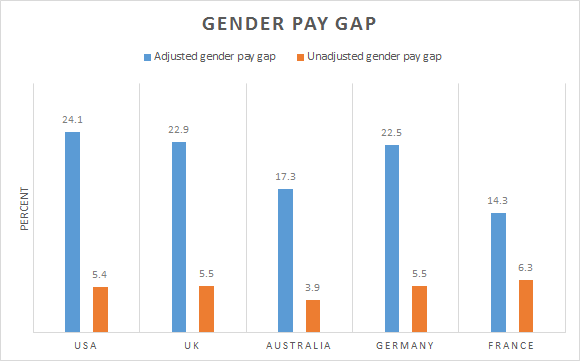
Source: Demystifying the Gender Pay Gap: Evidence from Glassdoor Salary Data – Glassdoor Economic Research via Wednesday evening links – AEI | Carpe Diem Blog » AEIdeas.
https://twitter.com/adchamberlain/status/713097526878953472
.
Do musicians ever make any money from recording music?
24 Mar 2016 Leave a comment
in economics of media and culture, labour economics, labour supply, Music, occupational choice

Just exactly how big is @grantrobertson1’s great big new tax?
20 Mar 2016 1 Comment
in labour economics, labour supply, politics - USA, poverty and inequality, welfare reform Tags: Director's Law, universal basic income
https://twitter.com/grantrobertson1/status/711303279284629505
Gareth Morgan’s universal basic income, by his own calculations, make well-to-do people better off and the poor and old age pensioners worse off at the cost of $12 billion tax rise. The Labour Party has now adopted this policy as worth considering.

Source: Gareth Morgan Presentation Slide 20 of 27 | Big Kahuna Book.
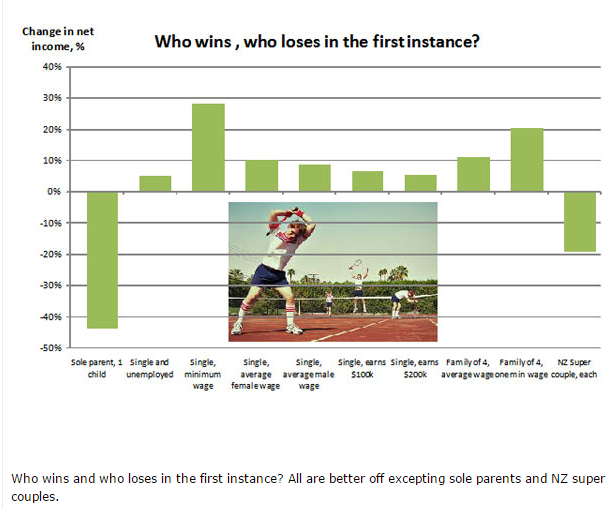
Source: Gareth Morgan Presentation Slide 20 of 27 | Big Kahuna Book.
Usual hours worked per New Zealand working week
20 Mar 2016 Leave a comment
in entrepreneurship, labour economics, labour supply Tags: hours worked, inherent inequality of bargaining power, self-employed, small business
45% of New Zealand employers work at least 50 hours per week and 25% of the work at least 60 hours per week. Less than 15% of permanent employees work similar hours. Who is exploiting whom in the inherent inequality of bargaining power between employers and workers?
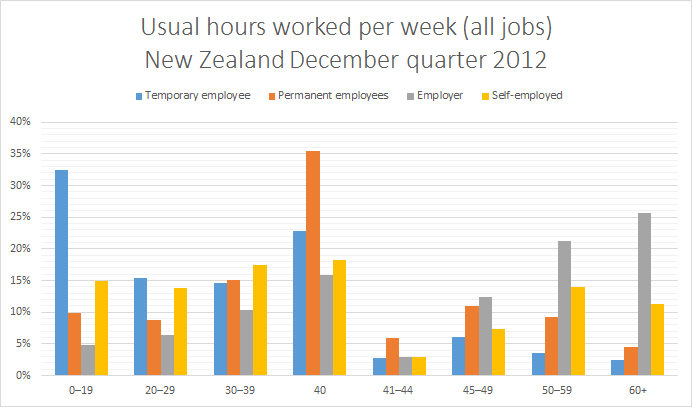
Source: Statistics New Zealand Survey of Working Life: December 2012 quarter.
The self-employed in the above chart employ no one else. Self-employed who also hire others are included in employers. In consequence, many of the self-employed are contractors rather than small business owners.
Unadjusted US gender wage gap at the 10th, 50th and 90th percentiles in 1980, 1989, 1998 and 2010
19 Mar 2016 Leave a comment
in discrimination, economic history, gender, human capital, labour economics, labour supply, occupational choice Tags: compensating differentials, gender wage gap
Much ducking and diving is required to explain why the women with most options in life have the largest gender wage gap.
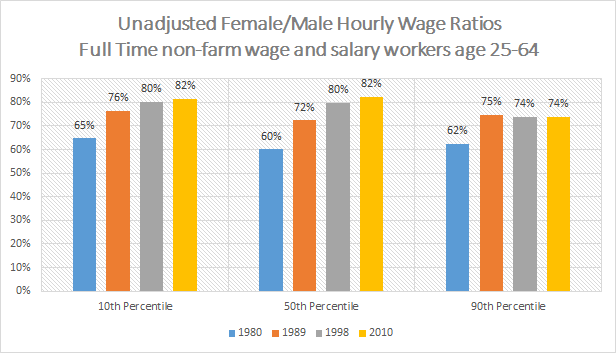
Source: The Gender Wage Gap: Extent, Trends, and Explanations by Francine D. Blau, Lawrence M. Kahn :: SSRN via Panel Study of Income Dynamic (PSID).
How is the gender pay gap going in the USA since 1980, adjusted and unadjusted?
19 Mar 2016 Leave a comment
in discrimination, gender, human capital, labour economics, labour supply, occupational choice, politics - USA Tags: compensating differentials, gender wage gap
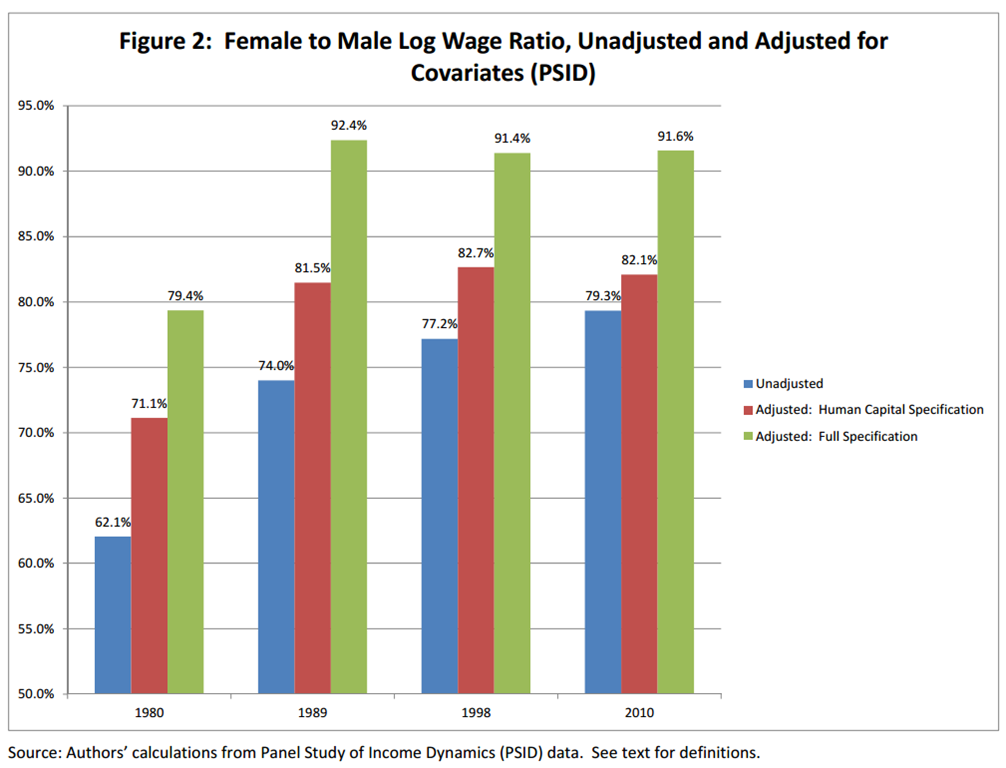
Source: The Gender Wage Gap: Extent, Trends, and Explanations by Francine D. Blau, Lawrence M. Kahn :: SSRN
Pizza and Conversation with James Heckman
19 Mar 2016 Leave a comment
in applied price theory, applied welfare economics, economics, economics of education, human capital, labour economics, labour supply, poverty and inequality Tags: James Heckman

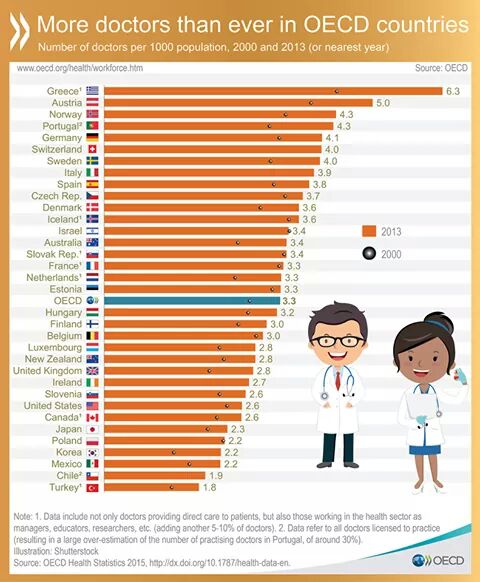
 Utopia, you are standing in it!
Recent Comments