Is welfare dependence optimal for whom – part 4: In-work tax credits and labour supply

In-work tax credits were introduced in many countries including New Zealand to encourage movement into employment by breadwinners. By linking a large payment with full-time and semi-full-time work, the rewards for working are increased for single parents and families. These in work tax credits combined child tax credit with an in work tax credit for the sole mother or couple.

These in-work benefits can phase-in when a minimum income level is reach such as with the Earned Income Tax Credit (EITC) in the USA, or a paid in full when a minimum number of hours are worked. The Working for Families in-work tax credit in New Zealand and the UK family tax credit are two examples where there is a large cash payment with no phasing-in:

  • Working for Families in New Zealand is paid if 30 hours are worked by New Zealand families or 20 hours are worked by sole parents; and
  • The British family tax credit was paid if 16 hours are worked, initially 24 hours per week.

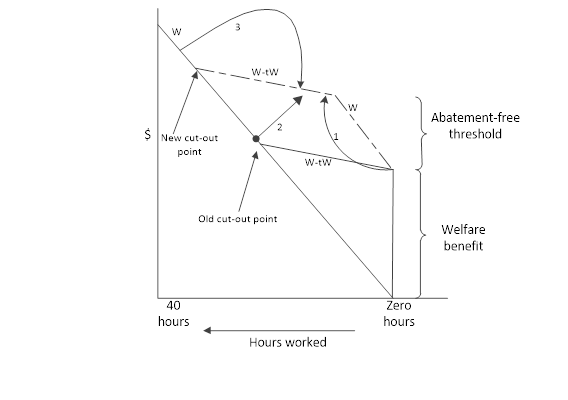
Figure 1 shows the impact of the introduction of an in-work tax credit paid in full to families and sole parents if a minimum number of hours per week are worked by a family or sole parent. There is no phase-in region such as with the earned income tax credit (EITC) in the USA.

Figure 1: In work tax credits and labour supply

in-work tax credits and labour supply

The in-work tax credit phases-out after once the family’s income increases past an income threshold. This income threshold is usually linked to the number of children as well.

An in-work family tax credit linked to a high number of minimum number of hours worked provides an incentive for those not in work to increase their hours worked by a large amount and leave welfare, as is shown by arrow 1 in Figure 1.

For those already work, the income and substitution effect cut against each other and their net effect depend on the number of hours currently worked.

  • Those working a low number of hours, hours less per week than the minimum to qualify for the in-work tax-credit have an incentive to increase their hours to the minimum to qualify and leave welfare is shown by arrow 2 in Figure 1.
  • Arrows 3 and 4 in Figure 1 both represent reduction in hours worked.
  • Some workers can take-home more pay and work fewer hours per week or per year as shown by arrow 3.
  • Other high working hours worker can enjoy more leisure time at the expense of a slightly reduced take-home pay as shown by arrow 4.

The net labour supply effects of an in-work tax credit are therefore ambiguous because of these multiplicity of labour supply effects with some people working more another’s work in letters.

There will also be a bunching of hours worked at around the eligibility point for paying the in-work tax credit. The eligibility point is usually grouped around working a minimum of three or four days per week part or full-time that sum to 30 hours for families and 20 hours for sole parents.

Workers working less that the weekly working hour minimums will increase to the minimum to qualify for the family tax credit. Workers working more than the minimum required to qualify for the family tax credit might cut back to the working hours minimum because of the superior labour leisure trade-off. The number of people on welfare will fall because workers leave part and full benefit dependence to qualify for the in-work tax credit.

Whether labour supply on net actually increases or decreases depends on the relative numbers of individuals at different points on the budget constraint working full-time, not working and working part-time and on the magnitudes of their responses. Some will stay as they are working full-time, not working and working part-time.

To summarise, the static labour–leisure trade-off model of labour supply suggests that increases in either benefit abatement thresholds or a reduction in benefit abatement rates will increase the numbers entering the benefit and see none leave. No one will leave.

A hours worked per week based in-work tax credit will move people who are not working and working a low number of hours to work and into a higher number of work hours respectively, with bunching around the eligibility point. An in-work tax credit will also cause some to cut back their hours so the net labour supply effect is ambiguous.

The net fiscal cost of an in-work tax credit depends on the phase-in and phased out particulars of the tax credit programme and the increase in paid employment and the number of taxpaying workers as a result of the in-work tax credit. The Working for Families tax credits in New Zealand and the United Kingdom are famous for clustering of labour supply around the eligibility point for the in work tax credit.

single mum graphic

For example, in the UK, a lot of people used to work exactly 24 hours week. When the eligibility point was reduced to 16 per week, a new word had to be invented. This new word was mini-jobs to describe the large number of part-time workers in the UK who cut-back to exactly 16 hours per week. The family tax credit for workers is twice as generous in the UK as in New Zealand.

The blogs so far

part-one-the-labour-leisure-trade-off-and-the-rewards-for-working

part-two-the-labour-supply-effects-of-welfare-benefit-abatement-rate-changes

part-3-abatement-free-income-thresholds-and-labour-supply

part-4-in-work-tax-credits-and-labour-supply

part-5-higher-abatement-rates-and-labour-supply

part-6-mandatory-work-requirements-and-labour-supply

part-7-the-role-of-tagging-in-welfare-benefits-system

Claudia Goldin’s pollution theory of sex discrimination

Claudia Goldin argues that it is  difficult to rationalise sex segregation and wage discrimination on the basis of men’s taste for women in the same way as discrimination based on race or ethnicity. Goldin developed a pollution theory of discrimination in which new female hires may reduce the prestige of a previously all-male occupation.

When work took more brawn than brain, the distributions of skills and natural talents of men and women were further apart. Women were not as physically strong as men. This counted for more both before the Industrial Revolution and at the height of the Industrial Revolution when most factory work involved a considerable amount of brawn.

As machines substituted for strength, as brain replaced brawn and as educational attainment increased, the distributions of attributes, skills and natural talents narrowed by sex.

Because there is asymmetric information regarding the value of the characteristic of an individual woman, a new female hire may reduce the prestige of a previously all-male occupation.

Prestige is conferred by some portion of society and is based on the level of a productivity-related characteristic (e.g., strength, skill, education, ability) that originally defines the minimum needed to enter a particular occupation. People had to have a minimum amount of the socially prestigious strength or skill before they are hired.

Male fire fighters or police officers, to take two examples, may perceive their occupational status to depend on the sex composition of their police station or firehouse. These occupations are socially prestigious because of the strength and courage of police and fire-fighters. Men in an all-male occupation might be hostile to allowing a woman to enter their occupation even if the woman meets the qualifications for entry.

A reason for this hostility of the existing male members of the occupation is the rest of society may be slow to learn of the qualifications of these female newcomers. Their entry against this background of ignorance in the wider society  may downgrade the occupation as still carrying prestigious characteristics such as physical strength. As Goldin explains:

Because they feel that the entry of women into their occupations would pollute their prestige or status in that occupation. Very simply, some external group is the arbiter of prestige and status.

Let’s take an example of firemen, and let’s say we begin not that long ago when there were no women who were firemen—which is why they’re called firemen.

And to become a fireman you have to take a test, lifting a very heavy hose and running up many flights of stairs. And every night, the firemen get off from work and go to the local bar.

Everyone slaps them on the back and says what great brawny guys they are and what a great occupation they are in, and everybody knows that to be a fireman requires certain brawny traits and lots of courage.

But nobody knows when there’s a technological shock to this occupation. And in this case it might be that fire hoses become really light or the local fire department changes the test. There are information asymmetries. But they do note that for this “brawny” characteristic, the median woman is much lower.

So if we observe a woman entering the occupation and we don’t know how to judge women, we’re going to assume that her skills are those of the median woman. Or it may be that we can observe something having to do with her muscles and that may up it a little bit.

But chances are we’re going to assume that some technological shock has happened to this occupation. And so her entry into the occupation is going to pollute it.

Then when they go to the bar, people will say, “oh you’ve got a woman in the firehouse; now fire fighting has become women’s work.” That’s where the pollution comes in.

Union rules also played a role in preventing the entry of women into some occupations

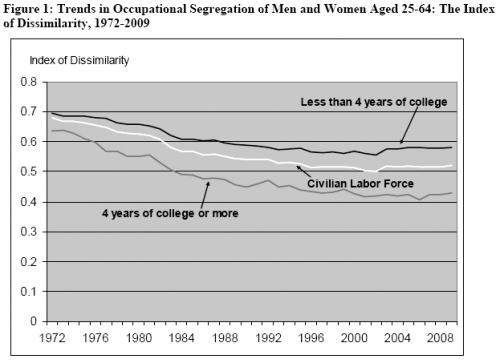
Many occupations have changed sex over time e.g., librarians, bank tellers, teachers, telephone operators, and sales positions. New occupations  and industries are less like to be segregated on the basis of sex  because they have not developed a social image regarding the prestige of workers.

Occupational segregation came to an end because credentialisation, which spreads information about individual women’s productivities and shatters old stereotypes, can help expunge this pollution of the prestige of specific occupations and jobs both within the industry and in wider society .

The visibility successful women today and in the past may help shatter old stereotypes and increase knowledge about the true distribution of female attributes in this prestigious occupation.

Goldin found that  when typists were primarily men, it was claimed that typing required physical stamina so woman need not apply.

But later, when the occupational sex segregation reversed, when typing became a female occupation, it was said that typing required a woman’s dexterity, which men did not have! When I was at school, only women were taught to type.

Bryan Caplan on the deserving and undeserving poor

Image

How to End the Gender Pay Gap Once and for All

Image

Trends in Income Inequality and its Impact on Economic Growth – OECD working paper (9 December 2014) – updated

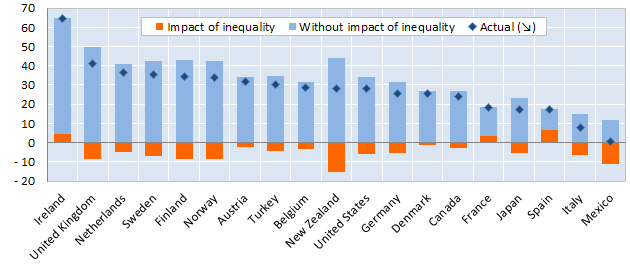
Figure 1: Estimated consequences of changes in inequality (1985 – 2005) on subsequent cumulative growth (1990-2010)

image

Drawing on harmonised data covering the OECD countries over the past 30 years, the econometric analysis suggests that income inequality has a negative and statistically significant impact on subsequent growth.

In particular, what matters most is the gap between low income households and the rest of the population.

In contrast, no evidence is found that those with high incomes pulling away from the rest of the population harms growth.

The paper also evaluates the “human capital accumulation theory” finding evidence for human capital as a channel through which inequality may affect growth.

Analysis based on micro data from the Adult Skills Survey (PIAAC) shows that increased income disparities depress skills development among individuals with poorer parental education background, both in terms of the quantity of education attained (e.g. years of schooling), and in terms of its quality (i.e. skill proficiency).

Educational outcomes of individuals from richer backgrounds, however, are not affected by inequality.

via Trends in Income Inequality and its Impact on Economic Growth – Papers – OECD iLibrary.

The OECD analysis published overnight in Paris suggest that the increase in equality in New Zealand the late 1980s is still scarring economic growth today by about 15 percentage points in lost cumulative economic growth.

The analysis of the OECD  published overnight depends crucially upon how greater inequality reduces the ability of the lower income families to invest in human capital:

The evidence strongly suggests that high inequality hinders the ability of individuals from low economic background to invest in their human capital, both in terms of the level of education but even more importantly in terms of the quality of education.

The OECD theory of inequality and lower growth is there is a financing constraint because of inequality that reduces economic growth because of less human capital accumulation by lower income families.

This is interesting because in 2002, with Pedro Carneiro, James Heckman showed that lack of credit is not a major constraint on the ability of young Americans to attend college. They found that credit constraints prevent, at most, 4% of the U.S. population from attending. Credit constraints is weakening as a rationale for a lack of an accumulation of human capital, and can be easily solved.

The OECD is putting a lot of their growth inequality nexus eggs in one basket. That student loans and other government interventions are not closing credit constraints on financing higher education.

To add to that basket , they are placing a lot of weight in human capital as a driver of growth, and in New Zealand’s case,  of technology absorption, which is a main foundation of economic growth in New Zealand. The evidence that human capital is a key contributor  to higher economic growth is weakening ruck rather than strengthening.

The trend rate of productivity growth did not accelerate over the 20th century despite a massive rise in investments in human capital and R&D because of the rising cost of discovering and adapting new technological knowledge. The number of both R&D workers and highly educated workers increased many-fold over the 20th century in New Zealand and other OECD member countries including the global industrial leaders such as the USA, Japan and major EU member states.

Higher education has been free for the low income families for several generations. Student loans are readily available. It is hard to believe that such a readily solvable problem is a major source of inequality and lower growth.

Cross-country differences in total factor productivity are due to differences in the technologies that are actually used by a country and the degree in the efficiency with which these technologies are used. Differences in total factor productivity, rather than differences in the amount of human capital or physical capital per worker explain the majority of cross-country differences in per capita real incomes (Lucas 1990; Caselli 2005; Prescott 1998; Hall and Jones 1999; Jones and Romer 2010).

Differences in the skills of the individual worker or in the total stock of human capital of all workers in a country cannot explain  cross national differences in value added per worker at the industry level.

  • The USA competes with Japan for productivity leadership in many manufacturing industries.
  • The Japanese services sector productivity can be as little as a one-third of that of the USA.
  • Japanese labour productivity is almost twice Germany’s in producing automobiles and is better that Germany by a large margin for many other manufactured goods.
  • The USA is uniformly more productive in services sector labour productivity. For example, British, French and German telecom workers were 38 to 56 per cent as productive as their American counter-parts.

The USA, Japan, France, the UK and Germany all have relatively well-educated, experienced and tested labour forces. For example, the 1993 McKinsey’s study inquired into the education and skills levels of Japanese and German steel workers. Comparably skilled German steel workers were half as productive as their Japanese counterparts (Prescott and Parente 2000, 2005).

As for the source of the growing income inequality, there is a long literature dating back 25-years arguing that skill-biased technological change is increasing the returns to investing in education

Important is the OECD conclusion that inequality in terms of the rich getting richer does not harm growth. To make sure I have not misquoted them , I quote once again from their abstract, where the OECD summarises its own findings:

Drawing on harmonised data covering the OECD countries over the past 30 years, the econometric analysis suggests that income inequality has a negative and statistically significant impact on subsequent growth.

In particular, what matters most is the gap between low income households and the rest of the population.

In contrast, no evidence is found that those with high incomes pulling away from the rest of the population harms growth.

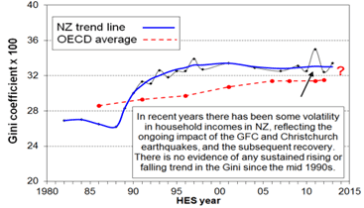
That  conclusion of the OECD  almost saves me from having to go on about how inequality has not increased in New Zealand for the last 20 years, see figure 2, and that the top 1% have not increased their share of income in recent decades  – see figure 3. The fact that the rich can get richer without harming the poor is an important conclusion that will surely not be reported by the media.

Figure 2: Gini coefficient New Zealand 1980-2015

Figure 3: Top 1% income shares, USA, New Zealand and Australia, 1970-2012

Another inconvenience for the OECD is the last major increase in Gini coefficient in New Zealand was followed by a 15 year economic firm – see figures 2 and 4.

Figure 4: Real GDP per New Zealander and Australian aged 15-64, converted to 2013 price level with updated 2005 EKS purchasing power parities, 1956-2013

The NZ top 1% share has been steady at 8-9% since the mid-1990s  see figure 4; the top 1%’s share rose strongly in the USA in recent decades, from 13% in the mid-1980s to 19% in 2012.

The Occupy crowd blame everything from the global financial crisis to a bad environment on growing inequality and the growing riches of living top 1%. Such an argument has no foundation in fact in New Zealand. The last major increase in Inequality was a long time ago in New Zealand.

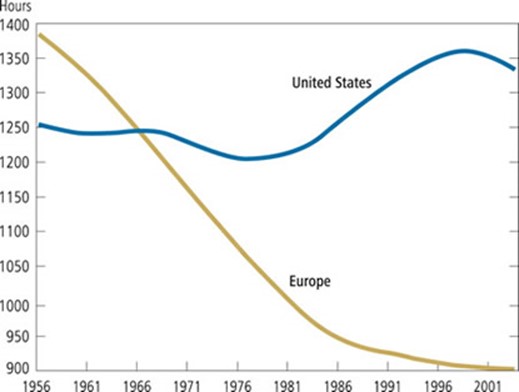
The OECD is also rather casual about how policies to redistribute wealth and increasing incomes. While Western Europe is diverse, as a group, the higher taxes  in the European Union reduced incentives to work. Employment as a percentage of the population has been consistently lower in Western Europe than in the USA since the 1950s, with an average employment rate gap of 10 percentage points over 1980-2007.

Large increases in taxes on income from labour since the 1970s, enhanced incentives for retire early, and the interaction of generous employment insurance with the larger skill losses among workers displaced by the greater economic turbulence since 1980 all acted to reduce both real GDP and hours worked per week per working age person by up to a third in Western Europe as compared to the USA since the 1970s (Prescott 2004, 2007; Rogerson 2006, 2008; Ohanian et al. 2008; Ljungqvist and Sargent 1998, 2007, 2008). For example, Ohanian, Rao and Rogerson 2008 in “Work and taxes: allocation of time in OECD countries” found that:

  1. A steep decline in average hours worked per adult and large variations across OECD member countries in the magnitude of this decline.
  2. Changes in labour taxes accounted for a large share of the trend differences.
  3. Countries with high tax rates devote less time to market work, but more time to home activities, such as cooking and cleaning.
  4. This reallocation of time from market work to home work is much stronger for females than for males.

Europeans pay more taxes, work fewer hours per year, have longer vacations, retire sooner, and invest less in human capital in an era in which trends in technology have significantly increased the demand for skilled workers, more innovation, more intense competition and greater entrepreneurial alertness. In The Impact of Labor Taxes on Labor Supply: An International Perspective (AEI Press, 2010) Rogerson finds that:

• a 10 percentage point increase in the tax rate on labour leads to a 10 to 15 per cent decrease in hours of work.
• Even a 5 per cent decrease in hours worked would mean a decline in labour output equating to a serious recession.
• While recessions are temporary, permanent changes in government spending patterns have long-lasting repercussions.
• Although government spending provides citizens with important benefits, such benefits must be weighed against the disincentive effects of increased labour taxes.
• Policymakers who fail to account for the decrease in labour output risk expanding government programs beyond their optimal scale.

Robert Lucas estimated in 1990 that eliminating all taxes on income from capital would increase the U.S. capital stock by about 35% and consumption by 7%.

Hans Fehr, Sabine Jokisch, Ashwin Kambhampati, and Laurence J. Kotlikoff (2014) found that eliminating the corporate income tax completely would raise the U.S. capital stock (machines and buildings) by 23%, output by 8% and the real wages of unskilled and skilled workers each by 12%.

In summary, this one paper by the OECD, which is a working paper makes profound conclusions about taxation and economic growth that contradict a large literature based on the lack of statistical significance of coefficients in the OECD’s regressions.

More fundamentally, linking lower economic growth to inequality through credit constraints on the human capital accumulation of the lower middle class is a weak reed to hang its argument. Human capital is not a good explanation of variations in growth across time or between countries.

What happened to income inequality in New Zealand in the late 1980s is not a credible explanation for lower growth 30 years later. Lower economic growth because of greater inequality is certainly an easy problem to solve if all that is required is more action on the financing constraint on human capital accumulation.

Poverty and Behavior: Bryan Caplan

  • alcoholism: Alcohol costs money, interferes with your ability to work, and leads to expensive reckless behavior.
  • drug addiction: Like alcohol, but more expensive, and likely to eventually lead to legal troubles you’re too poor to buy your way out of.
  • single parenthood: Raising a child takes a lot of effort and a lot of money.  One poor person rarely has enough resources to comfortably provide this combination of effort and money.
  • unprotected sex: Unprotected sex quickly leads to single parenthood.  See above.
  • dropping out of high school: High school drop-outs earn much lower wages than graduates.  Kids from rich families may be able to afford this sacrifice, but kids from poor families can’t.
  • being single: Getting married lets couples avoid a lot of wasteful duplication of household expenses.  These savings may not mean much to the rich, but they make a huge difference for the poor.
  • non-remunerative crime: Drunk driving and bar fights don’t pay.  In fact, they have high expected medical and legal expenses.  The rich might be able to afford these costs.  The poor can’t.

Yet as Charles Murray keeps reminding us, all of the pathologies on my list are especially prevalent among the poor.

via Poverty and Behavior: Generalizing Yglesias, Bryan Caplan | EconLog | Library of Economics and Liberty.

The shape of the welfare state in the USA

For able-bodied adults, there is limited help in lean times.

One in five Americans on Medicaid; this image does not include those on Medicare –those over 65 who get their healthcare paid by the government.

Image


Is welfare dependence optimal for whom – part 3: abatement free income thresholds and labour supply

Another welfare reform is a modest income threshold below which benefits are not abated. This is low for unemployment and sickness beneficiaries and higher for domestic purposes and invalid beneficiaries.

The idea behind abatement-free income thresholds is to not penalise part-time work among sole mothers and encourage the unemployed and sick to return to full-time work.

The Figure 1 shows that an increase in the benefit abatement threshold has similar ambiguous net labour supply effects to a lowering of welfare benefit abatement rates.

Figure 1: Impact of abatement thresholds on labour supply

abatement free income threshold

  • Arrow 1 in figure 1 shows that some who were not currently working will now find working part-time a more attractive option because of the introduction of a benefit abatement-free threshold. Their take-home pay is higher although they enjoy less leisure time.
  • Arrow 2 in figure 1 shows that some part-time workers will reduce their working hours because working less and claiming the benefit clearly increases both their take-home pay and allow for more leisure time.
  • Arrow 3 in figure 1 shows that workers who work a relative high number of hours per week for a relative low wage will reduce from full-time to part-time working hours because of a revised leisure-labour trade off now makes a somewhat lower take-home pay worthwhile because of increased leisure time.
  • No welfare recipients leave the welfare system but some join it because of the introduction or increase in the abatement-free income threshold.

The net labour supply effects of a higher benefit abatement-free threshold are ambiguous because the reduced hours of those already in work offsets the labour force participation of those previously not in work.

Whether net labour supply increases or decreases depends on the relative numbers of individuals at different points on the budget constraint working full-time, not working and working part-time and on the magnitudes of their responses. Some will stay as they were either working full-time, not working or working part-time.

The objective of reducing welfare dependency by encouraging part-time work by those not working has important unintended adverse consequences for the labour supply and welfare dependency of those currently working part-time and full-time on low wages.

A common result of welfare reforms that increase abatement thresholds or reduce abatement rates is that no welfare recipients leave the welfare system but some join it. Welfare dependency is not reduced by financial incentives that increase the generosity and the availability of welfare benefits.

The labour supply effects of welfare reforms that increase benefit abatement thresholds or reduce benefit abatement rates are ambiguous because the reduced working hours of existing workers offsets the hours worked by those not employed prior to the reform. A further complexity is that encouraging part-time work channels beneficiaries into low paid jobs that offer little training and other human capital benefits.

In summary, an increase in the benefit abatement-free income thresholds for welfare recipients has the following effects:

  • not all welfare recipients will respond to a higher abatement-free income threshold by supplying more labour;
  • those welfare recipients who do respond to a higher abatement-free income are better-off and supply more labour and take-home more pay;
  • the increase in labour supply is in part-time work by beneficiaries earning income up to the higher abatement-free income threshold;
  • No welfare recipient leaves the welfare system – those welfare recipients who respond to this welfare reform continue to collect their full welfare benefit and work a few more hours each week.

While reforming the welfare system is intended to change the labour market behaviour of welfare recipients, it also has unintended consequences on individuals who are not collecting welfare benefits.

An increase in the exemption level for earned income affects the labour market behaviour of someone who is not receiving welfare benefits has the following effects:

  • prior to the increase in the abatement-free threshold, the individual is best off by working part-time or full-time and not collecting welfare or even being eligible to collect welfare benefits; and
  • after an increase in the benefit abatement-free income threshold, a worker is better-off by supplying less labour and collecting a full welfare benefit, which raises their total income.

Permitting welfare recipients to keep larger amounts of income without losing any of their welfare benefits will attract more workers into the welfare system. Some workers will find that they are better-off by joining the welfare system and switch from full-time work to being a welfare recipient who works part-time (up to the new higher exemption level). The cost of the welfare programme increases, there are more welfare recipients, and no welfare recipient loses any benefits.

All welfare recipients who increase their labour supply up to the new higher exemption level (and lower abatement rates) and all workers who switch to the welfare system will be better-off.

The effect of the quantity of labour supplied is ambiguous: some old welfare recipients will increase their labour supply up to the new higher abatement-free threshold (probably by a relatively small amount) but new welfare recipients will decrease their labour supply (probably by a relatively large amount) as they move from full-time work to part-time work on welfare.

The overall effect of changes in benefit abatement regimes depends on the number of old and new welfare recipients and the size of the labour supply change for each.

  • The quality of labour supplied will deteriorate as some full-time workers switch to welfare and work part-time; part-time workers generally have less attachment to the labour force and tend to invest less in human capital to up-grade their labour market skills.
  • High-productivity workers are working fewer hours while lower-productivity workers work more hours.

If the objective is to reduce the number of people on welfare by moving some welfare recipients (those who are able to work) into work, increasing abatement free income thresholds or lowering abatement rates are not the solution. Both options increase the number of people on welfare.

A reduction in the amount of welfare benefits will reduce the number of people on welfare, reduce the cost of the welfare programme, increase the supply of labour, increase the number of full-time workers relative to part-time workers but make all current welfare recipients worse-off and risks providing inadequate income support to those who are unemployable.

The blogs so far

part-one-the-labour-leisure-trade-off-and-the-rewards-for-working

part-two-the-labour-supply-effects-of-welfare-benefit-abatement-rate-changes

part-3-abatement-free-income-thresholds-and-labour-supply

part-4-in-work-tax-credits-and-labour-supply

part-5-higher-abatement-rates-and-labour-supply

part-6-mandatory-work-requirements-and-labour-supply

part-7-the-role-of-tagging-in-welfare-benefits-system

Some economics of zero hours contracts – part 4: team production as a constraint on working time flexibility

To continue with my theme in my previous three blogs that zero hours contracts aren’t supposed to exist, a leading explanation for the hesitancy of employers to agree to part-time hours is team production (Hutchens and Grace-Martin 2004, 2006; Hutchens 2010).

Employers may want their employees to work a minimum number of working hours because of rigid production technologies and/or team production. Production technologies vary in the rigidity they impose on the hours worked by employees.

The co-ordination of working times is paramount to effective team production. Once the work time schedule is fixed for team, the worker faces a choice between working at the fixed schedule or working in another team or job.

Two common examples of teams are an assembly line and a football team. Both require a minimum number of workers with rigid starting and finishing times. The absence of a team member could reduce team productivity or safety or even stop production entirely.

When the cost of absence is higher such as for team production, there are more efforts to reduce absences. When a single employee absence is costly to employers, employers take steps to ensure that a minimum number of workers plus a reserve are present. There will be increased spending on monitoring, more cross-training, mutual monitoring by employees and the use of peer pressure. Multiple production lines reduce the risks of absence because spare staff can be hired to fill in across different teams.

Other workers can produce independently of their co-workers. One example is a member of a typing pool. The contribution of each typist depends on their efforts alone. The increment they add to production does not vary with the presence or absence of others, nor is the productivity of others affected by their output. If there is little teamwork, the absence of a worker does not affect other workers.

The Department of Labour (2009) found that about 60 per cent of New Zealand full-time employees did not have flexible hours.

A leading reason for employers hiring part-time workers is to solve scheduling problems that arise when hours of operation and peak periods of daily or weekly production do not easily divide into standard shift lengths.

For example, within the day and within the week variation in customer demand explains the heavy use of part-timers in restaurants, retails stores and many services outlets. Not surprisingly, zero hours contracts arise in industries such as the food services sector where there is already a long history of part-time work.

Different production technologies require their own levels of coordination and supervision. This complicates the use of part-timers. Scheduling problems can arise of workers arrive at different times.

A mix of full and part-time employees could increase supervision costs. There can be repetitions of instructions and different capabilities to perform the same tasks.

Two part-timers could be productive if job is repetitive and does not require much co-ordination. Again, and not surprisingly, zero hours contracts occur in industries where the jobs appear to be relatively simple and the worker can pretty much work out what to do after a little bit of training with little supervision.

A managerial employee is less likely to be allowed to be part-time because they will be absent when employees need direction (Hutchens and Grace-Martin 2004, 2006. Managerial employees have scale effects. Higher level management decisions percolate through the rest of the organisation. The interaction of talent and scale ensures that the impact of any loss of efficiency from having part-time managers compound geometrically into the efforts and productivity of those they lead. Sharing a managerial job has costs because information must be exchanged and a common agenda agreed.

The economics of team production suggests that zero hours contracts will occur in teams with peaks and ebbs in customer demand, where workers are pretty much interchangeable alone can take over with little or no instructional briefing, and the level of task dependency between workers is small.

When extra workers on zero hours contracts are brought on to deal with the spike in demand, they take over the servicing of this demand. There is little need for them to interact with existing workers. For example, in a restaurant situation, they could deal with the extra tables filled by the spike in demand. In a McDonald’s restaurant, for example, they could just take over that the till that was otherwise not in use and serve the extra queues of customers.

To summarise, unless we have a good idea about why firms are moving to zero hours contracts, which we don’t, and why employees sign these contracts rather than work for other employers who offer more regular hours of work, meddling in these still novel arrangements is pretty risky.

Is welfare dependence optimal for whom – part 2: the labour supply effects of welfare benefit abatement rate changes

Figure 1 shows that the introduction of a welfare benefit has both income and substitution effects. The welfare benefit abates at rate t so the take-home pay of workers is less than the full wage until the benefit cut out point shown by the arrow in Figure 1. After this cut-out point, no benefits are payable and the work receives a full wage of w times the hours worked.

Figure 1: the labour supply effects of the introduction of a welfare benefit

clip_image002

The income effect increases the consumption of all goods including leisure. The substitution effect increases the attractiveness of not-working relative to work because prior to the cut-out point, take-home pay is less.

· Some workers will choose to not work at all as indicated by arrow 1 in figure 1 because this makes them better off. They have more leisure time and more income.

· Other workers working at a relative low wage will work less hours than before as indicated by arrow 2 in Figure 1 because of the revised rewards of working. Working fewer hours for slightly less is a better labour-leisure trade-off for them. They earn less, but have more leisure time.

Figure 1 illustrates several of the ambiguities of welfare reform. A welfare benefit induces some workers to work fewer hours and others to stop working altogether. In addition, the abatement rate of less than 100 per cent increases the region in which workers working full-time or semi-full-time might find working less hours attractive. Some workers move from full-time work to part-time work on lower income but with more leisure time.

If the benefit abatement rate was 100 per cent, there is a larger gap between working full-time and not working at all. This large take-home pay gap makes jumps from not working to full-time work much more rewarding.

Several jurisdictions increased benefit abatement rates to 100 per cent to make full-time work more rewarding and part-time work less rewarding. Higher benefit abatement rates on earned income of welfare beneficiaries may actually increase net labour supply because fewer workers enter the benefit, more leave for full-time jobs, but fewer work part-time.

These intended and unintended consequences of welfare reform for abatement rate reforms are illustrated further in Figure 2.

Figure 2: Benefit abatement rate reductions and labour supply

clip_image004

Benefit abatement rates are reduced in Figure 2, which increases the cut-out point at which workers cease to be eligible for any welfare benefits.

· Arrow 1 shows the decision of those currently not working to start working part-time, which is a common motive for and the desired outcome behind reduced benefit abatement rates. These beneficiaries are working but are taking-home a higher income. Their labour leisure trade-off now favours more work and less leisure.

· Arrow 2 shows those currently working part-time reducing their hours because this clearly increases both their take-home pay and their leisure time.

· Arrow 3 shows the full-time workers working at a relative low wage have an incentive to reduce to part-time because this is a better labour-leisure trade-off for them. Their take-home pay is less, but they enjoy more leisure time.

The net labour supply effects of lower abatement rates are ambiguous because the reduced hours of those who are already in work offsets the labour force participation of those previously not working.

A key point to remember from this reduction in welfare abatement rates is no welfare recipients leaves the welfare system but some join the welfare rolls because of the reduction in the benefit abatement rate.

Whether labour supply on net actually increases or decreases depends on the relative numbers of individuals at different points on the budget constraint working full-time, not working and working part-time and on the magnitudes of their responses.

Some will stay as they are working full-time, not working and working part-time. Others will reduce their hours of work. The dictates of team production and co-ordinated working times may prevent this happening immediately. At the next job changes, those currently working full and part-time can take full advantage of lower benefits abatement rates as shown in Figure 2.

The objective of reducing welfare dependency and poverty by encouraging part-time work with lower benefit abatement rates has unintended consequences.

People focus on those who start working part-time as a conduit to eventual full-time work and self-sufficiency if welfare abatement rates are lowered to make part-time work more attractive.

What is forgotten is those who are currently working full-time, or part-time, who because of the increase in income from part-time work plus continued for partial benefit receipt find that part-time welfare dependency is optimal for them. They drop out of full-time work.

An additional reason for this entry of new people onto the welfare rolls is that welfare benefits come with a range of second tier benefits. In addition to housing supplements to pay the rent, there are special grants that can be applied for to pay for unexpected expenses such as medical and dental work or damaged around the house.

As alluded to previously, one of the welfare reforms introduced in the United States in the early 1980s was to increase the welfare abatement rate on earned income to 100% from 67% which it applied since the 1960s. This increase in welfare benefit abatement rates to 100% on earned income increased the gap between welfare dependency and working full time. The idea was to make full-time work a more attractive option relative to welfare benefit receipt.

The blogs so far

part-one-the-labour-leisure-trade-off-and-the-rewards-for-working

part-two-the-labour-supply-effects-of-welfare-benefit-abatement-rate-changes

part-3-abatement-free-income-thresholds-and-labour-supply

part-4-in-work-tax-credits-and-labour-supply

part-5-higher-abatement-rates-and-labour-supply

part-6-mandatory-work-requirements-and-labour-supply

part-7-the-role-of-tagging-in-welfare-benefits-system

Is welfare dependence optimal for whom – part 1? The labour-leisure trade-off and the rewards for working

The higher is the welfare benefit, the greater the probability that an individual will choose to go on welfare rather than work. Welfare dependency is the most rewarding leisure-labour trade-off for them.

The higher the wage on offer to a given worker in the labour market, the greater is the probability that they will choose to work rather than go on welfare. Working is the most rewarding leisure-labour trade-off for them.

Both the income and substitution effects of welfare benefits provide a disincentive to work. Higher income levels from generous welfare benefits induce higher consumption of all normal goods, including leisure. Income taxes and a high benefit abatement rate provides little incentive to work (the substitution effect) for lower paid workers and some second earners.

When confronted with the choice of a low-paying job and a generous welfare benefit, some will choose welfare over work. These workers are responding rationally to the (dis)incentives embedded in the labour market and welfare system. For them, welfare dependency is optimal.

This is particularly true for single parents with low labour market skills. One or more children may generate more net income (from increased welfare benefits) than working in the labour market and paying child care. If there is no expiry date for these welfare benefits, some individuals who go on welfare will stay on welfare for a long period of time.

Of course, the economics of crime comes up. A condition of receipt of welfare benefits in just about every welfare state is healthy adults must make themselves available for work and actively look for work.

Most of the essentials of the impact of welfare reform on labour-leisure trade-offs are captured, and most policy dilemmas are clearly defined within the framework in Figure 1. Figure 1 illustrates the position of two workers regarding whether to work (the participation decision) and how many hours to work.

Figure 1: The basic leisure-labour trade-off

The hourly wage rate represented by the symbol W in Figure 1 is traded-off against working fewer or no hours. This additional of leisure time includes: pure leisure; household production such as child care, cooking and cleaning; education and other human capital investments; and personal time such as self-care and sleep.

  • Worker 1 in Figure 1 works 40 hours while worker 2 with different circumstances works part-time in Figure 1.
  • Worker 1 could be a male with no dependents so not working full-time has a relatively high opportunity cost even if low paid.
  • Women who higher qualifications are also more likely to be persistent workers alternating between full-time career and part-time work when there are child care responsibilities.
  • Worker 2 in Figure 1 could be a sole parent or a second earner in a married couple with young children. For these workers, working can have a high opportunity cost because of the cost of child care, especially if the sole parent or second earner is low paid.
  • For workers with a high opportunity cost of work and low wages from working, for them, welfare dependents can be quite optimal.
  • Not so for society because the welfare benefits conditional on people making themselves available for work and taking steps to find it and stay in work.

The next few blogs will explain how various welfare reforms change the labour leisure trade-off for welfare recipients. There are three main parameters in any welfare system:

  1. the amount of the welfare benefit,
  2. the threshold for the benefit abatement on earned income, and
  3. the benefit reduction rate for income exceeding the abetement-free threshold.

This is not to ignore work testing and work requirements, these complications are postponed to later blogs. All of these parameters and the implications of changing them on labour supply will be discussed in future blogs.

The blogs so far

is-welfare-dependants-optimal-for-whom-part-one-the-labour-leisure-trade-off-and-the-rewards-for-working

is-welfare-dependence-optimal-for-whom-part-two-the-labour-supply-effects-of-welfare-benefit-abatement-rate-changes

is-welfare-dependency-optimal-for-whom-part-3-abatement-free-income-thresholds-and-labour-supply

is-welfare-dependents-optimal-for-the-whom-part-4-in-work-tax-credits-and-labour-supply

is-welfare-dependence-optimal-for-whom-part-5-higher-abatement-rates-and-labour-supply

is-welfare-dependence-optimal-for-whom-part-6-mandatory-work-requirements-and-labour-supply

is-welfare-dependence-optimal-for-whom-part-7-the-role-of-tagging-in-welfare-benefits-system

Claudia Goldin and the power of the pill

Claudia Goldin has documented well that the availability of reliable contraception in the late 1960s led to an explosion in female investment in higher education, and in particular, long duration professional educations.

Although rapidly disseminated among married women once it came on the market in 1960, the pill at first was almost inaccessible to single females, due to the prevailing state laws on prescriptions of drugs.

Liberalisation of availability for single females was on a state-by-state basis and was staggered over a few years. This allowed Claudia Goldin to study what happened to investment in professional education by young women in each of those states as they reformed their laws on the dispensing of contraception to single females.

As contraception was made lawful for single women on a state-by-state basis in the USA in the late 60s and 1970s, young women started investing in long duration professional educations at an explosive rate. They stayed in high school the longer, more young women went on to college, and more of these college female students majored in long duration professional degrees.

In the 1960s, it was common to get engaged and even marry while at college in the USA. As Claudia Goldin, and her co-author Larry Katz explain:

It was a stark choice, you could be celibate, get your career started, and potentially face a very thin marriage market once you were done.

Or, you could have fun, get married earlier, and not necessarily have a career.

The availability of the pill allowed  college-age women to have certainty in their career investments and therefore the payoff of investing in professional educations was much greater.

Participation Rates Women

By decoupling sex for marriage, women could afford to defer marriage and shop around looking for better partners. Postponing marriage for at least a few years didn’t mean all the “good guys” would be taken. In addition, with higher career incomes for female college graduates, as Goldin explained:

You might think of it as the decline of the trophy wife, as women with careers who might not be as intrinsically good-looking became more highly valued than—or at least as equally valued as—women for whom appearance was a primary asset.

But as Goldin’s co-author Larry Katz explained:

Potential losers in this equation, in addition to trophy wives, are women with poor career prospects.

The clear winners are women with careers and, of course, the men they marry… Guys have more money, more sex, and less responsibility.

One side effect of the availability of contraception to better educated women was that young women with poor career prospects were also left with a pool of more unattractive men to marry.

Many of these young women who wanted to have  baby chose just to have the child, and perhaps marry the father later if the responsibilities of fatherhood turned him into marriage material.

This reversal in order of parenthood and marriage  among less well educated young women was one of the surprising social developments in the mid to late 20th century.

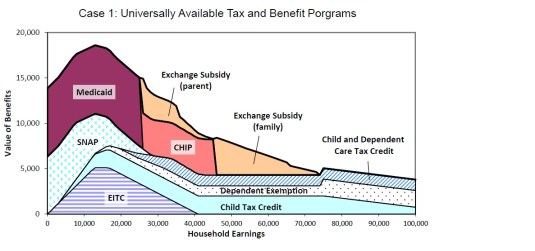
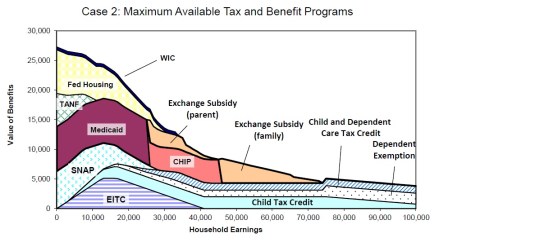
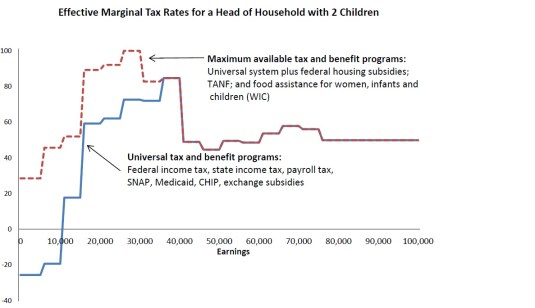
Explicit and implicit marginal tax rate increases in the past seventy years in the USA

CaseyMulligan

HT: After New Keynesian Macroeconomics

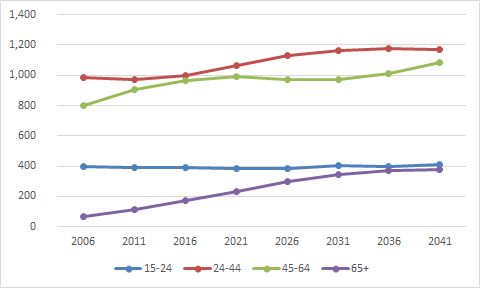
New Zealand national labour force projections – the invasion of the 65+ worker

Figure 1: National labour force projections by age group, 2006-2041

image

Source: Statistics New Zealand, cyclical migration scenario

Not that many years time, about 2035, there will be almost as many workers as there are young workers – those between 15 and 24. About 400,000 workers in each age bracket.

Not that long ago all, in the early 1990s, there were about 25,000 workers in New Zealand were over 65 – they could fit in a football stadium. Soon, they will equal the population of the national capital: Wellington.

Workers aged 65+ moved from accounting for 1.5 per cent of workers in 1991 to 5 per cent in 2011 and 9 per cent in 2021!

Some economics of zero-hours contracts – part 3: the fixed costs of working

The Unite Union, which represents about 7000 workers across New Zealand, has announced a campaign against zero-hours contracts. Zero-hours contracts have no specified hours or times of work so a worker could end up working 40 hours one week and none the next.

Unite national director Mike Treen did not know of the specific numbers of such contracts, but said these contracts were particularly common in the fast food industry, although they also appeared in some other industries.

Unite Union’s national director said that zero hours contracts made workers vulnerable to abuse as they became too nervous to speak out, for fear of having their hours reduced.

There’s no security and it puts enormous power in the hands of managers. People are extremely reluctant to assert their rights for simple things like breaks…

Treen admitted that zero-hours contracts gave employers flexibility, but pretended to know that the amount of flexibility employers actually needed was often exaggerated.


It’s not like they have huge swings or anything. They know how much they are going to sell on any particular day of the week during the year… We don’t expect everybody to have guaranteed hours but 80 per cent of the crew should be able to have it.

Treen said the union was not planning to push for a law change at this stage and would focus on addressing the issue during negotiations with fast food companies early next year.

The new leader of the opposition has promised to outlaw these zero our contracts when he gets into government. I wish him well in drafting a law that outlaws zero-hours contracts without outlawing some part-time and casual jobs as well.

 Zero-hours contracts and the class war

As is to be expected, the Guardian is rather hot and bothered about zero hours contracts. One of its columnists referred to those on zero-hours contracts as the new reserve army of the unemployed:

It is a pity Karl Marx was not around last week to comment on the news that 90% of the workers at Sports Direct are on zero-hours contracts.

The author of the Communist Manifesto would also have had plenty to say about the news that the official estimates of those working in this form of casualised labour had shot up by 25%…

It is safe to say Marx would have cavilled with those who see zero-hour contracts as an expression of Britain’s economic strength, a demonstration of flexible labour markets in action.

He would have thought "reserve army of labour" a better description of conditions in which workers were expected to be permanently on call for an employer.

The Guardian went on to admit that the reserve army of unemployed are not as discontented as they should be:

It’s only fair to say that some employees are content to be on zero-hours contracts.

Some students, for example, want to combine work with study and are willing to turn up when summoned. That’s also true of older workers topping up their pensions with a bit of irregular, part-time work.

Despite this, the class war continues as does the immiseration of the proletariat and the long-term decline in profits that will lead to the crisis in capitalism and, with a bit of luck, the inevitable proletarian revolution:

Marx would have seen zero-hours contracts as the continuation of a long historical trend, stretching back to the mid-1960s when the profitability of western manufacturing firms started to fall.

From that moment, he would say, the search was on for measures to boost profits, and this has manifested itself in a number of ways: by direct attacks on organised labour; by the increased financialisation of the economy; by the search for cheap raw materials whatever the environmental cost; and by asset bubbles.

Accordingly, zero-hours contracts are the response to tougher conditions facing firms as a result of the financial crisis.

Reversing that trend will require more than legislation: it will mean tackling one of the root causes of that crisis: the imbalance of power in the labour market.

A more mellow writer in the Guardian brought up the imagery of the interwar depression:

Of course it is difficult for employers to match the demand to work nine to five and yet also to be served on a 24-hour basis, cheaply and effectively by someone, not them.

But there are other ways to solve this conundrum than indenturing workers or making them wait at the metaphorical factory gate for a tap on the shoulder.

The fixed costs of working

I will start my third blog on the economics of zero-hours by reviewing the economic literature on the fixed costs of working. Helpfully, this literature predicts that zero hours contracts really shouldn’t exist much at all.

The literature on the economics of the fixed costs of work arose out of the economics of retirement and the economics of the labour supply of married women, and in particular of young mothers. This literature was attempting to explain why older workers, or young mothers either worked a minimum number of hours, or not at all.

Fixed costs of working constrain the choices that older employees make about how many hours and days that are worthwhile working part-time. For employees, the fixed costs of going to work limit the numbers of days and number of hours per day that a worker is willing to work part-time. The timing costs of working at scheduled times and a fixed number of days per week can make working fewer full-time days, rather than fewer hours per day less disruptive to the leisure and other uses of personal time.

The fixed costs of working induced older workers to retire completely, and young mothers to withdraw from the workforce for extended periods of time, unless these workers worked either full-time or enough hours part-time each day and through the week to justify the costs of commuting and otherwise disrupting their day and week.

In the case of older workers, there were the fixed costs of commuting and other disruptions to their day. In the case of mothers, there are additional fixed costs of working arising from child care and the commuting and other rather rigid time commitments of picking up and dropping off younger children at school and to day care centres.

The fixed costs of going to work

There is a minimum number of hours of work that will be supplied by different workers that is set by the fixed costs of working. These fixed costs of work arise from commuting time and from dressing and other tasks involved in preparing for the trip to work. These costs are fixed because they do not vary with the number of hours to be worked per day and the amount of effort to be exerted while working (Cogan 1981; Hamermesh and Donald 2007).
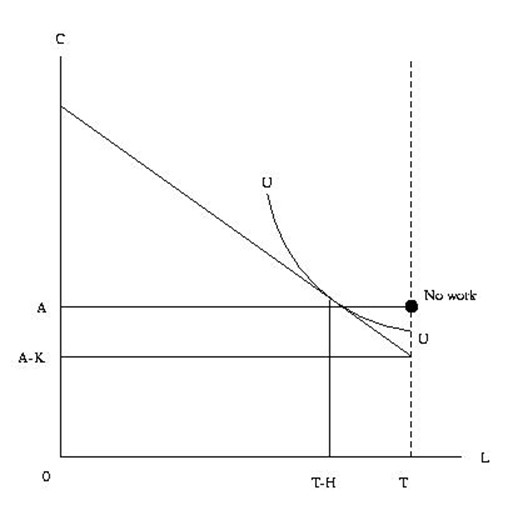


A worker will not accept a job offer or continue in a particular job unless they work sufficient hours so that these fixed costs of going to work are recovered along with receiving sufficient reward for giving up pursuing other job openings open now and in the future and for forgoing leisure and the option of making other uses of their time (Cogan 1981; Hamermesh and Donald 2007).

Cogan (1981) estimated that the average fixed time and money costs of married women entering the workforce was 28 per cent of their earnings, and also estimated that the minimum number of hours a married woman was willing to supply in the labour market was 1,300 hours per year.
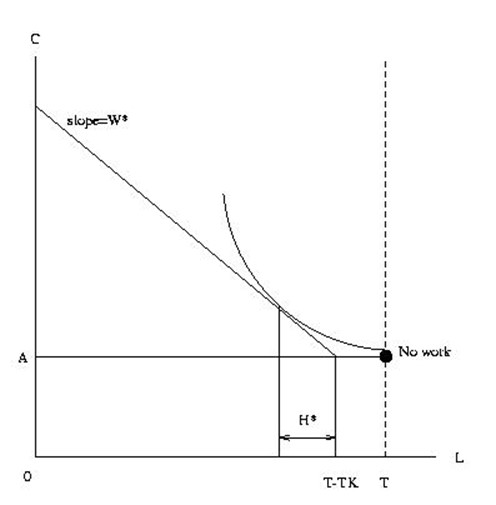

There may be a preference for fewer working days over fewer hours per day to reduce the time and money costs of going to work. Donald and Hamermesh (2009) estimated that fixed costs of going to work are equal to about 8 per cent of income. The fixed costs of working provide an incentive to workers to bunch activities.

The fixed timing costs of labour market entry

A surprisingly large part of the fixed costs of working comes from disruption in the ability to use spare time effectively (Donald and Hamermesh 2009, 2007). Entering or remaining in the workforce for any time at all significantly affects the effective allocation and enjoyment of time outside of working hours. This disruption to the effective use of the time that is left outside of working hours is the fixed timing cost of labour market entry.

One way to reduce this disruption from entering the labour force at all is to seek to reduce the number of days worked per week rather than the number of hours per day.

Leisure and other private uses of time are displaced if the individual takes or stays in even a small part-time job. Workers must use their reduced amount of remaining free time to catch-up on tasks, often at the weekend that they could have done if they were not working.

Leisure time may be the first to go because many personal tasks can be rescheduled but must be done eventually. These range from cooking, eating, and cleaning to personal upkeep, sleep and rest. Tasks must be hurried or done to a lower quality (Donald and Hamermesh 2009).

Routine – having the same schedule from day to day – saves time (Hamermesh 2005). Routine enables people to economise on the set-up costs of consumption, leisure and going to work.

Entering the work-force for any time at all to work even a small number of hours per day or per week calls for new daily and weekly routines and disrupts many existing routines that make better use of leisure, family and other uses of time (Hamermesh 2005).

Entering the workforce constrains the unfettered use of spare time. Working increases the fixed costs of coordinating family and leisure times. Workers must surround working times with buffers to ensure they are not late for work.

One reality of rising incomes is time become more valuable. A rise in wages raises the value of time because time is a finite and irreplaceable resource. Time cannot be stored or bought and sold but people can try and make better use of it.

With only 24 hours still in every day, the cost of time-intensive activities including working will rise as incomes increase. People shift away from time intensive activities and buy more of those products that are time saving or which are less time intensive to consume. Time is money and this maxim applies with greater resonance as incomes and wealth increase.

Another important fixed time costs of labour market entry is its impact on the efficiency of the remaining time devoted to leisure, household production and other activities when even a small amount of market work is undertaken. Spare time is of much less value if part of every day is to be spent at work.

Fixed timing costs arise because of a need to hurry to get to work on time and forego other activities to be rested for work the next morning. The requirement to attend work blocks out certain days from major other uses of that day and reduces the time available in any day of part-day work for leisure, family time and household production.

Household production refers to the goods and services made at home which could be purchased in the market from a third-party. These include food preparation, cooking, carer obligations, and household cleaning. There are also various other household tasks that must perform for one-self which are essentially personal maintenance and leisure.

Working even a few hours can reduce the worker’s efficiency in household production and other non-market activities and may require the worker to buy goods and services that were previously produced at home. This reduces the net financial rewards of working. Fewer full days of work, rather than fewer hours per day is less disruptive to leisure and the other uses of personal time.

The fixed time costs of market work might induce workers to engage in different mixes of other activities. The additional hours of work during the week affect the allocation of time on a non-working weekend day. They reduce leisure time on weekends and increase weekend time devoted to household production by those who do market work on week days. Workers catch up at the weekend on the household production that the rigidities of their market work prevented them from doing during the week.

Stress is an important fixed cost of working. Workers spend non-market time worrying or thinking about work-problems. Even a few hours of market work will place a worker at risk of some stress.

Floors and ceilings on the structure of the working week

The fixed costs of going to work and the fixed time cost of labour market entry both place constraints on the willingness of workers to accept a job offer involving a zero-hours contract. These contracts must offer something extra over competing job options.

The employer must offer something extra to prospective recruits to induce them to sign a zero-hours contract. There must be something substantial to overcome both the fixed costs of work, such as commuting, and the less obvious but still substantial fixed costs of labour market entry.

Any commitment to work, such as working on a zero hours contract, carries with it significant costs in terms of disruption to the rest of the day, the rest of the working week and the amount of the weekend that is spent on leisure versus resting from work and catching up on tasks that otherwise could have been done during the week but for work commitments.

A zero-hours contract must pay enough over the expected life time of the job to make up for the costs of going to work as well as the disruption and loss of leisure time and also the pure disutility of working before the worker breaks even on working.

As the Unite Union official noted, zero hours contracts appear to be most prevalent in the fast food sector. Job turnover rates in the sector can be several hundred per cent per year.

Many of the workers in the fast food sector, as the Unite union official himself noted, are young. Teenagers and young workers changed jobs frequently, particularly those who are studying part-time or full-time work, injuring the summer.

As such, zero-hours contracts in any particular job will have a short expected life over which the teenager or young worker would have to recoup for the fixed cost of working and the fixed cost of any labour market entry. Employers would have to offer some sort of premium or other implicit guarantee of regular work to induce prospective young recruits to sign a zero hours contract.

The type of workers who will profit from signing a zero hours contracts of those workers with few other demands on their time and flexible days. The workers who might find zero hours contract appealing will be those who do have much routine in their day. Workers who have a considerable amount of routine in their day such as because of family commitments will not find the wage offers in zero hours contracts appealing.

There will be job sorting: workers who have low fixed costs of working and low fixed costs of labour market entry will be attracted to zero-hours contracts.

Employers profit from offering zero hours contracts to workers who don’t want to make a regular commitment to come into work every day. Teenagers and students fall into this category, which makes it less surprising that zero hours contracts appear to be most common in the fast food sector.

There are mutual gains in the fast food sector to both employers and workers from zero hours contracts when there are peaks and troughs in product demand, and some teenagers and young workers have a low cost of coming into work at short notice.

Previous Older Entries Next Newer Entries

Bassett, Brash & Hide

Celebrating humanity's flourishing through the spread of capitalism and the rule of law

Truth on the Market

Scholarly commentary on law, economics, and more

The Undercover Historian

Beatrice Cherrier's blog

Matua Kahurangi

Celebrating humanity's flourishing through the spread of capitalism and the rule of law

Temple of Sociology

Celebrating humanity's flourishing through the spread of capitalism and the rule of law

Velvet Glove, Iron Fist

Celebrating humanity's flourishing through the spread of capitalism and the rule of law

Why Evolution Is True

Why Evolution is True is a blog written by Jerry Coyne, centered on evolution and biology but also dealing with diverse topics like politics, culture, and cats.

Down to Earth Kiwi

Celebrating humanity's flourishing through the spread of capitalism and the rule of law

NoTricksZone

Celebrating humanity's flourishing through the spread of capitalism and the rule of law

Homepaddock

A rural perspective with a blue tint by Ele Ludemann

Kiwiblog

DPF's Kiwiblog - Fomenting Happy Mischief since 2003

The Dangerous Economist

Celebrating humanity's flourishing through the spread of capitalism and the rule of law

Watts Up With That?

The world's most viewed site on global warming and climate change

The Logical Place

Tim Harding's writings on rationality, informal logic and skepticism

Doc's Books

A window into Doc Freiberger's library

The Risk-Monger

Let's examine hard decisions!

Uneasy Money

Commentary on monetary policy in the spirit of R. G. Hawtrey

Barrie Saunders

Thoughts on public policy and the media

Liberty Scott

Celebrating humanity's flourishing through the spread of capitalism and the rule of law

Point of Order

Politics and the economy

James Bowden's Blog

A blog (primarily) on Canadian and Commonwealth political history and institutions

Science Matters

Reading between the lines, and underneath the hype.

Peter Winsley

Economics, and such stuff as dreams are made on

A Venerable Puzzle

"The British constitution has always been puzzling, and always will be." --Queen Elizabeth II

The Antiplanner

Celebrating humanity's flourishing through the spread of capitalism and the rule of law

Bet On It

Celebrating humanity's flourishing through the spread of capitalism and the rule of law

History of Sorts

WORLD WAR II, MUSIC, HISTORY, HOLOCAUST

Roger Pielke Jr.

Undisciplined scholar, recovering academic

Offsetting Behaviour

Celebrating humanity's flourishing through the spread of capitalism and the rule of law

JONATHAN TURLEY

Res ipsa loquitur - The thing itself speaks

Conversable Economist

In Hume’s spirit, I will attempt to serve as an ambassador from my world of economics, and help in “finding topics of conversation fit for the entertainment of rational creatures.”

The Victorian Commons

Researching the House of Commons, 1832-1868

The History of Parliament

Articles and research from the History of Parliament Trust

Books & Boots

Reflections on books and art

Legal History Miscellany

Posts on the History of Law, Crime, and Justice

Sex, Drugs and Economics

Celebrating humanity's flourishing through the spread of capitalism and the rule of law

European Royal History

Exploring the Monarchs of Europe

Tallbloke's Talkshop

Cutting edge science you can dice with

Marginal REVOLUTION

Small Steps Toward A Much Better World

NOT A LOT OF PEOPLE KNOW THAT

“We do not believe any group of men adequate enough or wise enough to operate without scrutiny or without criticism. We know that the only way to avoid error is to detect it, that the only way to detect it is to be free to inquire. We know that in secrecy error undetected will flourish and subvert”. - J Robert Oppenheimer.

STOP THESE THINGS

The truth about the great wind power fraud - we're not here to debate the wind industry, we're here to destroy it.

Lindsay Mitchell

Celebrating humanity's flourishing through the spread of capitalism and the rule of law

Alt-M

Celebrating humanity's flourishing through the spread of capitalism and the rule of law

croaking cassandra

Economics, public policy, monetary policy, financial regulation, with a New Zealand perspective

The Grumpy Economist

Celebrating humanity's flourishing through the spread of capitalism and the rule of law

International Liberty

Restraining Government in America and Around the World