CEO compensation at large firms is high, especially in comparison to average worker wages, sparking debates over income inequality. Critics argue that such pay packages are unfair and disproportionate to actual company performance. Proponents contend that high pay reflects productivity and is necessary to attract scarce top talent to large firms. Let’s go to the […]
My tradition on this blog is to take a break (mostly!) from current events in the later part of August. Instead, I pre-schedule daily posts based on things I read during the previous year about three of my preoccupations: economics, editing/writing, and academia. With the posts pre-scheduled, I can then relax more deeply when floating…
In the year to June, 80,200 New Zealand citizens moved abroad, almost double the numbers prior to the Covid-19 pandemic. Meanwhile, just 24,900 returned, according to Stats NZ — the country’s official data agency. The net loss of 55,300 citizens (which follows a net loss of 56,500 in the year to April) smashed the previous record […]
Stuff reports: The number of people claiming refugee status in New Zealand has exploded in the past two years, statistics released by Immigration New Zealandshow. In the 11 months to 31 May 2024, a total of 2220 people claimed refugee status in New Zealand. Half of these asylum seekers – 1108 people – were from a […]
Writing about Mitt Romney’s selection of Paul Ryan in 2012, I opined that, “…it probably means nothing. I don’t think there’s been an election in my lifetime that was impacted by the second person on a presidential ticket.” I feel the same way about Tim Walz, who is Kamala Harris’ pick for Vice President. But […]
The idea behind Uber first arose, the story goes, on a snowy evening in Paris back around 2008, when Travis Kalanick and Garrett Camp found themselves stuck in Paris on a snowy evening, unable to find a taxi. They wondered “What if you could request a ride simply by tapping your phone?” They co-founded Uber based…
This week’s column for the Stuff papers covered the excellent new US work testing the effects of a UBI. From November 2020, 3000 low-income people were randomly assigned into two groups for three years. One thousand people each received $1000 per month in unconditional funds for three years. Two thousand people each received $50 per month.Both…
The Miami Herald reports: A stunning 10% of Cuba’s population — more than a million people — left the island between 2022 and 2023, the head of the country’s national statistics office said during a National Assembly session Friday, the largest migration wave in Cuban history. Isn’t it such a weird coincidence that the queue […]
Texas won a big victory in the United States Court of Appeals in the long struggle over floating buoy barriers in the Rio Grande River to help block unlawful migration. In United States v. Abbott, the court ruled 11-7 in an en banc decision against the Biden Administration over the barrier. It is an interesting decision […]
In an interesting new paper Federal Reserve economists Marianna Kudlyak, Murat Tasci and Didem Tüzemen look at what happens to job vacancy postings when the minimum wage increases. The vacancy data in our analysis come from the job openings data from the Conference Board as a part of its Help Wanted OnLine (HWOL) data series. […]
Earlier this week, I was interviewed by Paul Brennan on Reality Check Radio, on New Zealand’s declining birth rate. You can listen to the interview here. We didn’t have time to go through all of the questions I was given beforehand, so I thought I would add some points here, along with some links to…
By Eva Vivalt, Elizabeth Rhodes, Alexander W. Bartik, David E. Broockman, Sarah Miller, Here is the link, but I am still sleeping. Here is the abstract: We study the causal impacts of income on a rich array of employment outcomes, leveraging an experiment in which 1,000 low-income individuals were randomized into receiving $1,000 per month […]
Edmund Phelps won the Nobel prize in economics in 2006 for “for his analysis of intertemporal tradeoffs in macroeconomic policy.” However, he has spent a considerable chunk of this time in the last few decades musing over strengths and weaknesses of capitalism and, more generally, a dynamic economy. Jon Hartley interviews Phelps on both topics,…
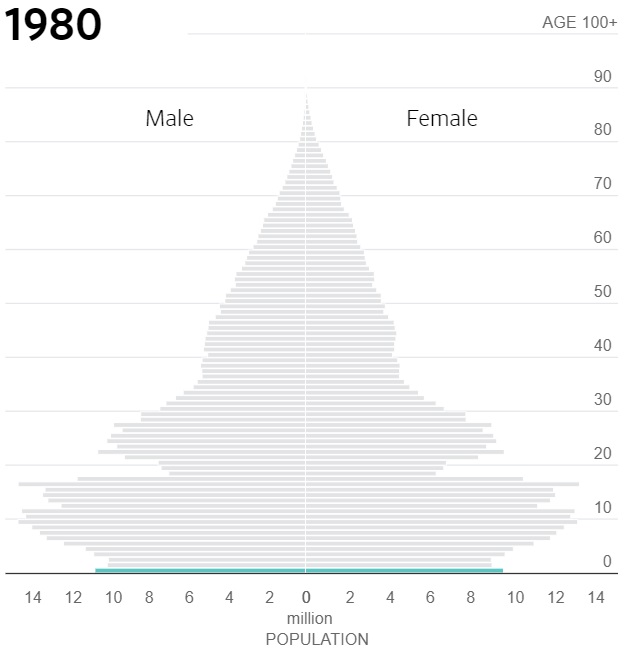
I’m in China this week, teaching about fiscal policy, convergence theory, and inequality at Northeastern University in Shenyang. So it’s a good opportunity to write about some pluses and minuses of Chinese economic policy. We’ll start this series by looking at demographics, which almost surely is the biggest long-run challenge for Chinese policymakers. How big […]
Why Evolution is True is a blog written by Jerry Coyne, centered on evolution and biology but also dealing with diverse topics like politics, culture, and cats.
In Hume’s spirit, I will attempt to serve as an ambassador from my world of economics, and help in “finding topics of conversation fit for the entertainment of rational creatures.”







Recent Comments