How to lie about statistics on inequality and global poverty @oxfamnz @Oxfam
29 Sep 2015 Leave a comment
in applied price theory, applied welfare economics, development economics, econometerics, economic history, growth disasters, growth miracles, human capital, labour economics, Marxist economics, poverty and inequality, rentseeking Tags: activists, do gooders, expressive voting, Leftover Left, Oxfam, rational ignorance, rational irrationality, Twitter left
Number of beers you can buy with your monthly minimum wage in Europe
29 Sep 2015 Leave a comment
in economics of regulation, labour economics, law and economics, minimum wage Tags: alcohol regulation, EU
Number of beers you can buy with your monthly minimum wage in Europe http://t.co/uvuunx5mkF—
Amazing Maps (@Amazing_Maps) June 21, 2015
The explosion in health workers supply
28 Sep 2015 Leave a comment
in economics of education, health economics, human capital, labour supply Tags: College premium, economics of healthcare, education premium, graduate premium
The causes of the 1466 US police officer deaths, 2005 – 2014
27 Sep 2015 Leave a comment
in economic history, economics of crime, health and safety, occupational choice Tags: law and order, police, road safety
A surprisingly large number of police officers die in car crashes or struck by vehicles.

Source: National Law Enforcement Officers Memorial Fund: Causes of Law Enforcement Deaths.

Source: National Law Enforcement Officers Memorial Fund: Causes of Law Enforcement Deaths.
High-speed police chases kill 330 people per year, one-third of whom are innocent bystanders: priceonomics.com/the-case-for-b… http://t.co/uFmzxgcplk—
Zachary Crockett (@zzcrockett) July 22, 2015
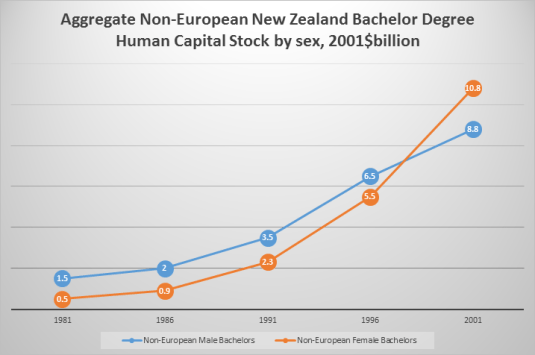
Aggregate New Zealand non-European graduate human capital stock by sex, 1981-2001, $2001 billion
27 Sep 2015 Leave a comment
in economics of education, gender, human capital
US, British, French and Japanese working age populations, 1950 – 2013
27 Sep 2015 Leave a comment
in economic history, labour supply
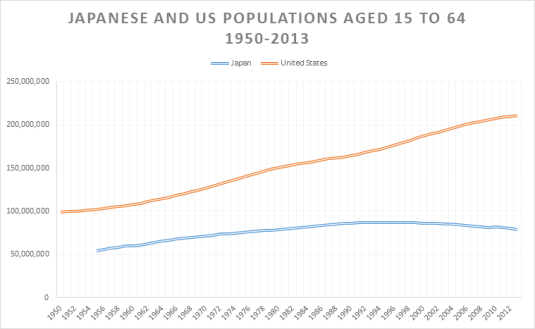
Source: Data extracted on 27 Sep 2015 02:23 UTC (GMT) from OECD.Stat
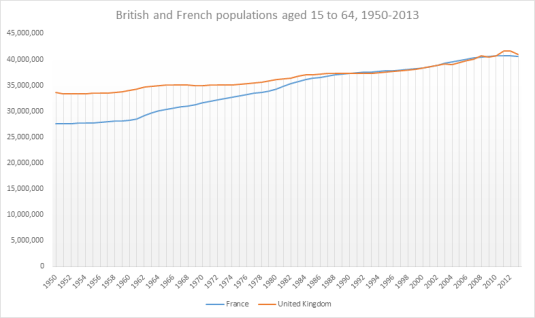
Source: Data extracted on 27 Sep 2015 02:23 UTC (GMT) from OECD.Stat
Income tax burdens of workers across the OECD
27 Sep 2015 Leave a comment
in labour economics, labour supply Tags: taxation and labour supply
US Illegitimacy Rates
27 Sep 2015 Leave a comment
CHART of the DAY: US Illegitimacy Rates http://t.co/TcbPo1Yhf9—
Mark J. Perry (@Mark_J_Perry) May 12, 2015
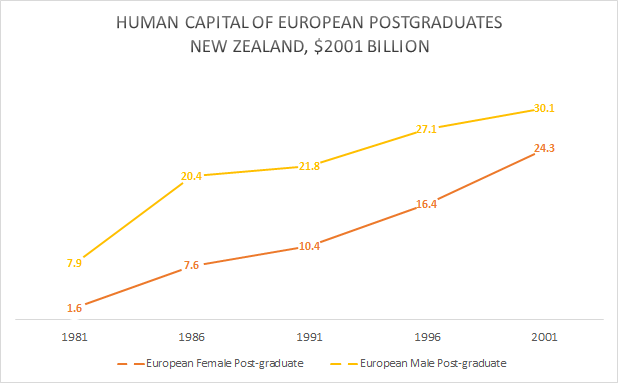
Aggregate New Zealand European human capital of graduates, 1981-2001
26 Sep 2015 Leave a comment
in economic history, gender, human capital, labour economics, labour supply, politics - New Zealand Tags: female labour force participation, graduate premium, male labour force participation, postgraduate premium, reversing gender gap
There was rapid growth in the human capital of graduates and postgraduates in New Zealand between 1981 and 2001 according to the census data. The growth in female human capital was particularly rapid and especially so at the postgraduate level.
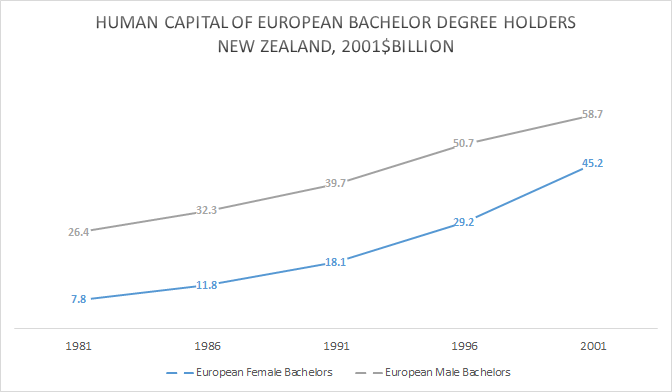
Source: Lˆe Thi. Vˆan Tr`ınh, Estimating the monetary value of the stock of human capital for New Zealand, thesis submitted in partial fulfilment of the requirements for the Degree of Doctor of Philosophy at the University of Canterbury (September 2006).
Source: Lˆe Thi. Vˆan Tr`ınh, Estimating the monetary value of the stock of human capital for New Zealand, thesis submitted in partial fulfilment of the requirements for the Degree of Doctor of Philosophy at the University of Canterbury (September 2006).
Cross-sectional versus lifetime inequality in the UK
26 Sep 2015 Leave a comment
in economic history, economics of education, human capital, labour economics, poverty and inequality Tags: British economy
Why inequality is actually much lower in Britain than it at first seems economist.com/blogs/freeexch… http://t.co/uwjqsfan6A—
Charles Read (@EconCharlesRead) September 23, 2015

Big gaps in life expectancy by gender in former USSR countries
26 Sep 2015 Leave a comment
in economics, labour economics, labour supply Tags: life expectancies
Check out @FactTank’s Tweet: https://twitter.com/FactTank/status/632183329635307520?s=09
@nzlabour @FairnessNZ My first Parliamentary submission – opposing regulation of zero hours contracts
25 Sep 2015 1 Comment
in applied price theory, labour economics, labour supply, occupational choice, personnel economics, politics - New Zealand Tags: employment law, employment protection law, employment regulation, fixed costs of employment, Leftover Left, The fatal conceit, unintended consequences, zero hours contracts
This Labour Party link made it very easy for me to submit to the Select Committee of Parliament to oppose the Bill on regulating zero hours contracts. I oppose the Bill for the exact opposite reasons that the Labour Party opposes the Bill.
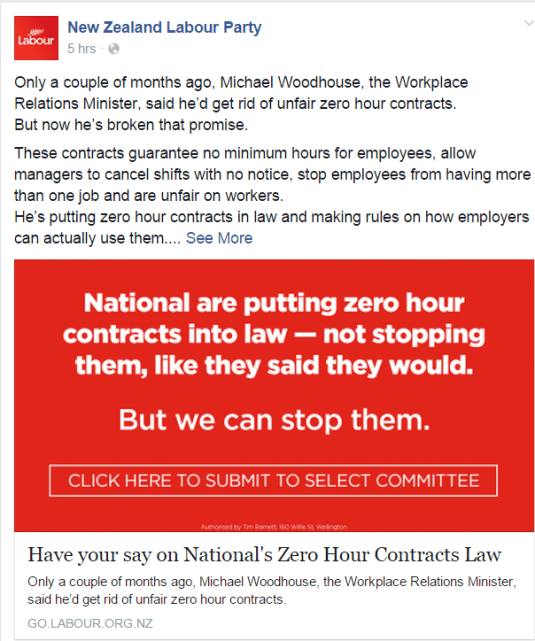
I encourage others to make a submission to Parliament as well opposing this draft amendment that will lower the wages of workers. My submission is as follows:
I do not support the proposed changes to the legislation governing zero hour contracts in the Employment Standards Legislation Bill. There should be no regulation of zero hours contracts.
Zero hours contracts is creative destruction at work in the labour market, sweeping away obsolete working time arrangements, mostly in the retail services sector. Plenty of new ways of working have emerged in recent years that include the proliferation of part-time work, temporary workers, leased workers, working from home, teleworking and sub-contracting. Employment laws were built on the now decaying assumption that workers had career-long, stable relationships with single employers.
Advance notice of work schedules is always known only to a minority of temporary and permanent employees in New Zealand, and there’s not much difference between that advance notice between temporary and permanent employees.
Critics overplay their hand if they suggest that somehow workers are very much disadvantaged and employers are holding all the cards. Job turnover and recruitment problems are a serious cost to a business. Workers will not sign zero hours contracts if they are not to their advantage.
Unless labour markets are highly uncompetitive with employers having massive power over employees, employers should have to pay a wage premium if zero-hour contracts are a hassle for workers.
The fixed costs of employment are such that you shouldn’t expect zero-hour contracts: you’ll typically do better with one 40-hour worker over two 20-hour workers because of these costs. Zero hour contracts would be most likely in jobs with low recruitment costs and where specialised training needs are low. Workers with low fixed costs of working will move into the zero-hour sector while those with higher fixed costs would prefer lower hourly rates but more guaranteed hours. Again, read lower here as meaning relative to what they could elsewhere earn.
Unless we have a good idea about why firms are moving to zero hours contracts, which we don’t, and why employees sign these contracts rather than work for other employers who offer more regular hours, meddling in these novel working time arrangements is risky.
Employers must pay a wage premium to induce in workers to sign zero hours contracts. This Bill seeks to deny workers the right to seek higher wages.
Feel free to use the above text as the basis for your own submission to Parliament.


Recent Comments