Is @fightfor15 the best answer?

https://twitter.com/FightFor15WI/status/683754760923549699

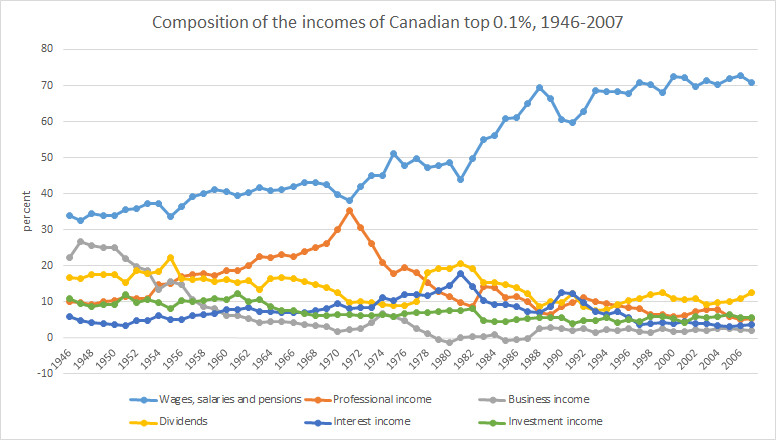
The rise of the Canadian working super-rich – composition of top 0.1% incomes since 1946

image

Source: The World Wealth and Income Database.

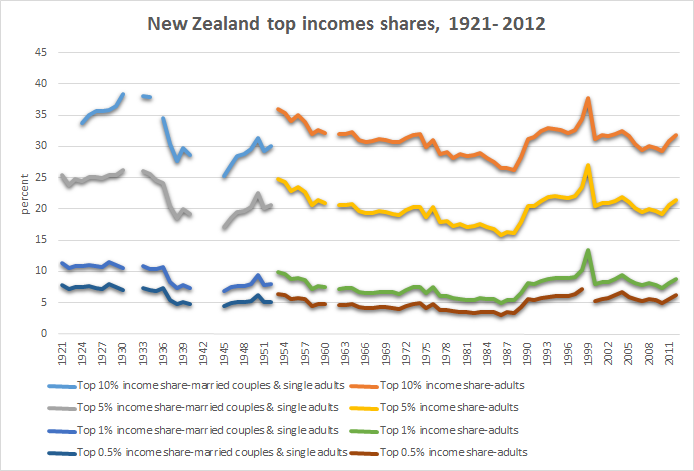
Did the rich get richer under Rogernomics? New Zealand top income shares since 1921

Apart from a bump in the late 80s, the top income earners in New Zealand really are not doing much better than they were in the 1950s or 1920s. The rich are not getting richer in New Zealand. They are just holding their own.

image

Source: The World Wealth and Income Database.

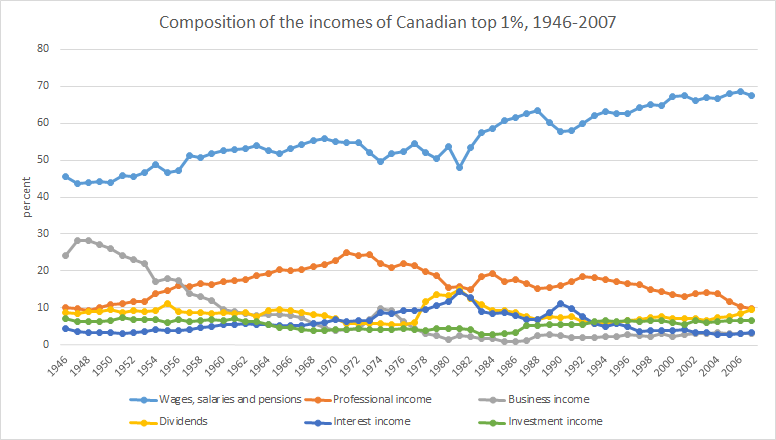
The rise of the Canadian working rich – composition of top 1% incomes since 1946

image

Source: The World Wealth and Income Database.

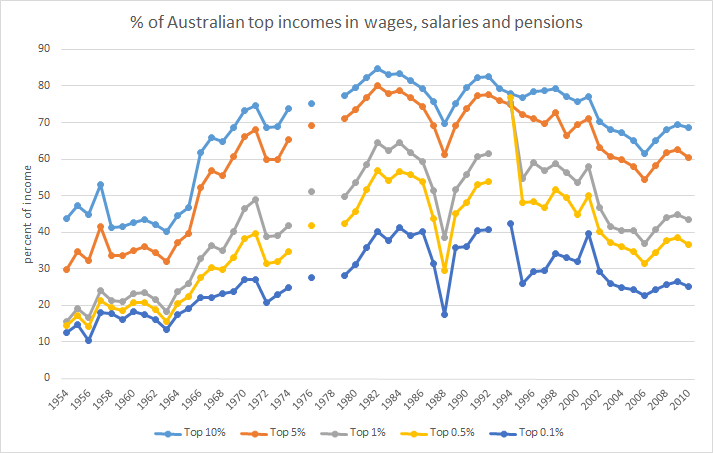
The rise of the working rich in Australia – top income compositions since 1954

Over the course of the post-war period top incomes in Australia turned into top wage earners. It is unfortunate that information is not available on the extent to which business incomes make up the balance of top incomes as distinct from dividend incomes.

image

Source: The World Wealth and Income Database.

The New Zealand top 1% is still bone lazy – top 1% income shares USA, New Zealand and Australia since 1913

What slackers. Despite 30 years of neoliberalism oppressing the unions and working class, the top 1% in New Zealand (and Australia) are unable to do any better in terms of their share of national income than in the good old days of pre-1984 New Zealand looked upon with such fondness by the the Leftover Left.

image

Source: The World Wealth and Income Database.

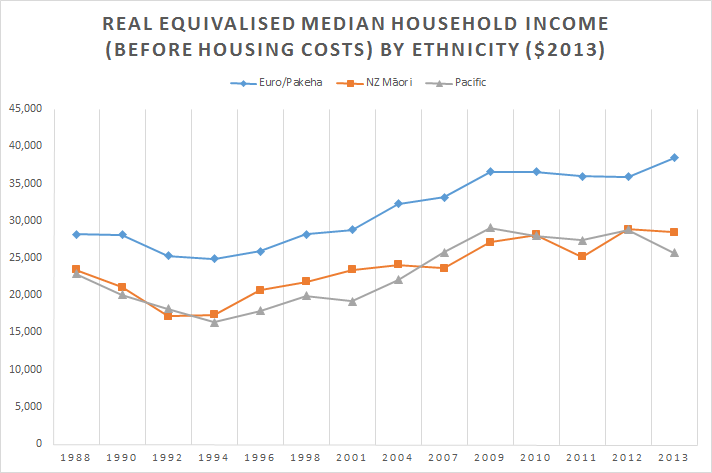
NZ real household incomes up 55% since 1994 but no dancing in the street by the Leftover Left

https://twitter.com/sbancel/status/654162844884205568

Pakeha and Pasifika real household incomes increased by 55% since the low point of 1994. Maori household incomes increased by 65% since 1994.

image

Source: Bryan Perry, Household Incomes in New Zealand: trends in indicators of inequality and hardship 1982 to 2014 – Ministry of Social Development, Wellington (August 2015), Table D.6.

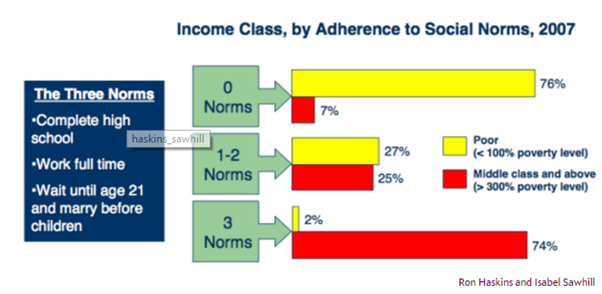
What is the success sequence?

image

Source: The success sequence: Conservatives think they have a formula for raising people out of poverty.

.

Adam Smith versus Jamie Whyte or is there poverty on the Starship Enterprise?

Jamie Whyte today wrote an excellent op-ed on the meaninglessness of current measures of poverty. His point was that defining poverty as 60% of the median income means the poor will always be with us. This relative definition of poverty misleads us as to the level of hardship and deprivation in society as Jamie Whyte says today:

There is no poverty in New Zealand. Misery, depravity, hopelessness, yes; but no poverty.

The poorest in New Zealand are the unemployed. They receive free medical care, free education for their children and enough cash to pay for basic food, clothing and (subsidised) housing. Most have televisions, refrigerators and ovens. Many even own cars. That isn’t poverty.

I agree that this definition of poverty in relative income terms is misleading and reflects a political agenda. When I was young, the poor were thin, now they are fat.

Poverty rates have not changed despite a greater abundance of food. Indeed, child poverty rates have increased since I was young despite this relative opulence of food.

Over the Christmas break I read Simon Chapple and Jonathan Boston’s Child Poverty in New Zealand. They included a discussion of what was poverty drawing on the relative concept of poverty of Adam Smith. Smith spoke about wrote about the differences in poverty between countries and across time:

A linen shirt … is, strictly speaking, not a necessary of life. The Greeks and Romans lived, I suppose, very comfortably though they had no linen.

But in the present times, through the greater part of Europe, a creditable day-labourer would be ashamed to appear in public without a linen shirt, the want of which would be supposed to denote that disgraceful degree of poverty which, it is presumed, nobody can well fall into without extreme bad conduct.

In any society, a certain level of material well-being is necessary to not be in poverty. Smith also talked about how poverty lines differ between countries starting with the discussion about shoes:

The poorest creditable person of either sex would be ashamed to appear in publick without them. In Scotland, custom has rendered them a necessary of life to the lowest order of men; but not to the same order of women, who may, without any discredit, walk about bare-footed. In France, they are necessaries neither necessaries neither to men nor to women; the lowest rank of both sexes appear there publickly, without any discredit, sometimes in wooden shoes, and sometimes bare-footed.

Under necessaries, I comprehend, not only those things which nature, but those things which the established rules of decency have rendered necessary to the lowest rank of people.

All other things I shall call luxuries; without meaning by this appellation, to throw the smallest degree of reproach upon the temperate use of them. Beer and ale, for example, in Great Britain, and wine, even in the wine countries, I call luxuries. A man of any rank may, without any reproach, abstain totally from tasting such liquors. Nature does not render them necessary for the support of life; and custom nowhere renders it indecent to live without them.

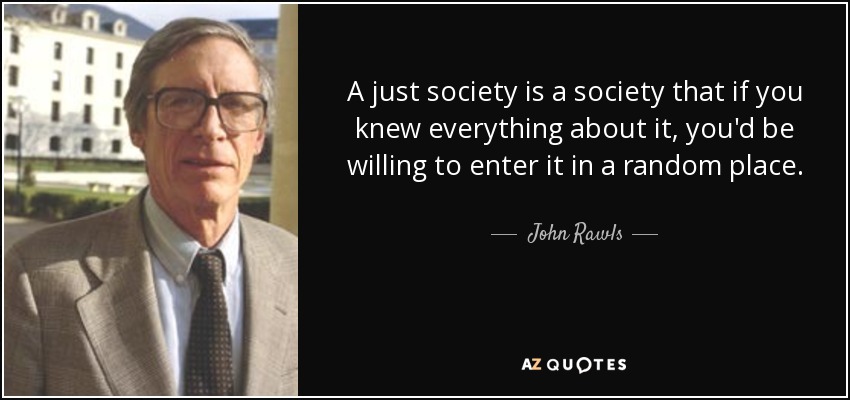
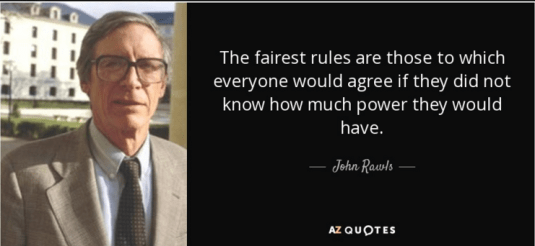
Much of the Wealth of Nations was about the natural progress of opulence under a capitalist system. There is nothing wrong with inequality as John Rawls has explained.


The fact that citizens have different talents can be used to make everyone better off. In a society governed by the difference principle, those better endowed with talents are welcome to use their gifts to make themselves better off, so long as they also contribute to the good of those less well endowed.


With his emphasis on fair distribution of income, Rawls’ initial appeal was to the Left, but left-wing thinkers started to dislike his acceptance of capitalism and tolerance of large discrepancies in income.
Will the poor always be with us? I once had an argument with a colleague at work about whether there was poverty on the Starship Enterprise.

Star Trek was supposed to be a society that had abolished money and a post-scarcity economy because everything was available through a replicator. To quote Captain Picard:

A lot has changed in three hundred years. People are no longer obsessed with the accumulation of ‘things’. We have eliminated hunger, want, the need for possessions.

The economics of the future is somewhat different. You see, money doesn’t exist in the 24th century… The acquisition of wealth is no longer the driving force in our lives. We work to better ourselves and the rest of Humanity.

The Ferengi and their 285 rules of acquisition were a satire on capitalism. The Ferengi was originally meant to replace the Klingons as the Federation’s arch-rival but they were too comical.

Gene Roddenberry’s love story with socialism was a class-ridden society. In Star Trek, higher ranked officers had larger cabins, and most of all they always beamed back from the planet.
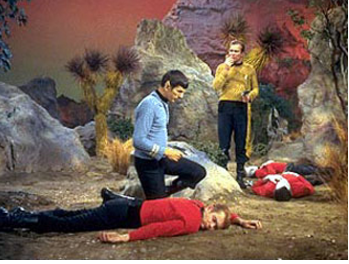
An old mate reminded me years ago that anyone who beamed down with Captain Kirk dressed in those red security officer tops were expendables. They were lucky to last 60 seconds in most episodes I watched.

Death and accommodation were class based on Star Trek but it was a supremely opulent society for everyone. That is the point to remember.

Standards are living are much better today than before for everyone despite inequalities that are quite acceptable under the difference principle of John Rawls.

Current definitions of poverty do not take into account the natural progress of opulence. In the 1970s, US Department of Energy started collecting its Household Energy Consumption Survey. This survey is one of the few accurate measures of growing affluence among the poor in America.

Not only does this survey ask about household appliances, it asked about on income. The survey is conducted every 4 years or so since the 1970s. Because of that, it is able to track the diffusion of appliances to households of varying incomes across America.

Yesterday’s luxuries at today’s necessities in poor households with a rapid diffusion of everything from air-conditioners to digital appliances. Many poor households in the USA have more space than middle-class households in Western Europe. Food is also much cheaper in the USA than in Europe.

https://twitter.com/VisualEcon/status/644080191841640448

This growing affluence of poorer Americans is despite higher measured family poverty in America according to the relative poverty measure based on the median income. That makes no sense.
Poverty, plenty and the old age pension

https://twitter.com/paul1kirby/status/673472886020120576

@GarethMorgannz the universal basic income is inferior to the minimum family tax credit

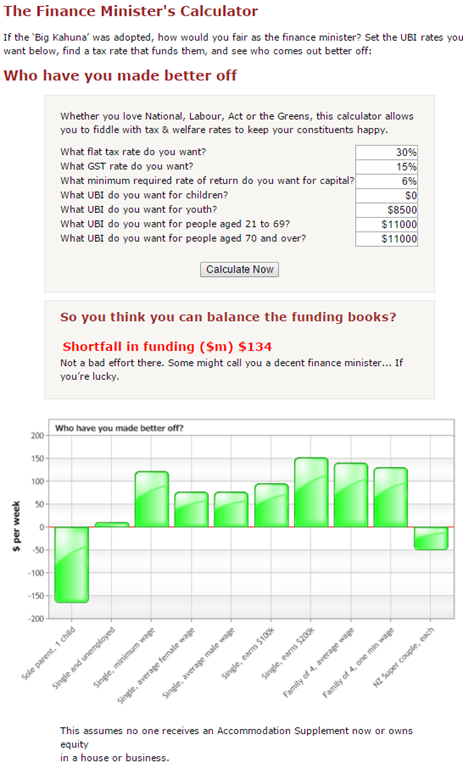
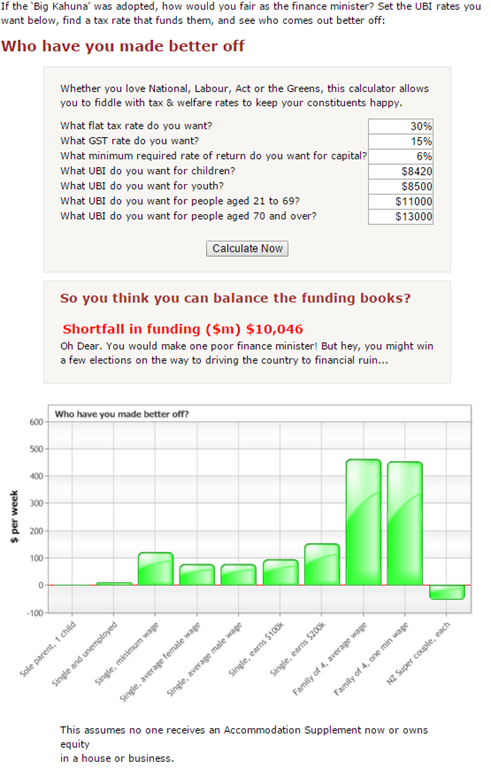
Gareth Morgan’s universal basic income appears to make everybody better off except those for whom the modern welfare state was established to protect. Examples of these from his online calculator are single mothers and retirees.

image

Source: The Big Kahuna – Tax and Welfare.

To stay even just with single mothers blows a good $10 billion hole in the budget deficit according to the online calculator provided by Gareth Morgan. Retirees are still worse off.

image

Source: The Big Kahuna – Tax and Welfare.

Central to the package is a comprehensive capital gains tax despite evidence growing with each day that the optimal tax rates on income from capital and on capital gains are zero.

A universal basic income for New Zealand is a long  trip to where we are now. There is already a guaranteed minimum family income in New Zealand.

The minimum family tax credit makes sure that a family’s annual income (net income after tax has been deducted) doesn’t fall below $23,036 a year ($443 per week). To qualify, you must  work for a salary or wage for at least 30 hours each week as a couple, or 20 hours each week as a single parent, and receive a family tax credit.

The Treasury modelled a Guaranteed Minimum income at the request of the Welfare Working Group in 2010. A  guaranteed minimum income  of $300 per week – the mean benefit income among those on benefits – would cost $44.5 billion or $52.6 billion if we extended it to super annuitants as a replacement for NZ Superannuation or old age pension. The former could be covered by a flat personal income tax rate of 45.4%; the latter, 48.6%. Full fiscal neutrality would require tax rates of 50.6% and 54.4%.

The universal basic income seems to be a big day out for Director’s Law of Public Expenditure. Director’s Law is public expenditure is used primary for the benefit of the middle class, and is financed with taxes which are borne in considerable part by the poor and the rich.

The universal basic income and a comprehensive capital gains tax seems to cause a lot of economic upheaval but still struggles to make the worse off groups in society even break-even on this throwing of all the cards in the air. Brian Easton put it well the other day when he said:

Many advocates put the UMI forward without doing the sums. Those who do, find that the required tax rates are horrendous or the minimum income is so low that it is not a viable means of eliminating poverty. Among the latter are New Zealanders Douglas, Gareth Morgan and Keith Rankin.

Roland Fryer on Education, Inequality, & Incentives

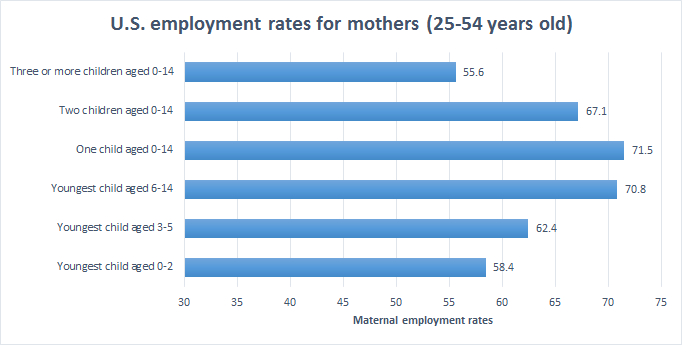
US maternal employment rates by number and age of children

image

Source: Pensions at a Glance 2015 – Statistics – OECD iLibrary.

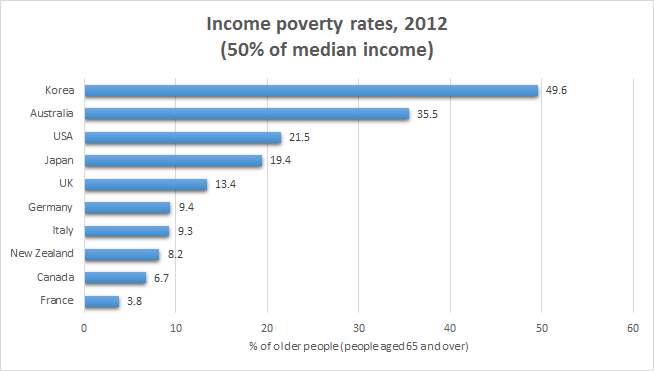
Old age poverty rates in the G7, Australia, New Zealand and Korea

image

Source: Old-age income poverty – Pensions at a Glance 2015 – OECD iLibrary.

@jacindaardern the role of drug addiction in poverty and unemployment

Jacinda Adern does have a point that the Prime Minister overplayed the role of drug dependency in child poverty, but he is not completely off the mark. A whole bunch of self-destructive behaviours play a role in family poverty.

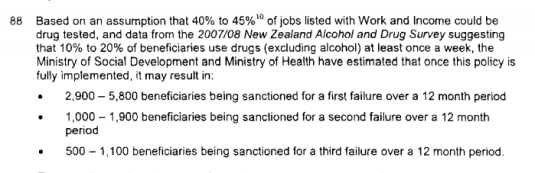
Source: Minister of Social Development Cabinet Paper on Pre-employment Drug Testing Requirements.

Too many children have irresponsible parents. Caplan along with Charles Murray point out that a number of pathologies are particularly prevalent among poor:

  1. alcoholism: Alcohol costs money, interferes with your ability to work, and leads to expensive reckless behaviour.
  2. drug addiction: Like alcohol, but more expensive, and likely to eventually lead to legal troubles you’re too poor to buy your way out of.
  3. single parenthood: Raising a child takes a lot of effort and a lot of money.  One poor person rarely has enough resources to comfortably provide this combination of effort and money.
  4. unprotected sex: Unprotected sex quickly leads to single parenthood.  See above.
  5. dropping out of high school: High school drop-outs earn much lower wages than graduates.  Kids from rich families may be able to afford this sacrifice, but kids from poor families can’t.
  6. being single: Getting married lets couples avoid a lot of wasteful duplication of household expenses.  These savings may not mean much to the rich, but they make a huge difference for the poor.
  7. non-remunerative crime: Drunk driving and bar fights don’t pay.  In fact, they have high expected medical and legal expenses.  The rich might be able to afford these costs.  The poor can’t.

Caplan is disputing that healthy adults who are poor are victims. That is central to the poverty is not a choice movement: the poor are victims.

The New Zealand experience with work testing of beneficiaries for drugs is most of them quickly stopped using dope. Many jobs have tests for drug-taking.

Previous Older Entries Next Newer Entries

David Andolfatto

Celebrating humanity's flourishing through the spread of capitalism and the rule of law

Monetary Non-Neutrality

Celebrating humanity's flourishing through the spread of capitalism and the rule of law

Reason Magazine

Celebrating humanity's flourishing through the spread of capitalism and the rule of law

Coyote Blog

Celebrating humanity's flourishing through the spread of capitalism and the rule of law

Thoughts from the North

Celebrating humanity's flourishing through the spread of capitalism and the rule of law

Fardels Bear

A History of the Alt-Right

Vincent Geloso

Econ Prof at George Mason University, Economic Historian, Québécois

Bassett, Brash & Hide

Celebrating humanity's flourishing through the spread of capitalism and the rule of law

Truth on the Market

Scholarly commentary on law, economics, and more

The Undercover Historian

Beatrice Cherrier's blog

Matua Kahurangi

Celebrating humanity's flourishing through the spread of capitalism and the rule of law

Temple of Sociology

Celebrating humanity's flourishing through the spread of capitalism and the rule of law

Velvet Glove, Iron Fist

Celebrating humanity's flourishing through the spread of capitalism and the rule of law

Why Evolution Is True

Why Evolution is True is a blog written by Jerry Coyne, centered on evolution and biology but also dealing with diverse topics like politics, culture, and cats.

NoTricksZone

Celebrating humanity's flourishing through the spread of capitalism and the rule of law

Homepaddock

A rural perspective with a blue tint by Ele Ludemann

Kiwiblog

DPF's Kiwiblog - Fomenting Happy Mischief since 2003

The Dangerous Economist

Celebrating humanity's flourishing through the spread of capitalism and the rule of law

Watts Up With That?

The world's most viewed site on global warming and climate change

The Logical Place

Tim Harding's writings on rationality, informal logic and skepticism

Doc's Books

A window into Doc Freiberger's library

The Risk-Monger

Let's examine hard decisions!

Uneasy Money

Commentary on monetary policy in the spirit of R. G. Hawtrey

Barrie Saunders

Thoughts on public policy and the media

Liberty Scott

Celebrating humanity's flourishing through the spread of capitalism and the rule of law

Point of Order

Politics and the economy

James Bowden's Blog

A blog (primarily) on Canadian and Commonwealth political history and institutions

Science Matters

Reading between the lines, and underneath the hype.

Peter Winsley

Economics, and such stuff as dreams are made on

A Venerable Puzzle

"The British constitution has always been puzzling, and always will be." --Queen Elizabeth II

The Antiplanner

Celebrating humanity's flourishing through the spread of capitalism and the rule of law

Bet On It

Celebrating humanity's flourishing through the spread of capitalism and the rule of law

History of Sorts

WORLD WAR II, MUSIC, HISTORY, HOLOCAUST

Roger Pielke Jr.

Undisciplined scholar, recovering academic

Offsetting Behaviour

Celebrating humanity's flourishing through the spread of capitalism and the rule of law

JONATHAN TURLEY

Res ipsa loquitur - The thing itself speaks

Conversable Economist

In Hume’s spirit, I will attempt to serve as an ambassador from my world of economics, and help in “finding topics of conversation fit for the entertainment of rational creatures.”

The Victorian Commons

Researching the House of Commons, 1832-1868

The History of Parliament

Articles and research from the History of Parliament Trust

Books & Boots

Reflections on books and art

Legal History Miscellany

Posts on the History of Law, Crime, and Justice

Sex, Drugs and Economics

Celebrating humanity's flourishing through the spread of capitalism and the rule of law

European Royal History

Exploring the Monarchs of Europe

Tallbloke's Talkshop

Cutting edge science you can dice with

Marginal REVOLUTION

Small Steps Toward A Much Better World

NOT A LOT OF PEOPLE KNOW THAT

“We do not believe any group of men adequate enough or wise enough to operate without scrutiny or without criticism. We know that the only way to avoid error is to detect it, that the only way to detect it is to be free to inquire. We know that in secrecy error undetected will flourish and subvert”. - J Robert Oppenheimer.