43.1% of single mothers are living in poverty this #MothersDay statusofwomendata.org http://t.co/OgWcmvLnDZ—
IWPR (@IWPResearch) May 10, 2015
Single motherhood and the feminisation of poverty
31 Aug 2015 Leave a comment
in discrimination, economics of love and marriage, gender, labour economics, labour supply, politics - USA, poverty and inequality, welfare reform Tags: asymmetric marriage premium, child poverty, economics and fertility, engines of liberation, family poverty, marriage and divorce, marriage premium, single mothers, single parents
US income distribution
29 Aug 2015 Leave a comment
in applied welfare economics, income redistribution, labour economics, politics - USA, poverty and inequality Tags: top 1%
The incomes of the bottom 99%
28 Aug 2015 Leave a comment
in applied welfare economics, politics - USA, poverty and inequality, Public Choice Tags: top 1%
Did Mass Incarceration Destroy the Black Family?
28 Aug 2015 Leave a comment
in discrimination, economics of crime, economics of love and marriage, labour economics, law and economics, politics - New Zealand, population economics, poverty and inequality, unemployment, urban economics, welfare reform Tags: crime and punishment, criminal deterrence, economics of the family, racial discrimination, single mothers, single parents, teen pregnancies
Did Mass Incarceration Destroy the Black Family? Not exactly. bit.ly/1f8jgXm http://t.co/1q2nKJnU9W—
City Journal (@CityJournal) August 13, 2015
Do the @NZGreens care about the fuel poverty consequences of carbon taxes?
24 Aug 2015 Leave a comment
in energy economics, environmental economics, global warming, politics - Australia, politics - New Zealand, politics - USA, poverty and inequality Tags: carbon tax, climate alarmism, expressive voting, fuel poverty, global warming
Who is harmed the most from higher energy costs? The poor, who spend almost 25% of their disposable income on energy? http://t.co/YOn28COXy8—
Mark J. Perry (@Mark_J_Perry) June 22, 2015
When do rising incomes increase child poverty?
22 Aug 2015 2 Comments
in economic history, labour economics, politics - New Zealand, poverty and inequality, welfare reform Tags: child poverty, family poverty, Leftover Left, measurement error, New Zealand Greens
Summary of the 222 pages of MSD's Household Incomes report: kids are still missing out BIG time. #itsnotchoice http://t.co/4x7dm1O0Wg—
Child Poverty NZ (@povertymonitor) August 13, 2015
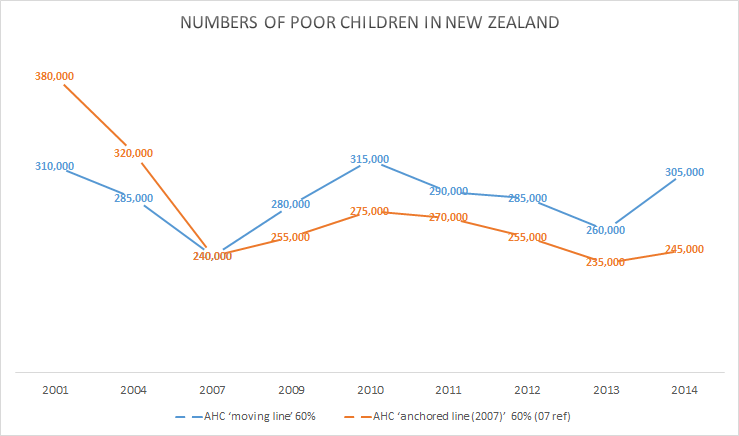
AHC = after deducting housing costs
BHC = before deducting housing costs
‘anchored line’:
- this is the line set at a chosen level in a reference year (now 2007), and held fixed in real terms (CPI adjusted)
- the concept of ‘poverty’ here is – have the incomes of low-income households gone up or down in real terms compared with what they were previously?
‘moving line’:
- this is the fully relative line that moves when the median moves (e.g. if median rises, the poverty line rises and reported poverty rates increase even if low incomes stay the same)
- the concept of ‘poverty’ here is – have the incomes of low-income households moved closer or further away from the median?
Bryan Perry, Household Incomes in New Zealand: trends in indicators of inequality and hardship 1982 to 2014 – Ministry of Social Development, Wellington (August 2015), p. 133.
Source: Bryan Perry, Household Incomes in New Zealand: trends in indicators of inequality and hardship 1982 to 2014 – Ministry of Social Development, Wellington (August 2015), p. 133.
Is child poverty in New Zealand 245,000 children or 305,000 children?
260,000 kids in income poverty, 180,000 in material hardship, 10% in severe poverty, 3in5 in poverty for a long time http://t.co/Oy5cWftvwU—
Child Poverty NZ (@povertymonitor) May 21, 2015
If you base your estimate of child poverty on the 60% of median income after housing costs moving line, which is the number of low income households who moved further away from 60% of median income, a median which increased by 5% last year, the figure is 305,000 children after housing costs. 45,000 children are in households that is not as close to the median as last year but are not necessarily any poorer than last year in terms of money coming into the house.
45k more children in #poverty this year than last, that’s 305k Kiwi kids without life's basics. C'mon @johnkeypm! http://t.co/K8zeQpgA79—
UNICEF New Zealand (@UNICEFNZ) August 13, 2015
If you base your estimate on the anchored line, which is the number of low income households whose income has gone up on down compared to what they were on previously,the number of children in poverty has increased from 235,000 to 245,000 after housing costs. About 10,000 children are poorer than last year – poorer enough than last year to be classified as in poverty.

Poverty in America
22 Aug 2015 Leave a comment
in economic history, labour economics, politics - USA, poverty and inequality, welfare reform Tags: 1996 U.S. welfare reforms, child poverty, family poverty
Half as many blacks in the U.S. today are living in poverty as in 1960. buff.ly/1KTT5Sz http://t.co/PKK5REXr0P—
HumanProgress.org (@humanprogress) August 07, 2015
More evidence of mass kidnappings of #occupywallstreet activists
20 Aug 2015 Leave a comment
in applied price theory, human capital, income redistribution, labour economics, labour supply, politics - USA, poverty and inequality, Public Choice, rentseeking, sports economics Tags: expressive voting, Left-wing hypocrisy, Leftover Left, mass kidnappings, Occupy Wall Street, rational ignorance, rational irrationality, superstar wages, superstars, top 0.1%, top 1%
Ratio of Median Salary of Top 25 Highest Paid MLB Player to Avg. Worker Pay Increased from 100:1 to 700:1 Since 1988 http://t.co/5zLktBXS3D—
Mark J. Perry (@Mark_J_Perry) August 18, 2015
Vanishing effect of #religion on the labour market participation of European women
19 Aug 2015 Leave a comment
in economics of religion, gender, human capital, labour economics, labour supply, occupational choice, poverty and inequality, welfare reform Tags: female labour force participation, female labour supply, France, gender gap, Germany, Greece, Italy, Portugal, Spain, Turkey
Vanishing effect of #religion on the labor market participation of European women newsroom.iza.org/en/2015/08/10/… http://t.co/25nx8NiEfk—
IZA (@iza_bonn) August 10, 2015
@DandLMitchell Lindsey Mitchell on poverty
15 Aug 2015 Leave a comment
in labour economics, politics - New Zealand, poverty and inequality, welfare reform Tags: child poverty, family poverty, Lindsey Mitchell, welfare state
Director’s Law in New Zealand?
14 Aug 2015 Leave a comment
in applied price theory, income redistribution, labour economics, politics - New Zealand, poverty and inequality, Public Choice, public economics Tags: child poverty, Director's Law, family poverty, family tax credits, welfare state
One group with negative net tax liability is low- to middle-income households with dependent children. For example, single-earner families with two children can earn up to around $60,000 pa before they pay any net tax.
Around half of all households with children receive more in welfare benefits and tax credits than they pay in income tax.
![clip_image002[6]](https://utopiayouarestandinginit.com/wp-content/uploads/2015/08/clip_image0026.jpg "clip_image002[6]")
@metiria @NZGreens 20,000 drop in children in hardship in 2014
13 Aug 2015 Leave a comment
in applied welfare economics, economic history, income redistribution, labour economics, politics - New Zealand, poverty and inequality, Public Choice, welfare reform Tags: child poverty, family poverty, family tax credits, Leftover Left, New Zealand Greens, Twitter left
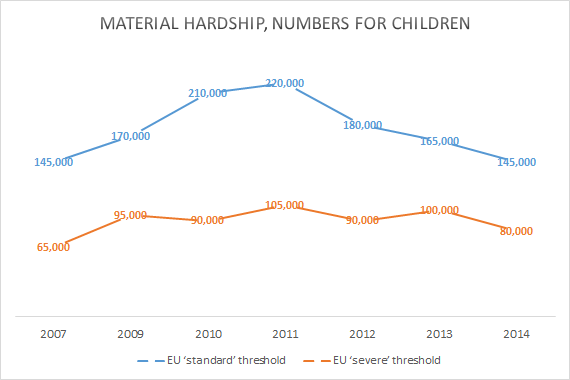
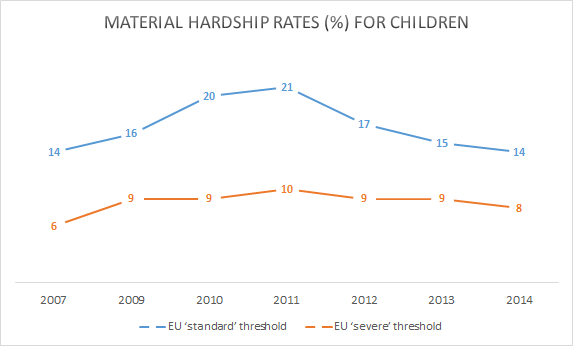
The material hardship measure shows a falling child material hardship rate using a threshold equivalent to the ‘standard’ EU level, down from a peak of 21% immediately after the GFC to 14% in 2014.
Using the more severe threshold, there was a slight rise through the GFC to 10% and a small fall to 8%, the level it was at before the GFC.
Source: Bryan Perry, Household Incomes in New Zealand: trends in indicators of inequality and hardship 1982 to 2014 – Ministry of Social Development, Wellington (August 2015), p. 133.
Source: Bryan Perry, Household Incomes in New Zealand: trends in indicators of inequality and hardship 1982 to 2014 – Ministry of Social Development, Wellington (August 2015), p. 133.
Maori and Pasifika economic progress since 1988
13 Aug 2015 Leave a comment
in applied welfare economics, discrimination, economic history, labour economics, politics - New Zealand, poverty and inequality Tags: Maori economic development
From a longer-term perspective, all groups showed a strong rise from the low point in the mid 1990s through to 2010. In real terms, overall median household income rose 47% from 1994 to 2010: for Maori, the rise was even stronger at 68%, and for Pacific, 77%.
These findings for longer- term trends are robust, even though some year on year changes may be less certain. For 2004 to 2010, the respective growth figures were 21%, 31% and 14%.

Source: Bryan Perry, Household Incomes in New Zealand: trends in indicators of inequality and hardship 1982 to 2014 – Ministry of Social Development, Wellington (August 2015), Table D6.
@WJRosenbergCTU A brief history of rising equality in New Zealand
13 Aug 2015 Leave a comment
in applied price theory, applied welfare economics, economic history, economics of media and culture, income redistribution, labour economics, politics - New Zealand, poverty and inequality, Public Choice Tags: capitalism and freedom, Leftover Left, The Great Enrichment, The Great Fact, top 1%, Twitter left
Bill Rosenberg at the Council of Trade Unions was good enough to tweet a Treasury chart that shows next to no increases in inequality in New Zealand for at least 20 years.
A brief history of inequality-from Treasury paper Fig4. Note Employment Contracts Act,GST,income tax,benefit cuts,WFF http://t.co/y4w3cUsgjD—
Bill Rosenberg (@WJRosenbergCTU) June 27, 2015
Inequality in both market and disposable incomes has been stable for a good 20 years, as the above tweet shows, while inequality in consumption has been falling. To back this interpretation of mine up, coincidentally today Bryan Perry published his annual report on income and inequality under the banner of the Ministry of Social Development.
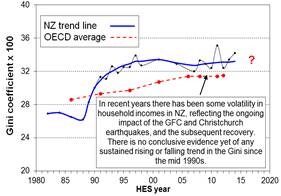
His report showed that there be no significant increase in New Zealand in at least 20 years.
@metiria @NZGreens child poverty is driven by housing unaffordability – by Green opposition to RMA reform
13 Aug 2015 1 Comment
in applied welfare economics, economic history, economics of regulation, labour economics, politics - New Zealand, poverty and inequality, urban economics Tags: antimarket bias, child poverty, expressive voting, family poverty, green rent seeking, housing affordability, land use planning, Leftover Left, New Zealand Greens, NIMBYs, rational ignorance, rational irrationality, RMA, zoning
#moreinclusivenz @povertymonitor Killer graphs & #infographics by NZ Children's Commissioner. Shameful content, NZ http://t.co/mG987C5kh0—
Isabella Cawthorn (@fixiebelle) July 26, 2015
Nothing much has happening to child poverty before housing costs in New Zealand since the early 1980s. It is after housing costs poverty that is crucifying the children in New Zealand.
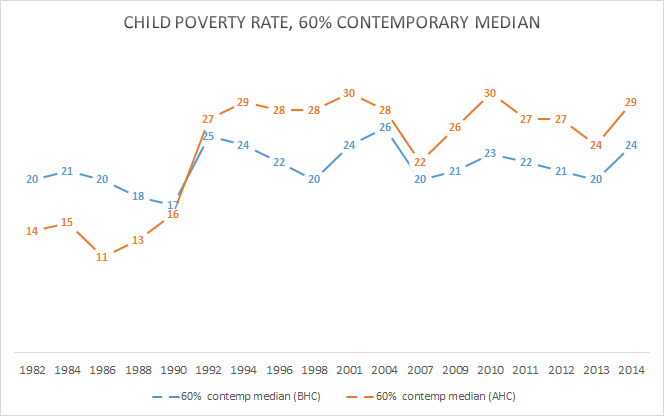
Source: Bryan Perry, Household Incomes in New Zealand: trends in indicators of inequality and hardship 1982 to 2014 – Ministry of Social Development, Wellington (August 2015), Table F6 and table F7.
An economy that is not working for all of us, is simply not working. http://t.co/zZu0LOy7ED—
Green Party NZ (@NZGreens) August 13, 2015
From HES 2013 to HES 2014 median household income rose 5% in real terms (5% above the CPI inflation rate)…
On the AHC moving line measures, child poverty rates in HES 2014 are around the same as their peak after the GFC. A good amount of the rise from HES 2013 to HES 2014 is due to the large rise in the BHC median, as noted above, rather than a change in the numbers in low income per se.
The parties that oppose measures to increase the supply of land and reduce the cost of housing through reform of the Resource Management Act and its many restraints on the supply of land are the New Zealand Labour Party and New Zealand Greens.
Children's views on poverty #childpovertynz occ.org.nz/assets/Uploads… http://t.co/wZHJ19QcpN—
Child Poverty NZ (@povertymonitor) September 08, 2015
 Utopia, you are standing in it!
Recent Comments