In 1993, >30% of India's urban population lived in extreme poverty. In 2011? Only 13%. buff.ly/1iutlQA http://t.co/238hsW2aeF—
HumanProgress.org (@humanprogress) September 09, 2015
The Great Escape actually accelerated after the GFC
10 Sep 2015 Leave a comment
in development economics, economic history, global financial crisis (GFC), growth disasters, growth miracles, health economics, labour economics, macroeconomics, poverty and inequality Tags: child poverty, extreme poverty, global poverty, India, The Great Escape, The Great Fact
The mancession
06 Sep 2015 Leave a comment
in business cycles, economic history, global financial crisis (GFC), great recession, job search and matching, labour economics, labour supply, macroeconomics, unemployment Tags: reversing gender gap
How frequent are simultaneous financial crises in one country?
04 Sep 2015 Leave a comment
in business cycles, currency unions, development economics, economic growth, economic history, Euro crisis, financial economics, global financial crisis (GFC), great depression, great recession, growth disasters, growth miracles, law and economics, macroeconomics, monetary economics, property rights Tags: bank runs, banking crises, banking panics, currency crises, current account crises, debt crises, pseudo financial crises, real financial crises, sovereign debt crises, sovereign default
Longest time without a recession
02 Sep 2015 Leave a comment
in business cycles, economic growth, economic history, fiscal policy, global financial crisis (GFC), great recession, macroeconomics, monetary economics, politics - Australia, politics - New Zealand, politics - USA Tags: Australia, recessions and recoveries
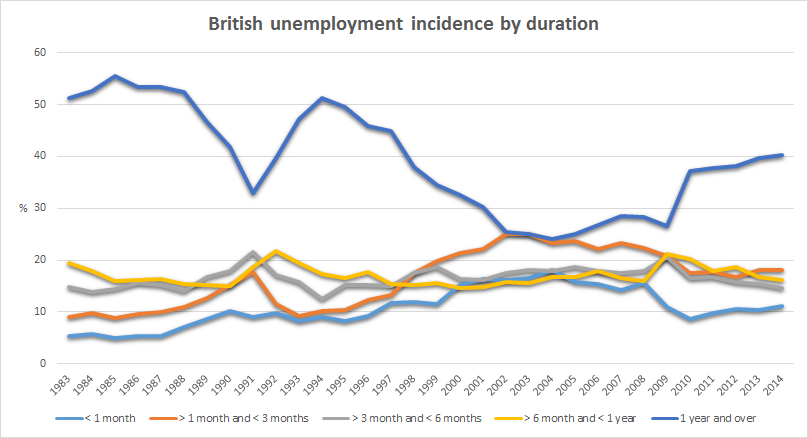
British unemployment incidence by duration since 1983
09 Aug 2015 Leave a comment
in business cycles, economic history, global financial crisis (GFC), job search and matching, labour economics, labour supply, macroeconomics, unemployment Tags: British disease, British economy, equilibrium unemployment rate, Margaret Thatcher, natural unemployment rate, unemployment duration, unemployment rates
In contrast to the USA, there is been a long-term decline in long-term unemployment, that is unemployment of more than a year, in the British economy over the 1990s. The situation then stabilised and then increased after the global financial crisis. There is also a rather rapid fall in long-term unemployment in the mid-1980s as the British economy recovered under Thatchernomics
Source: OECD StatExtract.
ABCT insights are predominantly a theory of unsustainable credit-induced booms
09 Aug 2015 Leave a comment
in Austrian economics, business cycles, global financial crisis (GFC), great depression, great recession, macroeconomics, monetarism, monetary economics Tags: Austrian business cycle theory, Austrian macroeconomics, booms and busts, central banking, monetary policy, Roger Garrison

via What Austrian business cycle theory does and does not claim as true | Institute of Economic Affairs
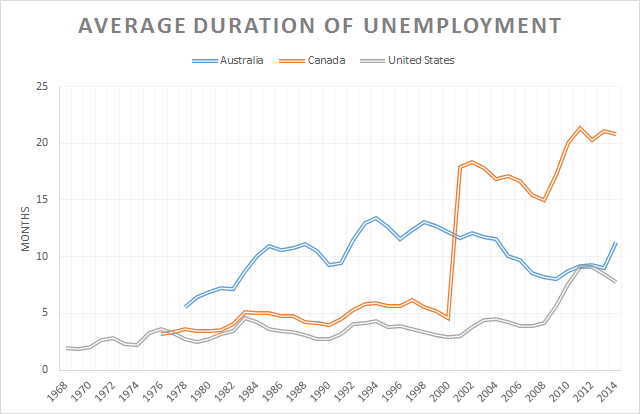
Average duration of unemployment, USA, Canada and Australia, 1968 – 2014
08 Aug 2015 Leave a comment
in business cycles, economic history, global financial crisis (GFC), great recession, job search and matching, labour economics, labour supply, macroeconomics, unemployment Tags: Australia, Canada, unemployment rates
Source: OECD StatExtract.
I have no information as to why there is a sudden surge in the Canadian unemployment duration rate in 2001.
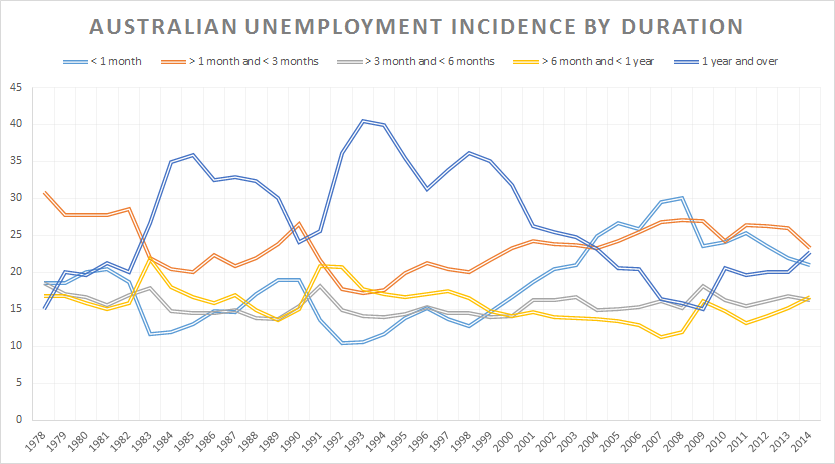
Australian unemployment incidence by duration since 1978
07 Aug 2015 Leave a comment
in economic history, global financial crisis (GFC), job search and matching, labour economics, labour supply, macroeconomics, politics - New Zealand, unemployment Tags: Australia, equilibrium unemployment rate, natural unemployment rate, unemployment duration
As with New Zealand, Australian long-term unemployment seems to go up and down quite a lot with recessions such as those in the early 1980s and early 1990s but not after the global financial crisis.
Source: OECD StatExtract.
Did fiscal austerity in 2010 have credible academic support?
05 Aug 2015 1 Comment

#Greece austerity gauge. Greek government spending has fallen 20% since 2008. In UK and Italy it's up. #GreekCrisis http://t.co/WMQBxxVFqq—
RBS Economics (@RBS_Economics) July 07, 2015
One measure of the scale of austerity in Greece…and other advanced economies. http://t.co/PxCLagdd3L—
RBS Economics (@RBS_Economics) July 06, 2015
The employment level in #Greece is back to where it was in 1985. It's the equivalent of the UK losing 6 million jobs. http://t.co/AAWHMEFwfK—
RBS Economics (@RBS_Economics) July 06, 2015
Did the GFC catch modern macroeconomists by surprise?
03 Aug 2015 Leave a comment
in budget deficits, business cycles, currency unions, economic growth, Euro crisis, fiscal policy, global financial crisis (GFC), great depression, great recession, history of economic thought, law and economics, macroeconomics, monetary economics Tags: bank panics, bank runs, banking crises, currency crises, Thomas Sargent
@sjwrenlewis The stimulus package ignored what we have learned in the last 60 years of macroeconomic research
02 Aug 2015 Leave a comment
in budget deficits, business cycles, economic growth, fiscal policy, global financial crisis (GFC), great recession, history of economic thought, macroeconomics, monetarism, monetary economics Tags: Brad Delong, fiscal multiplier, fiscal stimulus, Larry Summers, New Keynesian macroeconomics, Thomas Sargent
Italy compared to Greece – bust without the boom
31 Jul 2015 1 Comment
in business cycles, currency unions, economic growth, economic history, Euro crisis, global financial crisis (GFC), macroeconomics Tags: Eurosclerosis, Greece, Italy, sovereign defaults
Is the socialist solution to the Greek economic crisis working?
25 Jul 2015 Leave a comment
in budget deficits, business cycles, currency unions, economic growth, Euro crisis, fiscal policy, global financial crisis (GFC), international economics, law and economics, macroeconomics, monetary economics, property rights Tags: capital controls, capital flight, Greece, labour exodus, sovereign defaults
For down and out Greeks, the U.K. is the promised land with jobs aplenty bloom.bg/1Lwcc55 http://t.co/XHHXxdTUiN—
Bloomberg Business (@business) July 24, 2015


Recent Comments