Milton Friedman on inflation as a monetary phenomena
24 May 2016 1 Comment
in macroeconomics, Milton Friedman, monetarism, monetary economics Tags: American Civil War, inflation
What Was the Industrial Revolution? – Robert E. Lucas
18 May 2016 Leave a comment
in economic growth, economic history, fiscal policy, Robert E. Lucas Tags: industrial revolution
The cost of regulation in the USA
27 Apr 2016 Leave a comment
in applied price theory, applied welfare economics, comparative institutional analysis, economic growth, economic history, economics of regulation, macroeconomics, politics - USA Tags: cost of economic regulation, endogenous growth theory
What 3 skills do public policy analysts need?
27 Apr 2016 Leave a comment
in applied price theory, business cycles, economics of bureaucracy, economics of regulation, fiscal policy, macroeconomics, monetary economics Tags: anti-market bias, antiforeign bias, expressive voting, lags on monetary policy, makework bias, rational rationality, tax incidence, The fatal conceit, The pretense to knowledge
I used to argue that the quality of public policy making would double if public policy analysts remembered the first 6 weeks of microeconomics 101 but on reflection more than that is required.
Could we economists today ever show such self-restraint about our own expert recommendations? https://t.co/2UE12JuIgn—
William Easterly (@bill_easterly) November 24, 2015
I picked up my initial insight out when working as a graduate economist in the Australian Department of Finance. That was a few years ago.
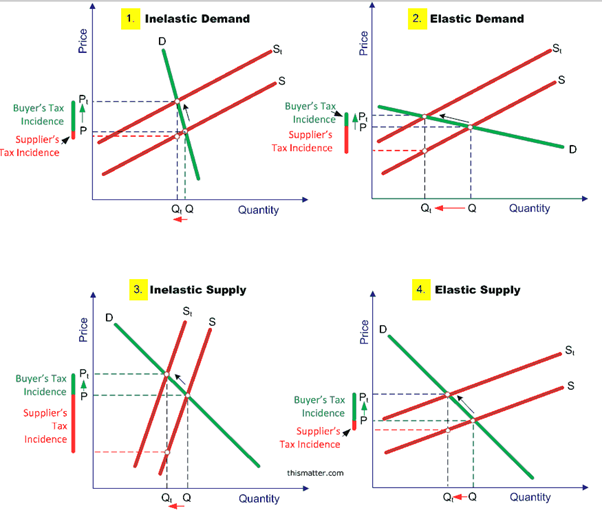
I am now concluded that policy analysts also need to know the basics of the economics of tax incidence. Who pays the tax depends on the elasticities of supply and demand rather than who writes the check to the taxman.
The number of times that I have read media and public policy analysis saying who pays the tax is the writer of the cheque to the taxman is beyond counting.
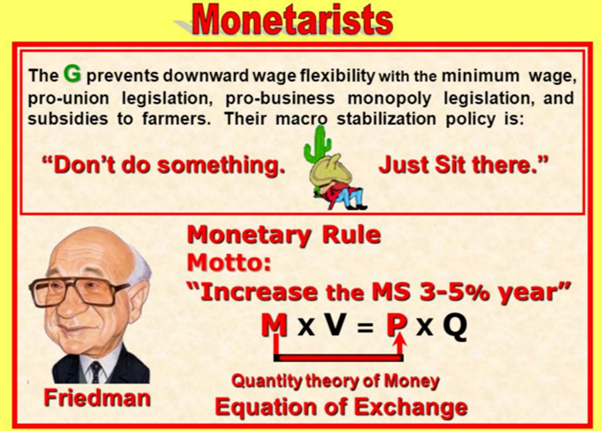
There is also what to do about unemployment and inflation. Do not just do something, sit there might be good advice on most occasions. As Tim Kehoe and Gonzalo Fernandez de Cordoba explain in the context of first do no harm:
Looking at the historical evidence, Kehoe and Prescott conclude that bad government policies are responsible for causing great depressions.
In particular, they hypothesize that, while different sorts of shocks can lead to ordinary business cycle downturns, overreaction by the government can prolong and deepen the downturn, turning it into a depression.
A Mall divided by different city minimum wage laws @SueMoroney @GreenCatherine
26 Apr 2016 1 Comment
in applied price theory, applied welfare economics, economics of regulation, labour economics, minimum wage, politics - New Zealand, politics - USA, Robert E. Lucas Tags: Alan Manning, city minimum wage laws, living wage, monopsony
The Westfield Valley Fair Mall is half in San Jose city and half in Santa Clara city. In 2012, San Jose raised its minimum wage from $8 to $10 per hour.
National Public Radio in 2014 had a brilliant broadcast on the implications of this new city minimum wage law on the Westfield Valley Fair Mall. As the broadcast said:
This change created two economic worlds within a single, large building. Employees doing more or less the same work, just steps away from each other, started making different wages.
The radio show discussed what happened on the $8 side of the Mall and then on the $10 side through interviews with employers and workers.
On the then $8 per hour minimum wage side of the Mall, employers quickly noticed that many of their employees quit to jobs elsewhere in the same Mall. These same employees found that the quality of job applicants also fell away seriously. There were noticeable differences in the personalities traits and dress standards presented by the $8 an hour job applicants and $10 an hour job applicants.
As is to be expected because information about job opportunities is costly, some of the minimum wage employees did not know that other parts of the Mall paid more.
(This change in job turnover rates and applicant pool quality subsequent to the minimum wage increase in San Jose has implications for the inequality of bargaining power between workers and employers. Minimum wage workers do keep an eye on competing opportunities and take them up when better options arise – JR aside).
Since 2012, the minimum wage rates in the Mall have changed again: Santa Clara’s minimum wage initially increased to $9 an hour – the state-wide minimum wage, which had increased from $8 per hour; San Jose’s $10.15 per hour.
Those city minimum wages were increased further this year to $11 in Santa Clara city and $10.30 in San Jose city respectively by the respective city councils.
The state-wide minimum wage in California is to increase to $15 per hour by 2020 under a law just passed. California’s current $10-per-hour minimum wage is already among the highest in the country — only Washington, DC, has a higher minimum wage at $10.50 per hour.
Getting back to what was said in the National Public Radio broadcast, the show then moved on to the Gap Store, which straddled the two city boundaries.

Source: Episode 562: A Mall Divided : Planet Money : NPR.
The Gap Store had the option of keeping a record of how much time employees spent in each city within its store and pay accordingly under each city law. The Gap raised everybody’s wage to $10.
There was then a fascinating interview with a Pretzels store owner. The question she asked herself every time she bought anything was how many pretzels se had to sell to cover the cost. She quickly concluded that she could not sell enough additional pretzels to cover the wage rise.
There is another Pretzels store just around the corner from her in the same mall but in the other city so she could not raise her prices by that much. She had a picture of that day’s menu and price list of the competing Pretzels store on her smart phone.
She instead took a cut in her profit. This flowed back to her employers because they received an annual bonus based on 15% of each year’s profit. They did not like that reduction in their bonus.
In a delicious irony, this same entrepreneur owned another Pretzels store in a different part of the Mall but which was in the other city subject to the lower minimum wage law. She owned two of the three pretzels stores in that Mall.
She solved the problem in staff morale by rotating her staff in alternate weeks between her two stores in the same Mall but different cities and paying them accordingly.
In my opinion, this NPR story is pretty much a vindication of standard microeconomics of minimum wage laws. Minimum wage workers are alert to their opportunities and take the best ones available to them but this is not perfect because of cost of information. As Manning observed in his superb book Monopsony in Motion:
That important frictions exist in the labor market seems undeniable: people go to the pub to celebrate when they get a job rather than greeting the news with the shrug of the shoulders that we might expect if labor markets were frictionless.
And people go to the pub to drown their sorrows when they lose their job rather than picking up another one straight away. The importance of frictions has been recognized since at least the work of Stigler (1961, 1962).
As George Stigler argued, information is costly to obtain in the labour market and this leads to price and wage dispersion with this variance related to the cost of searching for information. He concluded that the one-price (one-wage) market will occur only where the cost of information about the prices (wages) offered by buyers and sellers is zero.
Finally, minimum wages rises threaten the profitability of businesses and therefore their survival. That puts low-pay jobs at risk. As Bhaskar, Manning and To (2002) explain in their survey paper on monopsony:
Notice also that because a binding minimum wage reduces employers’ profits when there is free entry into and exit out of the labor market, some employers will be forced to exit. Employer exit has a negative effect on total employment through the loss of exiting employer payrolls.
That is, although establishments that remain after the imposition of a minimum wage increase their employment, some employers are forced out of business.
Thus, minimum wages have two opposing effects: the employment-increasing “oligopsony” effect and the employment-reducing “exit” effect. The overall effect of a minimum wage depends on which effect dominates.
An increase in the family tax credit puts no jobs at risk and is a superior alternative to minimum wage laws. Minimum wage increases throw some low page workers onto the social scrapheap.
Some look upon these large minimum state and city wage increases as worthwhile policy experiments. As Dube said:
… 30 to 40 percent of the California workforce will get a raise … This will be a big experiment. It’s far outside of our evidence base… If you’re risk-averse, this would not be the scale at which to try things.
On the other hand, if you think that wages are really low and they’ve been low for a really long time and we can afford to take some risks, doing things at this scale will get us more evidence.
“Big experiments” to use Dube’s words such as these with state and city minimum wages laws are wrong as Robert Lucas explained in 1988:
I want to understand the connection between in the money supply and economic depressions.
One way to demonstrate that I understand this connection–I think the only really convincing way–would be for me to engineer a depression in the United States by manipulating the U.S. money supply.
I think I know how to do this, though I’m not absolutely sure, but a real virtue of the democratic system is that we do not look kindly on people who want to use our lives as a laboratory. So I will try to make my depression somewhere else.
@BernieSanders nothing is free in Denmark
24 Apr 2016 Leave a comment
in applied welfare economics, fiscal policy, politics - USA, public economics Tags: 2016 presidential election, Denmark, growth of government, size of government, social insurance, taxation and labour supply, welfare state
What a $15 Minimum Wage Would Do
20 Apr 2016 Leave a comment
in applied price theory, economics of media and culture, entrepreneurship, job search and matching, labour economics, managerial economics, minimum wage, organisational economics, personnel economics, theory of the firm Tags: living wage, offsetting behavior, The fatal conceit
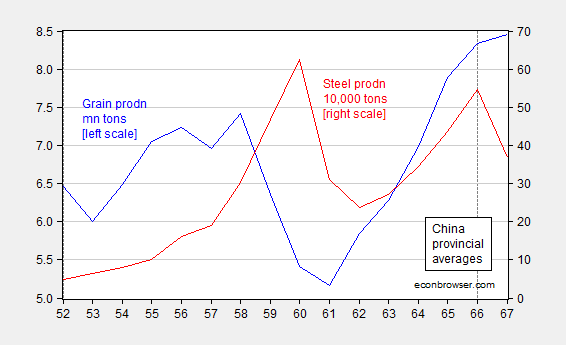
Thinking about The Great Leap Forward | Econbrowser
19 Apr 2016 Leave a comment
in applied price theory, applied welfare economics, comparative institutional analysis, development economics, economic growth, economic history, growth disasters, industrial organisation, law and economics, Marxist economics, Public Choice, rentseeking Tags: China, economics of planning, extreme poverty, famine, Great Leap Forward
Did the rise of welfare state cause more inequality in wealth?
18 Apr 2016 Leave a comment
in fiscal policy, labour economics, labour supply, macroeconomics, poverty and inequality, public economics Tags: growth of government, income inequality, measurement error, Ricardian theory of budget deficits, Social Security, top 1%, wealth inequality
Markus Poschke and Barış Kaymak have just put out a paper arguing that increased social spending is a major driver of wealth inequality:
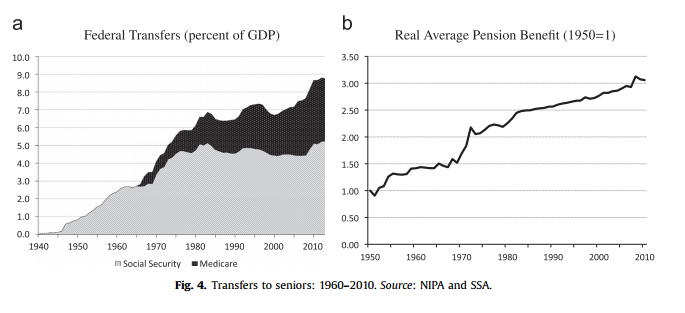
Another important and often overlooked third factor is the rise in the generosity of government transfers since 1960, mostly due to the expansion of public pensions (social security) and the introduction of public health insurance for the elderly (Medicare).
Combined spending on these two programs accounted for almost 9% of US GDP in 2010, up from less than 3% in 1960…
These government programmes tend to curb the need to rely on personal savings for retirement, especially among low and middle-income households, and might thus explain why their share in total wealth has declined.
This makes a good to good degree of sense. I have previously argued that using the arguments of Edward Prescott that it is not wise for people on ordinary income to save for their retirement when they can go down to the local Social Security office and claim an old age pension.
51% of nonretirees doubt they will receive Social Security… on.gallup.com/1NcwzEa #GallupDaily http://t.co/ZhKnHYtr1X—
(@GallupNews) August 13, 2015
It is even less wise to save that for retirement if those savings reduce your eligibility for an old age pension. Far better just to invest in a nicer house and pass it on to your children. Poschke and Kaymak note that measures of private wealth inequality miss these claims to old age pensions:
… statistics on wealth inequality that do not capture households’ claims on the public sector are incomplete and overstate top wealth shares.
This is not a new argument. Back when the Ricardian theories of budget deficits came to prominence and before that in debates on theories of the public debt, the more Keynesian sides of those arguments did argue that people were irrational for not including their old age pension entitlements under social security schemes in their calculations of their wealth.
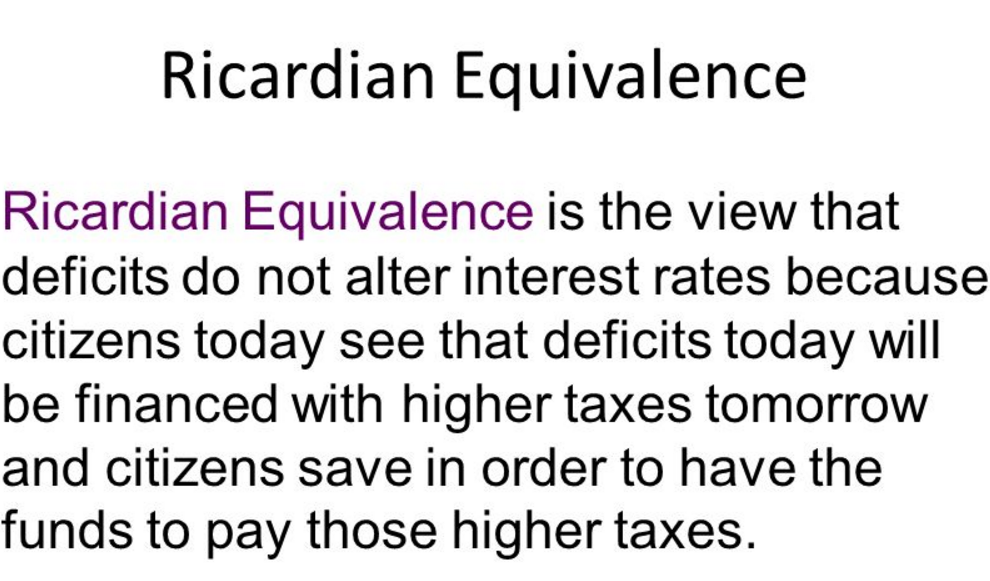
Some of their taxes were paying for their future old age pension and were another form of wealth rather than a tax. As such, taxpayers should regard this part of their taxes as investments and not cutting back their labour supply in response as they do to other taxes.
How much of the rise in wealth inequality is due to this failure to measure Social Security wealth as represented by old age pension entitlements? Their estimate is about 25%:
…technological factors play a dominant role not only for changes in income inequality, as is well known, but also for wealth inequality. As high-earning households save part of their additional income, their share of wealth also rises.
This channel accounts for about half of the total increase in wealth inequality. Tax cuts and the expansion of transfers each account for about half of the remainder…
While tax cuts encourage saving, larger transfers reduce saving incentives for retirement, in particular for low and middle income groups. This implies that these groups’ share of private wealth declines.
Note though that this is partly due to the fact that measures of private wealth inequality, like those compiled by Saez and Zucman, do not include claims to future government transfers, like social security, which constitute wealth for their owners.
@garethmorgannz gives optimal tax theory a pass once again @JordNZ
17 Apr 2016 Leave a comment
in applied price theory, entrepreneurship, fiscal policy, macroeconomics, politics - New Zealand, public economics Tags: company tax, Gareth Morgan, rational irrationality, taxation and entrepreneurship, taxation and investment, taxation and labour supply, taxation of capital income
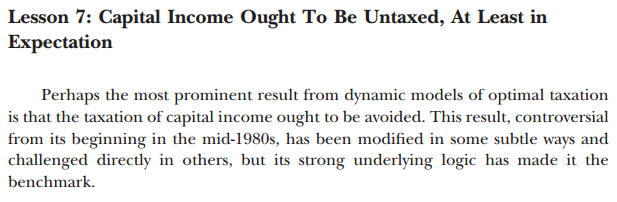
The Morgan Foundation gave optimal tax theory a pass in yesterday’s publication about taxes on land and capital. Gareth Morgan is keen on a comprehensive capital tax.
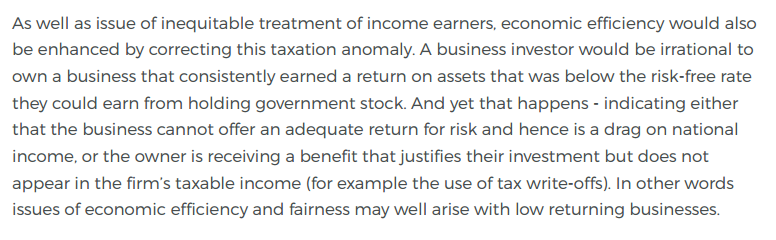
Source: Taxing Wealth & Property – What Works? A Morgan Foundation Report.
This failure to refer to optimal tax theory is despite the Foundation’s strong commitment to evidence-based policy. Any discussion of tax policy that is evidence-based must refer optimal tax theory.
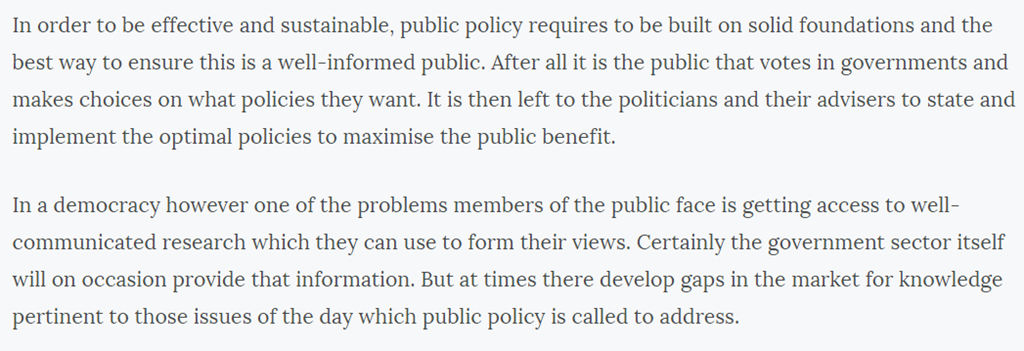
Source: Morgan Foundation, Public Policy Education.
<p>
Will the population bomb prevent the great stagnation?
16 Apr 2016 Leave a comment
in applied price theory, development economics, economic growth, industrial organisation, P.T. Bauer, population economics Tags: doomsday prophecies, endogenous growth theory, pessimism bias, population bomb

If only Paul Ehrlich had been right! Population explosion would have meant an explosion in people who could invent new technologies and populate in much larger markets to provide an incentive to invent new products.

Among Paul Ehrlich’s many analytical errors, he did not take into account that more people meant more inventors and more untapped markets.
Jones argued that in the very long run the only way to have further innovation is to have more people. If there are more people undertaking R&D and more people to populate the markets for those inventions, there will be further growth because the decreasing returns to knowledge creation will be overcome by having more R&D workers.
Jones attributes much of the growth in the 20th century to one-off effects that cannot be repeated such as putting more people into higher education:
… growth in educational attainment, developed-economy R&D intensity, and population are all likely to be slower in the future than in the past. These factors point to slower growth in US living standards.
Second, a counterbalancing factor is the rise of China, India, and other emerging economies, which likely implies rapid growth in world researchers for at least the next several decades.
Third, and more speculatively, the shape of the idea production function introduces a fundamental uncertainty into the future of growth. For example, the possibility that artificial intelligence will allow machines to replace workers to some extent could lead to higher growth in the future.
A larger population increases the rate of technological progress by increasing the number of geniuses and other creative people.The doomsday prophecies about the population bomb never took that into account. That is why they are wrong.
Interesting critique of the Big Short (moral hazard)
15 Apr 2016 Leave a comment
in applied price theory, business cycles, economics of media and culture, global financial crisis (GFC), law and economics, macroeconomics Tags: moral hazard, The Big Short
What undergrads and @stevenljoyce need to know about trade @GreenCatherine
12 Apr 2016 Leave a comment
in applied price theory, applied welfare economics, development economics, international economics, job search and matching, labour economics, labour supply, macroeconomics, politics - New Zealand Tags: antiforeign bias, free trade, makework bias, Paul Krugman, protectionism, tariffs, trade policy
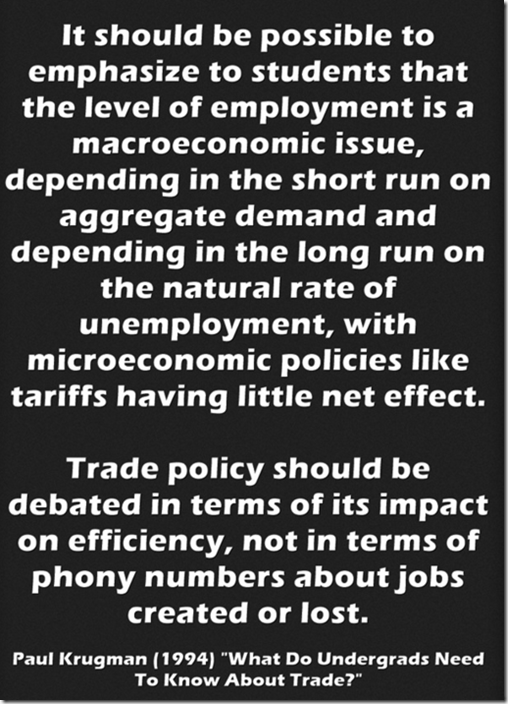
Minister for everything Stephen Joyce wrote some nonsense in the paper today about how trade agreements and more exports will mean more jobs:
I would like to make the point that trade access is hugely important for a small country like New Zealand.
Without fair and equal trade access we can’t sell as much of our goods and we get less for them. And that means fewer jobs.
This make-work bias is as bad as those who oppose trade agreements on the grounds of an anti-foreign bias. Trade affects the composition of employment, not the number of jobs. Paul Krugman spent a good part of the 1990s trying to explain that to the general public and public intellectuals.


Recent Comments