Source: Macro and Other Market Musings: The Latest Central Bank Fad: Asymmetric Inflation Targeting
Inflation targeting explained
06 Feb 2016 Leave a comment
in economics of bureaucracy, macroeconomics, monetary economics
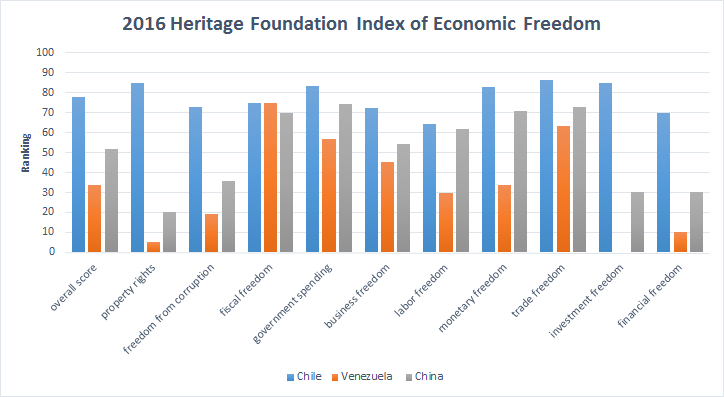
@OwenJones84 @K_Niemietz Venezuelan, Chilean and Chinese index of economic freedom rankings 2016
06 Feb 2016 Leave a comment
in development economics, economics of regulation, entrepreneurship, fiscal policy, growth disasters, growth miracles, industrial organisation, labour economics, law and economics, macroeconomics, monetary economics, property rights, public economics Tags: capitalism and freedom, Chile, China, The Great Escape, Venezuela
A bizarre Finnish amateur racing car practice for redistributing winning
06 Feb 2016 Leave a comment
in economics of media and culture, fiscal policy, income redistribution, labour economics, labour supply, law and economics, poverty and inequality, property rights, public economics, rentseeking Tags: basic income, car racing, Finland, guaranteed minimum income, negative income tax
The Inability to Understand Exponential Growth
05 Feb 2016 Leave a comment
in applied price theory, economic growth, macroeconomics Tags: endogenous growth theory, great stagnation
% industrialised countries at zero or near zero central bank interest rates
04 Feb 2016 Leave a comment
in business cycles, currency unions, Euro crisis, global financial crisis (GFC), great recession, inflation targeting, macroeconomics, monetarism, monetary economics Tags: central banks, liquidity trap, monetary policy
Review of #TheBigShort including of the movie
02 Feb 2016 Leave a comment
in applied price theory, business cycles, economic history, entrepreneurship, financial economics, global financial crisis (GFC), great recession, macroeconomics, monetary economics, movies Tags: bank runs, financial crises
About the only time the Hollywood Left oozes with patriotism is when getting stuck into Wall Street. Hollywood must get its revenge for all those times investors did not back their film pitches, trimmed budgets and get the lion’s share of merchandising royalties and syndication profits. As Larry Ribstein explained:
American films have long presented a negative view of business…. it is not business that filmmakers dislike, but rather the control of firms by profit-maximizing capitalists… this dislike stems from filmmakers’ resentment of capitalists’ constraints on their artistic vision.
The Big Short is still a good film despite the left-wing populism, worth going to see. Its limitations in not discussing the monetary policy of The Fed or regulations that encouraged lending to high risk borrowers are justified poetic license and editing.
The film is already 120+ minutes long despite frequent resorts to breaking the fourth wall to explain technical terms, who was what and what they were doing, past and present. The Big Short is a film designed it make money at the box office, not a semester long documentary.
The Big Short is well acted, funny, insightful and still a good story despite the documentary element that was impossible to do without.
The Big Short highlights that its protagonists had skin in the game. They were investing in mortgages or shorting the same in the expectation of a crash. There were no windbags and armchair critics in The Big Short talking gloom and doom on the horizon without investing their own money to profit from their forecasts. That said, the protagonists betting on a sub-prime mortgages crash, bar two of them, were a little bit nutty.
I do not know any of the critics of the economics of the film’s explanation of the sub-prime crisis who suggested how they could fix these gaps in its economics without making the film much, much longer.
These critics fall into the exact same trap that the Big Short was not about. The Big Short was about investors to put their money where their mouth is. The critics of the film should put their script doctoring skills where their mouths are at least of The Big Short.
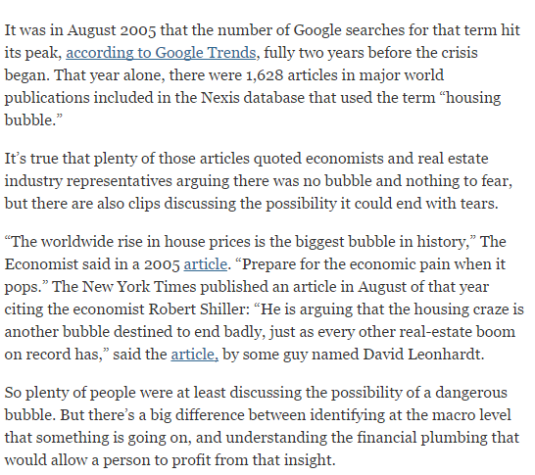
Source: What ‘The Big Short’ Gets Right, and Wrong, About the Housing Bubble – The New York Times.
Getting stuck into the role of the Fed and regulatory mandates on the banks regarding their level of sub-prime mortgages is for another film. Plenty of people warned of dark days ahead. An essay anyone can read with profit is Ross Levine’s “An Autopsy of the U.S. Financial System: Accident, Suicide, or Negligent Homicide?“
Other films, correctly documentaries, place the blame for the sub-prime crisis and the Great Recession directly on the Fed:
The financial mess we’re still climbing out of can be laid directly at the feet of the Fed, whose misguided advocacy, under Greenspan, of a borrow-and-spend economy rather than a focus on savings and investment has created a situation where, as the title implies, money is disconnected from any underlying value.
There are plenty of points that could be added to the economics of The Big Short if it was a film of more or less unlimited length:
Krugman and friends like the film because it leaves out any discussion of the main culprit behind the financial crisis, which was not Wall Street “greed” but bad monetary and credit policies from the Federal Reserve and the federal government. The movie barely hints at any exogenous factors behind the boom or bust. (This FEE report by Peter Boettke and Steven Horwitz fills in the missing information.) So the pro-regulation crowd is cheering. Viewers are given no understanding of the real causal factors and hence fill in the missing data with a feeling that banks just love ripping people off. To be sure, if you approach this movie with some knowledge of economics and monetary policy, the rest of the narrative makes sense. Of course Wall Street got it wrong, given Washington’s policies on mortgage lending!
To add to the brew, Edward Prescott points out the Great Recession can be explained through productivity shocks. Specifically, a collapse in investment and in particular investment in intangibles such as intellectual property in 2007 in anticipation of more taxes and more regulation.
The Great Recession had many of the same features of the 1990s technology boom but in reverse. The boom in the 1990s and bust in 2007 were somewhat inexplicable because major sources of volatility were unmeasured, specifically, investment in intangible capital.
V.V. Chari also points out that the extent of the financial crisis was overstated. This is because the typical firm can finance its capital expenditures from retained earnings so it was hard to see how financial market disruptions could directly affect investment.
What Chari disputed was that bank lending to non-financial corporations and individuals has declined sharply, that interbank lending is essentially non-existent; and commercial paper issuance by non-financial corporations declined sharply, and rates have risen to unprecedented levels.
John Taylor argues that we should consider macroeconomic performance since the 1960: There was a move toward more discretionary policies in the 1960s and 1970s; A move to more rules-based policies in the 1980s and 1990s; and back again toward discretion in recent years.
These policy swings are correlated with economic performance—unemployment, inflation, economic and financial stability, the frequency and depths of recessions, the length and strength of recoveries. Less predictable, more interventionist, and more fine-tuning type macroeconomic policies have caused, deepened and prolonged the current recession. Robert Hetzel puts it this way:
The alternative explanation offered here for the intensification of the recession emphasizes propagation of the original real shocks through contractionary monetary policy. The intensification of the recession followed the pattern of recessions in the stop-go period of the late 1960s and 1970s, in which the Fed introduced cyclical inertia in the funds relative to changes in economic activity.
Finn Kydland considers fiscal policy to be at the heart of the slow recovery. Instead of restructuring and investing more prudently, Western countries faced with budget shortfalls will seek to increase taxes:
- The U.S. economy isn’t recovering from the Great Recession of 2008-2009 with the anticipated strength.
- A widespread conjecture is that this weakness can be traced to perceptions of an imminent switch to a regime of higher taxes.
- The fiscal sentiment hypothesis can account for a significant fraction of the decline in investment and labor supply in the aftermath of the Great Recession, relative to their pre-recession trends.
- The perceived higher taxes must fall almost exclusively on capital income. People must suspect that the tax structure that will be implemented to address large fiscal imbalances will be far from optimal.
Now imagine trying to incorporate all the above points into a film and keeping it at its current two-hour length?
Compulsory superannuation makes a big difference to the size of Australian public sector
01 Feb 2016 Leave a comment
in fiscal policy, politics - Australia, public economics
Share market losses during previous financial crises in the USA and UK
31 Jan 2016 Leave a comment
in business cycles, economic history, fisheries economics, global financial crisis (GFC), great depression, great recession, macroeconomics Tags: banking crises, financial crises, sovereign debt crises, sovereign defaults
Indirect taxes as % of US, UK, Danish, Australian and New Zealand GDPs
30 Jan 2016 Leave a comment
in economic history, fiscal policy, public economics
There are big differences between the USA, between the USA and Australia and the rest with a mild exception for the UK.
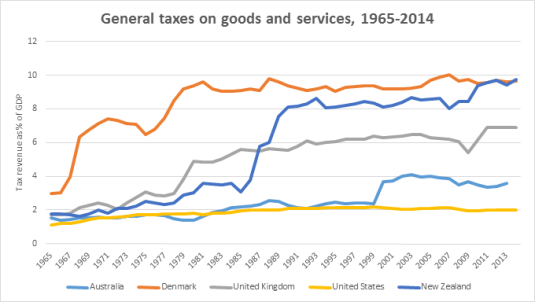
Data extracted on 30 Jan 2016 03:05 UTC (GMT) from OECD.Stat.
% global GDP with negative central bank interest rates
30 Jan 2016 Leave a comment
in economic history, global financial crisis (GFC), monetary economics
Haggling and the gender pay gap
29 Jan 2016 1 Comment
in discrimination, economics of love and marriage, gender, job search and matching, labour economics, occupational choice Tags: asymmetric marriage premium, gender wage gap, marital division of labour, marriage and divorce
Geoff Simmons attributes part of the gender wage gap to the reluctance especially among women in high-paying jobs to haggle over pay. These women at the top end of the labour market are more likely to accept the first offer.
This relative reluctance of women to haggle over their pay is important to explaining why the gender wage gap is much larger at the top end of the labour market than at the bottom according to Geoff Simmons. Women have to haggle more if the gender pay gap is to close further.
Haggling over the wage has costs as well as benefits as Richard Epstein explained 20 years ago within a search and matching framework when commenting on a paper written by Carol Rose in 1992:
If one party is known to gobble up virtually all the cooperative surplus, then that party will find it difficult to attract deals. People anticipate getting some portion of the gain and will have a tendency to migrate to other individuals and transactions when they do not have to be ever watchful of their fair share of the gain.
If women have the characteristics that Rose attributes to them, then they would be able to enter more deals and find jobs more easily than men. At this point it becomes an empirical question: whether the greater frequency of deals (or shorter periods of unemployment) offset the tendency to gain a larger share of the profits of any given transaction.
Women will find it easier to get a job because they haggle less and therefore negotiations are less likely to breakdown, which will increase their lifetime income. This reduction in the cost of search because of a greater prospect of a match offset the losses in wages from successful haggling.
Indeed, does not this reluctance to haggle among women make it more likely that employers will hire women and promote the because their reluctance to haggle makes them cheaper. This starts off a competition between employers that will slowly drive up the wages offered to women.
It is also the case that women invest in human capital that is more mobile between the jobs and they are more likely to quit the workforce and return again after motherhood.
The ability to quickly find a job after a career interruption is a competitive advantage rather than a disadvantage.
Men have more specialised human capital and are more likely to stay in one job so they have more to gain from haggling. In comparison, women invest in human capital that is more mobile between jobs because they anticipate downscaling or quitting because of motherhood.
In such a case, it is advantageous to have human capital that appeals to a wide range of employers and become can be quickly matched so that full-time or part-time employment and the associated income stream can start quick as quickly as possible. Workers who changed jobs more often and have shorter job tenures have less to gain and more to lose from haggling and not getting the job at all.
If women do not like to haggle, does this not imply they are less likely to be attracted the jobs with performance pay? Alan Manning investigated this specific question a few years ago.
The propensity of women to seek or avoid jobs with performance pay in a more competitive workplace is an important question because up to 40% of jobs have some form of performance pay which would put women off if they do not like to haggle as Geoff Simmons implies.
Manning used jobs with performance pay in the the 1998 and 2004 British Workplace Employees Relations Survey as a proxy for the level of competition in the workplace.
If Geoff Simmons is right, women should shy away from jobs with performance pay. Women should be less likely to hold these jobs with performance pay, other things being equal. That is precisely the hypothesis that Alan Manning explored. He is a world-class labour economist. What did he find?
We find very modest evidence for differential sorting into performance pay schemes by gender, and small effects of performance pay on hourly wages. Furthermore, and unlike the laboratory studies, we find no significant effect of the gender mix in the job on the responsiveness to performance pay.
We do find some evidence for an effect of performance pay on a measure of work effort in line with the experimental evidence but the bottom line is that a very small part of the gender pay gap can be attributed to these factors.
The gender pay is already tiny in New Zealand and only a tiny part of that can be explained as any reluctance of women to compete in the workforce such as through signing on for performance pay.
Manning found that the gender mix of jobs in occupation is not affected by the presence of performance pay but it should be if women are reluctant to angle and to be competitive as suggested by Geoff Simmons.
The reluctance of women to sign on for performance pay maybe be an aspect of the asymmetric marriage premium and the marital division of effort. Mothers, unlike fathers, cannot afford to go home at the end of the workday completely exhausted if there are children to care for.
Women have a long history of carefully selecting education and other human capital and occupations to anticipate the responsibilities of motherhood and minimising human capital depreciation during the associated career interruptions. Anticipating that motherboard is a lot of work is no stretch on that occupational sorting by women.
Women still do most of the household chores? Data on who does what in the house: goo.gl/3doqy4 #statistics https://t.co/fnY0d9OgkT—
DataStories (@LindaRegber) October 24, 2015
That division of effort between the sexes has got nothing to do with the behaviour of employers and everything to do with the marital division of labour. As to what to do about that Richard Posner raised a very good conundrum in a paper from 20 years ago:
The idea the government should try to alter the decisions of married couples on how to allocate time to raising children is a strange mixture of the utopian and the repulsive. The division of labour within marriage is something to be sorted out privately rather than made a subject of public intervention.
Liberal and radical frameless can if they wanted women to stay in the labour force and have no children or fewer children, or, persuade their husbands to assume a greater role in child rearing. Others can search the contrary. The ultimate decision is best left to private choice.
I remember from decades ago a couple at work who were very modern and trying to share the child rearing equally. Their three-year-old daughter was not very cooperative because she found that her mother was much better at braiding her hair than a father. That tantrum by their three-year-old was the beginning of the end of a grand plan.
The @LordAshcroft focus group research on @UKLabour
27 Jan 2016 Leave a comment
in constitutional political economy, fiscal policy, politics - New Zealand, Public Choice
The focus group work of Lord Ashcroft after the 2015 British general election reinforces what was learnt about the New Zealand Labour Party’s drift away from the values of the working class.
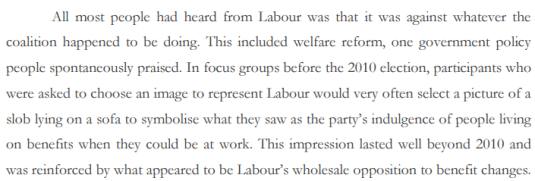
Source: The Unexpected Mandate: my review of the 2015 election and the unusual parliament that preceded it – Lord Ashcroft Polls.
In the 2014 election in New Zealand, the Labour Party promised to extend the in work tax credit for families to welfare beneficiaries. This was worth about $60 a week.
The following week was the worst week that Labour Party MPs and party workers experienced in their door-knocking. In their own Heartland electorates, the Labour Party door knockers received a hostile response to that proposal.
Working class Labour voters believe they had earned that family tax credit by working and it should not be paid to people who do not earn it by working.
There is a re-occurring theme among those who stopped voting labour everywhere is that Labour Party is are now too concerned about scroungers and are not interested enough in rewarding strivers, and in particular those who strive to improve themselves in the working class.
Ashcroft’s research after the 2010 British general election found that British voters who had stopped voting Labour after previously supporting it believed that the Labour Party did not have the right answers to important questions. 7 out of 10 of these voters believe that the expenditure cuts of the Conservative party when necessary.
Importantly for labour parties everywhere, two thirds of voters would take a lot of persuading before they voted for the British Labour Party again. Labour would need to change quite fundamentally before they did so again.
Many said they would wait until Labour had been re-elected and served a full term before they themselves considered voting Labour again. That means two thirds of the vote lost by Labour were unwilling to vote Labour again until the 2025 general election. They had really given up on Labour despite their support for it in the past. Issues such as a perception that Labour elected the wrong brother as its leader in 2010 were minor in comparison to this.
Fortunately for the Conservative Party, research among Labour Party members and Labour supporters in the trade unions tells a very different message as to why Labour lost the 2010 British general election.
These Labour Party members and supporters thought the voters were wrong to not vote for them according to the Ashcroft research after the 2010 election:
They thought they had lost because people did not appreciate what Labour had achieved; that voters had been influenced by the right-wing media; and that while Labour’s policies had been right, they had not been well communicated.
More than three quarters thought their party had not deserved to lose, and most rejected the idea that the Labour government had been largely to blame for the economic situation.
They thought the swing voters they had lost (and needed to win back) were ignorant, credulous and selfish. More than half thought the coalition would prove so unpopular that Labour would probably win the 2015 election without having to change very much.
The strength of British Labour in the eyes of many voters is it is seen as compassionate and concerned about fairness. Unfortunately for British Labour, many of the people who do not currently vote for Labour but are receptive to these messages of compassion and fairness re fiscal conservatives according to the Ashcroft research:
I found in my focus groups that this message was best received by those already most inclined to vote for the party.
It was less effective for those who had harder questions, particularly about how all this compassion and decency would be paid for. As one of our participants put it, ‘it’s all well and good to say we’re nicer people and we care about you more, but I want someone who can sort out the country’.
There is plenty of evidence of downward nominal wage flexibility
24 Jan 2016 1 Comment
in applied price theory, business cycles, macroeconomics, unemployment
Elsby, Shin and Solon (2016) have published a paper throwing a spanner in the works for business cycle theories premised on downward wage rigidity:
We devote particular attention to the hypothesis that downward nominal wage rigidity plays an important role in cyclical employment and unemployment fluctuations. We conclude that downward wage rigidity may be less binding and have lesser allocative consequences than is often supposed.
Keynesian macroeconomics is premised on downward wage rigidity. There is mass unemployment during recessions because employers are unwilling or unable to cut wages.
Elsby, Shin and Solon (2016) found that a non-trivial fraction of workers report nominal wage reductions: at least 10% of hourly workers and 20% of non-hourly workers. This fraction of workers whose nominal wage has been cut has been increasing since 1980 as shown in the chart below. The remaining workers either experienced a nominal wage freeze or a nominal wage increase in that year.
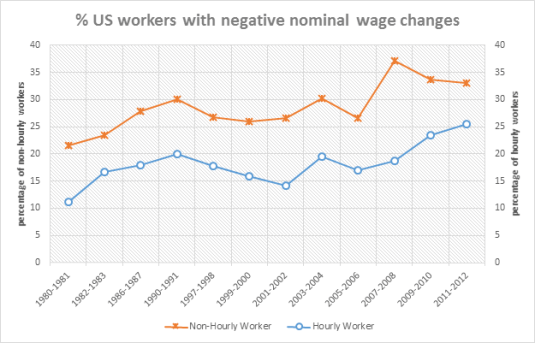
“What can wages and employment tell us about the UK’s productivity puzzle?” by Richard Blundell, Claire Crawford and Wenchao Jin found that in the recent British recession, 12% of employees in the same job as 12 months ago experienced wage freezes and 21% of workers in the same job as 12 months ago experienced wage cuts.
These results from the USA and UK come as no surprise to me because I have been on a collective employment agreement where after a restructuring, my pay was cut. The alternative was to leave and not receive a redundancy payment.
Chris Pissarides(2009), The Unemployment Volatility Puzzle: Is Wage Stickiness the Answer?, Econometrica argued the wage stickiness is not the answer to explaining unemployment since wages in new job matches are highly flexible:
1. wages of job changers are always substantially more procyclical than the wages of job stayers.
2. the wages of job stayers, and even of those who remain in the same job with the same employer are still mildly procyclical.
3. there is more procyclicality in the wages of stayers in Europe than in the United States.
4. The procyclicality of job stayers’ wages is sometimes due to bonuses, and overtime pay but it still reflects a rise in the hourly cost of labor
to the firm in cyclical peaks
I have been on several individual and collective agreements that grandfathered pay and conditions for existing workers and paid recruits less. I have lost count of the number of retirement pension scheme closed to new employees since I first encountered this cost saving practice at my first lecture at University.
My commercial law lecturer was explaining that he was lecturing part-time. His main job dealing with the litigation that might arise out of closing of the University retirement pension scheme. Some top-class academics had to retire earlier than they planned because of this closure to avoid a reduction in their pensions.
Most of my friends in the private sector are on bonus schemes were the great majority of the bonus is based on company profitability. Indeed, I know one company where everyone from the CEO down loses their bonus if there is a fatal workplace accident.
How can downward wage rigidity be a scientific hypothesis if the extensive international evidence of widespread nominal wage cuts wage cuts since the 1980s and 40%+ of the workforce on performance bonuses is not enough to refute it?
The same edition of the Journal of Labour Economics had a paper by Edward Lazear about how workplace effort varies with the business cycle and employment conditions:
…it seems that employers push their employees harder during recessions as they cut back the work force and ask each of the remaining workers to cover the tasks previously performed by the now-laid-off workers.
A number of models of long-term contracting in the labour market suggest that the level of employee effort expected varies with peak loads and general labour market conditions. That is understood from the start and is not is regarded as some form of opportunism by the employer after the contract is signed.
Likewise, employers do not lay off workers as soon as they become unprofitable in a downturn. If they did so, they would write off valuable firm specific human capital that might become profitable soon once the market recovers.
It is much easier to explain mass unemployment during a recessionas a a burst of layoffs at the beginning of the recession followed by the time it takes the unemployed to find suitable new vacancies and for employers to find it profitable to create such vacancies.
Some of these unemployed will simply wait for conditions to improve their existing industrial occupation so as to preserve their specialised human capital. These unemployed can be characterised as waiting unemployment or rest unemployment.
Other jobseekers will search further afield in new industries and occupations. These unemployed either have human capital that more general and mobile across many industries or have decided to scrap their industry specific and occupation specific human capital and try something else. The downturn in their current industry or occupation may be of sufficient duration that they regard waiting is a poor investment.
The economic concept of unemployment was rather primitive until Hutt write his hard to read theory of idle resources in 1939, Stigler’s paper in 1962 and the Phelps book in 1970.
I found Lucas and Prescott’s islands model to be an excellent explanation of unemployment. Lucas and Prescott’s economy is composed of a large number of scattered islands. Each of these islands is a one local labour market.
Workers in each of these islands have no precise knowledge of what wages will prevail in the economy outside of their own local labour market. Workers either remain on their island or leave it for what they expect to be a more alluring job further afield. Some workers are unemployed crossing between the islands, but they are nevertheless engaging in optimizing behaviour because they are looking for a better job than they have now.
Alchian (1969) lists three ways to adjust to unanticipated demand fluctuations:
• output adjustments;
• wage and price adjustments; and
• Inventories and queues (including reservations).
Alchian (1969) suggests that there is no reason for wage and price changes to be used regardless of the relative cost of these other options:
• The cost of output adjustment stems from the fact that marginal costs rise with output;
• The cost of price adjustment arises because uncertain prices and wages induce costly search by buyers and sellers seeking the best offer; and
• The third method of adjustment has holding and queuing costs.
There is a tendency for unpredicted price and wage changes to induce costly additional search. Long-term contracts including implicit contracts arise to share risks and curb opportunism over sunken investments in relationship-specific capital. These factors lead to queues, unemployment, spare capacity, layoffs, shortages, inventories and non-price rationing in conjunction with wage stability.
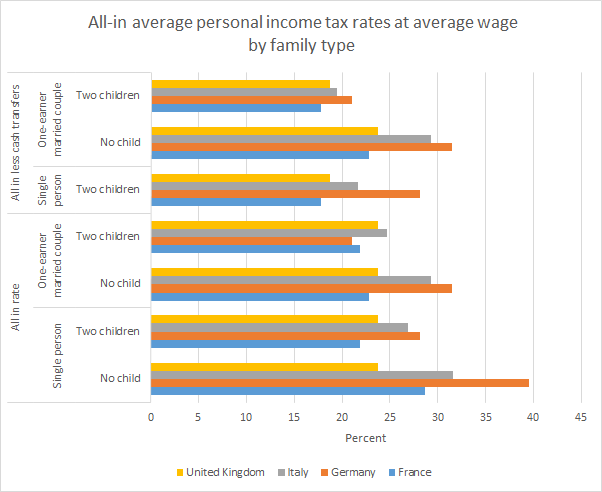
British, French, German and Italian All-in average personal income tax rates at average wage by family type
23 Jan 2016 Leave a comment
in fiscal policy, macroeconomics, public economics Tags: British economy, France, Germany, Italy, taxation and labour supply
Why @garethmorgannz wants his great big new tax @geoffsimmonz
21 Jan 2016 Leave a comment
in economic growth, fiscal policy, labour economics, labour supply, macroeconomics, politics - New Zealand, public economics Tags: Gareth Morgan, optimal tax theory, taxation of capital
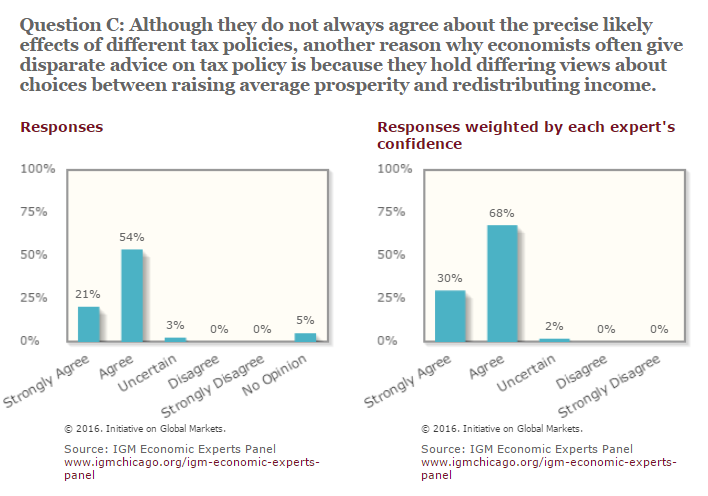
Source: Poll Results | IGM Forum.


Recent Comments