In graphics: Singapore at 50 http://t.co/FsMLXMz1G4 pic.twitter.com/H6FQF402E5
— The Economist (@TheEconomist) August 8, 2015
Singapore at 50
10 Aug 2015 Leave a comment
in constitutional political economy, development economics, economic history, economics of bureaucracy, growth miracles, Public Choice Tags: Singapore
An internal inconsistency in certain leading conspiracy theories
05 Aug 2015 Leave a comment
in applied price theory, comparative institutional analysis, economics of bureaucracy, economics of media and culture, health economics, Public Choice, rentseeking Tags: antiscience left, climate alarmism, conspiracy theories, conspiracy theorists, GMOs, political psychology
North and South Korea in the 20th century
03 Aug 2015 Leave a comment
in applied price theory, applied welfare economics, comparative institutional analysis, constitutional political economy, development economics, economic history, economics of bureaucracy, growth disasters, growth miracles, income redistribution, Marxist economics, Public Choice, rentseeking Tags: central planning, North Korea, South Korea
Has Africa Outgrown Development Aid?
03 Aug 2015 Leave a comment
in applied price theory, development economics, economic history, economics of bureaucracy, growth disasters, growth miracles, Public Choice, rentseeking Tags: Africa, capitalism and democracy, capitalism and freedom, rule of law, The Great Fact
I’m in hog heaven! Found a blog devoted to anomalies on maps!!
02 Aug 2015 Leave a comment
in economic history, economics of bureaucracy, Public Choice Tags: Bangladesh, economics of borders, enclaves, exclaves, geography, India, maps


via Say goodbye to the weirdest border dispute in the world – The Washington Post.


via An Apology of Enclaves – The New York Times.
The great new blog is http://bigthink.com/articles?blog=strange-maps
Buzz Aldrin’s travel voucher to the moon
31 Jul 2015 Leave a comment
in economic history, economics of bureaucracy, technological progress Tags: moon landing
If bureaucrats were any good at picking winners, they would be hedge funds managers
30 Jul 2015 Leave a comment
in applied price theory, comparative institutional analysis, economics of bureaucracy, entrepreneurship, financial economics, human capital, industrial organisation, labour economics, managerial economics, occupational choice, organisational economics, rentseeking, survivor principle Tags: active investing, corporate welfare, efficient markets hypothesis, entrepreneurial alertness, hedge funds, industry policy, passive investing, picking winners, The fatal conceit, The pretence to knowledge
Page 32 of "An Illustrated Guide to Income" more economic #dataviz at: bit.ly/12SEI9p http://t.co/HYm0II2UNI—
Catherine Mulbrandon (@VisualEcon) May 08, 2013
Page 33 of "An Illustrated Guide to Income" more economic #dataviz at: bit.ly/10M7lqR http://t.co/FcmaqZWB32—
Catherine Mulbrandon (@VisualEcon) May 09, 2013
The hedge fund industry held $2.9 trillion of assets in June. Exchange-traded funds did better econ.st/1DdXgWS http://t.co/CK2foqMOpw—
The Economist (@EconEconomics) August 01, 2015

62 years ago North and South Korea signed a truce
28 Jul 2015 Leave a comment
in applied price theory, applied welfare economics, Austrian economics, comparative institutional analysis, constitutional political economy, development economics, economics of bureaucracy, growth disasters, growth miracles, income redistribution, liberalism, Marxist economics, Public Choice, rentseeking Tags: collapse of communism, economics of central planning, failed states, North Korea, South Korea
https://twitter.com/TheEconomist/status/625658259861598209/photo/1
Truce is signed and the fighting ends in Korea on this day in 1953. nyti.ms/1D1Yswe http://t.co/O9a8iJgE99—
NYT Archives (@NYTArchives) July 27, 2015
Hong Kong and Venezuela compared
27 Jul 2015 Leave a comment
in applied price theory, applied welfare economics, comparative institutional analysis, constitutional political economy, development economics, economics of bureaucracy, growth disasters, growth miracles, income redistribution, Public Choice, rentseeking Tags: capitalism and freedom, Hong Kong, Latin American crony capitalism, Venezuela
Socialism works -Venezuela twice as rich as Hong Kong!
No, wait, that was in 1960. http://t.co/sqwVnMc19t—
Screwed by State (@ScrewedbyState) July 26, 2015
A key reason why self-funded candidates often falter
26 Jul 2015 Leave a comment
in constitutional political economy, economics of bureaucracy, politics - USA, Public Choice, rentseeking Tags: 2016 presidential election, campaign finance reform, campaign finance regulation, congressional elections


via Sometimes, Money Can’t Buy You Votes | FiveThirtyEight and Four Ways To Fund A Presidential Campaign | FiveThirtyEight.
Murray Rothbard on the falling popularity of Pope Francis
25 Jul 2015 Leave a comment
in applied price theory, applied welfare economics, comparative institutional analysis, constitutional political economy, economic history, economics of bureaucracy, economics of education, economics of regulation, economics of religion, energy economics, environmental economics, income redistribution, industrial organisation, international economics, Murray Rothbard, politics - Australia, politics - New Zealand, politics - USA, Public Choice, rentseeking, survivor principle Tags: antiforeign bias, antimarket bias, Catholic social thought, climate alarmism, expressive voting, global warming, makework bias, Pope Francis, rational ignorance, rational irrationality, voter demographics


The Amtrak and KiwiRail bailouts compared
18 Jul 2015 1 Comment
in economic history, economics of bureaucracy, politics - New Zealand, politics - USA, Public Choice, rentseeking, transport economics Tags: Amtrak, corporate welfare, expressive voting, industry policy, KiwiRail, privatisation, rational ignorance, rational irrationality, state owned enterprises
Figure 1: Amtrak and KiwiRail bailouts, (exchange rate US$1:NZ$1.53), 2008 – 2015
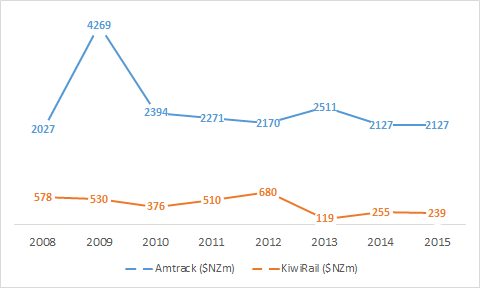
Sources: Federal Funding Received by Amtrak | Mercatus and New report: Corporate welfare in the 2015 budget – Taxpayers’ Union.
New Zealand with its KiwiRail does a good job of keeping up with the Amtrak bailout especially when you look at figure 2, which computes the bailouts on a per capita basis.
Figure 2: Amtrak and KiwiRail bailouts per capita (2014 populations), (exchange rate US$1:NZ$1.53), 2008 – 2015
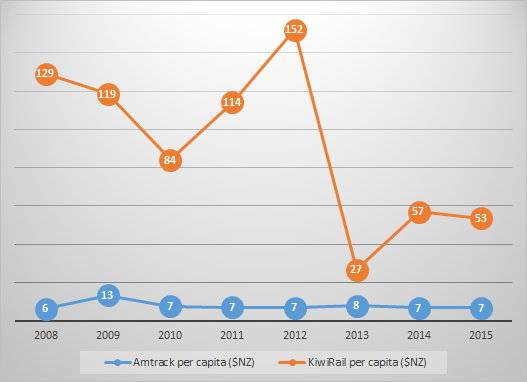
Sources: Federal Funding Received by Amtrak | Mercatus and New report: Corporate welfare in the 2015 budget – Taxpayers’ Union.
Where not to invest in Europe
18 Jul 2015 Leave a comment
in applied price theory, applied welfare economics, comparative institutional analysis, economics of bureaucracy, economics of regulation, industrial organisation, law and economics, property rights, Public Choice, rentseeking, survivor principle Tags: doing business, Eurosclerosis, Greece
Where not to invest in Europe: Greece econ.st/1TAd3CZ http://t.co/X9vtnz0uhQ—
The Economist (@EconBizFin) July 15, 2015


Recent Comments