I frequently make the point that America’s tax system is more progressive than European tax systems. But not because the United States imposes higher tax rates on upper-income households. Instead, the big difference is that lower-income and middle-class households in the United States face much lower tax burdens than their European counterparts. In those columns, […]
Is it time to pack our belongings and head to Argentina, where Javier Milei is dramatically improving economic policy and cultural attitudes? I’m joking, but also not joking. The reason I’m not joking is that there’s a very depressing scenario for America’s near-term economic outlook. It involves these six potential developments. Thanks in part to […]
Class-warfare tax policy is always a bad idea. Economists generally don’t like class-warfare policies because it is foolish to impose high marginal tax rates on productive behaviors such as investment and entrepreneurship. Politicians should not like class-warfare policies because of the negative impact on jobs and wages for ordinary people as well as the potential negative […]
By Paul Homewood h/t Ian Magness From the Telegraph: “I think the customer has spoken. That’s the punchline,” said Jim Farley, the chief executive of Ford. The American boss was speaking last week as his company unveiled a $5bn (£3.7bn) annual loss, barely two months after it had booked a shock $19.5bn write-down. The […]
Below is my column in the California Post and New York Post on the exodus of wealthy taxpayers from the state as Democrats seek to trap them with a retroactive wealth tax. They are engineering a type of reverse Gold Rush as up to a trillion dollars leave the state with a line of U-Hauls […]
Based on a video from the Center for Freedom and Prosperity back in 2010, as well a video from Johan Norberg I shared in 2016, there’s a lot to learn by looking at Swedish economic history. Here’s a more recent video that also looks at that nation’s economic track record. You’ll notice a similar message […]
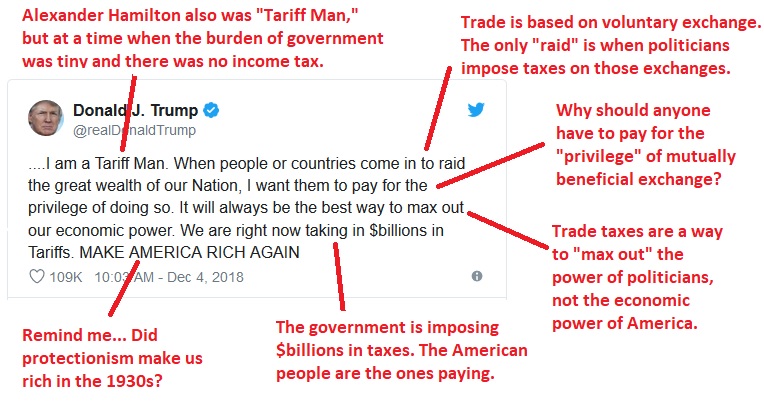
Donald Trump, who describes himself as “Tariff Man,” recently wrote a column in defense of his protectionist trade policy for the Wall Street Journal. After reading the column, my first thought was that Trump was trying to show he is more economically illiterate than Joe Biden (a big challenge, as seen here and here). And […]
This is what I’m seeing: + 2.4 million rent-controlled apartments in a city with a massive housing shortage and 1.4% vacancy rate. + A huge % of these tenants are wealthy, white boomers using the units as pieds-a-terres while they spend their weekends and summers elsewhere. + Meanwhile, the government is using rent control to…
In 2016, here’s some of what I wrote about the economic outlook in Illinois. And I shared the same observation when writing about California in 2018. There’s a somewhat famous quote from Adam Smith (“there is a great deal of ruin in a nation“) about the ability of a country to survive and withstand lots of […]
As I wrote nine years ago, Oxfam is a pathetic organization. Originally created to help the poor, it has been captured by activists who peddle class warfare. But they play that role in an incredibly sloppy fashion. In all the debates I’ve been part of over the years, no left-leaning academic has been willing to […]
Tweet… is from page 152 of Thomas Sowell’s Compassion Versus Guilt, a 1987 collection of some of his popular essays; specifically, it’s from Sowell’s June 14th, 1985, column titled “Chances versus Guarantees”: People who bought homes in a quiet little town often become resentful when other people begin moving in, expanding and changing the community.…
More recently, his research has found new attention and urgency in President Donald Trump’s second term: Borjas, 75, worked as a top economist on the Council of Economic Advisers, a post he stepped down from last week. Borjas is an immigrant and refugee who escaped Cuba for the United States in 1962 and later obtained…
No, today’s column is not about Trump’s inane protectionism, which is definitely an example of economic illiteracy. It’s about another area where Trump is copying Joe Biden, channeling Elizabeth Warren, mind-melding with AOC, and acting like Bernie Sanders. Though it probably is indirectly connected with protectionism. “Affordability” has become a big issue, in part because […]
Why Evolution is True is a blog written by Jerry Coyne, centered on evolution and biology but also dealing with diverse topics like politics, culture, and cats.
“We do not believe any group of men adequate enough or wise enough to operate without scrutiny or without criticism. We know that the only way to avoid error is to detect it, that the only way to detect it is to be free to inquire. We know that in secrecy error undetected will flourish and subvert”. - J Robert Oppenheimer.






 Utopia, you are standing in it!
Recent Comments