Why propaganda?
21 Nov 2015 Leave a comment
in constitutional political economy, economics of media and culture, income redistribution, Marxist economics, Public Choice, rentseeking Tags: economics of advertising, expressive voting, rational ignorance, rational irrationality
How Scandinavian Countries Pay for Their Government Spending
20 Nov 2015 1 Comment
in politics - Australia, politics - New Zealand, politics - USA, Public Choice, public economics Tags: Denmark, Finland, growth of government, Norway, Scandinavia, size of government, Sweden, taxation and entrepreneurship, taxation and investment, taxation and labour supply, welfare state
JFK assassination conspiracy theories are still going strong, unfortunately
19 Nov 2015 Leave a comment
in economic history, health economics, politics - USA, Public Choice Tags: conspiracy theories, cranks, expressive voting, JFK conspiracy theorists, political psychology, Quacks, rational ignorance, rational irrationality, social psychology

..

Deirdre McCloskey on Piketty, the Bourgeoisie Deal, the Bolshevik Deal, and the Bridal Deal
17 Nov 2015 Leave a comment
in applied price theory, applied welfare economics, comparative institutional analysis, constitutional political economy, development economics, economic history, economics of bureaucracy, growth disasters, growth miracles, Public Choice Tags: bourgeoisie deal, capitalism and freedom, Deirdre McCloskey, industrial revolution, The Great Enrichment, The Great Escape, The Great Fact, Thomas Piketty

.
One in five support a military coup to stop Boris Johnson becoming prime minister
16 Nov 2015 Leave a comment
in constitutional political economy, Public Choice Tags: British politics, expressive voting, military coups, rational ignorance, rational rationality, voter demographics
Bruce Yandle discusses the concept of Bootleggers and Baptists
15 Nov 2015 Leave a comment
in applied price theory, economics of bureaucracy, Public Choice, rentseeking Tags: bootleggers and baptists, Bruce Shanley, pressure groups
Trust in media by ideology
15 Nov 2015 Leave a comment
in economics of information, economics of media and culture, industrial organisation, politics - USA, Public Choice, survivor principle Tags: expressive voting, media bias, rational ignorance, rational irrationality, The meaning of competition
Virtue signaling
13 Nov 2015 Leave a comment
in Public Choice Tags: expressive voting, political psychology, signaling
@WorldBank wants to boost the agriculture sector!
11 Nov 2015 Leave a comment
in development economics, economics of bureaucracy, growth miracles
When did buying your own home become an investment in New Zealand?
09 Nov 2015 Leave a comment
in economics of regulation, politics - New Zealand, Public Choice, rentseeking, urban economics
Buying a house became an investment in New Zealand coincidently with the passing of the Resource Management Act and all the restrictions on land supply it empowered. Prior to then buy a house was a good idea except if you want to make money because real housing prices in 1993 were the same as in the mid-70s.
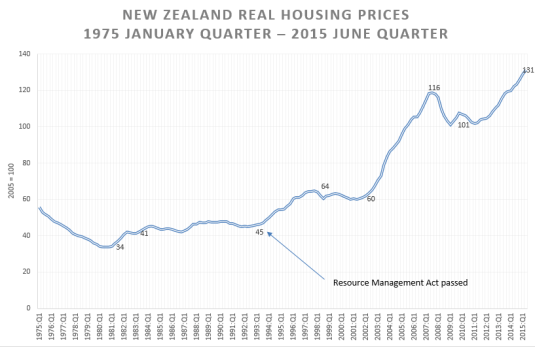
Source and notes: Dallas Fed International Housing Database July 2015 – The author acknowledge use of the dataset described in Mack and Martínez-García (2011); real housing prices are nominal housing prices deflated by a personal consumption deflator.
Housing prices rose by 50% in the first few years after the passage of the Resource Management Act. Housing prices doubled again in the last five years of the last Labour Government in New Zealand. With the economic recovery, housing prices increased again by 30% in the last four years or so.
The housing prices charted in deflated above are nationwide figures originally from nationwide nominal data published by the Reserve Bank of New Zealand and Quotable Value. They do not show the even faster growth in housing prices in, example, Auckland, Wellington and Christchurch and stagnant housing prices in declining regions, cities and towns of New Zealand.
The Holy Roman Empire in 1789
08 Nov 2015 Leave a comment
in constitutional political economy, economic history, Public Choice Tags: European history
The Holy Roman Empire in 1789. http://t.co/CC6zV8IcI5—
History Facts 247 (@historyfacts247) July 05, 2015


Recent Comments