How big are @JohnKeyPM’s $3 billion tax cuts in 2017 going to be?

On morning radio this morning, Prime Minister John Key said "We are not ruling that out for 2017 or campaigning on it for a fourth term in 2017, but having a bigger one, to be blunt, than $1 billion." Asked how much was needed to deliver meaningful tax cuts, he said: "$3 billion, I reckon."

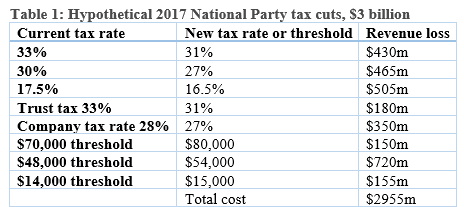
The table below uses the Treasury scoring of how much tax cuts can be delivered through $3 billion. That scoring is static. That is, no behavioural changes are assumed as the result of the tax cuts on labour supply, investment or entrepreneurship.

image

Source: computed from Revenue Effect of Changes to Key Tax Rates, Bases & Thresholds for 2015/16 — The Treasury – New Zealand.

The big sensitivity is how the company tax rate cut scoring treats offsets for dividend imputation credits. If there is no change in the other tax rates, a cut in the company tax forgoes $225 million a year per percentage point because some of it is clawed back through dividend imputation. The costing of the company tax cut by the Treasury when the other income tax rates are changed is assumed to be $350 million per percentage point. When calculating the dividend imputation offset, the Treasury assumes that shareholders are on an average tax rate of 30%.

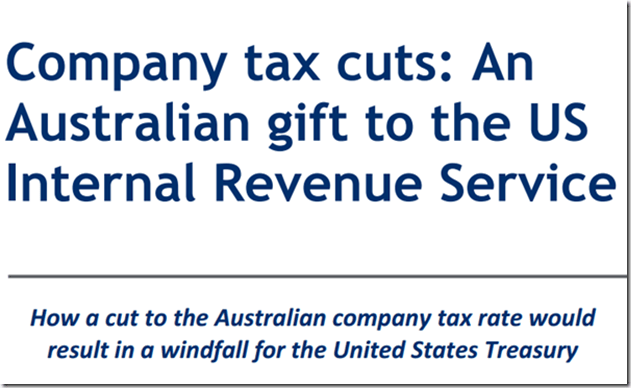
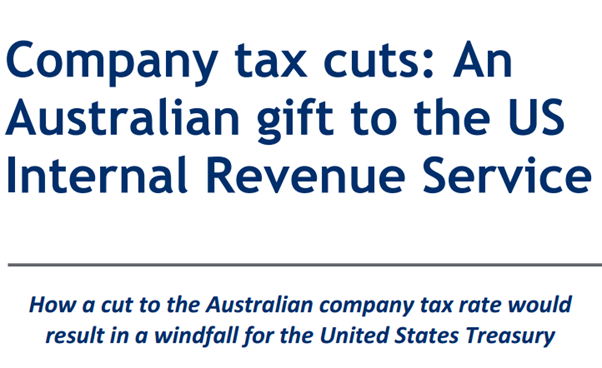
If the Prime Minister chooses not to match the company tax rate announced by the Liberal National party government in Australia ahead of their election, there is certainly more room for individual income tax cuts.

Most @BernieSanders’ supporters don’t want to #FeelTheBern in their hip-pocket

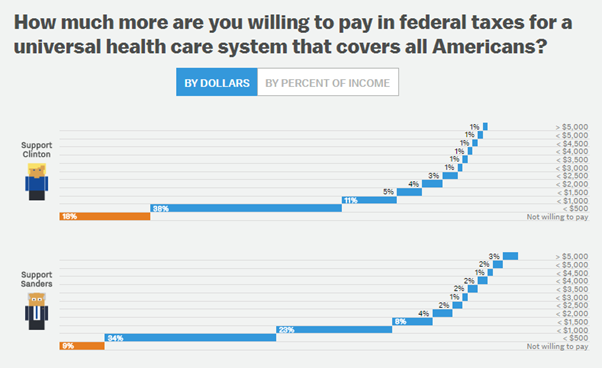
66 percent of Sanders supporters are unwilling to pay more than $1,000 in higher taxes for universal health care. This includes the 8 percent of Sanders supporters who aren’t willing to pay anything more!

image

Source: Most Bernie Sanders supporters aren’t willing to pay for his revolution – Vox.

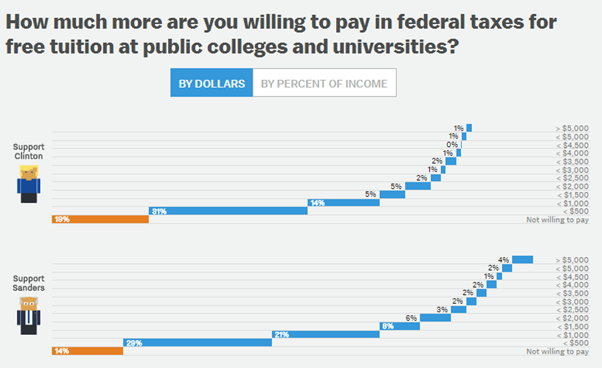
Sanders supporters want free public college tuition but 14 percent said they don’t want to pay additional taxes for it; another half said they would only pay up to $1,000 a year!

image

Source: Most Bernie Sanders supporters aren’t willing to pay for his revolution – Vox.

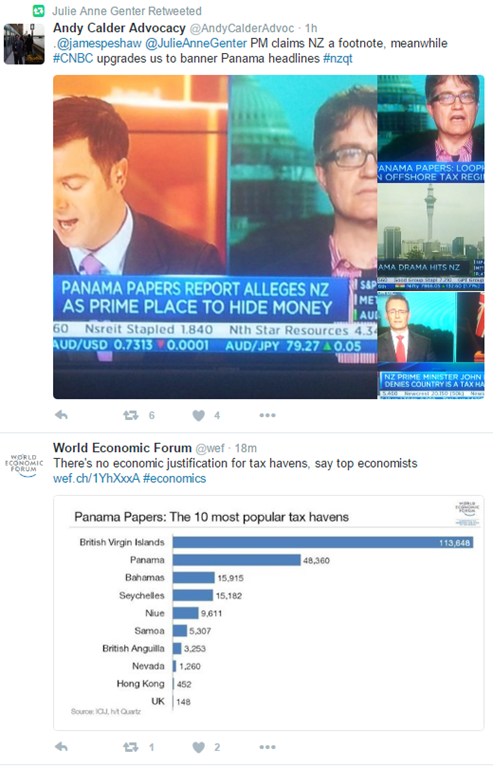
@JulieAnneGenter Twitter feed rules on NZ as top #taxhaven @JordNZ #Panamapapers

image

Image

With friends like these, the #UBI will not live to face its enemies @jordNZ

Running around saying that Universal Basic Income will make work optional leaves open the question of who will be the suckers who actually do the work and pay enormous taxes to fund the idyllic lifestyle of the bohemian rest.

image

Source: What If Everybody Didn’t Have to Work to Get Paid? – The Atlantic.

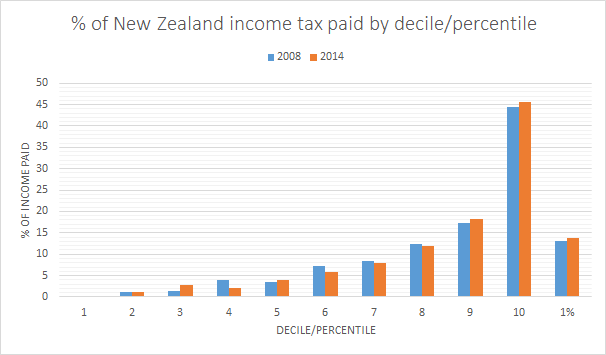
Did top income earners pay less income tax after @JohnKeyMP was elected?

image

Source: Revealed: No change in the rich’s income share under National – Inequality: A New Zealand Conversation.

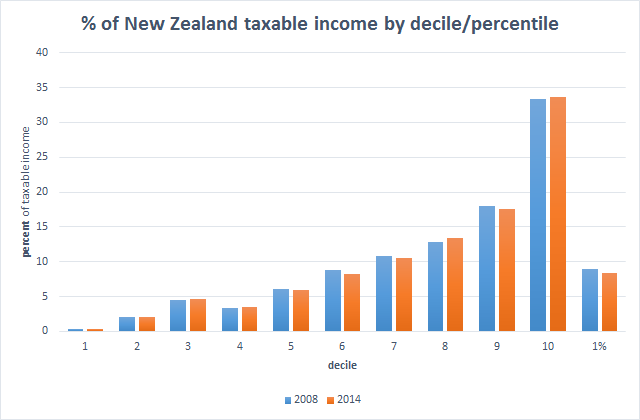
#NewZealand’s top 1% is getting even lazier under neoliberal @johnkeyMP

The share of incomes of the top 1% in New Zealand has not increased since the 1950s – they are just bone lazy at extracting labour surplus.

Veteran left-wing grumbler Max Rashbrooke was good enough to collect Inland Revenue Data data that show that getting even lazier under right-wing government elected in 2008. Their share of taxable income has dropped from 9% when labour lost power to 8.4% now. These figures exclude capital gains.

image

Source: Revealed: No change in the rich’s income share under National – Inequality: A New Zealand Conversation.

Johan Norberg on Tax Havens 

Source: Johan Norberg on Tax Havens | Catallaxy Files

Does invested $1 in retrofitting saves $6 in health expenditure? @PhilTwyford @PeterDunneMP @AndrewLittleMP

Various bold claims have been made about the payoff from investing more in retrofitting insulation into housing. The government recently spent $600 million on such retrofitting of insulation.

https://twitter.com/PhilTwyford/status/728137160113557505

There is a private member’s bill before Parliament to introduce minimum standards for rental properties with regard to insulation and other matters. Little is by the Leader of the Opposition Andrew Little said for the consequences for rents of this additional expense to landlords.

Ian Harrison of Tail Risk Economics initially estimated that the $600 million invested in retrofitting of insulation will save barely half of that:

After correcting for this major error and taking a more realistic view of the benefit estimates in other studies, the net benefits of $630 million disappear.

The $600 million insulation investment will probably generate benefits of closer to $170 million, for an economic loss of $430 million.

After meeting with Ian, I read through the rather dull background documents behind a cost benefit analysis relied upon by the government to spend the $600 million dollars.

The most interesting part of the cost benefit analysis is most of the benefits come from fewer cardiovascular related hospitalisation of the elderly and not from respiratory diseases among children.

I found the error was far more fundamental than a incorrect transfer of a calculation between tables discussed in the first publication by Harrison. I had to read the background documents several times to understand what had been done wrong.

The cost benefit analysis for the Warm Up New Zealand Heat Smart Programme assumes that the number of elderly occupants of the newly insulated house increases by one each year and after 5 years, one of these dies but is replaced by a new elderly occupant.

We have modelled the probability of a vulnerable person avoiding mortality as a result of the intervention. The probability of this is (112.7/1000)*0.27= 0.03 (3%). We treat avoidance of mortality by treatment in each year as independent events.

The multi-year benefit calculated above would accrue based on the life years gained as a result of deaths avoided in year one.

However, we would expect these benefits to accrue in year two for different vulnerable individuals (aged 65 and over with a cardiovascular related hospitalisation in previous 18 months), and for different individuals again in every subsequent year that the treatment continues to have an effect, i.e. an on-going stream of benefits of $1,050.74 per year. This assumes a constant proportion of people aged 65+ who have recently been hospitalised with circulatory problems….( p.38).

In the first year of the new insulation, the first occupant benefits and the net present value is included in the benefit cost analysis calculation – the erroneous benefit cost analysis calculations which its authors still defend.

In the 2nd year, another elderly person moves into that same house and the same calculation is done for them. In the following year, yet another elderly person moves into the same house and the net present value calculation is repeated.

By the end of 5 years, there are 5 occupants in this house all benefiting from the same insulation investment. In the 6th year, the first elderly occupant dies to be replaced by a new elderly occupant who then gains from the insulation upgrade.

There was double counting of the number of people who benefited from the insulation as Iain Harrison explains

The analysis assumed that there was not one, but five occupants who had been hospitalised with a cardiovascular illness in the previous 18 months in each of the relevant insulated houses. There should have been only one such occupant.

The retrofitting of insulation was estimated to cost $600 million. Iain Harrison estimated the benefits to be $300 million, not $1.2 billion. That is a benefit cost ratio of 0.5.

image

Source: Iain Harrison, The mortality reduction benefits of insulation: the error identified.

Why is GST but not company tax incidence so easy to understand

image The tax incidence of sales taxes is understood by everybody but who pays company tax is stubbornly misunderstood. The seller is sending the tax cheque to the taxman does not fool anyone regarding who ultimately pays sales taxes.

Everyone expects that sales tax increases such as of the GST or VAT will be passed on to buyers but sometimes a little bit is absorbed in terms of lower profits by sellers if it is more than the market can bear.

When it comes to company taxes, this intuitive understanding of the economics of the incidence of taxes completely disappears. There is a strong belief that only investors pay the company tax in the form of dividends.

The notion that investors may reduce their investment and therefore the amount of capital with which workers can work is stoutly denied as is the implications for lower than otherwise wages because of this.

The possibility that the entire company tax may show up as lower wages when capital is internationally mobile is just not even contemplated. This is despite foreign direct investment being welcomed on the grounds that more capital means higher wages for local workers.

Likewise, when a factory is re-located offshore, it is understood that that will harm wages. That understanding does not carry through to company tax incidence when the factory relocates offshore because of low company taxes rather than import competition.

Who will pay @johnkeypm’s great big new land tax?

A critical aspect of a land tax rarely addressed in public debate is its “economic incidence – or who actually bears the burden of the – tax  as opposed to its statutory incidence, or who literally pays the tax.

John Key has floated a land tax as an option to deal with rising land prices in Auckland if a large number of buyers are foreign.

It is pretty standard public economics the elasticities of supply and demand essential to working out who actually pays tax rather than who sends the cheque.

More of the taxes paid by either the buyer or seller who is demand or supply is more inelastic; responds less to changes in price.

In the case of land, supply is looked upon as highly inelastic. Because of this lack of responsiveness of suppliers to changes in price, most to all of the tax is paid by sellers of land. 


image

Since supply is fixed, the same amount of land is still available The owner now has a lower after-tax rental return of his land. As the Australian Treasury explains

As the capital value of the land is equal to the discounted present value of all the future expected rental returns, a lower rental return implies a one-off fall in the value of all land. Owners of land bear the incidence of the land value tax even if they sell their land in response to the tax.

This reduction in the rental value of land will mean future buyers will pay less for land. The price of land will fall in the future because returns are less after-tax.

image

Source: Part 2: Detailed analysis – Chapter C: Land and resources taxes – C1. Charging for non-renewable resources – Australia’s Future Tax System: Final Report.

The introduction of a land tax by John Key will mean the price of land might fall by the present value of the land tax. Zodrow explains

In principle, the economic incidence of all of these capitalization effects is on the owners of land and housing at the time of the imposition of the tax, when the effects are “capitalized” as one-time changes in the prices of these assets..

@BernieSanders nothing is free in Denmark

image

Source: Brutal Meme Reveals Truth About European Socialist Countries? : snopes.com.

Ten Word Answers

Forget avoidance outrage: public’s real attitude to tax is revealed by their actions @JordNZ

image

Source: Panama Papers: Forget avoidance outrage: The public’s real attitude to tax is revealed by their actions | City A.M.

Did the rise of welfare state cause more inequality in wealth?

 Markus Poschke and Barış Kaymak have just put out a paper arguing that increased social spending is a major driver of wealth inequality:

Another important and often overlooked third factor is the rise in the generosity of government transfers since 1960, mostly due to the expansion of public pensions (social security) and the introduction of public health insurance for the elderly (Medicare).

Combined spending on these two programs accounted for almost 9% of US GDP in 2010, up from less than 3% in 1960…

These government programmes tend to curb the need to rely on personal savings for retirement, especially among low and middle-income households, and might thus explain why their share in total wealth has declined.

This makes a good to good degree of sense. I have previously argued that using the arguments of Edward Prescott that it is not wise for people on ordinary income to save for their retirement when they can go down to the local Social Security office and claim an old age pension.

It is even less wise to save that for retirement if those savings reduce your eligibility for an old age pension. Far better just to invest in a nicer house and pass it on to your children. Poschke and Kaymak note that measures of private wealth inequality miss these claims to old age pensions:

… statistics on wealth inequality that do not capture households’ claims on the public sector are incomplete and overstate top wealth shares.

This is not a new argument. Back when the Ricardian theories of budget deficits came to prominence and before that in debates on theories of the public debt, the more Keynesian sides of those arguments did argue that people were irrational for not including their old age pension entitlements under social security schemes in their calculations of their wealth.

image

Some of their taxes were paying for their future old age pension and were another form of wealth rather than a tax. As such, taxpayers should regard this part of their taxes as investments and not cutting back their labour supply in response as they do to other taxes.

image

Source: Barış Kaymak and Markus Poschke The evolution of wealth inequality over half a century: The role of taxes, transfers and technology, Journal of Monetary Economics (2016).

How much of the rise in wealth inequality is due to this failure to measure Social Security wealth as represented by old age pension entitlements? Their estimate is about 25%:

…technological factors play a dominant role not only for changes in income inequality, as is well known, but also for wealth inequality. As high-earning households save part of their additional income, their share of wealth also rises.

This channel accounts for about half of the total increase in wealth inequality. Tax cuts and the expansion of transfers each account for about half of the remainder…

While tax cuts encourage saving, larger transfers reduce saving incentives for retirement, in particular for low and middle income groups. This implies that these groups’ share of private wealth declines.

Note though that this is partly due to the fact that measures of private wealth inequality, like those compiled by Saez and Zucman, do not include claims to future government transfers, like social security, which constitute wealth for their owners.

@garethmorgannz is getting a little techie about debating optimal tax theory

All I said was “optimal tax theory including that pioneered by Stiglitz and Merrlees, economists of impeccable left-wing credentials, show that taxes on the income from capital should be low because the deadweight social costs of taxes on capital are very high”.

image

Previous Older Entries Next Newer Entries

Bassett, Brash & Hide

Celebrating humanity's flourishing through the spread of capitalism and the rule of law

Truth on the Market

Scholarly commentary on law, economics, and more

The Undercover Historian

Beatrice Cherrier's blog

Matua Kahurangi

Celebrating humanity's flourishing through the spread of capitalism and the rule of law

Temple of Sociology

Celebrating humanity's flourishing through the spread of capitalism and the rule of law

Velvet Glove, Iron Fist

Celebrating humanity's flourishing through the spread of capitalism and the rule of law

Why Evolution Is True

Why Evolution is True is a blog written by Jerry Coyne, centered on evolution and biology but also dealing with diverse topics like politics, culture, and cats.

Down to Earth Kiwi

Celebrating humanity's flourishing through the spread of capitalism and the rule of law

NoTricksZone

Celebrating humanity's flourishing through the spread of capitalism and the rule of law

Homepaddock

A rural perspective with a blue tint by Ele Ludemann

Kiwiblog

DPF's Kiwiblog - Fomenting Happy Mischief since 2003

The Dangerous Economist

Celebrating humanity's flourishing through the spread of capitalism and the rule of law

Watts Up With That?

The world's most viewed site on global warming and climate change

The Logical Place

Tim Harding's writings on rationality, informal logic and skepticism

Doc's Books

A window into Doc Freiberger's library

The Risk-Monger

Let's examine hard decisions!

Uneasy Money

Commentary on monetary policy in the spirit of R. G. Hawtrey

Barrie Saunders

Thoughts on public policy and the media

Liberty Scott

Celebrating humanity's flourishing through the spread of capitalism and the rule of law

Point of Order

Politics and the economy

James Bowden's Blog

A blog (primarily) on Canadian and Commonwealth political history and institutions

Science Matters

Reading between the lines, and underneath the hype.

Peter Winsley

Economics, and such stuff as dreams are made on

A Venerable Puzzle

"The British constitution has always been puzzling, and always will be." --Queen Elizabeth II

The Antiplanner

Celebrating humanity's flourishing through the spread of capitalism and the rule of law

Bet On It

Celebrating humanity's flourishing through the spread of capitalism and the rule of law

History of Sorts

WORLD WAR II, MUSIC, HISTORY, HOLOCAUST

Roger Pielke Jr.

Undisciplined scholar, recovering academic

Offsetting Behaviour

Celebrating humanity's flourishing through the spread of capitalism and the rule of law

JONATHAN TURLEY

Res ipsa loquitur - The thing itself speaks

Conversable Economist

Celebrating humanity's flourishing through the spread of capitalism and the rule of law

The Victorian Commons

Researching the House of Commons, 1832-1868

The History of Parliament

Articles and research from the History of Parliament Trust

Books & Boots

Reflections on books and art

Legal History Miscellany

Posts on the History of Law, Crime, and Justice

Sex, Drugs and Economics

Celebrating humanity's flourishing through the spread of capitalism and the rule of law

European Royal History

Exploring the Monarchs of Europe

Tallbloke's Talkshop

Cutting edge science you can dice with

Marginal REVOLUTION

Small Steps Toward A Much Better World

NOT A LOT OF PEOPLE KNOW THAT

“We do not believe any group of men adequate enough or wise enough to operate without scrutiny or without criticism. We know that the only way to avoid error is to detect it, that the only way to detect it is to be free to inquire. We know that in secrecy error undetected will flourish and subvert”. - J Robert Oppenheimer.

STOP THESE THINGS

The truth about the great wind power fraud - we're not here to debate the wind industry, we're here to destroy it.

Lindsay Mitchell

Celebrating humanity's flourishing through the spread of capitalism and the rule of law

Alt-M

Celebrating humanity's flourishing through the spread of capitalism and the rule of law

croaking cassandra

Economics, public policy, monetary policy, financial regulation, with a New Zealand perspective

The Grumpy Economist

Celebrating humanity's flourishing through the spread of capitalism and the rule of law

International Liberty

Restraining Government in America and Around the World