
Political bias, free trade and @berniesanders @realdonaldtrump
31 Mar 2016 Leave a comment
in applied price theory, applied welfare economics, economics of media and culture, industrial organisation, international economics, politics - USA, Public Choice, public economics, rentseeking Tags: 2016 presidential election, antiforeign bias, antimarket bias, makework bias, pessimism bias, rational irrationality
No two tax cuts impact the economy in the same way.
31 Mar 2016 Leave a comment
in applied price theory, public economics Tags: capital gains tax, company tax, family tax credits, in-work tax credits, taxation and entrepreneurship, taxation and investment, taxation and labour supply
Average incomes before and after US federal taxes
23 Mar 2016 Leave a comment
in politics - USA, public economics Tags: after-tax income distribution

The Swedish tax mix as a percentage of GDP since 1965
21 Mar 2016 Leave a comment
in economic history, public economics Tags: growth of government, size of government, Sweden
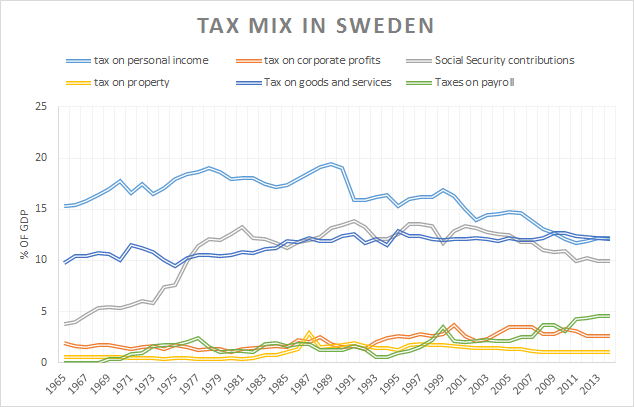
Source: OECD Stat.
British tax mix as a percentage of GDP
19 Mar 2016 Leave a comment
in economic growth, economic history, entrepreneurship, fiscal policy, macroeconomics, public economics Tags: British disease, British economy, growth of government, sick man of Europe, size of government, taxation and entrepreneurship, taxation and investment, taxation and labour supply, Thatchernomics
The large rise in tax in personal income in the 1970s coincided with the rise of the British disease and British economy becoming widely known as the sick man of Europe. The large decline in taxation in personal income under Thatchernomics was followed by an economic boom.
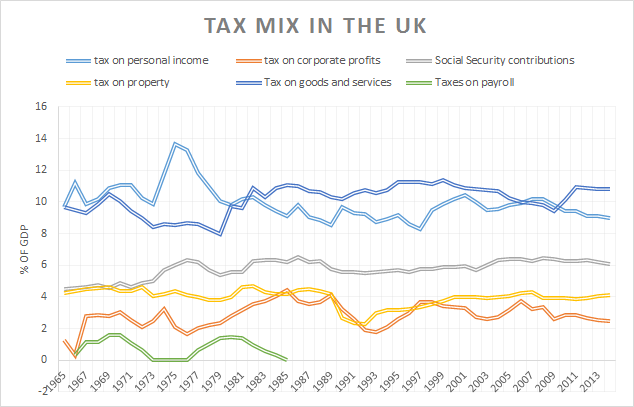
Source: OECD Stat.
Tax mix in New Zealand as percentage of GDP since 1965
19 Mar 2016 Leave a comment
in economic history, politics - New Zealand, public economics Tags: growth of government, size of government, taxation and entrepreneurship, taxation and investment, taxation and labour supply
That GST certainly played a major role since the 1980s. Taxes on corporate profits are on the up and up despite what you would believe from the grumblings of the Left down under.
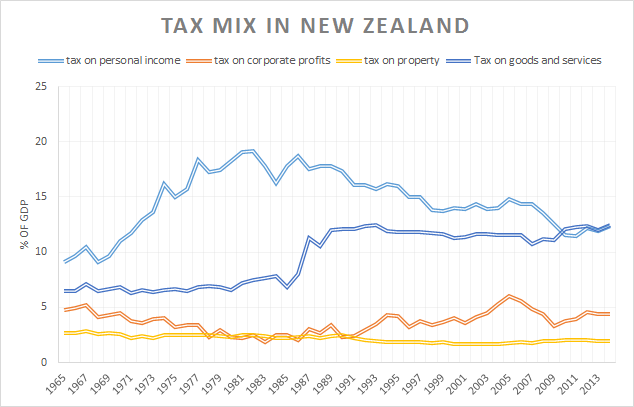
Source: OECD Stat.
Tax mix in the USA as a percentage of GDP since 1965
18 Mar 2016 Leave a comment
in business cycles, economic history, fiscal policy, great recession, macroeconomics, politics - USA, public economics Tags: company tax, company tax rate, growth of government, GST, indirect taxation, property taxes, size of government, Social Security contributions, taxation and investment, taxation and labour supply, welfare state
The only major change in the US tax mix in the last 50 years has been greater reliance on social security contributions.
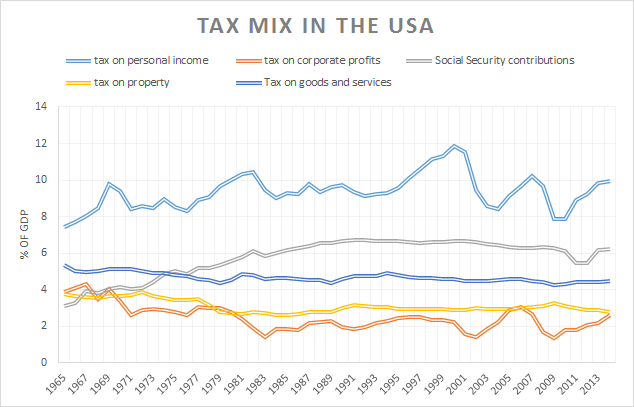
Source: OECD Stat.
The share going to income taxes bobbing up and down quite a lot in the last 30 years much of that to do with the business cycle. In the 1990s, the share of taxes from personal income increased during boom times. In the Great Recession, the tax share to income tax rose with the declining economy as did that on corporate profits.
Taxation of personal income and social security contributions as a percentage of US, British, Danish, German, French and New Zealand GDPs since 1965
18 Mar 2016 Leave a comment
in economic history, public economics Tags: growth of government, size of government, social insurance, Social Security, Social Security contributions, taxation and labour supply, welfare state
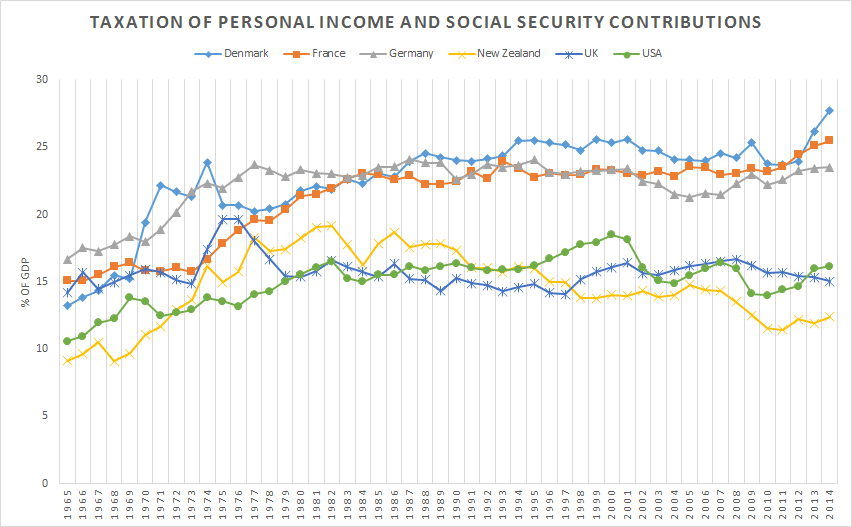
Source: Tax – Social security contributions – OECD Data and Tax – Tax on personal income – OECD Data.
Who Pays the Tax?
18 Mar 2016 Leave a comment
in applied price theory, economics, public economics Tags: tax incidence
The impact of the 1986 GST on the New Zealand tax mix since 1965
17 Mar 2016 Leave a comment
in economic history, politics - New Zealand, public economics Tags: growth of government, GST, income tax, size of government, taxation and labour supply, VAT
The introduction of the GST in 1986 led to a major change in the New Zealand tax mix. There was no offsetting income tax cuts.
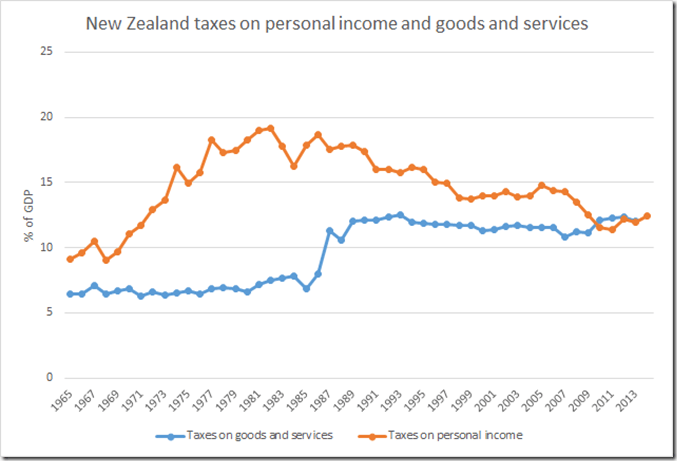
Source: Tax – Tax on goods and services – OECD Data and Tax – Tax on personal income – OECD Data.
Combined federal, state and local company tax rates across the OECD, 2015
17 Mar 2016 Leave a comment
in politics - New Zealand, public economics Tags: British economy, company tax rate, optimal tax theory
Britain will have the 2nd lowest company tax rate across the OECD by 2020. The 2016 British budget announced overnight reduces the tax to 17% by 2020.

Source: OECD Stat Table II.1. Corporate income tax rate.
New Zealand Post (incl. Kiwibank) dividends
15 Mar 2016 Leave a comment
in industrial organisation, monetary economics, politics - USA, public economics Tags: economics of banking, government ownership, KiwiBank, network industries, New Zealand Greens, New Zealand Post, rational irrationality, state owned enterprises
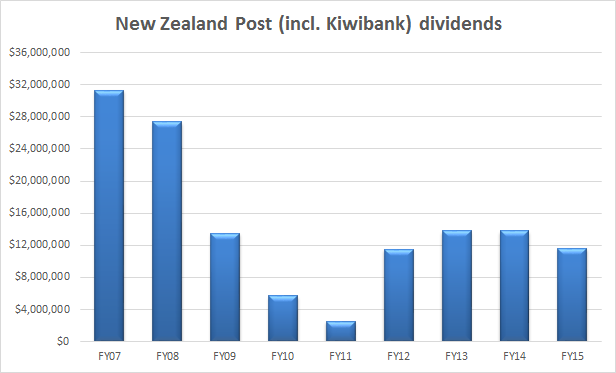
Source: New Zealand Treasury – data released under the Official Information Act.
Tax burdens of the top 10% across the OECD
14 Mar 2016 Leave a comment
in politics - New Zealand, politics - USA, public economics Tags: taxation and entrepreneurship, taxation and investment, taxation and labour supply, top 1%
General government expenditure and general government revenue as a % of Australian and New Zealand GDP since 1970
13 Mar 2016 Leave a comment
in budget deficits, economic history, fiscal policy, macroeconomics, politics - New Zealand, politics - USA, public economics Tags: Australia, growth of government, size of government
I do not trust the numbers for New Zealand prior to the early 1990s released by the OECD. New Zealand simply did not have a tax structure including a GST in the double digits back then to support estate of that size. Nonetheless, the size of government in New Zealand is systematically larger than in Australia, a richer country which can afford a large government and generous welfare state.
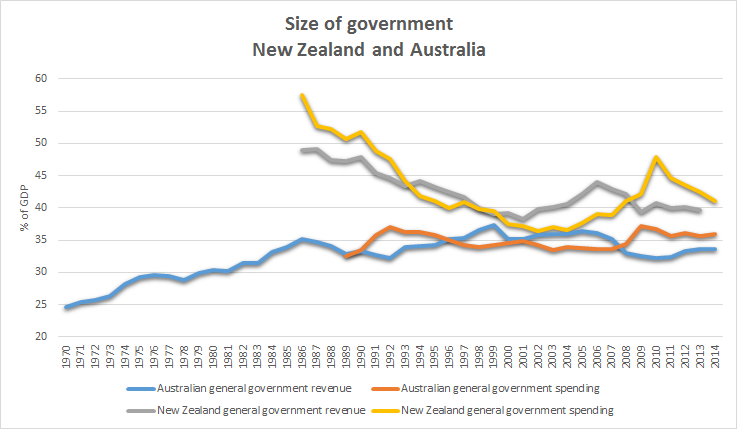
Source: General government – General government revenue – OECD Data and Data extracted on 12 Feb 2016 08:45 UTC (GMT) from OECD.Stat from OECD Economic Outlook November 2015.
 Utopia, you are standing in it!
Recent Comments