Figure 1: unadjusted median pay per hour by gender and age group, New Zealand, 2014

Source: New Zealand Income Survey 2014 via Human Rights Commission: Tracking Equality at Work.
Celebrating humanity's flourishing through the spread of capitalism and the rule of law
28 Jul 2015 Leave a comment
in discrimination, economics of education, gender, human capital, labour economics, labour supply, occupational choice, politics - New Zealand Tags: gender wage gap
Figure 1: unadjusted median pay per hour by gender and age group, New Zealand, 2014
Source: New Zealand Income Survey 2014 via Human Rights Commission: Tracking Equality at Work.
28 Jul 2015 Leave a comment
in labour economics, labour supply, politics - Australia, politics - New Zealand, politics - USA, welfare reform Tags: earned income tax credits, family tax credits, in-work tax credits, taxation and the labour supply
#MinimumWage shd be combined w/ #tax policies to help both workers & their employers; see bit.ly/1KfRNOB http://t.co/8klfJXmY4s—
(@OECD) July 25, 2015
28 Jul 2015 Leave a comment
in economic history, economics of education, entrepreneurship, financial economics, human capital, labour supply, occupational choice, politics - USA Tags: creative destruction, entrepreneurial alertness, top 1%, top income earners, top wage earners
Page 47 from "An Illustrated Guide to Income" more economic #dataviz at: bit.ly/10QWgyR http://t.co/d1dhSYKWDC—
Catherine Mulbrandon (@VisualEcon) June 03, 2013
28 Jul 2015 Leave a comment
in applied welfare economics, labour economics, politics - USA, population economics, poverty and inequality Tags: living standards, The Great Enrichment
28 Jul 2015 Leave a comment
in politics - Australia, politics - USA, public economics Tags: Eurosclerosis, growth of government, sick man of Europe, size of government, taxation and entrepreneurship, taxation and investment, taxation and the labour supply
How does America's tax revenue compare to the average collected by OECD countries? bit.ly/1HTtRTg #TaxDay http://t.co/Q17jMuwtNI—
The Hamilton Project (@hamiltonproj) April 15, 2015
27 Jul 2015 Leave a comment
in economics of crime, human capital, labour economics, labour supply, law and economics, occupational choice, politics - USA Tags: crime and punishment, criminal deterrence
26 Jul 2015 Leave a comment
in defence economics, economic history, politics - Australia, Public Choice, Thomas Schelling, war and peace Tags: Australian national security policy, East Timor, game theory, Indonesia, John Howard
What I admire most about John Howard was his decision to intervene in East Timor to stop massacres, which were a by-product of succession struggles within TNI. Howard didn’t have to do that. He didn’t.
If there ever was a prime directive in Australian national security policy, more so than have a great and powerful friend (first the UK, than the USA, dumping Britain like a stone in 1941 when a better great and powerful friend became available), it’s never put Australian military forces in a position risking an exchange of fire with TNI.
That did happen during the East Timor intervention. There were armed stand-offs at roadblocks between the Australian Army and TNI. Platoon leaders in the Australian Army had to keep their cool with guns drawn on both sides otherwise it would be a real shooting war that could spiral out of control.
That is why there is a genuine risk of major war not from accidents in the military machine but through a diplomatic process of commitment and escalation that is itself unpredictable. Schelling also argues that nations, like people, are continually engaged in demonstrations of resolve, tests of nerve, and explorations for understandings and many misunderstandings.
In Schelling’s view, many wars including World War 1 were products of mutual alarm and unpredictable tests of will. When people discuss the futility of World War 1, they under rate the role of unintended consequences and the dark side of human rationality in situations involving collective action.
Indonesia and its politically ambitious and corrupt military wing are next door to Australia forever. A pragmatic approach is a necessity of survival along such a volatile border.
That’s actually why Whitlam did what he did, and sat on his hands over the East Timor massacres in 1975. Australia had no credible capability of intervening, particularly against a country with such a large military and unstable politics. In 1975, the Indonesian military most certainly would have shot back.
26 Jul 2015 1 Comment
in applied welfare economics, economic history, economics of media and culture, health economics, industrial organisation, politics - USA, Public Choice, rentseeking, survivor principle Tags: adverse selection, expressive voting, health insurance, Leftover Left, media bias, medicaid, Medicare, moral hazard, Obamacare, rational ignorance, rational irrationality
#Medicaid expands access to health coverage and supports work: bit.ly/1RKHQ2x #Medicaidat50 http://t.co/mydZMggcXg—
Center on Budget (@CenterOnBudget) July 20, 2015
6.4 million seniors get the vital support & care they need thanks to Medicaid: bit.ly/1HqYvNG #Medicaidat50 http://t.co/onWMiYj301—
Center on Budget (@CenterOnBudget) July 23, 2015
Reminder: #Medicaid helps millions of babies: bit.ly/1RS7ME5 #Medicaidat50 http://t.co/SeJ7MFPGWE—
Center on Budget (@CenterOnBudget) July 20, 2015
#Medicaid help millions of children across the country live healthier lives. #Medicaidat50: bit.ly/1RS7ME5 http://t.co/LT6rXhNzUg—
Center on Budget (@CenterOnBudget) July 16, 2015
50 years of coverage that every American deserves. #Medicare http://t.co/uRtERV2k9K—
American Progress (@amprog) July 30, 2015
Mann: Celebrating historic gains in coverage for kids CCF#2015 http://t.co/g7CYQ7DuwN—
Georgetown CCF (@GeorgetownCCF) July 22, 2015
#Medicare has been keeping seniors insured and healthy for 50 years. http://t.co/mXW4x12Rhi—
American Progress (@amprog) July 30, 2015
The majority of Americans of all ages don't recognize that gov subsidizes their health care: vox.com/2015/3/1/81257… http://t.co/ivq5eLThsi—
(@SocImages) April 22, 2015
26 Jul 2015 Leave a comment
in economics of crime, health and safety, labour economics, law and economics, politics - USA Tags: common law, crime and punishment, law enforcement, occupational health and safety, police, rule of law
More British English, Scottish and Welsh police (68) have been murdered by gunfire than British police have shot people dead (52) in over a century.

Source: Number of police officers shot dead in the UK by decade | John Graham-Cumming.
This suggests to me that the ledger is in the wrong direction. This list does not include British police stabbed or beaten to death nor are Northern Ireland deaths.
According to the FBI, from 1980–2014, an average of 55 law enforcement officers are feloniously killed per year in the USA. Those killed in accidents in the line of duty are not included in this number.
More law enforcement officers are murdered every year in the USA than ever murdered by gunfire in Britain. Police have the same common law right as any other to defend their own lives and the lives of others.
/cdn0.vox-cdn.com/uploads/chorus_asset/file/2849636/Screen_Shot_2014-12-21_at_1.42.15_PM.0.png)
26 Jul 2015 Leave a comment
in labour economics, minimum wage, politics - Australia, politics - New Zealand, politics - USA, population economics, public economics Tags: Australia, British economy, Canada, Japan, social insurance, Social Security taxes, taxation and labour supply
Figure 1: Hourly minimum wage before and after taxes, 2013, US dollars at purchasing power parities, single-person household
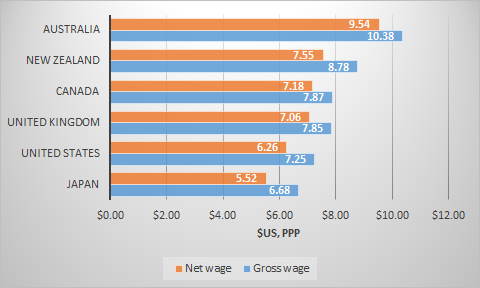
Source: OECD Focus on Minimum Wages after the crisis (2015).
26 Jul 2015 Leave a comment
in constitutional political economy, economic history, economics of media and culture, health economics, politics - USA, Public Choice Tags: abortion, constitutional law, expressive voting, median voter, rational ignorance, rational irrationality, social change
On abortion, the USA is split on pro-life versus pro-choice. State legislatures pass laws safe in the knowledge that they will be struck down the next day. they were playing to a grandstand made up of values voters.
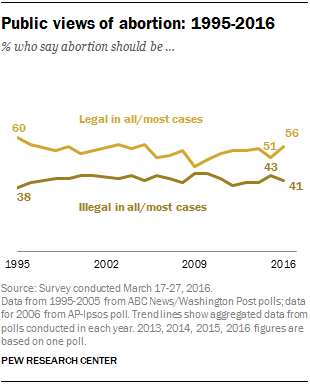
When the supreme court became a little vague on some procedural aspects of abortion law in the early 1990s, the state legislatures started showing much more restraint because the median voter would be annoyed.
Where Roe v. Wade to fall, some states would permit abortion, some would not. The Center for Reproductive Rights predicts that 21 states are likely to outlaw abortion immediately where Roe v. Wade to fall. This assessment is based not only on current law, but on the political makeup of the state legislatures. On the other hand, abortion is likely to remain legal in many states, according to these groups.
26 Jul 2015 Leave a comment
in constitutional political economy, economics of bureaucracy, politics - USA, Public Choice, rentseeking Tags: 2016 presidential election, campaign finance reform, campaign finance regulation, congressional elections


via Sometimes, Money Can’t Buy You Votes | FiveThirtyEight and Four Ways To Fund A Presidential Campaign | FiveThirtyEight.
25 Jul 2015 Leave a comment
in politics - USA, property rights Tags: constitutional law, rule of law, takings
Celebrating humanity's flourishing through the spread of capitalism and the rule of law
Celebrating humanity's flourishing through the spread of capitalism and the rule of law
Celebrating humanity's flourishing through the spread of capitalism and the rule of law
Celebrating humanity's flourishing through the spread of capitalism and the rule of law
Celebrating humanity's flourishing through the spread of capitalism and the rule of law
Celebrating humanity's flourishing through the spread of capitalism and the rule of law
A History of the Alt-Right
Econ Prof at George Mason University, Economic Historian, Québécois
Celebrating humanity's flourishing through the spread of capitalism and the rule of law
Scholarly commentary on law, economics, and more
Beatrice Cherrier's blog
Celebrating humanity's flourishing through the spread of capitalism and the rule of law
Celebrating humanity's flourishing through the spread of capitalism and the rule of law
Celebrating humanity's flourishing through the spread of capitalism and the rule of law
Why Evolution is True is a blog written by Jerry Coyne, centered on evolution and biology but also dealing with diverse topics like politics, culture, and cats.
Celebrating humanity's flourishing through the spread of capitalism and the rule of law
A rural perspective with a blue tint by Ele Ludemann
DPF's Kiwiblog - Fomenting Happy Mischief since 2003
Celebrating humanity's flourishing through the spread of capitalism and the rule of law
The world's most viewed site on global warming and climate change
Tim Harding's writings on rationality, informal logic and skepticism
A window into Doc Freiberger's library
Let's examine hard decisions!
Commentary on monetary policy in the spirit of R. G. Hawtrey
Thoughts on public policy and the media
Celebrating humanity's flourishing through the spread of capitalism and the rule of law
Politics and the economy
A blog (primarily) on Canadian and Commonwealth political history and institutions
Reading between the lines, and underneath the hype.
Economics, and such stuff as dreams are made on
"The British constitution has always been puzzling, and always will be." --Queen Elizabeth II
Celebrating humanity's flourishing through the spread of capitalism and the rule of law
Celebrating humanity's flourishing through the spread of capitalism and the rule of law
WORLD WAR II, MUSIC, HISTORY, HOLOCAUST
Undisciplined scholar, recovering academic
Celebrating humanity's flourishing through the spread of capitalism and the rule of law
Res ipsa loquitur - The thing itself speaks
In Hume’s spirit, I will attempt to serve as an ambassador from my world of economics, and help in “finding topics of conversation fit for the entertainment of rational creatures.”
Researching the House of Commons, 1832-1868
Articles and research from the History of Parliament Trust
Reflections on books and art
Posts on the History of Law, Crime, and Justice
Celebrating humanity's flourishing through the spread of capitalism and the rule of law
Exploring the Monarchs of Europe
Cutting edge science you can dice with
Small Steps Toward A Much Better World


Recent Comments