James Hansen just totally destroyed Hillary Clinton's climate plan. goo.gl/N8n9Cz http://t.co/ef8bElDBBn—
Steve Milloy (@JunkScience) July 29, 2015
It’s a worry when James Hansen is talking sense on energy policy
30 Jul 2015 Leave a comment
in economics of media and culture, energy economics, environmental economics, global warming, politics - USA, Public Choice, rentseeking Tags: Big Solar, green rent seeking, James Hansen, renewable energy, solar energy, solar power
The living wage as an application of Director’s Law
30 Jul 2015 Leave a comment
in income redistribution, labour economics, minimum wage, politics - Australia, politics - New Zealand, politics - USA, population economics, poverty and inequality, Public Choice, rentseeking Tags: British politics, Director's Law, expressive voting, living wage, rational ignorance, rational irrationality
OBR's idea of who will benefit from National Living Wage http://t.co/ztxfW906Gg—
James Bartholomew (@JGBartholomew) July 08, 2015
@ReserveBankofNZ will never be any good at forecasting
30 Jul 2015 Leave a comment
in economics of information, entrepreneurship, financial economics, macroeconomics, monetary economics, politics - New Zealand Tags: entrepreneurial alertness, forecasting errors, The pretence to knowledge
.@ReserveBankofNZ MPS inflation forecasts vs. actual. Via @jamespeshaw: http://t.co/TjPvcoVsbI—
Jayne Ihaka (@Jayniehaka) July 29, 2015
Cecil
30 Jul 2015 Leave a comment
Before #CecilTheLion, hunter Kendall Jones said hunting is crucial to conservation. False. bit.ly/1tvr5wj http://t.co/SV5FeANMsE—
(@PolitiFact) July 30, 2015PHOTO: #ZebraLivesMatter http://t.co/fUGjFKfJXP—
Mark J. Perry (@Mark_J_Perry) August 03, 2015


| Peter Klein |
 No doubt you’ve heard about Walter Palmer, the American dentist who shot the lion, “Cecil,” in Zimbabwe, pushing aside Sir Tim Hunt as the Internet’s Most Hated Person. (Aside from calling Palmer cruel and depraved — even wishing his death by bow and arrow — some are labeling him a sociopath, which makes me wonder, are lions now considered members of society? Orgheads?)
I don’t hunt and have no particular emotional attachment to lions, so I find the outrage level bewildering. However, I think this can be a teachable moment. Specifically, there are lessons here about trophy hunting and endangered species. Not surprisingly to anyone who has studied property-rights economics, there is evidence that allowing trophy hunting is a good means of protecting endangered species. This is a version of the general argument that defining and enforcing property rights in scarce resources, including wildlife, provides incentives…
View original post 71 more words
‘The Simpsons’ predicted President Trump way back in 2000
29 Jul 2015 Leave a comment
in economics of media and culture, politics - USA Tags: Donald Trump, The Simpsons 2016 presidential election

Why no ethnic wage gap for New Zealanders aged 15 to 24?
29 Jul 2015 Leave a comment
in discrimination, gender, human capital, labour economics, labour supply, occupational choice, politics - New Zealand Tags: employer discrimination, ethnic wage gap, gender wage gap, racial discrimination, racial wage gap
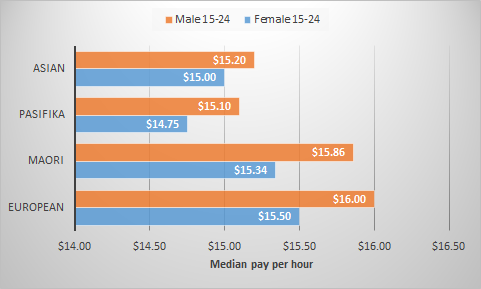
via New Zealand Income Survey 2014 via Human Rights Commission: Tracking Equality at Work
#TPPA The first Paul Krugman on trade agreements that level the playing field behind the border
29 Jul 2015 2 Comments

Has there been any labour market deregulation ever in the UK, Australia or New Zealand?
29 Jul 2015 Leave a comment
in economic history, job search and matching, labour economics, labour supply, law and economics, minimum wage, politics - Australia, politics - New Zealand, politics - USA, unions Tags: Australia, British economy, employment law, employment law regulation
Major deregulations and re-regulations of the labour market in Australia and New Zealand did not move the employment protection inducts around that much in figure 1. All is been quiet on the labour market regulation front of the UK pretty much since the index was started.
Figure 1: OECD employment protection index (EPI), strictness of employment protection – individual and collective dismissals, USA, UK, Australia and New Zealand, 1990 – 2013
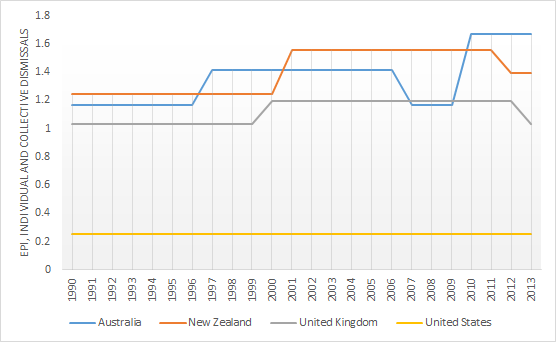
Source: OECD StatExtract.
The Work Choices legislation in Australia in 2006 was looked upon by the OECD as a somewhat minor deregulation not much more in scale than the deregulation introduced in 2008 with the election of the National Party led government.

Nobody told the unions that.
Congress is more polarized than any time since the 1970s
29 Jul 2015 Leave a comment
in constitutional political economy, economic history, politics - USA, Public Choice Tags: political polarisation
And it's not just the public – Congress is more polarized than any time since the 1970s: pewrsr.ch/SCAUr3 http://t.co/ccjXByaTdY—
Drew DeSilver (@DrewDeSilver) June 12, 2014
A severe commentary
29 Jul 2015 Leave a comment
in macroeconomics, politics - New Zealand Tags: central banks, forecasting errors, monetary policy, The pretence to knowledge
I don’t place much weight on criticisms of forecasting errors. If someone is any good at forecasting the economy, they would be fabulously rich through trading on their own account rather than working in a central bank.
The fact that Reserve Banks can’t forecast with any greater accuracy than anybody else is a bit of an indictment considering they have inside knowledge of the future course of monetary policy.
By the way, I wrote my masters sub thesis on official forecasting errors.

Plenty of commentaries have remarked on the very low inflation numbers out this morning.
None (that I have seen) has highlighted what a severe commentary these numbers are on the Reserve Bank’s conduct of monetary policy over the last few years.
Reciting the history in numbers gets a little repetitive, but:
• December 2009 was the last time the sectoral factor model measure of core inflation was at or above the target midpoint (2 per cent)
• Annual non-tradables inflation has been lower than at present only briefly, in 2001, when the inflation target itself was 0.5 percentage points lower than it is now.
• Non-tradables inflation is only as high as it is because of the large contribution being made by tobacco tax increases (which aren’t “inflation” in any meaningful sense).
• Even with the rebound in petrol prices, CPI inflation ex tobacco was -0.1 over the last year…
View original post 1,600 more words
State legislators’ salaries vary wildly across the USA
29 Jul 2015 Leave a comment
in constitutional political economy, politics - USA, Public Choice Tags: politician's pay
State legislators’ salaries vary wildly across the country. vox.com/2014/7/30/5949… (via @TheEconomist) http://t.co/i8ZsplNST6—
Vox Maps (@VoxMaps) July 10, 2015
Measles cases and measles deaths in the USA
29 Jul 2015 Leave a comment
in applied welfare economics, health economics, politics - USA Tags: measles commonly anti-vaccination movement, The Grade Escape, The Great Fact, vaccines
Digital poverty in America is less than 3% for young adults
29 Jul 2015 Leave a comment
in economic history, economics of media and culture, politics - USA, poverty and inequality Tags: 10-90 lag, Digital poverty, technology diffusion, The Great Enrichment
15% of Americans don’t use the internet. Who are they? pewrsr.ch/1HYkSgM http://t.co/vL6uRuz5iK—
PewResearch FactTank (@FactTank) July 28, 2015
Down and out in America
28 Jul 2015 Leave a comment
in labour economics, politics - USA, poverty and inequality Tags: child poverty, family poverty, living standards, The Great Enrichment
A B-25 bomber crashed into the Empire State Building, today 1945
28 Jul 2015 Leave a comment
A B-25 bomber crashes into the Empire State Building on the morning of July 28, 1945. http://t.co/C2UcflEc36—
History Pictures (@CombinedHistory) April 21, 2015


Recent Comments