Map of countries whose flags contain red or blue
– http://t.co/O1yhnJQ7l3—
Amazing Maps (@Amazing_Maps) July 03, 2015
What colours shouldn’t be in the new New Zealand flag?
25 Jul 2015 Leave a comment
in politics - New Zealand Tags: New Zealand flag
Who has heavily guarded borders?
25 Jul 2015 Leave a comment
in international economic law, international economics, International law, politics - Australia, politics - USA Tags: Australia, British politics, economics of immigration, EU, illegal immigration, Mexico, North Korea, Spain
The walled world
– http://t.co/dXmzCUrjpD—
Amazing Maps (@Amazing_Maps) July 13, 2015
Average effective retirement ages by gender in the USA, UK, Germany and France, 1970 – 2012
25 Jul 2015 1 Comment
in economic history, gender, labour economics, labour supply, politics - USA Tags: ageing society, British economy, demographic crisis, economics of retirement, effective retirement ages, female labour force participation, female labour supply, France, Germany, male labour force participation, male labour supply, old age pensions, older workers, retirement ages, social insurance, Social Security, welfare state
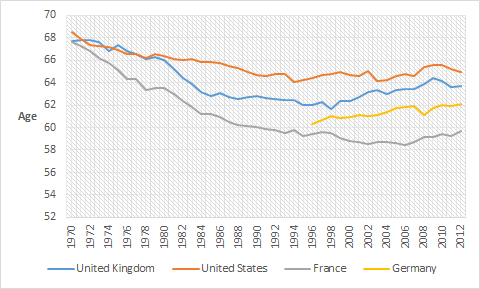
Figure 1 shows a divergence from a common starting point in 1974 effective retirement ages. The French in particular were the first to put their feet up and start retiring by the age of 60 by the early 1990. There was also a sharp increase in the average effective retirement age for men in the UK over a short decade. After that, British retirement ages for men started to climb again in the late 1990s. Figure 1 also shows that the gentle taper in the effective retirement age for American men stopped at the 1980s and started to climb again in the 2000s. The German data is too short to be of much use because of German unification. France only recently stopped seeing its effective retirement age fall and it is slightly increased recently – see figure 1
Figure 1: average effective retirement age for men, USA, UK, France and Germany, 1970 – 2012, (five-year average)
Source: OECD Pensions at a Glance.
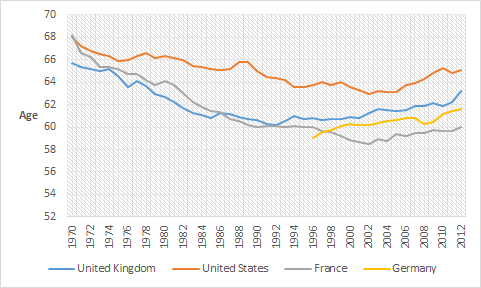
Figure 2 shows similar results for British and American women as for men in the same country shown in figure 1 . That is, falling effective retirement ages for both British and American women in the 1970s and 1980s followed by a slow climb again towards the end of 1990s. French effective retirement ages for women followed the same pattern as for French retirement ages for men – a long fall to below the age of 60 with a slight increase recently. The German retirement data suggest that effective retirement ages for German women is increasing.
Figure 2: average effective retirement age for women, USA, UK, France and Germany 1970 – 2012, (five-year average)
Source: OECD Pensions at a Glance.
Obama’s report card – second quarter 2015
25 Jul 2015 Leave a comment
in economic history, politics - USA Tags: obama
Murray Rothbard on the falling popularity of Pope Francis
25 Jul 2015 Leave a comment
in applied price theory, applied welfare economics, comparative institutional analysis, constitutional political economy, economic history, economics of bureaucracy, economics of education, economics of regulation, economics of religion, energy economics, environmental economics, income redistribution, industrial organisation, international economics, Murray Rothbard, politics - Australia, politics - New Zealand, politics - USA, Public Choice, rentseeking, survivor principle Tags: antiforeign bias, antimarket bias, Catholic social thought, climate alarmism, expressive voting, global warming, makework bias, Pope Francis, rational ignorance, rational irrationality, voter demographics


US Illegitimacy Rates
24 Jul 2015 Leave a comment
in politics - USA, population economics Tags: child poverty, economics of the family, family poverty, single mothers, single parents
CHART of the DAY: US Illegitimacy Rates http://t.co/TcbPo1Yhf9—
Mark J. Perry (@Mark_J_Perry) May 12, 2015
@Income_Equality there’s an Internet you know – was there next to no unemployment prior to the mid-1980s in New Zealand?
24 Jul 2015 Leave a comment
in business cycles, econometerics, economic growth, economic history, job search and matching, labour economics, labour supply, macroeconomics, politics - New Zealand, Public Choice, unemployment, unions, welfare reform Tags: antimarket bias, Don Brash, economic reform, expressive voting, Homer Simpson, Leftover Left, lost decades, makework bias, neoliberalism, rational ignorance, rational irrationality, Sir Roger Douglas, Twitter left
Today, Closing The Gap – The Income Inequality Project boldly claimed today that there was next to no unemployment in New Zealand prior to the onset of the curse of neoliberalism.

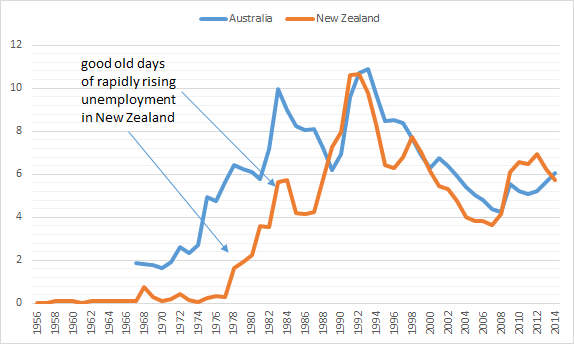
There is an Internet on computers now where it is easy to find data showing that the unemployment rate was rising rapidly in New Zealand in the 1970s and in double digits by the end of the 1980s – see figure 1.
Figure 1: harmonised unemployment rates, Australia and New Zealand, 1956-2014
Source: OECD StatExtract.
Figure 1 shows unemployment was rising rapidly in the 1970s and wasn’t much different by the end of the 1970s to the unemployment rates recorded after about 2000 in New Zealand.

One of the reasons that Sir Roger Douglas wrote There’s Got To Be A Better Way was the rapidly rising unemployment in New Zealand and the stagnant economic growth in the late 1970s and early 1980s.

New Zealand was one of the most regulated economies, so much so that Prime Minister David Lange said:
We ended up being run very similarly to a Polish shipyard.
As for those jobs on the railways, the then Reserve Bank Governor Don Brash said in 1996:
Railways cut its freight rates by 50 percent in real terms between 1983 and 1990, reduced its staff by 60 percent, and made an operating profit in 1989/90, the first for six years.
More on unemployment: In 1955 the New Zealand’s prime minister knew all unemployed personally.
– Atkinson’s new book http://t.co/x37Vxya97C—
Max Roser (@MaxCRoser) July 24, 2015
Bernie Sanders Introduces Bill for $15 Minimum Wage, Pays Staff Only $12
24 Jul 2015 Leave a comment
in labour economics, minimum wage, politics - USA Tags: 2016 presidential election, Bernie Sanders, expressive voting, Left-wing hypocrisy, rational ignorance, rational irrationality

Cumulative probability of a parent in prison by the age of 14
24 Jul 2015 Leave a comment
in economics of crime, law and economics, politics - USA Tags: crime and punishment, criminal deterrence, incarceration rates, single parents
What are some economic & social costs of crime & incarceration in the U.S? See 10 facts: bit.ly/1xvWAo2 http://t.co/6YNKYi6f43—
The Hamilton Project (@hamiltonproj) April 13, 2015
Creative destruction in family spending in the 20th century
24 Jul 2015 Leave a comment
in applied welfare economics, economic history, politics - USA Tags: creative destruction, living standards, The Great Enrichment
Change in Family spending in the 20th c. bit.ly/195NbKb http://t.co/9wd27BGzpT—
Catherine Mulbrandon (@VisualEcon) September 08, 2014
Average effective retirement ages by gender, Australia and New Zealand, 1970 – 2012
24 Jul 2015 1 Comment
in economic history, labour economics, labour supply, politics - Australia, politics - New Zealand Tags: ageing society, Australia, demographic crisis, economics of retirement, effective retirement ages, female labour force participation, female labour supply, male labour force participation, male labour supply, old age pensions, older workers, retirement ages, social insurance, Social Security, welfare state
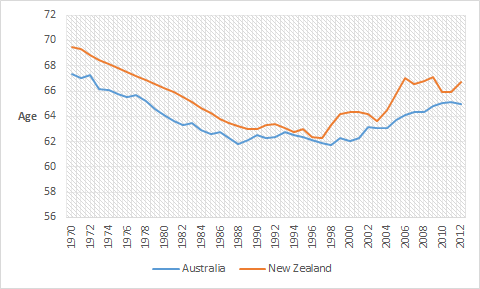
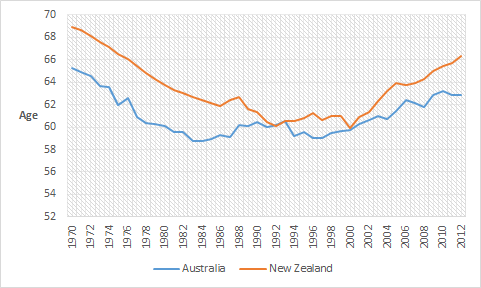
Figures 1 and 2 shows a sharp increase in the average effective retirement age for men and women in both Australia and New Zealand between 1970 and 1990. After that, retirement ages for men in both countries stabilised for about a decade. effective retirement age than Australia.
Figure 1: average effective retirement age for men, Australia and New Zealand, 1970 – 2012, (five-year average)
Source: OECD Pensions at a Glance.
Interestingly, in the 1970s and 1980s, New Zealand had an old-age pension scheme, known as New Zealand Superannuation, whose eligibility age was lowered from 65 to 60 in one shot in 1975. This old-age pension in New Zealand had no income test or assets test, but there was for a time a small surcharge on any income of pensioners. Nonetheless, New Zealand had a higher effective retirement age than in Australia where the old-age pension eligibility age is 65 with strict income and assets tests.
Figure 2: average effective retirement age for women, Australia and New Zealand, 1970 – 2012, (five-year average)
Source: OECD Pensions at a Glance.
Figure 1 and figure 2 also shows that the sharp increase in effective retirement ages in New Zealand for both men and women after the eligibility age for New Zealand’s old-age pension was increased from 60 to 65 over 10 years.
Figures 1 and 2 also show the gradual increase in effective retirement ages for Australian men and women from the end of the 1990s.
The price of 100% wind power in Denmark
24 Jul 2015 Leave a comment
in energy economics, environmental economics, politics - Australia, politics - New Zealand Tags: at nuclear power, Big Wind, Denmark, renewable energy
Why are more American mothers dying in childbirth?
23 Jul 2015 Leave a comment
Why are more American mothers dying in childbirth? The US defies a global trend econ.st/1TGG686 http://t.co/DbnYoE0Cef—
The Economist (@TheEconomist) July 20, 2015


Recent Comments