Low pay across the OECD
18 Jul 2015 Leave a comment
in minimum wage, politics - Australia, politics - New Zealand, politics - USA, poverty and inequality, unions, welfare reform Tags: living wage, low pay, minimum wage
NAFTA v. the Common Market: trading across the French, German, Italian, British, Canadian and US borders – World Bank Doing Business rankings compared
17 Jul 2015 Leave a comment
in economics of regulation, industrial organisation, international economics, politics - USA Tags: border costs, British economy, Canada, Common market, Common markets, customs unions, EU, France, free trade areas, Germany, Italy, NAFTA, trade costs
Figure 1: World Bank Doing Business rankings and sub rankings for trading across the French, German, Italian, British, Canadian and US borders, 2014
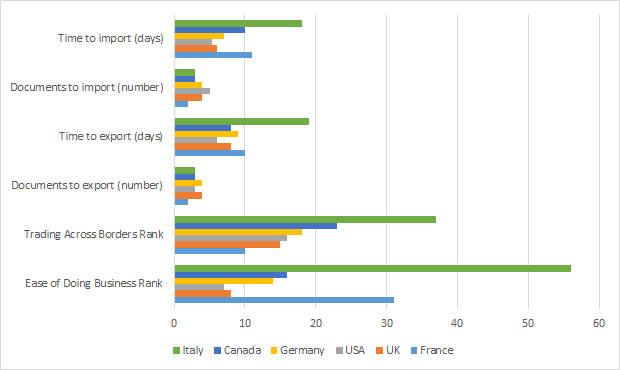
Source: World Bank Doing Business database; note: cost of importing and exporting not included.
Figure 2: World Bank Doing Business rankings – cost of importing and exporting across the French, German, Italian, British, Canadian and US borders, 2014
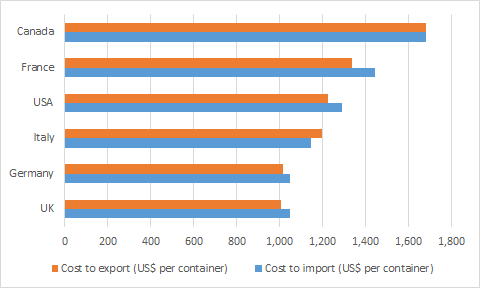
Source: World Bank Doing Business database; note: cost of importing and exporting not included.
The average worker doesn’t pay much in income taxes in New Zealand. Then who does?
17 Jul 2015 Leave a comment
in politics - Australia, politics - New Zealand, politics - USA, public economics, taxation Tags: growth of government, size of government, tax burdens, taxation and the labour supply


How to argue for inequality and neoliberalism when arguing dead set against it
17 Jul 2015 Leave a comment
in economic growth, economic history, human capital, income redistribution, labour economics, labour supply, politics - New Zealand, poverty and inequality, Public Choice, rentseeking Tags: Leftover Left, neoliberalism, top 1%
On 12 August last, Closer Together New Zealand posted a chart showing average hourly wages had been stagnant for 20 years and then started growing again in 1993. Closer Together New Zealand then rounded up the usual suspects of the Left over Left.
Later that month in a comment on that post, a chart was posted showing that inequality had been increasing quite rapidly in the late 1980s and early 1990s in New Zealand. There were a range of economic reforms Closer Together New Zealand didn’t like in the late 1980s and early 1990s.
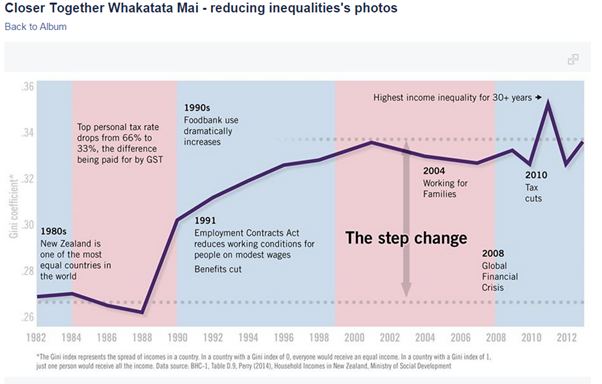
Closer Together New Zealand did not notice their second chart showed there had been a large increase in inequality, and their first chart showed that this was followed by the return of regular average hourly wages after 20 years of stagnation.
I am not so vulgar as to suggest correlation is causation, but it is amusing to watch that one day a chart is posted showing a resumption of wages growth after 20 years of wage stagnation and the next day a chart is posted showing that the major economic developments in the preceding years were a large increase in inequality and substantial economic liberalisation.
To add to my amusement, a companion site Inequality A New Zealand Conversation posted a chart showing the top 1% had not had much at all in income growth for the last 20 years while most everyone else had. This spike in the incomes of the top 1% prior to about 1994 was followed by the resumption in average wages growth after 1994.
The time when the mass kidnappings of principled anti-war activists started has been uncovered
16 Jul 2015 Leave a comment
in politics - USA, Public Choice Tags: activists, anti-war movement, expressive voting, green hypocrisy, Left-wing hypocrisy, Leftover Left, mass kidnappings, peace movement


via What’s Wrong With the U.S. Peace Movement, Bryan Caplan | EconLog | Library of Economics and Liberty.
Personal cameras as evidence that criminal deterrence works and works well
16 Jul 2015 1 Comment
in economics of crime, law and economics, managerial economics, organisational economics, personnel economics, politics - New Zealand, politics - USA Tags: body cameras, crime and punishment, criminal deterrence, police, prisons
Hutt City Council parking wardens are the latest in a long line of frontline staff to wear lapel cameras to deter assaults and verbal abuse. These lapel cameras are another illustration about how criminals and miscreants respond to incentives and are deterred by a greater prospect of being caught, convicted and punished. In the case of lapel cameras, there is a greater prospect of been identified and recorded for later proceedings.

The introduction of personal cameras in New Zealand prisons in high risk areas lead to a large reduction in the number of incidents of violence and abuse towards prison staff. Chief custodial officer Neil Beales said:
The use of on body cameras has led to a 15 to 20 per cent reduction in disruptive incidents (which can range from very minor to more serious) in units where cameras were used, compared with units where they were not used.
Even hardened prison inmates respond to incentives and a greater prospect of being caught and punished.

The introduction of personal cameras is not a priority for the New Zealand police. Mention was made of a six year long budget freeze as one of the reasons.
The first randomized controlled trial of police body cameras in the USA showed that cameras sharply reduce the use of force by police and the number of citizen complaints.

In Seattle, where a dozen officers started wearing body cameras in a pilot program in December, the police department has set up its own YouTube channel, broadcasting a stream of blurred images to protect privacy.
Share of university degrees conferred to U.S. women since 1970
16 Jul 2015 Leave a comment
in economic history, economics of education, human capital, labour economics, occupational choice, politics - USA Tags: lost boys, reversing gender gap
Share of university degrees conferred to U.S. women since 1970 (via @MaxCRoser) http://t.co/FUGrM7WbJd—
Claire Lehmann (@clairlemon) July 09, 2015
Poverty rates among immigrants and natives across the OECD
16 Jul 2015 Leave a comment
in income redistribution, labour economics, politics - Australia, politics - New Zealand, politics - USA, poverty and inequality, welfare reform Tags: Australia, child poverty, economics of immigration, family poverty
If government “programmes have been doing very little to help children out of poverty”, what halved child poverty in the last 20 years? Economic growth?
16 Jul 2015 Leave a comment
in economic growth, labour economics, labour supply, minimum wage, politics - New Zealand, poverty and inequality, unemployment, welfare reform Tags: child poverty, family poverty, family tax credits, in-work tax credits, social insurance, welfare reform, welfare state

RNZ: Govt advised in 2013 "social mobility" approach won't materially address child poverty. rnz.to/1RwVWoj http://t.co/nfd2gY0qcH—
Alastair Thompson (@althecat) July 14, 2015
Figure 1: child poverty (%) in New Zealand (before and after housing costs), 1982 – 2013
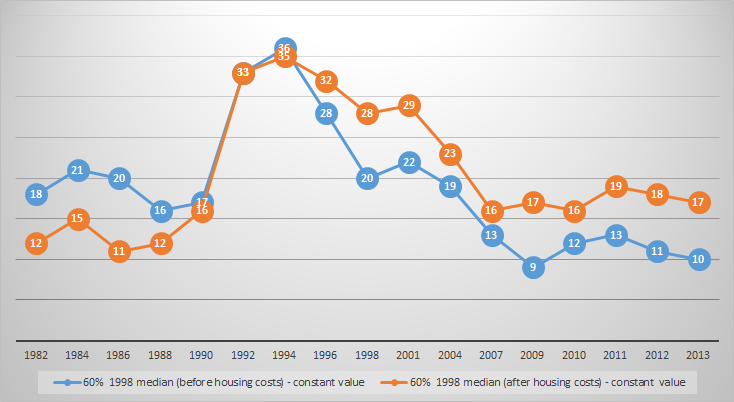
Source: Bryan Perry, Household incomes in New Zealand: Trends in indicators of inequality and hardship 1982 to 2013. Ministry of Social Development (July 2014), Tables F.6 and F.7.
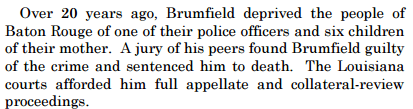
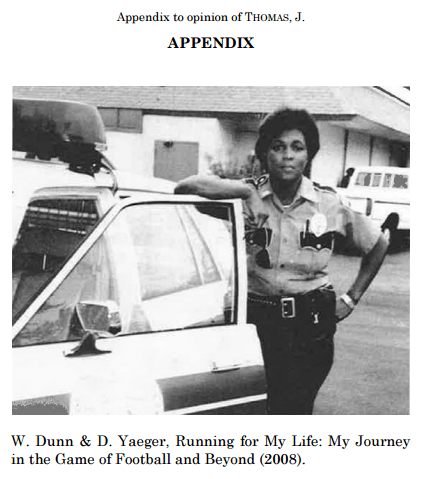
From the dissenting opinion of Justice Thomas in BRUMFIELD v. CAIN, WARDEN
15 Jul 2015 Leave a comment
in economics of crime, law and economics, politics - USA

NIMBY: Where, When, And to Which Developers It Happens in the USA
15 Jul 2015 Leave a comment
in economics of regulation, environmental economics, politics - Australia, politics - New Zealand, politics - USA, urban economics Tags: green rent seeking, Inner-city Left, land supply, land use planning, NIMBYs, zoning

How many working poor in USA, UK, Canada, Australia and New Zealand?
14 Jul 2015 Leave a comment
in international economics, labour supply, minimum wage, politics - Australia, politics - New Zealand, politics - USA, poverty and inequality, welfare reform Tags: Australia, British economy, Canada, low pay, New Zealand, social insurance, welfare state, working poor
Figure 1: working poor – proportion of employed persons with income below the poverty line (50% of median disposable income) living in households with a working age head and at least one worker in USA, UK, Canada, Australia and New Zealand, 2013
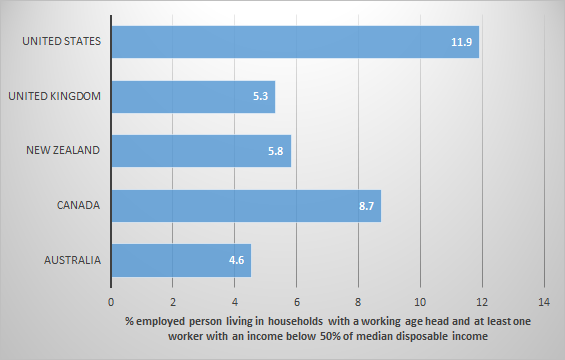
Source: In It Together – Why Less Inequality Benefits All – © OECD 2015, OECD Income Distribution Database (IDD), www.oecd.org/social/income-distribution-database.htm, Table 1.A1.1. Key indicators on the distribution of household disposable income and poverty, 2007, 2011 and 2013 or most recent year.
I thought solar energy supplied more energy than this
14 Jul 2015 Leave a comment
in energy economics, environmental economics, global warming, politics - USA Tags: Big Solar, climate alarmism, global warming, renewable energy, solar energy
These solar power plants provided around 0.11% of US electricity in 2012. vox.com/2014/6/12/5803… http://t.co/z7gUh0ofdD—
Vox Maps (@VoxMaps) April 09, 2015


Recent Comments