28 Jun 2015
by Jim Rose
in labour economics, politics - USA, poverty and inequality, welfare reform
Tags: British economy, Canada, top 1%
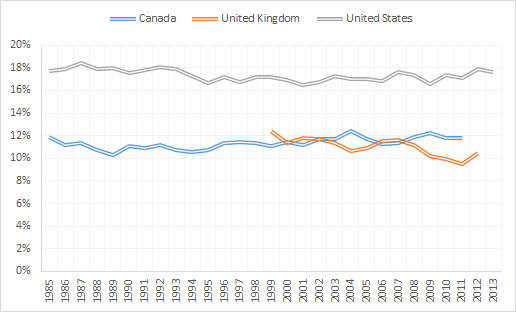
Despite 30 years of the ravages of neoliberalism, Reagan, Thatcher, and Blair, the whole lot, poverty has not gone up or down much at all.
Figure 1: relative poverty rate (% of persons living with less than 50% of equivalised disposable income), USA, UK and Canada

Source: In It Together – Why Less Inequality Benefits All – © OECD 2015
28 Jun 2015
by Jim Rose
in comparative institutional analysis, constitutional political economy, politics - Australia, politics - New Zealand, politics - USA, Public Choice
Tags: antiforeign bias, antimarket bias, economics of personality traits, expressive voting, Leftover Left, makework bias, political psychology, rational ignorance, rational irrationality
27 Jun 2015
by Jim Rose
in international economic law, international economics, politics - USA, Public Choice, rentseeking
Tags: 2016 presidential election, antiforeign bias, antimarket bias, crony capitalism, Donald Trump, expressive voting, left-wing populists, populists, right-wing populists
27 Jun 2015
by Jim Rose
in labour supply, politics - Australia, politics - New Zealand, politics - USA, poverty and inequality, public economics
Tags: Australia, British economy, family tax credits, family taxation, in-work tax credits, social insurance, taxation and the labour supply, welfare state
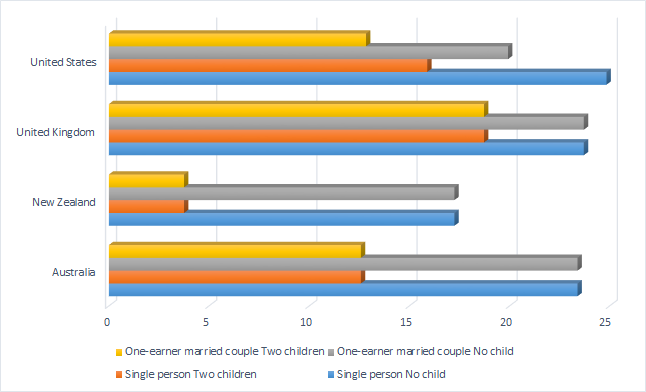
Figure 1: All in less cash transfers average income tax rates at average wage, 2014
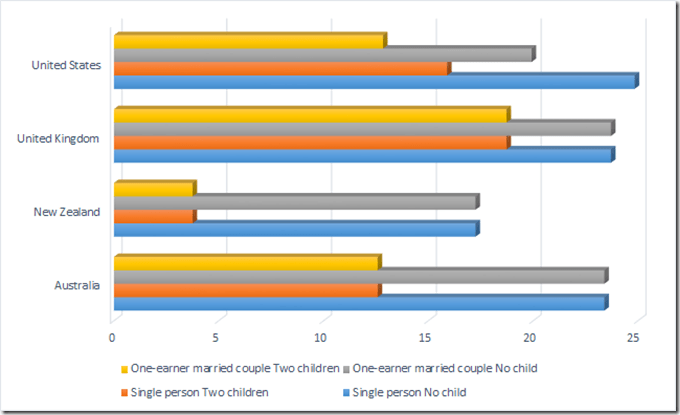
Source: OECD tax database
26 Jun 2015
by Jim Rose
in economic history, entrepreneurship, human capital, labour economics, labour supply, Marxist economics, occupational choice, politics - Australia, politics - USA, poverty and inequality
Tags: Australia, British economy, Canada, Leftover Left, top 0.1%, top 1%
Figure 1: top 0.1% share of gross income, Australia, UK, USA and Canada since 1946

Source: Chartbook of Economic Inequality.
The top 0.1% in Australia is earning not much more than it did in 1946. For most of the post-war period, the Australian top 0.1% earned less than what it earned in 1946. The only spike in the earnings of the Australian top 0.1% occurred after the top tax rate of 66% was reduced to 49% in 1986.
There were major cuts in the top tax rates in Australia,the USA and UK in the early 1980s. Figure 1 shows that these top tax rate cuts were matched with a spike in the earnings of the top 0.1% subsequent to those large tax cuts.
26 Jun 2015
by Jim Rose
in applied price theory, applied welfare economics, comparative institutional analysis, constitutional political economy, economics of crime, economics of media and culture, economics of regulation, law and economics, liberalism, politics - New Zealand, Public Choice
Tags: chilling effect, disorderly conduct, free speech, infotopia, Internet trolls, meddlesome preferences, nanny state, offsetting behaviour, The fatal conceit, The pretence to knowledge, unintended consequences
26 Jun 2015
by Jim Rose
in environmental economics, environmentalism, global warming, politics - New Zealand
Tags: climate alarmism, expressive politics, expressive voting, global warming, Greenpeace, Leftover Left, nonviolent direct action, peaceful protests
26 Jun 2015
by Jim Rose
in applied price theory, economics of regulation, health economics, politics - USA
Tags: meddlesome preferences, nanny state, offsetting behaviour, The fatal conceit, The pretence to knowledge, unintended consequences
Starting in 2012, the University of Vermont began a process of requiring that all campus locations selling beverages provided 30% “healthy” beverages, and then that all locations phases out all sales of bottled water.
There were two hope: 1) reduced use of bottles, when bottled water was no longer available, and 2) that healthier beverages would be consumed.
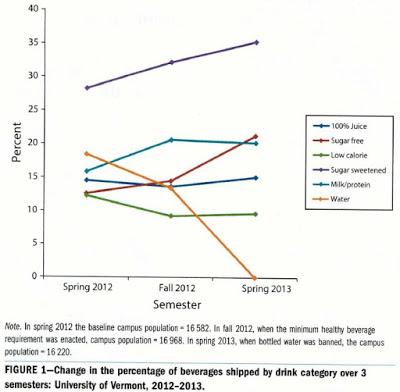
The orange line that drops to zero shows bottled water being phased out. The rising line at the top shows the rise in sugar-sweetened beverages. The red line in the middle that rises sharply shows the rise in sugar-free beverages.
via CONVERSABLE ECONOMIST: Banning Bottled Water: Unintended Consequences.
Previous Older Entries Next Newer Entries


Recent Comments