New from @iealondon: Scandinavian success is not due to high taxes and welfare spending. iea.org.uk/in-the-media/p… http://t.co/QVH566KNtV—
IEA (@iealondon) July 07, 2015
The impact of welfare states on life expectancy
07 Aug 2015 Leave a comment
in applied welfare economics, fiscal policy, labour economics, politics - Australia, politics - New Zealand, politics - USA, poverty and inequality, welfare reform Tags: Denmark, Finland, life expectancies, Norway, Sweden, welfare state
The Progressive Mind
06 Aug 2015 Leave a comment
in liberalism, Marxist economics, politics - Australia, politics - New Zealand, politics - USA, Public Choice Tags: antiforeign bias, antimarket bias, expressive voting, Left-wing hypocrisy, Leftover Left, makework bias, meddlesome preferences, nanny state, political correctness, rational irrationality, Twitter left
@DN_Debatt_betyg @LibyAlonso Vem vaktar väktarna? Vem tillser att experter är fria från bias? Vem nudgar, nudgarna? http://t.co/T01Va6UYOV—
Old Whig (@aClassicLiberal) July 26, 2015
Cannabis is pretty harmless by comparison
06 Aug 2015 Leave a comment
in economics of regulation, health economics, politics - Australia, politics - New Zealand, politics - USA Tags: alcohol regulation, economics of prohibition, marijuana decriminalisation, medical marijuana decriminalisation
US deaths (2013)
Tobacco 437k
Alcohol 29k
Opoids 16k
Heroin 8k
Cocaine 5k
Marijuana 0vox.com/2014/5/19/5727… http://t.co/o8yMDf7oE0—
Conrad Hackett (@conradhackett) August 04, 2015
The Left opposed airline deregulation
05 Aug 2015 Leave a comment
in applied price theory, applied welfare economics, comparative institutional analysis, economic history, economics of regulation, entrepreneurship, income redistribution, industrial organisation, politics - Australia, politics - New Zealand, politics - USA, Public Choice, rentseeking, survivor principle Tags: airline deregulation, antimarket bias, bootleggers and baptists, expressive voting, Leftover Left, rational ignorance, rational irrationality
CHART: US average airfares 1979 to 2014 measured in number of hours work at the average wage. @chartoftheday http://t.co/q7Phz3VkU0—
Mark J. Perry (@Mark_J_Perry) August 02, 2015
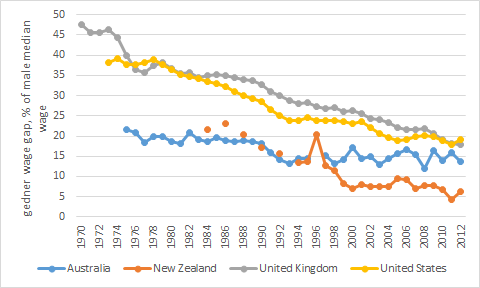
Gender wage gap, USA, UK, Australia and New Zealand since 1970
04 Aug 2015 1 Comment
in discrimination, gender, labour economics, politics - Australia, politics - New Zealand, politics - USA Tags: Australia, British economy, gender wage gap
New Zealand does much better than most on the gender wage gap for full-time workers.
Figure 1: gender wage, % of median male wage, full-time employees, USA, UK, Australia and New Zealand, 1970 – 2012
Source: Earnings and wages – Gender wage gap – OECD Data.
The gender wage gap in figure 1 is unadjusted and defined as the difference between median earnings of men and women relative to median earnings of men. Data refer to full-time employees.
I never found it terribly helpful to include part-time workers, such as in an hourly measure of the gender wage gap because of a larger trade-off between cash wages and work life balance in part-time jobs.
What difference did the Kyoto protocol make and that’s before you consider 3rd World development
04 Aug 2015 Leave a comment
in development economics, economic history, energy economics, environmental economics, global warming, growth miracles, politics - Australia, politics - New Zealand, politics - USA Tags: climate alarmism clock, climate treaties, expressive voting, free-riders, Kyoto Protocol, rational ignorance, rational irrationality
The lamps were going out all over Europe this day 1914
03 Aug 2015 Leave a comment
in economic history, liberalism, politics - Australia, politics - New Zealand, politics - USA, war and peace Tags: World War I
TPP – Trojan Horse in a global race to the bottom
03 Aug 2015 Leave a comment
in international economics, International law, law and economics, politics - Australia, politics - New Zealand, politics - USA, property rights, Public Choice Tags: free trade agreements, ISDS, regional trade agreements, TPPA
I can’t think of a single fact that this crank got right in this clip on the Trans-Pacific partnership agreement (TPPA).
Robert Reich, a Democratic party hack, referred to the TPPA as the biggest trade deal ever. He ignored a large number of multinational trade deals under the World Trade Organisation and the GATT such as the Uruguay round and the current Doha round.
http://www.cuts-international.org/brf-97-1.gif
Reich claims the deal is negotiated in secret and later talks about its submission to the Congress for fast track.
Robert Reich claims that investor state dispute settlement allows challenges to any regulation and compensation for unfair reductions in profits. It is a far narrow criteria than that involving discrimination against foreigners.
http://images.slideplayer.com/5/1585527/slides/slide_6.jpg
Currently, about 3000 international treaties give the ability to sue governments. Some 2700 of these are Bilateral Investment Treaties. The rest are trade treaties, including NAFTA. These treaties have spread rapidly around the world since the 1990s.
The TPP draft chapter says that the point of investment protection has long been “to encourage and promote the flow of investment…as a means to promote economic growth.”
At the same time, the TPP draft chapter specifically highlights “the inherent right to regulate…to protect legitimate public welfare objectives, such as public health, safety, the environment, the conservation of living or non-living exhaustible natural resources, and public morals.”


Robert Reich talks about the Trans Pacific Partnership and its implications especially if it is signed. It would be the largest trade deal in history representing 792 million people and accounting for 40% of the world economy. Well worth a look.
Tax rates on labour income across the OECD area
02 Aug 2015 Leave a comment
in labour economics, labour supply, politics - Australia, politics - New Zealand, politics - USA, public economics Tags: Australia, British economy, Canada, France, Germany, taxation and labour supply
How high is the US #tax burden on labor? Here's an OECD comparison tax.foundation/1KojUv9 by @samcjordan_ @kpomerleau http://t.co/fSAT8ut52z—
Tax Foundation (@taxfoundation) July 24, 2015
Would the reckless maritime protests of @Greenpeace be tolerated on land?
01 Aug 2015 Leave a comment
in economics of crime, environmental economics, environmentalism, law and economics, politics - Australia, politics - New Zealand, politics - USA, property rights, Rawls and Nozick, transport economics Tags: Greenpeace, John Rawls, peaceful protest
Were the Greenpeace runabouts observing maritime safety rules such as avoiding collisions and giving way? Any protester that behaved like that in a car would be immediately arrested and charged.
Why it is tolerated in the high seas is beyond me when it would never be tolerated on the road. No one would pretend reckless driving was peaceful protest. Is it okay to behave recklessly in a boat? No one would accept that in a car on land.
Central to the notion of peaceful protest is fidelity to democracy and the rule of law. The idea is not to impose your will upon others, but to persuade the majority to reconsider their position by showing the passionate extent to which you disagree with them and honestly believe they are mistaken.
The civil disobedient is attempting to appeal to the “sense of justice” of the majority and a willingness to accept arrest is proof of the integrity of the act says Rawls:
…any interference with the civil liberties of others tends to obscure the civilly disobedient quality of one’s act.
Rawls argues that the use or threat of violence is incompatible with a reasoned appeal to fellow citizens to move them to change a law. The actions are not a means of coercing or frightening others into conforming to one’s wishes. That is a breach of the principles of a just society.
Trigger warning for the Twitter Left
31 Jul 2015 Leave a comment
in applied price theory, applied welfare economics, constitutional political economy, income redistribution, politics - Australia, politics - New Zealand, politics - USA, Public Choice, public economics, rentseeking Tags: antimarket bias, endogenous growth theory, expressive voting, laffer curve, Leftover Left, taxation and entrepreneurship, taxation and human capital, taxation and investment, taxation and the labour supply, top 1%, Twitter left
Alcohol consumption per adult across countries
31 Jul 2015 Leave a comment
in health economics, politics - Australia, politics - New Zealand, politics - USA Tags: alcohol regulation, meddlesome preferences, nanny state
The living wage as an application of Director’s Law
30 Jul 2015 Leave a comment
in income redistribution, labour economics, minimum wage, politics - Australia, politics - New Zealand, politics - USA, population economics, poverty and inequality, Public Choice, rentseeking Tags: British politics, Director's Law, expressive voting, living wage, rational ignorance, rational irrationality
OBR's idea of who will benefit from National Living Wage http://t.co/ztxfW906Gg—
James Bartholomew (@JGBartholomew) July 08, 2015


Recent Comments