Celebrating humanity's flourishing through the spread of capitalism and the rule of law
25 Aug 2015 Leave a comment
in applied price theory, applied welfare economics, economics of regulation, health economics, politics - Australia, politics - New Zealand, politics - USA, Public Choice, rentseeking Tags: bootleggers and baptists, economics of smoking, meddlesome preferences, nanny state, pressure groups, special interests
24 Aug 2015 Leave a comment
in energy economics, environmental economics, global warming, politics - Australia, politics - New Zealand, politics - USA, poverty and inequality Tags: carbon tax, climate alarmism, expressive voting, fuel poverty, global warming
Who is harmed the most from higher energy costs? The poor, who spend almost 25% of their disposable income on energy? http://t.co/YOn28COXy8—
Mark J. Perry (@Mark_J_Perry) June 22, 2015
23 Aug 2015 Leave a comment
in economic history, Marxist economics, politics - Australia, politics - New Zealand, politics - USA Tags: communist party, left-wing traitors, World War II
The Molotov-Ribbentrop Pact was signed #OnThisDay in 1939. Stalin was no less evil than Hitler econ.trib.al/iCowG41 http://t.co/yxr5FCW1xg—
The Economist (@EconEurope) August 23, 2015
23 Aug 2015 Leave a comment
CHART: How Big is Uber vs. Legacy Taxis? VERY, VERY BIG nationalpost.com/m/wp/blog.html… http://t.co/gz0vXPZDip—
Mark J. Perry (@Mark_J_Perry) August 22, 2015
via Summer of Uber: Everything you need to know about the upstart ride-sharing service.
23 Aug 2015 Leave a comment
in economic history, economics of love and marriage, labour economics, labour supply, politics - Australia, politics - New Zealand, politics - USA, public economics Tags: Australia taxation and labour supply, British economy, marriage and divorce
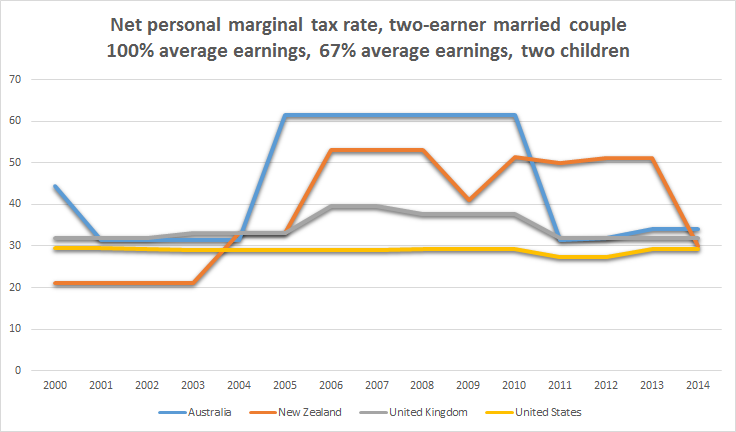
Source: OECD StatExtract.
22 Aug 2015 Leave a comment
in applied price theory, applied welfare economics, economics of bureaucracy, economics of regulation, financial economics, income redistribution, industrial organisation, politics - Australia, politics - New Zealand, politics - USA, Public Choice, rentseeking, survivor principle Tags: Australia, billionaires, Russia, top 0.1%, top 1%

…Bagchi and Svejnar carefully went through the lists of all the Forbes billionaires, and divided them into those who had acquired their wealth due to political connections, and those who had not. This is kind of a slippery slope — almost all billionaires have probably benefited from government connections at one time or another.
But the researchers used a very conservative standard for classifying people as politically connected, only assigning billionaires to this group when it was clear that their wealth was a product of government connections. Just benefiting from a government that was pro-business, like those in Singapore and Hong Kong, wasn’t enough.
Rather, the researchers were looking for a situation like Indonesia under Suharto, where political connections were usually needed to secure import licenses, or Russia in the mid-1990s, when some state employees made fortunes overnight as the state privatized assets.
…The negative effects of wealth inequality are largely being driven by politically connected wealth inequality. That seems to be the primary channel that drives this relationship…
a 3.72 percent increase in the level of wealth inequality would cost a country about half a percent of real GDP per capita growth. That’s a big impact, given that average GDP growth is in the neighbourhood of two percent per year
22 Aug 2015 Leave a comment
in economics of information, energy economics, environmental economics, global warming, politics - Australia, politics - New Zealand, Public Choice Tags: Australia, climate alarmism, global warming, Left-wing hypocrisy, The Guardian
https://twitter.com/guardianeco/status/634681114527797248
Excellent wrap up of carbon pricing globally, found here: worldbank.org/en/news/featur… #renewables http://t.co/Hocf9Z5cEC—
Danny Rose (@_DannyRose) August 19, 2015
Carbon pricing expanded in the last 21 months. New report shows where & how:
wrld.bg/R0EuZ http://t.co/VB69szI1je—
World Bank (@WorldBank) August 19, 2015
A carbon price gives investors a clearer view of the future risks of high-carbon assets: wrld.bg/R0GLE http://t.co/GuNnzlMMlZ—
World Bank (@WorldBank) August 21, 2015
22 Aug 2015 Leave a comment
in economic history, economics of love and marriage, labour economics, labour supply, politics - Australia, politics - New Zealand, politics - USA Tags: Australia, British economy, marriage and divorce, taxation and labour supply
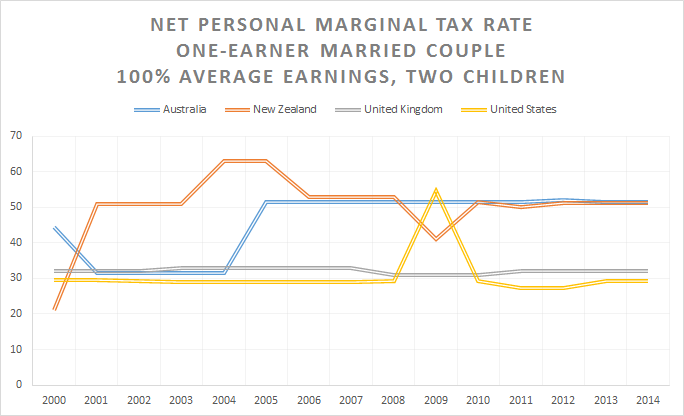
Source: OECD StatExtract.
22 Aug 2015 1 Comment
in applied price theory, constitutional political economy, economics of information, politics - New Zealand, Public Choice Tags: British Labour Party, British politics, economics of advertising, Eric Crampton, expressive voting, false consciousness, Leftover Left, median voter theorem, New Zealand Greens, New Zealand Labour Party, rational ignorance, rational rationality
Rob Salmond has written a great blog this week on the ideological spectrum of New Zealand voters based on the New Zealand Election Study.

In the course of his blog he drove a tremendously big stake through the heart of the old left fantasy that if Labour or Greens goes left, a large block of voters not voting for them now or not voting at all (the missing million voters) will shake lose its false consciousness and follow you:
But “pulling the centre back towards the left” is massively, massively hard.
You win those people over by being relevant to them as they are, not by telling them they’re worldview needs a rethink. It is just basic psychology. Tell people they were right all along; they like you. Tell people they were wrong all along; they don’t.
And if you win a majority of centrists, you win. The New Zealand Election Study series records six MMP elections in New Zealand – the three where Labour did best among centrists were the three Labour won.
That’s another message from the academic study I quoted above – in Germany, Sweden, and the UK, the elections where the left did best among centrists were the elections where they took power. As their popularity among centrists declined, so did their seat share.
What is more disturbing for the old left fantasy of the missing million is voting for the Labour Party or Greens is correlated with ignorance rather than knowledge.
Furthermore, the more people know about economics, the less likely they are to vote for the left as Eric Crampton explains:
When they get to the polls, the ignorant are significantly more likely to support the Labour Party (4% increase in predicted probability for a standard deviation increase in ignorance) and significantly less likely to support the Green party (1% decrease in predicted probability) and United Future (0.5% decrease in predicted probability).
Understanding economics strongly predicted supporting National in 2005, which comes as little surprise: the National Party leader was former Governor of the Reserve Bank of New Zealand. A standard deviation increase in our “economic thinking” index correlates with a 5.7% increased probability of voting National, a 1.5% decreased probability of voting NZ First, and a slight decrease in the probability of voting United Future and Maori.
To make matters worse, Crampton found that joining political organisations does little to cure ignorance of politics or otherwise lead to a political awakening. Sometimes active political affiliation reduces ignorance, other times such organisational membership intensifies ignorance.
via Salmond on the centre | Kiwiblog and StephenFranks.co.nz » Blog Archive » Why the left wants everyone to vote.
22 Aug 2015 2 Comments
in economic history, labour economics, politics - New Zealand, poverty and inequality, welfare reform Tags: child poverty, family poverty, Leftover Left, measurement error, New Zealand Greens
Summary of the 222 pages of MSD's Household Incomes report: kids are still missing out BIG time. #itsnotchoice http://t.co/4x7dm1O0Wg—
Child Poverty NZ (@povertymonitor) August 13, 2015
AHC = after deducting housing costs
BHC = before deducting housing costs
‘anchored line’:
- this is the line set at a chosen level in a reference year (now 2007), and held fixed in real terms (CPI adjusted)
- the concept of ‘poverty’ here is – have the incomes of low-income households gone up or down in real terms compared with what they were previously?
‘moving line’:
- this is the fully relative line that moves when the median moves (e.g. if median rises, the poverty line rises and reported poverty rates increase even if low incomes stay the same)
- the concept of ‘poverty’ here is – have the incomes of low-income households moved closer or further away from the median?
Bryan Perry, Household Incomes in New Zealand: trends in indicators of inequality and hardship 1982 to 2014 – Ministry of Social Development, Wellington (August 2015), p. 133.
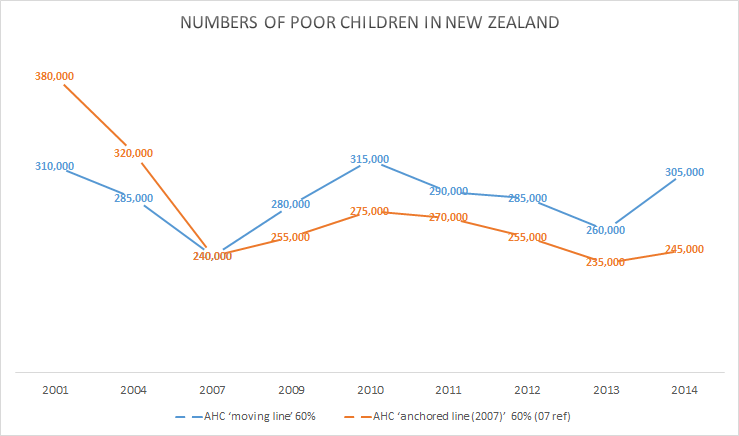
Source: Bryan Perry, Household Incomes in New Zealand: trends in indicators of inequality and hardship 1982 to 2014 – Ministry of Social Development, Wellington (August 2015), p. 133.
Is child poverty in New Zealand 245,000 children or 305,000 children?
260,000 kids in income poverty, 180,000 in material hardship, 10% in severe poverty, 3in5 in poverty for a long time http://t.co/Oy5cWftvwU—
Child Poverty NZ (@povertymonitor) May 21, 2015
If you base your estimate of child poverty on the 60% of median income after housing costs moving line, which is the number of low income households who moved further away from 60% of median income, a median which increased by 5% last year, the figure is 305,000 children after housing costs. 45,000 children are in households that is not as close to the median as last year but are not necessarily any poorer than last year in terms of money coming into the house.
45k more children in #poverty this year than last, that’s 305k Kiwi kids without life's basics. C'mon @johnkeypm! http://t.co/K8zeQpgA79—
UNICEF New Zealand (@UNICEFNZ) August 13, 2015
If you base your estimate on the anchored line, which is the number of low income households whose income has gone up on down compared to what they were on previously,the number of children in poverty has increased from 235,000 to 245,000 after housing costs. About 10,000 children are poorer than last year – poorer enough than last year to be classified as in poverty.

21 Aug 2015 Leave a comment
The U.S. places a high #tax on corporate income: tax.foundation/1Jf0ytp http://t.co/6inEfqftpQ—
Tax Foundation (@taxfoundation) August 18, 2015
The U.S. has the highest corporate income #tax rate in the developed world: tax.foundation/1WlGhIf http://t.co/Cp35sRwHjo—
Tax Foundation (@taxfoundation) August 13, 2015
The U.S. corporate #tax rate is out of line with our trading partners: tax.foundation/1UO4gy5 http://t.co/FzWDDTNrvC—
Tax Foundation (@taxfoundation) August 17, 2015
21 Aug 2015 1 Comment
in constitutional political economy, politics - Australia, politics - New Zealand, politics - USA, Public Choice, rentseeking Tags: British general election, British politics, Leftover Left
If you think equality and fairness in Britain is important you should do this: labour.tw/1MH6f4M http://t.co/7gCDkX7fj5—
The Labour Party (@UKLabour) August 06, 2015
Jeremy Corbyn had 30 years to split from the Labour Party, which he voted against 25% of the time, establish his own party and receive the same reception presumably he would have got without needing to have to run for leader of the Labour Party.
Conservatism and nationalism destroy the Labour Party nickcohen.net/2015/06/02/con… http://t.co/ue0XzXTEFo—
Nick Cohen (@NickCohen4) June 02, 2015
The reasoning Corbyn never split from the Labour Party, and the reason why the left never splits from the Labour Party, is the left knows that it would get far fewer votes on its own rather than piggybacking on the right wing of that party.
The right split from the British Labour Party in the early 1980s to form the Social Democratic party. The right-wing split from the Australian Labor Party at least four times over its history.
The left is never split from the New Zealand Labour Party because it knows that it could never get anywhere even under proportional representation without the image of being part of the traditional Labour Party, centre-left, social democratic, not socialist. Jeremy Corbyn and the rest of the left of British Labour are practising mild mannered entryism. By stealing the brand of the Labour Party, the left obtains far more power than it ever could standing on its own two feet as true believers.
Our vision is of an economy that works for all, provides opportunity for all and invests in all. #jeremy4leader http://t.co/59Gk9AN7Xf—
JeremyCorbyn4Leader (@Corbyn4Leader) July 22, 2015
The working hypothesis of the far left everywhere is if the Labour Party were to adopt hard left policies is many more votes.
Fabulous scenes wherever we go, but this picture of the Opera House in Newcastle is quite something. #voteCorbyn http://t.co/GzB96CjB7d—
JeremyCorbyn4Leader (@Corbyn4Leader) August 18, 2015
Labour would win many more votes because the offer of a genuine socialist alternative would shake voters loose of their false consciousness.

The left of the Labour Party never went out on its own to test that hypothesis because they knew in their hearts be lucky to not to lose their deposits.

This is despite the strong rise in third parties in British politics despite first past the post.
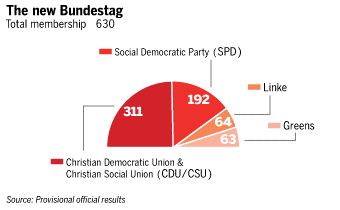
The remnants of the communist parties do well at elections in countries such as France, Germany (Linke or Left Party) and Japan and are in government in Greece.

The right wing of the Labour Party was willing to take its chances under first past the post voting in the House of Commons because it knew that a large part the electorate would vote for it in preference to the remnant of a left-wing run Labour Party.
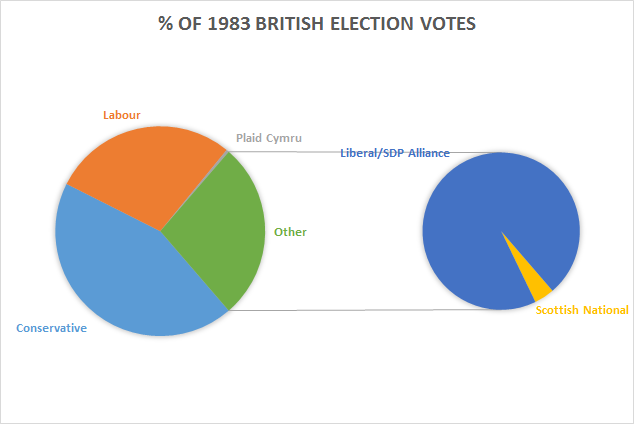
The combination of these splitters from the British Labour Party and the Liberal party won 25% of the vote, two percentage points behind the British Labour Party.
21 Aug 2015 1 Comment
in job search and matching, labour economics, occupational choice, politics - New Zealand, transport economics, urban economics Tags: Auckland, bicycles, commuting times, compensating differentials, expressive voting, green rent seeking, Inner-city Left, New Zealand Greens, public transport, rational irrationality, search and matching, The fatal conceit, The pretense to knowledge
I am not surprised only 7% of Auckland’s take public transport to work considering it takes much longer than any other form of commuting.
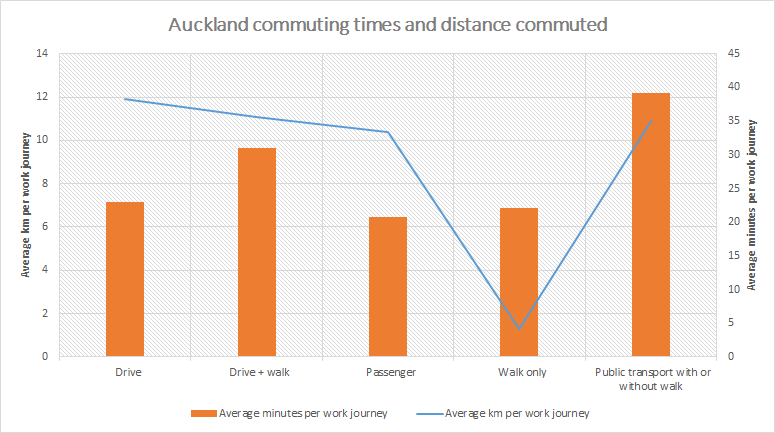
The average commute by public transport is 40 minutes as compared to less than 25 in a car. 74% of Aucklanders drive to work and another 9% are a passenger in a car.
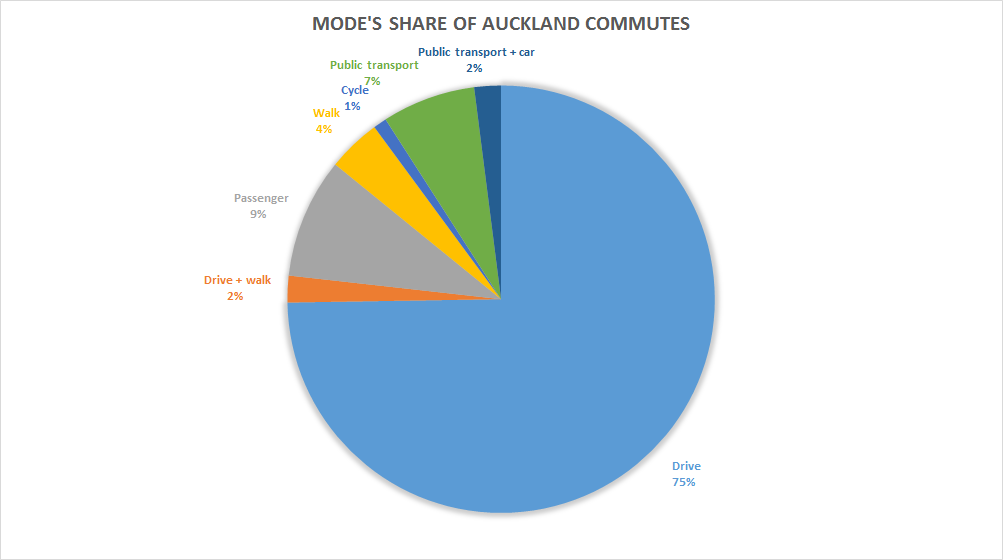
No information was available on those who bike to work because only 1% of Aucklanders bike to work. Only 2% of all New Zealanders take a bike to work. The sample size was therefore too small. Yet another reason to ban bikes at night. Few commute on this mode of transport in Auckland.
The near identical commuting distances irrespective of the mode of transport except walking is further evidence that people are quite discerning in balancing commuting times and job selection as per the theory of compensating differentials. Indeed, average commuting times in Auckland are much the same as the average commuting time in America.

The Auckland transport data showing people commute much the same distance by any mode of transport bar walking also validates Anthony Downs’ theory of triple convergence.

Improving the commuting times in one mode of transport will mean people simply take the mode of peak hour transport that is suddenly become less congested while others who were not going to commute at peak times or start commuting at peak times as Anthony Downs explains:
If that expressway’s capacity were doubled overnight, the next day’s traffic would flow rapidly because the same number of drivers would have twice as much road space.
But soon word would spread that this particular highway was no longer congested. Drivers who had once used that road before and after the peak hour to avoid congestion would shift back into the peak period. Other drivers who had been using alternative routes would shift onto this more convenient expressway. Even some commuters who had been using the subway or trains would start driving on this road during peak periods.
Within a short time, this triple convergence onto the expanded road during peak hours would make the road as congested as it was before its expansion.
21 Aug 2015 Leave a comment
in applied welfare economics, economics of regulation, energy economics, environmental economics, health economics, international economics, labour economics, law and economics, politics - New Zealand, Public Choice Tags: antiforeign bias, antimarket bias, expressive voting, Greenpeace, Leftover Left, make-work bias, methodology of economics, New Zealand Greens, New Zealand Labour Party, rational ignorance, rational irrationality
Quotation of the Day from French Economist Frederic Bastiat in the 1850s http://t.co/2ECWtb6m9u—
Mark J. Perry (@Mark_J_Perry) August 14, 2015
Celebrating humanity's flourishing through the spread of capitalism and the rule of law
Celebrating humanity's flourishing through the spread of capitalism and the rule of law
Celebrating humanity's flourishing through the spread of capitalism and the rule of law
Celebrating humanity's flourishing through the spread of capitalism and the rule of law
Celebrating humanity's flourishing through the spread of capitalism and the rule of law
A History of the Alt-Right
Econ Prof at George Mason University, Economic Historian, Québécois
Celebrating humanity's flourishing through the spread of capitalism and the rule of law
Scholarly commentary on law, economics, and more
Beatrice Cherrier's blog
Celebrating humanity's flourishing through the spread of capitalism and the rule of law
Celebrating humanity's flourishing through the spread of capitalism and the rule of law
Celebrating humanity's flourishing through the spread of capitalism and the rule of law
Why Evolution is True is a blog written by Jerry Coyne, centered on evolution and biology but also dealing with diverse topics like politics, culture, and cats.
Celebrating humanity's flourishing through the spread of capitalism and the rule of law
A rural perspective with a blue tint by Ele Ludemann
DPF's Kiwiblog - Fomenting Happy Mischief since 2003
Celebrating humanity's flourishing through the spread of capitalism and the rule of law
The world's most viewed site on global warming and climate change
Tim Harding's writings on rationality, informal logic and skepticism
A window into Doc Freiberger's library
Let's examine hard decisions!
Commentary on monetary policy in the spirit of R. G. Hawtrey
Thoughts on public policy and the media
Celebrating humanity's flourishing through the spread of capitalism and the rule of law
Politics and the economy
A blog (primarily) on Canadian and Commonwealth political history and institutions
Reading between the lines, and underneath the hype.
Economics, and such stuff as dreams are made on
"The British constitution has always been puzzling, and always will be." --Queen Elizabeth II
Celebrating humanity's flourishing through the spread of capitalism and the rule of law
Celebrating humanity's flourishing through the spread of capitalism and the rule of law
WORLD WAR II, MUSIC, HISTORY, HOLOCAUST
Undisciplined scholar, recovering academic
Celebrating humanity's flourishing through the spread of capitalism and the rule of law
Res ipsa loquitur - The thing itself speaks
In Hume’s spirit, I will attempt to serve as an ambassador from my world of economics, and help in “finding topics of conversation fit for the entertainment of rational creatures.”
Researching the House of Commons, 1832-1868
Articles and research from the History of Parliament Trust
Reflections on books and art
Posts on the History of Law, Crime, and Justice
Celebrating humanity's flourishing through the spread of capitalism and the rule of law
Exploring the Monarchs of Europe
Cutting edge science you can dice with
Small Steps Toward A Much Better World
“We do not believe any group of men adequate enough or wise enough to operate without scrutiny or without criticism. We know that the only way to avoid error is to detect it, that the only way to detect it is to be free to inquire. We know that in secrecy error undetected will flourish and subvert”. - J Robert Oppenheimer.


Recent Comments