#NHprimary winners @realDonaldTrump @BernieSanders have most radical #tax plans: https://t.co/H8YUbXx4Zq @AlanMCole pic.twitter.com/U7tAXFNrxW
— Tax Foundation (@TaxFoundation) February 13, 2016
@BernieSanders lies about the cost of single-payer health care
16 Feb 2016 Leave a comment
in health economics, politics - USA Tags: 2016 presidential election, health insurance
Milton Friedman on racism and sexism in Hollywood, today and yesterday
16 Feb 2016 Leave a comment
in applied price theory, discrimination, economics of media and culture, entrepreneurship, labour economics, law and economics, liberalism, politics - USA
David Henderson reminded me of the superb discussion by Milton Friedman in Capitalism and Freedom of the way in which the marketplace erodes prejudice.
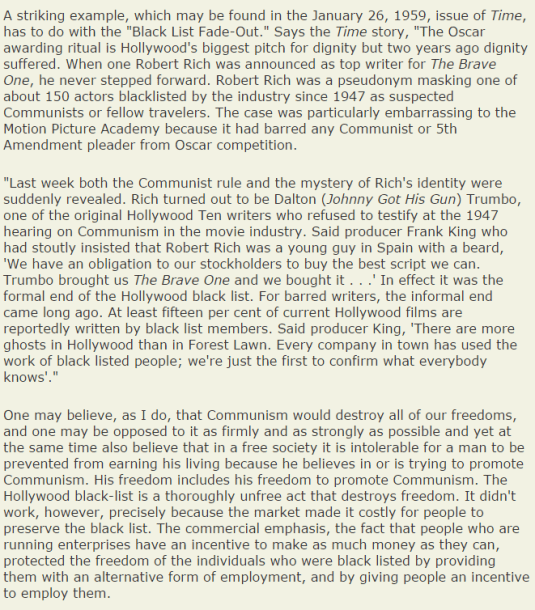
Source: Milton Friedman on Trumbo, David Henderson | EconLog | Library of Economics and Liberty.
Scalia on who should decide vexing social issues @PeterDunneMP
15 Feb 2016 Leave a comment
in comparative institutional analysis, constitutional political economy, law and economics, politics - New Zealand, politics - USA Tags: abortion rights, marijuana decriminalisation
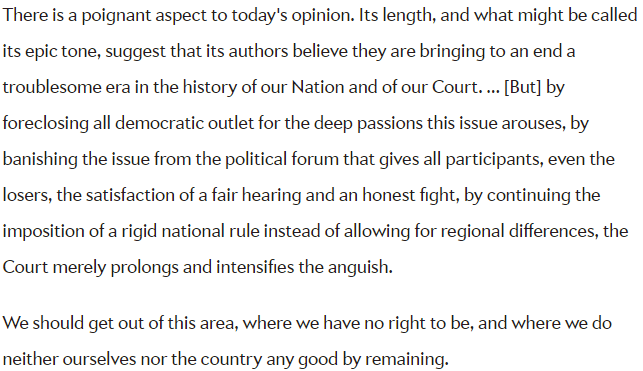
@BernieSanders has serious problems with Uber because it is unregulated
15 Feb 2016 Leave a comment
in applied price theory, economics of regulation, entrepreneurship, labour economics, politics - USA
@GreenCatherine 1996 US welfare reforms & deep poverty @JulieAnneGenter
15 Feb 2016 Leave a comment
in applied welfare economics, politics - USA, welfare reform
The 1996 federal welfare reforms were supposed to condemn the poor to homelessness and no money to buy food. Deep poverty did not get worse as a result of those reforms. That alone refutes its critics.

Source: Take 2: Another Look at Bernie Sanders, Welfare Reform, and Deep Poverty | Mother Jones.
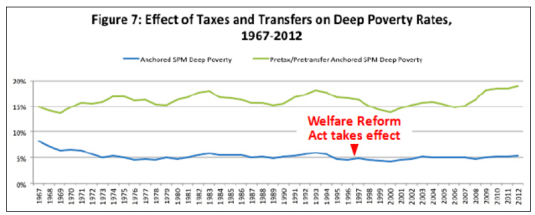
Source: New Study Says Poverty Rate Hasn’t Budged For 40 Years | Mother Jones.

Source: Weekend Follow-Up #1: Welfare Reform and Deep Poverty | Mother Jones.
% of workforce requiring license or certification by state– Corrected
13 Feb 2016 2 Comments
in applied welfare economics, economics of regulation, labour economics, occupational regulation, politics - USA
Some American states regulate twice as many occupations as others. This diversity in federalism strains any public interest explanation of occupational regulation.
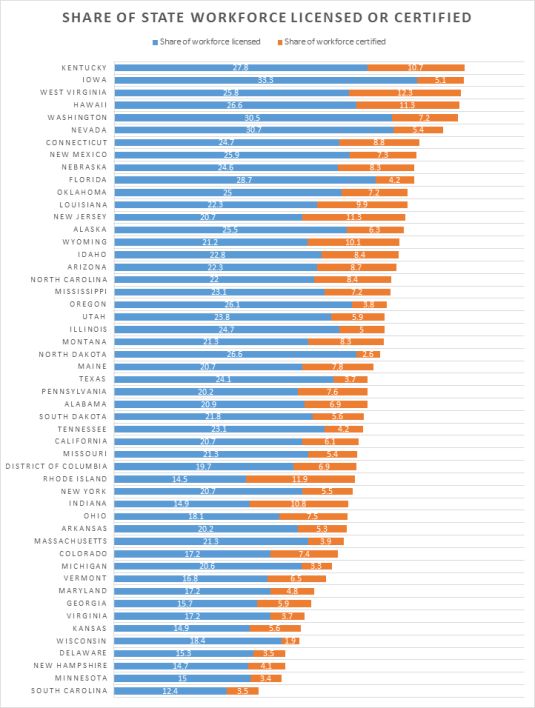
Source: Reforming Occupational Licensing Policies | The Hamilton Project – Kleiner and Vorotnikov (2015), based on an analysis of data from a Harris poll of 9,850 individuals conducted in the first half of 2013 (Harris Poll Interactive 2013).
The purpose of occupational regulation is to protect buyers from quacks and lemons – to overcome asymmetric information about the quality of the provider of the service.
Adverse selection occurs when the seller knows more than the buyer about the true quality of the product or service on offer. This can make it difficult for the two people to do business together. Buyers cannot tell the good from the bad products on offer so many they do not buy to all and withdraw from the market.
Any entrepreneur who finds ways of providing credible assurances of the quality of this service or work stands to profit handsomely. Brand names and warranties are examples of market generated institutions that overcome these information gaps through screening and signalling.
Screening is the less informed party’s effort, usually the buyer, to learn the information that the more informed party has. Successful screens have the characteristic that it is unprofitable for bad types of sellers to mimic the behaviour of good types. Signalling is an informed party’s effort, usually the seller, to communicate information to the less informed party.
The main issue with quacks in the labour market is whether there is a large cost of less than average quality service, and is there a sub-market who will buy less than average quality products in the presence of competing sellers competing on the basis of quality assurance. This demand for assurance creates opportunities for entrepreneurs to profit by providing assurance.
Mostly disciplinary investigations and deregistrations under the auspices of occupational regulation are for gross misconduct and criminal convictions rather than the shading of quality.
The 1996 US federal welfare reforms at 20
12 Feb 2016 Leave a comment
in applied welfare economics, economic history, labour economics, labour supply, politics - USA, welfare reform
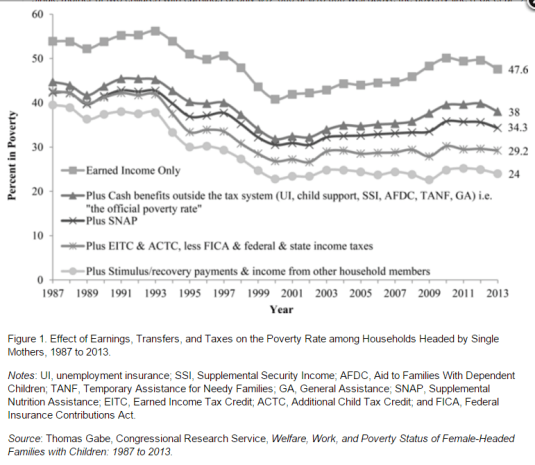
Despite the dire predictions, there has been a permanent reduction in child poverty of 25%, a 35% increase in the employment rates of never married mothers and a 16% increase in the employment rates of single mothers.
Minorities benefited the most from the 1996 US federal welfare reforms in terms of higher employment rates and lower child poverty rates.
As part of the 1996 reforms, Medicaid eligibility was not lost when going off welfare and single parents by getting a job qualified for the Earned Income Tax Credit.
Partisans divides on foreign threats in the USA
12 Feb 2016 Leave a comment
in defence economics, economics of media and culture, environmental economics, global warming, politics - USA Tags: 2016 presidential election, climate alarmism, foreign policy, global warming, voter demographics
Gerrymandering is even more infuriating when you can actually see it
11 Feb 2016 Leave a comment
in constitutional political economy, politics - USA, Public Choice
https://twitter.com/bargemUK/status/687610265400152065

Source: Gerrymandering Is Even More Infuriating When You Can Actually See It | WIRED.
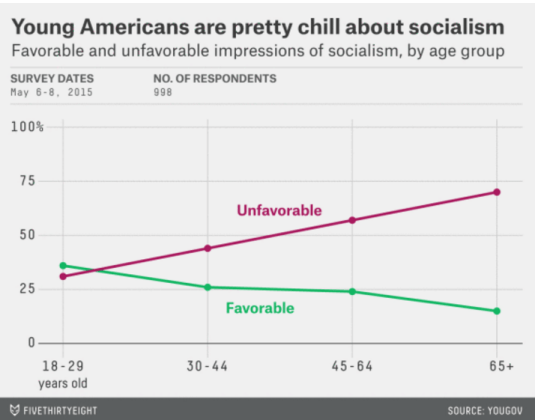
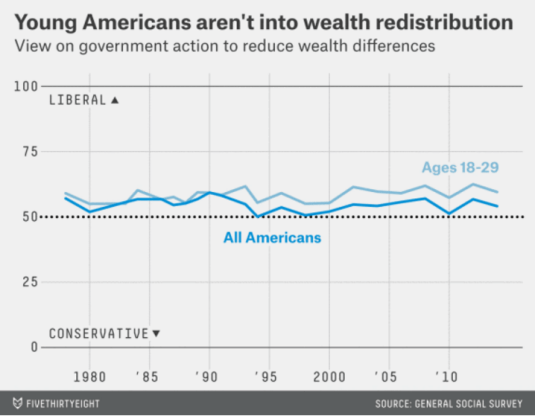
Young Democrats like @BernieSanders & socialism but oppose income redistribution as much as their parents do
09 Feb 2016 Leave a comment
in Marxist economics, politics - USA, Public Choice, public economics
The US presidential tax plans compared
09 Feb 2016 1 Comment
in applied price theory, politics - USA, public economics
@realdonaldtrump @BernieSanders are equally ignorant and unfit for office
09 Feb 2016 Leave a comment
in applied welfare economics, economic history, labour economics, macroeconomics, politics - USA Tags: 2016 presidential election, antiforeign bias, antimarket bias, Leftover cab left, pessimism bias, rational rationality, The Great Enrichment, Twitter left
Explaining free trade to @realdonaldtrump @BernieSanders with the same biased, bought and paid for video
08 Feb 2016 Leave a comment
in applied welfare economics, international economics, politics - USA Tags: 2016 presidential election, free trade, left-wing popularism, rational ignorance, rational irrationality, right-wing popularism
@berniesanders How America’s middle class is disappearing
08 Feb 2016 Leave a comment
in applied welfare economics, economic history, labour economics, politics - USA, poverty and inequality Tags: living standards, rational ignorance, rational irrationality, withering away of proletariat

Both the proletariat and the middle class are withering away these days thanks to capitalism and freedom.


Recent Comments