Why Do Politicians All Sound the Same? @BernieSanders
08 Feb 2016 Leave a comment
in constitutional political economy, politics - Australia, politics - New Zealand, politics - USA, Public Choice Tags: 2016 presidential election, median voter theorem
Here’s where Republicans and Democrats differ on the role of government
08 Feb 2016 Leave a comment
in defence economics, economics of bureaucracy, economics of education, economics of information, economics of media and culture, economics of regulation, energy economics, entrepreneurship, environmental economics, income redistribution, politics - USA, Public Choice, rentseeking Tags: 2016 presidential election Republican Party, Democratic Party, votor demographics
Contested conventions in presidential races, 1868 – 1984
07 Feb 2016 Leave a comment
in politics - USA Tags: 2016 presidential election

There hasn’t been a seriously contested convention in decades, and history helps explain why: Presidential candidates who needed multiple ballots to get nominated usually didn’t win.
Source: A look back at contested conventions | Pew Research Center
The impact of a famous name on future baby naming
07 Feb 2016 1 Comment
in politics - USA Tags: baby names
Is @HillaryClinton a Reformer or Hypocrite?
07 Feb 2016 Leave a comment
in discrimination, gender, labour economics, law and economics, politics - USA Tags: 2016 presidential election, Bill Clinton, Hillary Clinton, Left-wing hypocrisy, sexual harassment
@HillaryClinton @BernieSanders is it Republicans who are too extreme?
06 Feb 2016 Leave a comment
in economic history, politics - USA
…as Lynn Vavreck and John Sides show in The Gamble, their excellent book on the 2012 campaign, voters saw themselves as ideologically between Obama and Mitt Romney but closer to Romney.
Source: Bernie Sanders’s strong campaign is solving Hillary Clinton’s biggest problem – Vox

Source: Bernie Sanders’s strong campaign is solving Hillary Clinton’s biggest problem – Vox.
Gender wage gap myths and realities
06 Feb 2016 Leave a comment
in discrimination, gender, human capital, labour economics, labour supply, occupational choice, politics - New Zealand, politics - USA
What #guncontrol headlines mean for gun-industry bottom lines
06 Feb 2016 Leave a comment
in applied price theory, economics of regulation, financial economics, politics - USA
The left-wing tax dilemma
06 Feb 2016 Leave a comment
in politics - USA, public economics Tags: 2016 presidential election, entrepreneurial alertness, growth of government, size of government, taxation and entrepreneurship, taxation and investment, taxation and labour supply

Trading across the Mexican, Puerto Rican and US borders – World Bank Doing Business rankings, 2015
05 Feb 2016 Leave a comment
in international economics, politics - USA

Source: World Bank Doing Business database 2015.
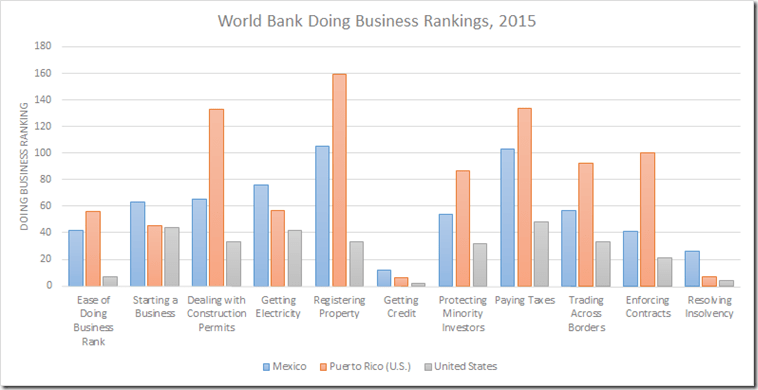
Much more than a high minimum wage – Puerto Rican, Mexican and U.S. Doing Business rankings 2015
05 Feb 2016 Leave a comment
in economics of religion, entrepreneurship, industrial organisation, law and economics, politics - USA, property rights Tags: doing business, Mexico, Puerto Rico
Having a high minimum wage is the least of the problems that the US territory of Porto Rico has when you consider reasons from its recent sovereign default. It owes about US$70 billion. It is a terrible place to do do business – worse than Mexico! Mexicans find it easier to export to the USA!
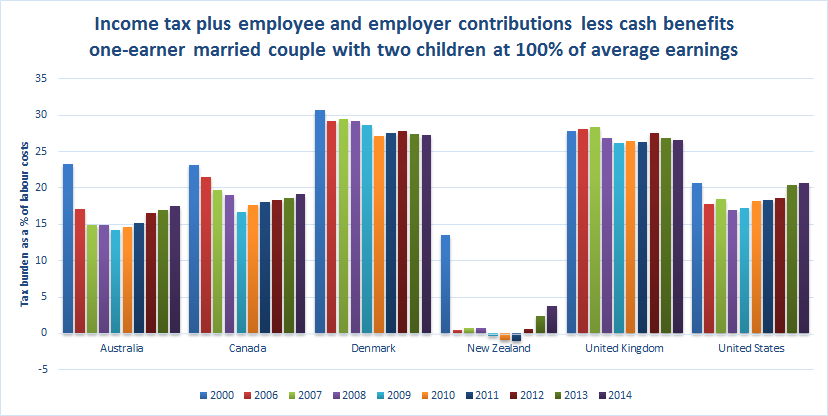
US, Danish, British, Canadian, Australian and New Zealand tax and social security burden net of cash benefits as a % of labour costs, one-earner married couple with two children since 2000
05 Feb 2016 Leave a comment
in labour economics, labour supply, politics - Australia, politics - New Zealand, politics - USA, public economics Tags: 2016 presidential election, British election, Canada, Denmark, family tax credit, in work tax credit, taxation and labour supply
For some reason the Labour government in New Zealand in the mid-2000s could not bring itself to admit it was introducing a huge tax cut for families. To avoid admitting it ever gave a tax cut, that Labour government called the huge family tax credit introduced in 2004 and 2005 Working for Families.
Source: Taxing Wages 2015 – OECD 2015
The above data does not include the effects of GST and VAT.
@BernieSanders MRI rationing – US v. Single-payer UK, Canada and Denmark
05 Feb 2016 Leave a comment
in health economics, politics - USA Tags: 2016 presidential election, British economy, Canada, Denmark, health insurance, medical rationing, NHS, single-payer, social insurance, universal health insurance
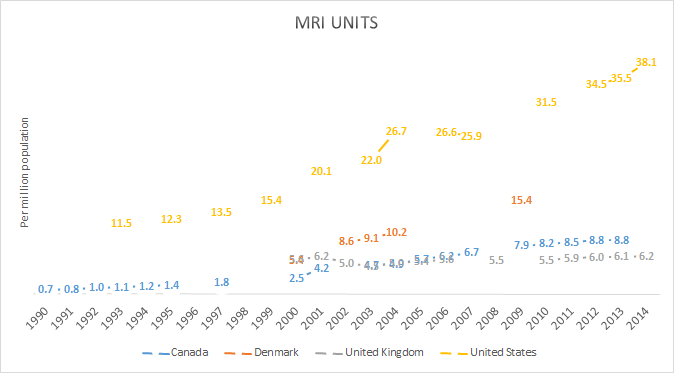
Single payer health insurance systems may have their advantages but one of which is not ready access to an MRI scan in the UK, Denmark or Canada.
Source: OECD Health Statistics.
Remember that those aged over 65 in the USA are covered by Medicare; the poor and welfare beneficiaries are covered by Medicaid; and children of the working poor are covered by CHIPS.
I am told that dogs to get an MRI scan in Canada far quicker than humans. This is because dog owners can pay for the MRI scan. Private health insurance is unlawful in 9 of the 10 Canadian provinces.
There is considerable medical tourism from Canada to the USA, including by politicians who passionately support the single-payer system.


Recent Comments