
HT: Julian Weeks
Celebrating humanity's flourishing through the spread of capitalism and the rule of law
06 Nov 2016 Leave a comment
in economics of media and culture Tags: Australia, economics of languages, slang
HT: Julian Weeks
12 Oct 2016 Leave a comment
in business cycles, job search and matching, labour economics, macroeconomics, unemployment Tags: Australia, Canada, long-term unemployment, social insurance, unemployment duration
05 Sep 2016 Leave a comment
in economic history Tags: Australia

.
31 Jul 2016 Leave a comment
in economics of education, human capital, labour economics, occupational choice Tags: Australia, British economy, Canada, College premium, Denmark, education premium, Finland, France, graduate premium, Ireland, Korea, Norway, post-graduate premium, Sweden
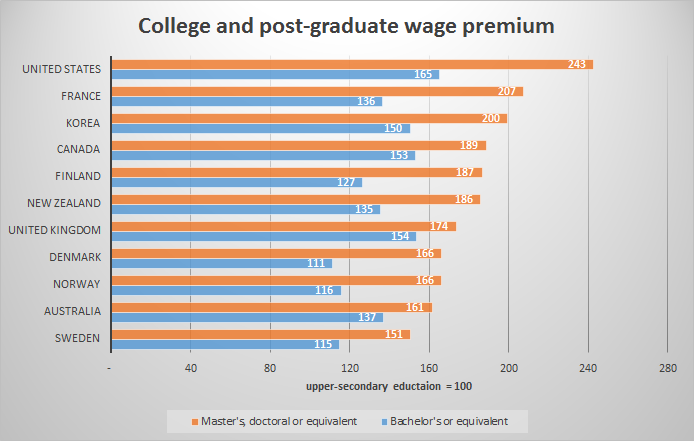
Source: Education at a Glance 2015, section 6.
24 Jul 2016 Leave a comment
in economic history, economics of education, human capital, labour economics Tags: Australia, Canada, France, Germany, Italy, tertiary educational attainment.
The British, Australians, and Italians experienced strong growth in tertiary attainment since the year 2000. In the case of the Italians, it was from a low base. There is still a big difference in tertiary attainment between English-speaking and other countries.
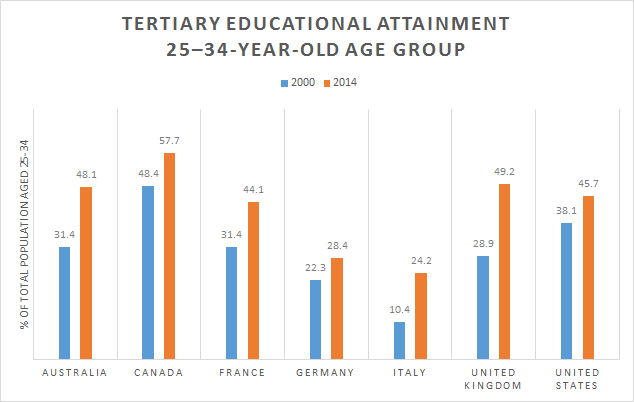
Source: OECD Factbook 2015-2016.
19 Jul 2016 Leave a comment
in economic history, human capital, industrial organisation, labour economics, occupational choice, politics - Australia, poverty and inequality Tags: Australia, CEO pay, superstar wages, superstars, top 1%, top incomes
Australia has had a working rich for a long time now. Australian top income earners are top wage earners. They are athletes, celebrities, business executives and in the professions.
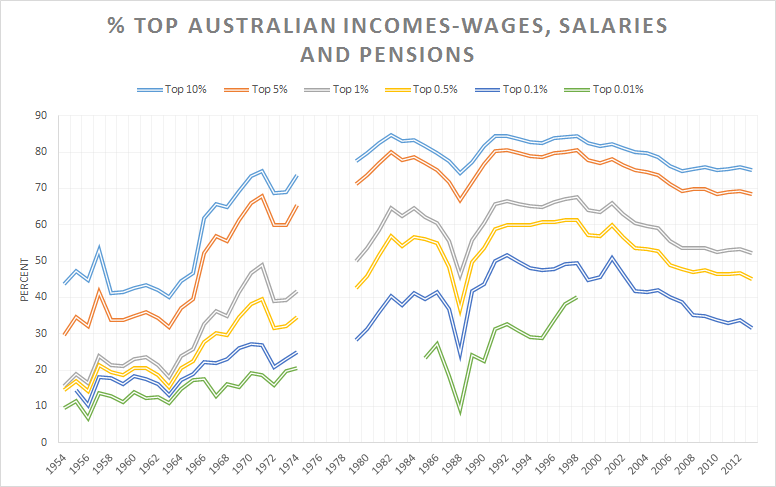
Source: The World Wealth and Income Database.
17 Jul 2016 Leave a comment
in economics of regulation, politics - Australia, politics - New Zealand, politics - USA, urban economics Tags: Australia, housing affordability
18 Jun 2016 Leave a comment
in economic history Tags: Australia, maps
07 Jun 2016 Leave a comment
in economics, economics of media and culture Tags: Australia, economics of languages
HT: Tony Gibbons
02 Jun 2016 Leave a comment
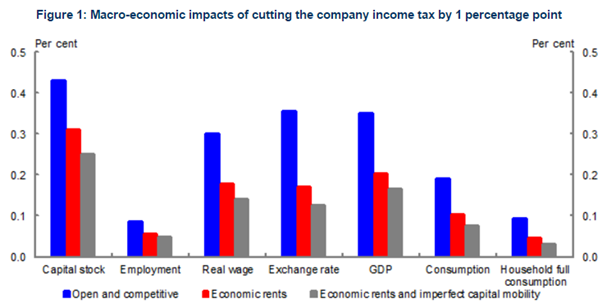
in applied price theory, politics - Australia, politics - New Zealand, public economics Tags: Australia, company tax, international tax competition, tax incidents, taxation and entrepreneurship, taxation and investment
30 May 2016 Leave a comment
in economic history, health economics, population economics Tags: Australia, life expectancies, The Great Escape
The graph shows how many years you have left if aged 25 to 29 in 1990.
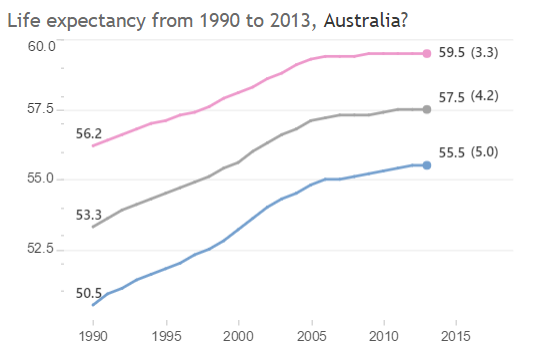
Source: Life Expectancy: progress from 1990 to 2013 | Health Intelligence.
30 May 2016 Leave a comment
in international economics Tags: Australia, British economy, Common market, customs unions, economics of borders, European Union, free trade areas, Germany
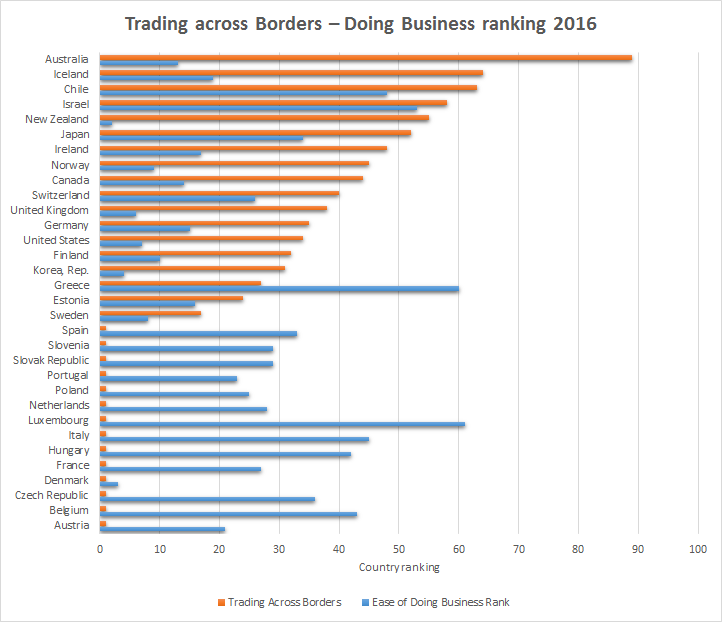
What did Australia do wrong to have the worst ranking of the high income countries for doing business across borders. New Zealand is not much better. The British are not benefiting as much as they could from the common market. Being in continental Europe must have advantages except if your Germany.
28 May 2016 Leave a comment
in economic growth, economic history, labour economics, labour supply, macroeconomics, politics - Australia, politics - New Zealand, politics - USA, public economics Tags: Australia, British economy, Canada, Eurosclerosis, France, Germany, Japan, labour productivity, measurement error, taxation and labour supply
This data tells more of a story than I expected. Firstly, New Zealand has not been catching up with the USA. Japan stopped catching up with the USA in 1990. Canada has been drifting away from the USA for a good 30 years now in labour productivity.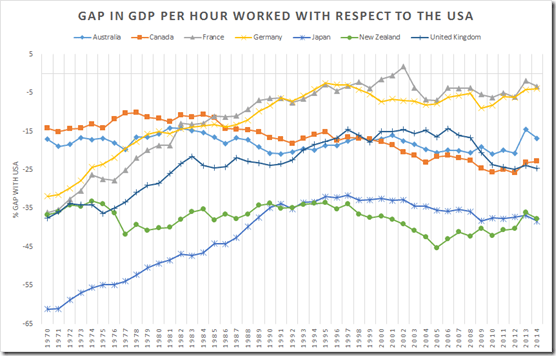
Data extracted on 28 May 2016 05:15 UTC (GMT) from OECD.Stat from OECD Compendium of Productivity Indicators 2016 – en – OECD.
Australia has not been catching up with the USA much at all since 1970. It has maintained a pretty consistent gap with New Zealand despite all the talk of a resource boom in the Australia; you cannot spot it in this date are here.
Germany and France caught up pretty much with the USA by 1990. Oddly, Eurosclerosis applied from then on terms of growth in income per capita.
European labour productivity data is hard to assess because their high taxes lead to a smaller services sector where the services can be do-it-yourself. This pumps up European labour productivity because of smaller sectors with low productivity growth.
Celebrating humanity's flourishing through the spread of capitalism and the rule of law
Scholarly commentary on law, economics, and more
Beatrice Cherrier's blog
Celebrating humanity's flourishing through the spread of capitalism and the rule of law
Celebrating humanity's flourishing through the spread of capitalism and the rule of law
Celebrating humanity's flourishing through the spread of capitalism and the rule of law
Why Evolution is True is a blog written by Jerry Coyne, centered on evolution and biology but also dealing with diverse topics like politics, culture, and cats.
Celebrating humanity's flourishing through the spread of capitalism and the rule of law
Celebrating humanity's flourishing through the spread of capitalism and the rule of law
A rural perspective with a blue tint by Ele Ludemann
DPF's Kiwiblog - Fomenting Happy Mischief since 2003
Celebrating humanity's flourishing through the spread of capitalism and the rule of law
The world's most viewed site on global warming and climate change
Tim Harding's writings on rationality, informal logic and skepticism
A window into Doc Freiberger's library
Let's examine hard decisions!
Commentary on monetary policy in the spirit of R. G. Hawtrey
Thoughts on public policy and the media
Celebrating humanity's flourishing through the spread of capitalism and the rule of law
Politics and the economy
A blog (primarily) on Canadian and Commonwealth political history and institutions
Reading between the lines, and underneath the hype.
Economics, and such stuff as dreams are made on
"The British constitution has always been puzzling, and always will be." --Queen Elizabeth II
Celebrating humanity's flourishing through the spread of capitalism and the rule of law
Celebrating humanity's flourishing through the spread of capitalism and the rule of law
WORLD WAR II, MUSIC, HISTORY, HOLOCAUST
Undisciplined scholar, recovering academic
Celebrating humanity's flourishing through the spread of capitalism and the rule of law
Res ipsa loquitur - The thing itself speaks
Celebrating humanity's flourishing through the spread of capitalism and the rule of law
Researching the House of Commons, 1832-1868
Articles and research from the History of Parliament Trust
Reflections on books and art
Posts on the History of Law, Crime, and Justice
Celebrating humanity's flourishing through the spread of capitalism and the rule of law
Exploring the Monarchs of Europe
Cutting edge science you can dice with
Small Steps Toward A Much Better World
“We do not believe any group of men adequate enough or wise enough to operate without scrutiny or without criticism. We know that the only way to avoid error is to detect it, that the only way to detect it is to be free to inquire. We know that in secrecy error undetected will flourish and subvert”. - J Robert Oppenheimer.
The truth about the great wind power fraud - we're not here to debate the wind industry, we're here to destroy it.
Celebrating humanity's flourishing through the spread of capitalism and the rule of law
Celebrating humanity's flourishing through the spread of capitalism and the rule of law
Economics, public policy, monetary policy, financial regulation, with a New Zealand perspective
Celebrating humanity's flourishing through the spread of capitalism and the rule of law
Restraining Government in America and Around the World


 Utopia, you are standing in it!
Recent Comments