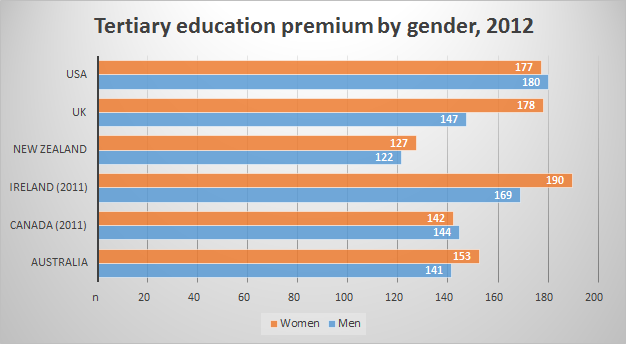
Tertiary education premium by gender in the English-speaking countries, 2012
19 Oct 2015 1 Comment
in discrimination, economics of education, gender, human capital, labour economics, occupational choice, politics - Australia, politics - New Zealand, politics - USA Tags: Australia, British economy, Canada, College premium, education premium, gender wage gap, Ireland, New Zealand, reversing gender gap
There are large differences in the education premium between English speaking countries and also by gender. The tertiary premium in New Zealand is pretty poor compared to the USA, UK or Ireland and is still mediocre when compared to Australia and Canada.
Source: Education at a Glance 2014.
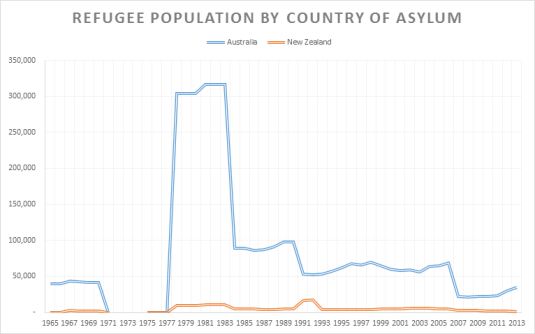
@nzlabour @greencatherine @johnkeymp @actparty Australia and New Zealand country of asylum numbers since 1965
10 Oct 2015 1 Comment
in Economics of international refugee law, International law, politics - Australia, politics - New Zealand Tags: Australia, economics of migration, refugees
Australia and New Zealand at times has taken in a great many refugees from abroad according to the United Nation’s High Commissioner for Refugees data. Oddly enough these bursts of generosity coincided with a Liberal Country party government in Australia and National Party governments in New Zealand. The Left of New Zealand politics was too busy fighting to be nuclear free to make New Zealand a place of refuge for the victims of oppression when they had their hands on the wheels of power.
Source: UNHCR – UNHCR Statistical Online Population Database.
Because Australia took in so many hundreds of thousands of refugees, it is difficult to read the New Zealand data so I have reproduced the New Zealand data on refugees as a separate graph.

Source: UNHCR – UNHCR Statistical Online Population Database.
At times of crisis such as after the Vietnam War and the chaos in the Balkans, New Zealand has taken in a great many refugees – many times its current generosity.
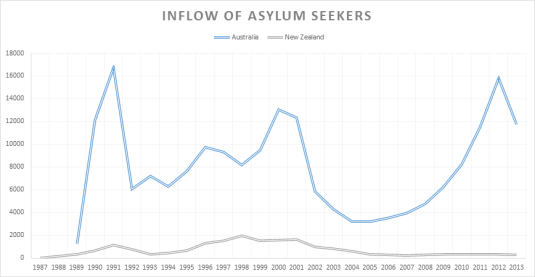
@jamespshaw @nzlabour @actparty inflow of asylum seekers into Australia and New Zealand since 1987
08 Oct 2015 Leave a comment
in International law, politics - Australia, politics - New Zealand, war and peace Tags: asylum seekers, Australia, economics of migration, refugees
Data extracted on 08 Oct 2015 09:06 UTC (GMT) from OECD.Stat; Dataset: International Migration Database.
@NZNationalParty @nzlabour @NZGreens inflow of asylum seekers into #UK #Canada, #Australia and #NewZealand since 1980
08 Oct 2015 Leave a comment
in economic history, Economics of international refugee law, International law, politics - Australia, politics - New Zealand, population economics Tags: Australia, British politics, economics of migration, refugees
New Zealand’s intake of asylum seekers has been embarrassingly low. The left-wing parties in New Zealand should be ashamed of themselves given the way they wear their international consciences on their sleeves about New Zealand being above it all morally, nuclear free, and can lecture the rest about war, peace and compassion from on high.

Data extracted on 08 Oct 2015 09:06 UTC (GMT) from OECD.Stat; Dataset: International Migration Database.
The UK absorbed an immense number of asylum seekers in the 1990 as did Canada. The data stops in 2013.
@DavidLeyonhjelm on deregulating the Australian labour market
17 Sep 2015 1 Comment
in applied price theory, economic history, economics of regulation, industrial organisation, job search and matching, labour economics, minimum wage, survivor principle, unions Tags: Australia, employment law, employment protection law, federalism, labour market deregulation, labour market regulation, union power, unions
The 1858 Map of World Migration
16 Sep 2015 Leave a comment
in economic history, labour economics, labour supply Tags: Australia, economics of migration
Migrants fleeing Europe..
The 1858 Map of World Migration bit.ly/1NjTMEb http://t.co/ZOK7UA6SdB—
Max Roser (@MaxCRoser) September 10, 2015
Real housing prices in Australia and New Zealand since 1975
15 Sep 2015 Leave a comment
in politics - Australia, politics - New Zealand, urban economics Tags: Australia, housing affordability, housing prices, land supply, land use planning, NIMBYs, zoning
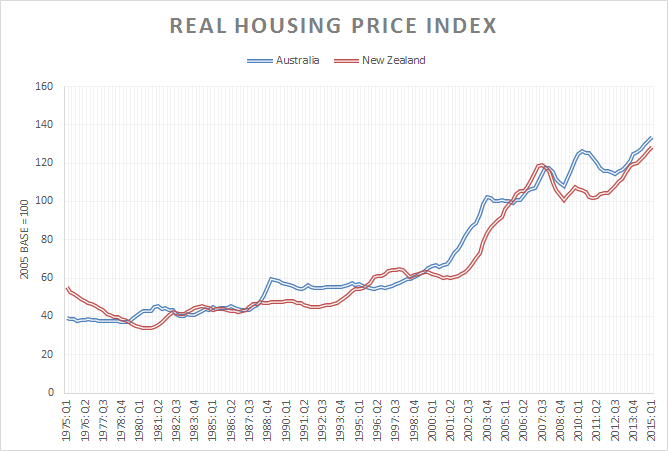
Source: International House Price Database – Dallas Fed
Note: The house price index series is an index constructed with nominal house price data. The real house price index is an index calculated by deflating the nominal house price series with a country’s personal consumption expenditure deflator
An opportunity lost – to expel #WesternAustralia from the rest of Australia and seal the border
11 Sep 2015 Leave a comment
in comparative institutional analysis, constitutional political economy, economic history, politics - USA, Public Choice, rentseeking Tags: Australia, economics of borders, economics of succession, Scotland, self-determination, succession movements, Western Australia
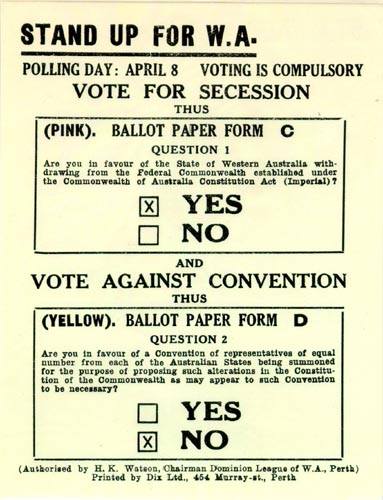
Western Australian secessionists, in common with Scottish nationalists, really do like to dictate the terms of their succession which always includes an open border and a generous financial settlement regarding division of federal government debts.
How arrogant. Why should parting be sweet? If you do not want us, why should we want you. If you want to find your own destiny, you can find it good and hard.
How Senator Bilyk’s Dad found paradise in Australia @Catbilyk
11 Sep 2015 Leave a comment
in economic history, politics - Australia, war and peace Tags: Australia, economics of migration, Poland, Russia, Ukraine, World War II
An old Uni mate’s dad was rounded up by the Nazis in the Polish Ukraine in 1941 and carted off as a slave in factories in Germany. He survived the war. He ended up in a refugee camp. He met and married a Dutch lass.
He did not want to go back to the Ukraine because that part of the Ukraine was now Russian under Stalin. That part of the Ukraine was Polish before the war.
Soviet post-war expansion resulted in border changes, the creation of a Communist Bloc & the start of the Cold War. http://t.co/0Os3EPp6Th—
History Facts 247 (@historyfacts247) August 17, 2015
Australia was the first country to accept them as refugees. He raised a family in Tasmania, working in a factory to support them.
I knew one of his two sons who became economists both at the University of Tasmania and in Canberra. One of his daughter’s was elected to the Australian Senate in the 2007 general election.
After such a rough start in life, my old mate’s dad must regard Australia as paradise for him, his wife and their family.
Longest time without a recession
02 Sep 2015 Leave a comment
in business cycles, economic growth, economic history, fiscal policy, global financial crisis (GFC), great recession, macroeconomics, monetary economics, politics - Australia, politics - New Zealand, politics - USA Tags: Australia, recessions and recoveries
Why some billionaires are bad for growth, and others aren’t
22 Aug 2015 Leave a comment
in applied price theory, applied welfare economics, economics of bureaucracy, economics of regulation, financial economics, income redistribution, industrial organisation, politics - Australia, politics - New Zealand, politics - USA, Public Choice, rentseeking, survivor principle Tags: Australia, billionaires, Russia, top 0.1%, top 1%

…Bagchi and Svejnar carefully went through the lists of all the Forbes billionaires, and divided them into those who had acquired their wealth due to political connections, and those who had not. This is kind of a slippery slope — almost all billionaires have probably benefited from government connections at one time or another.
But the researchers used a very conservative standard for classifying people as politically connected, only assigning billionaires to this group when it was clear that their wealth was a product of government connections. Just benefiting from a government that was pro-business, like those in Singapore and Hong Kong, wasn’t enough.
Rather, the researchers were looking for a situation like Indonesia under Suharto, where political connections were usually needed to secure import licenses, or Russia in the mid-1990s, when some state employees made fortunes overnight as the state privatized assets.
…The negative effects of wealth inequality are largely being driven by politically connected wealth inequality. That seems to be the primary channel that drives this relationship…
a 3.72 percent increase in the level of wealth inequality would cost a country about half a percent of real GDP per capita growth. That’s a big impact, given that average GDP growth is in the neighbourhood of two percent per year
@guardianeco slimes New Zealand’s record on #climatechange @NZGreens @GreenpeaceNZ
22 Aug 2015 Leave a comment
in economics of information, energy economics, environmental economics, global warming, politics - Australia, politics - New Zealand, Public Choice Tags: Australia, climate alarmism, global warming, Left-wing hypocrisy, The Guardian
https://twitter.com/guardianeco/status/634681114527797248
Excellent wrap up of carbon pricing globally, found here: worldbank.org/en/news/featur… #renewables http://t.co/Hocf9Z5cEC—
Danny Rose (@_DannyRose) August 19, 2015
Carbon pricing expanded in the last 21 months. New report shows where & how:
wrld.bg/R0EuZ http://t.co/VB69szI1je—
World Bank (@WorldBank) August 19, 2015
A carbon price gives investors a clearer view of the future risks of high-carbon assets: wrld.bg/R0GLE http://t.co/GuNnzlMMlZ—
World Bank (@WorldBank) August 21, 2015
Marginal tax rates of a nuclear family in USA, UK, Australia and New Zealand since 2000
22 Aug 2015 Leave a comment
in economic history, economics of love and marriage, labour economics, labour supply, politics - Australia, politics - New Zealand, politics - USA Tags: Australia, British economy, marriage and divorce, taxation and labour supply
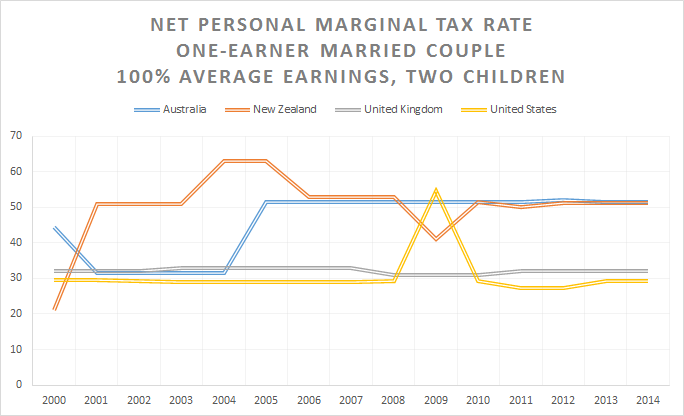
Source: OECD StatExtract.
 Utopia, you are standing in it!
Recent Comments