Figure 1: % gender gap in median earnings of full-time employees, 2012

Source: OECD family database
Celebrating humanity's flourishing through the spread of capitalism and the rule of law
11 Jun 2015 Leave a comment
in discrimination, gender, human capital, labour economics, labour supply, occupational choice, politics - Australia, politics - New Zealand, politics - USA Tags: Australia, British economy, Canada, gender wage gap, Ireland
Figure 1: % gender gap in median earnings of full-time employees, 2012
Source: OECD family database
05 Jun 2015 Leave a comment
in labour economics, minimum wage, public economics Tags: Australia, British economy, Canada, Ireland, progressive taxation, taxation and the labour supply, welfare state
Figure 1: Minimum wage after income tax and social security contributions, US$ PPP, Anglo-Saxon countries, 2013

01 Jun 2015 Leave a comment
in economic history, entrepreneurship, human capital, industrial organisation, labour economics, labour supply, occupational choice, survivor principle Tags: Canada, CEO pay, creative destruction, entrepreneurial alertness, super-entrepreneurs, superstar wages, superstars, top 0.1%, top 1%, working rich
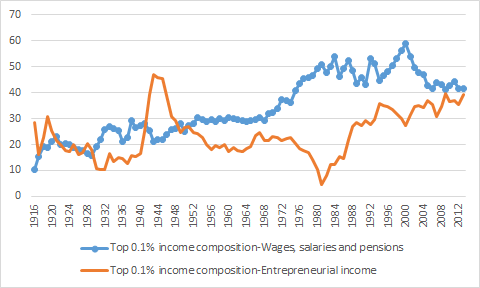
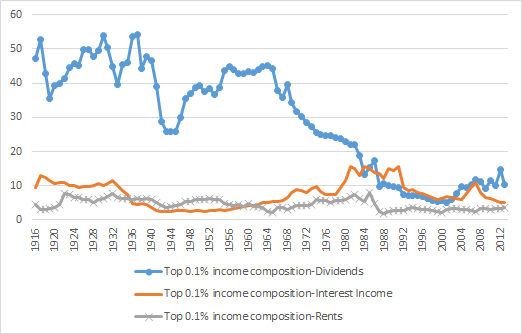
Piketty and Saez (2003) concluded that a substantial fraction of the rise in top incomes was due to surging top wage incomes. They concluded that top executives (the ‘working rich’) replaced top capital owners (the ‘rentiers’) at the top of the income hierarchy.
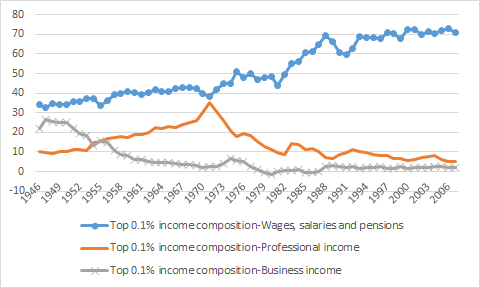
That conclusion still holds for both the USA and Canada. The largest portion of the top 0.1% in both countries have become those earning wages. The top 0.1% are top wage earners who work for their livings founding, building or directing businesses.
Figure 1: percentage of top 0.1% with wages, salaries, pensions or entrepreneurial incomes, USA, 1916 – 2013
Source: Alvaredo, Facundo, Anthony B. Atkinson, Thomas Piketty and Emmanuel Saez, The World Top Incomes Database.
Figure 2: percentage of top 0.1% with incomes from interest, dividends and rents, USA, 1916 – 2013
Source: Alvaredo, Facundo, Anthony B. Atkinson, Thomas Piketty and Emmanuel Saez, The World Top Incomes Database.
Figure 3: percentage of top 0.1% with wage salary and pension incomes, business incomes and professional incomes, Canada, 1946 – 2007
source : Alvaredo, Facundo, Anthony B. Atkinson, Thomas Piketty and Emmanuel Saez, The World Top Incomes Database.
Figure 4: percentage of top 0.1% with dividend, interest or investment incomes, Canada, 1946 – 2007

Source: Alvaredo, Facundo, Anthony B. Atkinson, Thomas Piketty and Emmanuel Saez, The World Top Incomes Database.
31 May 2015 1 Comment
in economic growth, economic history, macroeconomics, politics - Australia, politics - New Zealand Tags: Australia, Canada, economic geography, endogenous growth theory, lost decades
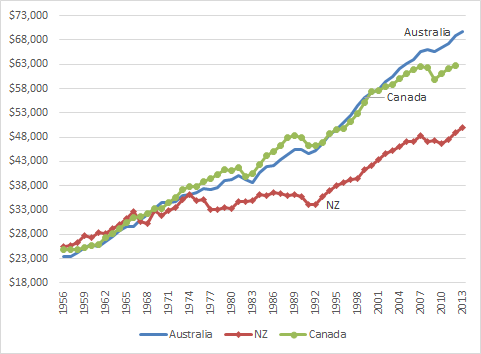
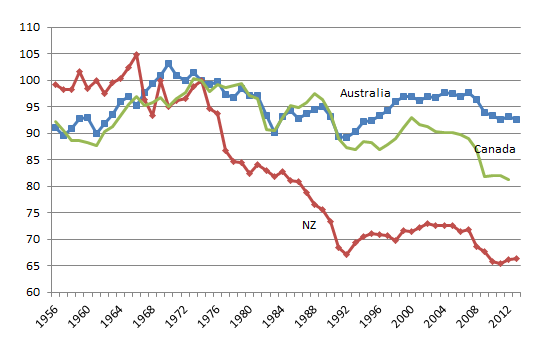
Figure 1 shows that Canada has been diverging from Australia in real GDP per working age person since the mid-1990s particularly since the global financial crisis.
Figure 1: Real GDP per New Zealander, Canadian and Australian aged 15-64, converted to 2013 price level with updated 2005 EKS purchasing power parities, 1956-2013
Source: Computed from OECD StatExtract and The Conference Board, Total Database, January 2014, http://www.conference-board.org/economics
In common with New Zealand, Figure 2 shows that Canadian productivity has been in a pretty much along declines is about 1974, rarely catching up with any lost ground. Figure 1 shows that Canada used to be richer than Australia but is now poorer than Australia. Figure 2 is real GDP growth data detrended by the growth rate of the USA in the 20th century. A flat line in figure 2 is annual real GDP growth at 1.9%; a rising line is growth above 1.9%; a falling line is annual growth below 1.9% a year.
Figure 2: Real GDP per New Zealander, Canadian and Australian aged 15-64, converted to 2013 price level with updated 2005 EKS purchasing power parities, 1.9 per cent detrended, 1956-2013
Source: Computed from OECD StatExtract and The Conference Board, Total Database, January 2014, http://www.conference-board.org/economics
Figure 2 shows that Canadian productivity has been below trend for perhaps 30 years. There has been the occasional recovery but followed by a further decline. If Canadian labour productivity had grown at the same rate as the USA since 1974, labour productivity in Canada is something like 18% better.
Australia, as shown in figure 2, has neither caught up nor falling behind the USA in labour productivity for the entire post-war period since 1956. Canada has been falling behind its neighbour most markedly since the mid-1970s.
The proximate causes of the Canadian productivity gap with the USA have a familiar echo to New Zealand ears. Relative to the USA, Rao et al. (2006) and Sharp (2003) attributed the gap to less capital per worker, an innovation gap as shown by lower R&D expenditure, a smaller and less dynamic high technology sector, less developed human capital at the top end of the labour market, and more limited scale and scope economies.
These factors have been put forward, at one time or another, as the proximate causes of the New Zealand productivity gap with the USA. Identifying the barriers to higher Canadian productivity may offer fresh insights into removing similar productivity barriers in New Zealand.
Canada, New Zealand and Australia should be catching-up with the USA in productivity per capita because copying the global leader is cheaper than innovation. Canada, New Zealand and Australia all have the basics to do this: a market economy, the rule of law and openness to foreign technology and international trade.
Instead of asking why New Zealand is not catching-up with Australian productivity, further study of the lack of productivity catch-up of Australia and Canada with the USA may uncover subtle barriers to productivity growth with similarities in New Zealand.
The productivity decline in Canada is of interest in New Zealand because Canada certainly cannot blame remoteness because it borders the USA. Canada cannot blame lack of size because it is noticeably larger than Australia and certainly New Zealand.
30 May 2015 2 Comments
in economic history, politics - Australia, politics - New Zealand, politics - USA, public economics Tags: Australia, Canada, growth of government
The tax take is noticeably higher in Canada and New Zealand and has been for a long time.
Figure 1: US, Canadian, Australian and New Zealand tax revenues as a percentage of GDP, 1965–2013

Source: OECD StatExtract.
26 May 2015 Leave a comment
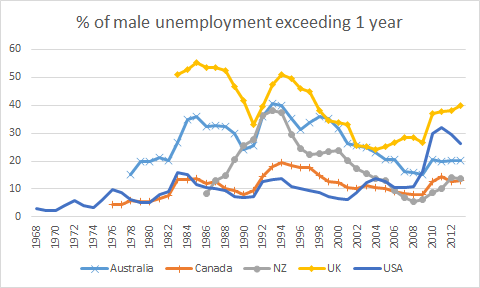
in business cycles, job search and matching, labour economics, labour supply, unemployment Tags: Australia, British economy, Canada
Source: OECD StatExtract

Source: OECD StatExtract
25 May 2015 Leave a comment
in economic history, labour economics, politics - Australia, politics - New Zealand, politics - USA, unions Tags: Australia, British economy, Canada, trade union density, union power, union wage premium

Source: OECD StatExtract
24 May 2015 Leave a comment
in economic history, labour economics, minimum wage, politics - Australia, politics - New Zealand, politics - USA Tags: Australia, British economy, Canada
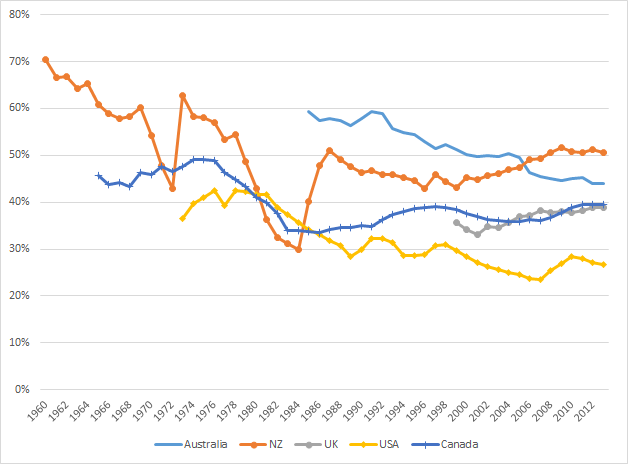
Figure 1: minimum wage relative to median wage in full-time worker, UK, USA, Canada, New Zealand and Australia, 1960 – 2012

Source: OECD StatExtract
Figure 2: minimum wage relative to mean wage in full-time worker, UK, USA, Canada, New Zealand and Australia, 1960 – 2012
Source: OECD StatExtract
19 May 2015 Leave a comment
in economic growth, economic history, macroeconomics, politics - USA Tags: British economy, Canada, convergence
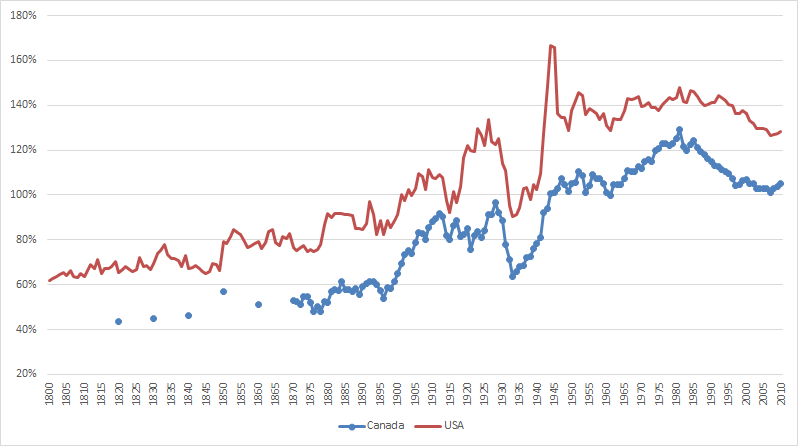
Figure 1: US and Canadian real GDP per capita are as percentage of British GDP per capita (1990 Int. GK$PPP), 1800 – 2010
Source: The Maddison-Project, http://www.ggdc.net/maddison/maddison-project/home.htm 2013 version.
18 May 2015 Leave a comment
in economic growth, economic history, macroeconomics Tags: British economy, Canada, convergence, industrial revolution
The USA only overtook Britain in per capita GDP per capita in purchasing power parity terms early in the 20th century. Canada overtook the mother country in the post-war period.
Figure 1: British, American and Canadian GDP per capita (1990 Int. GK$PPP), 1775 – 2010

Source: The Maddison-Project, http://www.ggdc.net/maddison/maddison-project/home.htm 2013 version.
Figure 2: British, American and Canadian GDP per capita (1990 Int. GK$PPP), 1775 – 1870
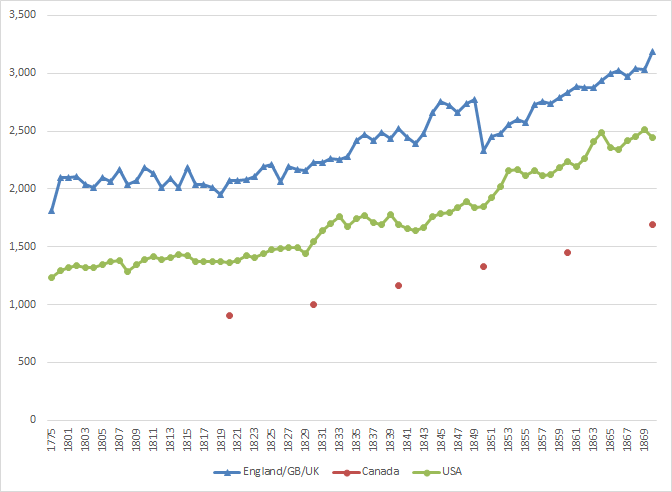
Source: The Maddison-Project, http://www.ggdc.net/maddison/maddison-project/home.htm 2013 version.
Figure 3: British, American and Canadian GDP per capita (1990 Int. GK$PPP), 1870 – 2010
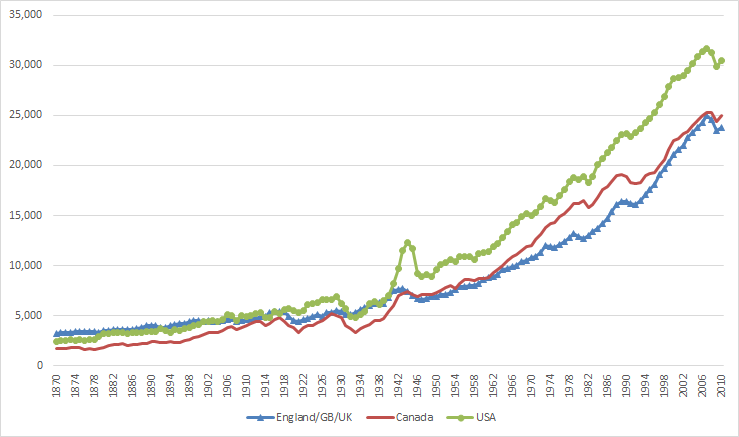
Source: The Maddison-Project, http://www.ggdc.net/maddison/maddison-project/home.htm 2013 version.
11 May 2015 Leave a comment
in business cycles, economic growth, economic history, macroeconomics, politics - USA Tags: Canada, prosperity and depression
Figure 1: Real GDP per American and Canadian aged 15-64, converted to 2013 price level with updated 2005 EKS purchasing power parities, 1955-2013
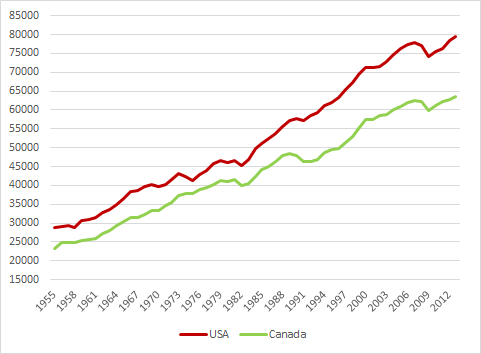
Source: Computed from OECD Stat Extract and The Conference Board, Total Database, January 2014, http://www.conference-board.org/economics
Figure 2: Real GDP per American and Canadian aged 15-64, converted to 2013 price level with updated 2005 EKS purchasing power parities, 1.9 per cent detrended, 1955-2013
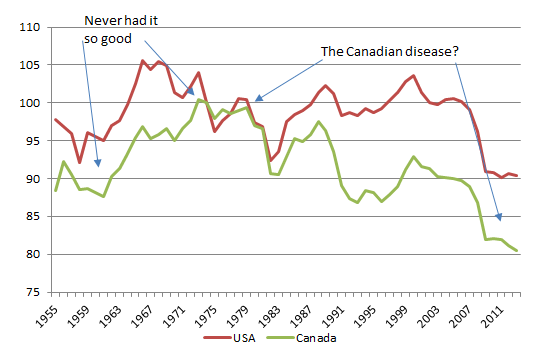
Source: Computed from OECD Stat Extract and The Conference Board, Total Database, January 2014, http://www.conference-board.org/economics
A rising line in figure 2 is above trend rate growth; a flat line is trend growth of 1.9%; and a falling line is below trend growth.
Canada has a volatile ride in the post-war period after economic success up until 1975. Despite ups and downs the Canadian economy has been in a long-term decline since 1975. Growth as rarely being at trend and was often below, sometimes sharply below trend.
None of these depressed periods in the Canadian economy were long enough to count as a great depression. Instead there was just a long-term decline.
Canada is next door to the USA and a member of the North American Free Trade Area (NAFTA) and its antecedents so its cannot blame distance nor small size for its decline in economic performance as some do in New Zealand.
Relative to the USA, Rao et al. (2006) and Sharp (2003) attributed the gap between the USA and Canada to less capital per Canadian worker, an innovation gap as shown by lower R&D expenditure in Canada, a smaller and less dynamic high technology sector in Canada, less developed human capital at the top end of the Canadian labour market, and more limited scale and scope economies in Canada.
These factors have been put forward, at one time or another, as the proximate causes of the New Zealand productivity gap with the USA. Identifying the barriers to higher Canadian productivity may offer fresh insights into removing similar productivity barriers in New Zealand.
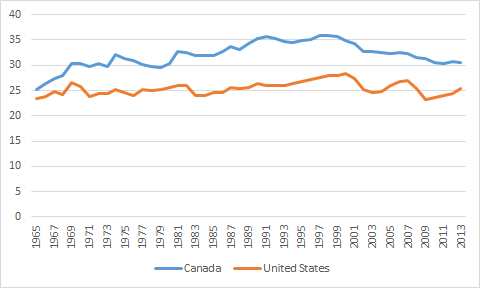
Figure 3 suggests that the increase in tax revenues as a percentage of GDP from 30% to 35% at the same time as the Canadian economic boom came to an end and its economic decline began is worthy of further scrutiny. The strong economic recovery from 1995 onwards also coincided with the decline tax revenues as a percentage of GDP.
Figure 3: tax revenue as a percentage of GDP
Source: OECD StatExtract
10 May 2015 Leave a comment
in business cycles, economic growth, job search and matching, labour economics, labour supply, macroeconomics, politics - USA, unemployment Tags: Canada, unemployment rates
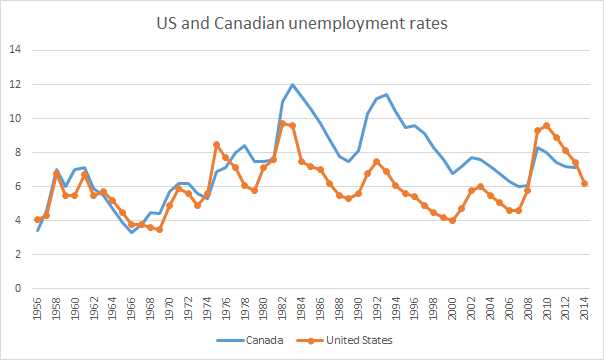
Source: OECD StatExtract
Unemployed people are defined as those who report that they are without work, that they are available for work and that they have taken active steps to find work in the last four weeks.
The ILO Guidelines specify what actions count as active steps to find work; these include answering vacancy notices, visiting factories, construction sites and other places of work, and placing advertisements in the press as well as registering with labour offices.
28 Apr 2015 Leave a comment
in business cycles, economic growth, Euro crisis, global financial crisis (GFC), great recession, macroeconomics, politics - USA Tags: British economy, Canada, Eurosclerosis, France, Germany, Italy, Japan, recoveries from recessions
UK recovery: stronger than Italy, weaker than US & Canada. http://t.co/C0TEsbzMm3—
Jonathan Portes (@jdportes) April 28, 2015
17 Apr 2015 5 Comments
in business cycles, economic growth, economic history, fiscal policy, global financial crisis (GFC), great recession, macroeconomics, politics - USA, public economics Tags: British economy, Canada, sick man of Europe, tax incidence, tax reform
Income taxes in the USA and UK didn’t change all that much after the mid-70s. Prior to that, income tax rose quite steadily in the UK in the 1950s and 1960s and not surprisingly, Britain was the sick man of Europe in the 1970s. Income taxes rose quite steadily in Canada for most of the post-war period up until 1990 and then levelled out for most of that decade before a small tapered downwards.
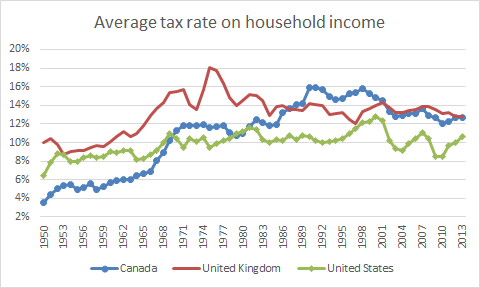
Source: Cara McDaniel.
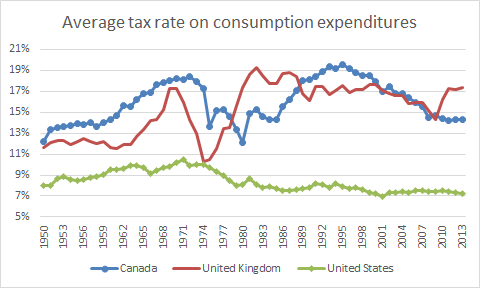
Taxes on consumption expenditure were very different stories across the Atlantic. There has been a tapering down in the average tax rate on American consumption expenditure since 1970 after modest increases before that. Canadian taxes on consumption expenditure rose steadily until the 1970s, then drop steadily in the 1970s and than rose in the 1980s and dropped again after 1992. British taxes on consumption expenditure rose sharply in the late 1960s, dropped sharply and then rose again in the 1970s and was pretty steady after that.
The sleeper tax in all three countries was payroll taxes to fund social security and the welfare state. These rose steadily in the USA, UK and Canada up until the 1990s.
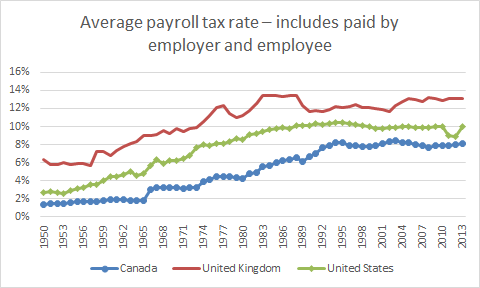
Source: Cara McDaniel.
Despite all that nonsense about neoliberalism from the Left over Left, the average rate of tax on capital income did not appear to change much at all over the last 50 years. There was a modest taper in US capital income taxation from the mid-30s to the mid-20s over the entire post-war period. The average Canadian tax rate on income from capital rose steadily in the 60s, fell steadily in the 70s before rising again in the mid-1980s and fell again after 2000. The average British tax rate on capital income rose steadily in the 60s and 70s, coinciding with the emergence of Britain as a sick man of Europe, and then stabilised in the the 1980s onwards but with a dip in the late 80s before a rise in the early 1990s.. Despite the large cuts in the statutory corporate tax rate in the UK, there was only a mild taper in the average tax rate on capital income in the UK.
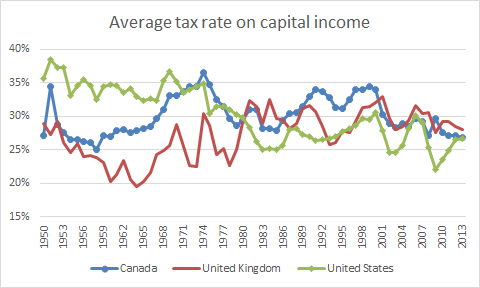
Source: Cara McDaniel.
The average tax rate on investment expenditures is pretty stable in the USA for the entire post-war period. The only significant increase in the average tax rate on investment expenditures in the UK coincided with the emergence of the sick man in Europe after a drop in the early 70s. The average tax rate on investment expenditures do not change at all in the UK after the 1970s. The Canadian average tax rate on investment expenditures is higher than elsewhere. It rose steadily in the 50s and 60s, dropped in the 70s and rose again in the 80s before tapering from 1992 onwards.
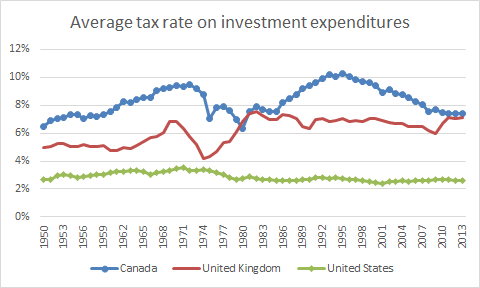
Source: Cara McDaniel.
These higher on rising taxes and the UK and Canada did nothing for either country in catching up with the USA. The figure 1 below shows real GDP per working age per American, Canadian and British.
Figure 1: Real GDP per Canadian, British and American aged 15-64, converted to 2013 price level, updated 2005 EKS purchasing power parities, 1950-2013
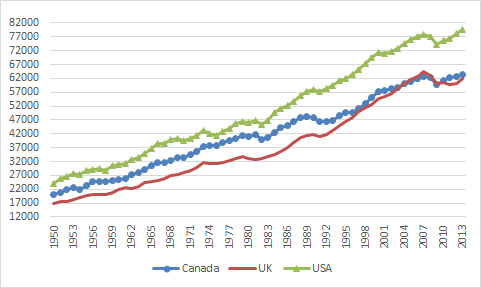
Source: Computed from OECD StatExtract and The Conference Board, Total Database, January 2014, http://www.conference-board.org/economics
The USA is pulling away from Canada and the UK in GDP per working age person. The exception is British economy from about 1990 onwards which caught up with Canada.
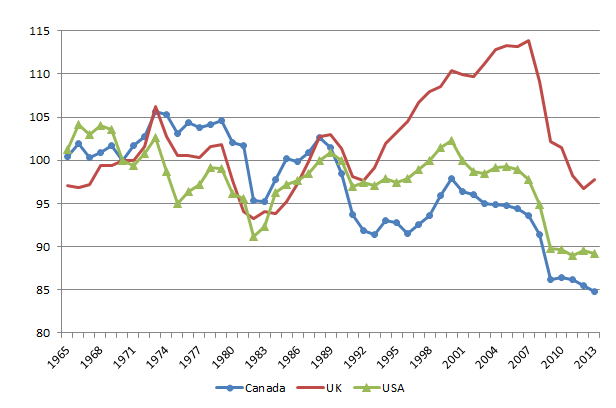
Figure 2, which is detrended GDP data, illustrates the British economic boom in the 1990s. Each country’s annual economic growth rate is detrended by 1.9%, the detrending value currently used by Ed Prescott. A flat line is growth at 1.9%, a rising line is above trend growth, a falling line is below trend growth.
Figure 2: Real GDP per Canadian, British and American aged 15-64, converted to 2013 price level, updated 2005 EKS purchasing power parities, detrended 1.9%, 1950-2013
Source: Computed from OECD Stat Extract and The Conference Board, Total Database, January 2014, http://www.conference-board.org/economics
Figure 2 shows that Canada has been in a long-term decline since the mid-1980s with much of this decline coinciding with periods of rising taxes on income from labour.
The British economy boomed in the 1990s, after the tax hikes of the 1970s and early 80s were reversed. This growth dividend was squandered by the Blair government in the 2000.
Figure 2 also shows that US growth was rather stable with some ups and downs up until 2007, expect during the productivity slowdown in the 1970s. The first major departure from trend growth of 1.9% was with the onset of the great recession.
Celebrating humanity's flourishing through the spread of capitalism and the rule of law
Scholarly commentary on law, economics, and more
Beatrice Cherrier's blog
Celebrating humanity's flourishing through the spread of capitalism and the rule of law
Celebrating humanity's flourishing through the spread of capitalism and the rule of law
Celebrating humanity's flourishing through the spread of capitalism and the rule of law
Why Evolution is True is a blog written by Jerry Coyne, centered on evolution and biology but also dealing with diverse topics like politics, culture, and cats.
Celebrating humanity's flourishing through the spread of capitalism and the rule of law
Celebrating humanity's flourishing through the spread of capitalism and the rule of law
A rural perspective with a blue tint by Ele Ludemann
DPF's Kiwiblog - Fomenting Happy Mischief since 2003
Celebrating humanity's flourishing through the spread of capitalism and the rule of law
The world's most viewed site on global warming and climate change
Tim Harding's writings on rationality, informal logic and skepticism
A window into Doc Freiberger's library
Let's examine hard decisions!
Commentary on monetary policy in the spirit of R. G. Hawtrey
Thoughts on public policy and the media
Celebrating humanity's flourishing through the spread of capitalism and the rule of law
Politics and the economy
A blog (primarily) on Canadian and Commonwealth political history and institutions
Reading between the lines, and underneath the hype.
Economics, and such stuff as dreams are made on
"The British constitution has always been puzzling, and always will be." --Queen Elizabeth II
Celebrating humanity's flourishing through the spread of capitalism and the rule of law
Celebrating humanity's flourishing through the spread of capitalism and the rule of law
WORLD WAR II, MUSIC, HISTORY, HOLOCAUST
Undisciplined scholar, recovering academic
Celebrating humanity's flourishing through the spread of capitalism and the rule of law
Res ipsa loquitur - The thing itself speaks
Celebrating humanity's flourishing through the spread of capitalism and the rule of law
Researching the House of Commons, 1832-1868
Articles and research from the History of Parliament Trust
Reflections on books and art
Posts on the History of Law, Crime, and Justice
Celebrating humanity's flourishing through the spread of capitalism and the rule of law
Exploring the Monarchs of Europe
Cutting edge science you can dice with
Small Steps Toward A Much Better World
“We do not believe any group of men adequate enough or wise enough to operate without scrutiny or without criticism. We know that the only way to avoid error is to detect it, that the only way to detect it is to be free to inquire. We know that in secrecy error undetected will flourish and subvert”. - J Robert Oppenheimer.
The truth about the great wind power fraud - we're not here to debate the wind industry, we're here to destroy it.
Celebrating humanity's flourishing through the spread of capitalism and the rule of law
Celebrating humanity's flourishing through the spread of capitalism and the rule of law
Economics, public policy, monetary policy, financial regulation, with a New Zealand perspective
Celebrating humanity's flourishing through the spread of capitalism and the rule of law
Restraining Government in America and Around the World
 Utopia, you are standing in it!
Recent Comments