Animation: World's largest countries 1950-2060. #datavizhttps://t.co/xwvx30FTJ5 pic.twitter.com/VIQ8Y5fknN
— Randy Olson (@randal_olson) January 13, 2016
World’s largest countries 1950-2060.
29 Jan 2016 Leave a comment
in development economics, growth miracles, population economics Tags: China, India
@realdonaldtrump is wrong in tariffs
26 Jan 2016 Leave a comment
in applied price theory, applied welfare economics, economic history, international economics, politics - USA Tags: 2016 presidential election, China, tariffs, trade wars
Chinese and Korean food consumption
25 Jan 2016 Leave a comment
in development economics, growth disasters, growth miracles Tags: China, North Korea. South Korea, The Great Escape
How India will pass China to become world’s most populous country
30 Dec 2015 Leave a comment
in development economics, growth miracles, population economics Tags: China, India
New Zealand exports to China
07 Dec 2015 Leave a comment
in economic history, international economics, politics - New Zealand Tags: China
how India will pass China to become world’s most populous country
05 Dec 2015 Leave a comment
in development economics, economic history, economics, growth miracles, population economics Tags: ageing society, China, economics of fertility, India, Population demographics
Peak China
20 Nov 2015 Leave a comment
in development economics, population economics Tags: China, offsetting behaviour, one child policy, The fatal conceit, The pretence to knowledge, unintended consequences
The western environmental movement’s role in China’s one-child policy
19 Nov 2015 Leave a comment
in development economics, environmental economics, environmentalism, growth disasters, growth miracles, health economics, labour economics, labour supply, population economics Tags: China, cranks, doomsday profits, doomsday prophecies, one child policy
Breathing Beijing’s air
10 Nov 2015 Leave a comment
Breathing Beijing’s air: the equivalent of smoking nearly 40 cigarettes a day. http://t.co/7M3TxrgUPD—
ian bremmer (@ianbremmer) October 13, 2015
The Great Fact in 2 charts
10 Nov 2015 Leave a comment
in applied welfare economics, development economics, economic history, growth disasters, growth miracles Tags: China, India, The Great Escape, The Great Fact
Chinese birth and death rates and the Chinese population since 1950
04 Nov 2015 Leave a comment
in development economics, growth disasters, growth miracles, labour economics, labour supply, population economics Tags: China, economics of fertility, one child policy, The fatal conceit, The pretense to knowledge, unintended consequences
@jeremycorbyn @BernieSanders oppose the one path to peace
04 Nov 2015 Leave a comment
in international economics, liberalism, politics - USA, war and peace Tags: British politics, capitalism and freedom, China, expressive voting, free trade, game theory, populists, rational ignorance, rational irrationality, Richard Cobden, World War I

Jeremy Corbyn is in trouble again, this time for describing World War I as pointless.
Corbyn has, for all his life, opposed the only means of securing peace either in Europe or anywhere else. He is against trade agreements, the European Union and NATO. Bernie Sanders is equally as misguided.
Corbyn and Sanders thinks you can make peace just by talking with people. Peace is made by trading with hostile countries to make them depend on you for their prosperity as well as yours. By growing rich through free trade, it’s in no ones interest to go to war or have poor relations with each other or each other’s friends.
Chinese and Hong Kong fertility since the one child policy was adopted
01 Nov 2015 Leave a comment
in development economics, growth disasters, growth miracles, Marxist economics, population economics Tags: China, economics of fertility, Hong Kong, one child policy, The fatal conceit, The pretense to knowledge
Chinese and Indian real GDP PPP since 1980
31 Oct 2015 Leave a comment
in development economics, economic history, growth miracles Tags: China, extreme poverty, India
Despite coming out of the blocks together, the Chinese economic miracle led to far larger increase in its respective real GDP PPP. Indian GDP only increased eightfold while Chinese GDP increased 18 fold since 1980 on a purchasing power parity basis.
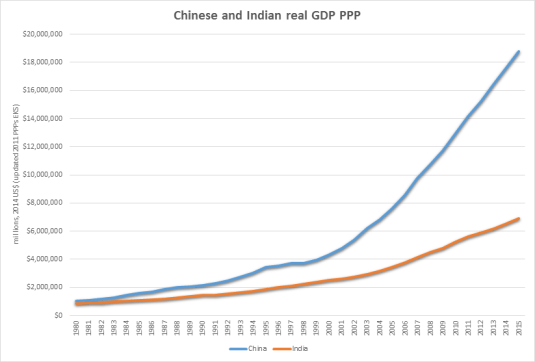
Source: The Conference Board. 2015. The Conference Board Total Economy Database™, May 2015, http://www.conference-board.org/data/economydatabase/
 Utopia, you are standing in it!
Recent Comments