Chinese birth and death rates and the Chinese population since 1950
04 Nov 2015 Leave a comment
in development economics, growth disasters, growth miracles, labour economics, labour supply, population economics Tags: China, economics of fertility, one child policy, The fatal conceit, The pretense to knowledge, unintended consequences
@jeremycorbyn @BernieSanders oppose the one path to peace
04 Nov 2015 Leave a comment
in international economics, liberalism, politics - USA, war and peace Tags: British politics, capitalism and freedom, China, expressive voting, free trade, game theory, populists, rational ignorance, rational irrationality, Richard Cobden, World War I

Jeremy Corbyn is in trouble again, this time for describing World War I as pointless.
Corbyn has, for all his life, opposed the only means of securing peace either in Europe or anywhere else. He is against trade agreements, the European Union and NATO. Bernie Sanders is equally as misguided.
Corbyn and Sanders thinks you can make peace just by talking with people. Peace is made by trading with hostile countries to make them depend on you for their prosperity as well as yours. By growing rich through free trade, it’s in no ones interest to go to war or have poor relations with each other or each other’s friends.
Chinese and Hong Kong fertility since the one child policy was adopted
01 Nov 2015 Leave a comment
in development economics, growth disasters, growth miracles, Marxist economics, population economics Tags: China, economics of fertility, Hong Kong, one child policy, The fatal conceit, The pretense to knowledge
Chinese and Indian real GDP PPP since 1980
31 Oct 2015 Leave a comment
in development economics, economic history, growth miracles Tags: China, extreme poverty, India
Despite coming out of the blocks together, the Chinese economic miracle led to far larger increase in its respective real GDP PPP. Indian GDP only increased eightfold while Chinese GDP increased 18 fold since 1980 on a purchasing power parity basis.
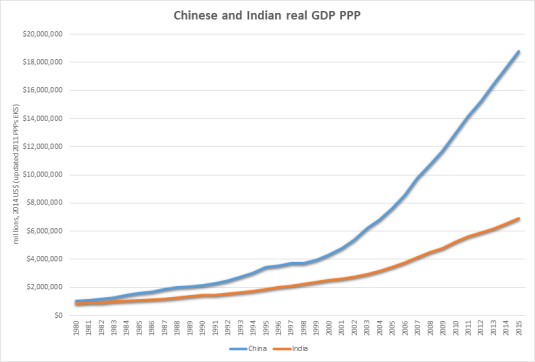
Source: The Conference Board. 2015. The Conference Board Total Economy Database™, May 2015, http://www.conference-board.org/data/economydatabase/
The Great Escape in China
18 Oct 2015 Leave a comment
in development economics, economic history, entrepreneurship, growth disasters, growth miracles Tags: China, The Great Escape
#China uses as much coal, steel, and concrete as the rest of the world combined
08 Oct 2015 Leave a comment
in development economics, energy economics, growth miracles, resource economics Tags: China
China uses as much coal, steel, and concrete as the rest of the world combined: bit.ly/1US1Lyc http://t.co/4NqNFNLAYz—
Vox (@voxdotcom) September 15, 2015
Bono – Capitalism Reduces Poverty
03 Oct 2015 Leave a comment
in development economics, economic history, economics of media and culture, growth disasters, growth miracles, Music Tags: Africa, Bono, China, The Great Enrichment, The Great Fact, U2
Official versus alternative Chinese economic statistics
03 Oct 2015 Leave a comment
in econometerics, economic history Tags: China
People assume a china massages its economic data – our shanghai corr challenges conventional wisdom http://t.co/qqqJ71Duwx—
Lionel Barber (@lionelbarber) September 29, 2015
RT @GreenpeaceNZ are right: Do not send anyone to @cop21 The summit is waste of time
25 Sep 2015 Leave a comment
in environmental economics, global warming, politics - Australia, politics - New Zealand, politics - USA, Public Choice Tags: China, climate alarmism, climate treaties, global warming, green tariffs, Greenpeace, international environmental law, Paris Summit 2015, Twitter left
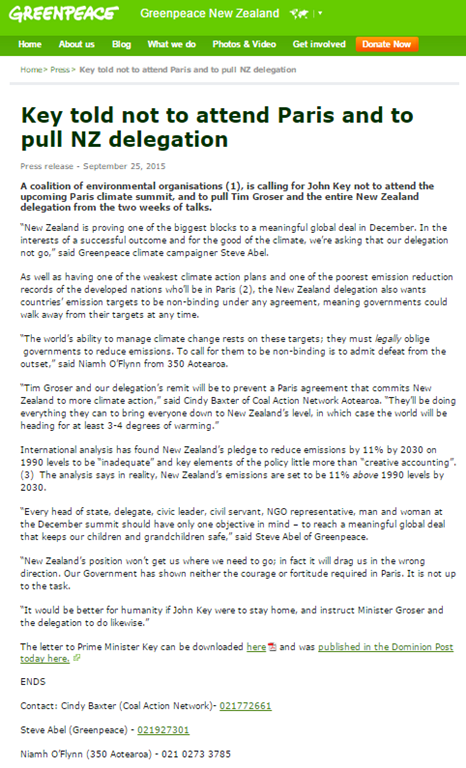
Greenpeace is right in saying in their open letter with others that New Zealand should not send a minister to the climate talks in Paris later this year. I agree for different reasons.
An open letter from @GreenpeaceNZ, @350nz & @coalaction to @johnkeypm not to send anyone to #climate talks in Paris. http://t.co/C1hBJ1teNU—
ActionStation (@actionstation) September 25, 2015
In common with many previous climate summits, the Paris talks will be a futile gesture that will have no significant effect on the pace of global warming and holding the summit is a waste of taxpayers money.
Nothing will come of them because the developing countries have no interest in postponing their development because of a minor inconvenience from global warming.
Do us all a favour @JohnKeyPM, don't send Tim to Paris >> stuff.co.nz/environment/cl… #GroserDontGo #COP21 http://t.co/DaqvPGZ4Ls—
Greenpeace NZ (@GreenpeaceNZ) September 25, 2015
The easy way to tell if there is anything going to happen at a climate summit is the seniority of the delegation.

The Chinese made it clear at the Copenhagen summit in 2009 that they were not interested in an agreement by sending a Vice Minister of Foreign Affairs to a key side meeting of the American and French presidents, the British Prime Minister and the German Chancellor. All subsequent policy manoeuvrings by the Chinese on global warming are an attempt to head off green tariffs on their exports.
The Great Fact in China
25 Sep 2015 Leave a comment
in development economics, economic history, growth disasters, growth miracles Tags: China, The Great Fact
In 1980, the average American was 42x wealthier than the average Chinese. Now it's 4x wapo.st/1j6YcDc http://t.co/7afGdDf6mp—
Ana Swanson (@AnaSwanson) September 22, 2015
The marriage squeeze in China and India
19 Sep 2015 Leave a comment
in economics of love and marriage, law and economics Tags: China, dating markets, family demographics, India, marriage and divorce, marriage markets, Population demographics, search and matching, sex-ratios
For every 100 single women in China in 2050-54 there will be up to 186 single men
economist.com/news/asia/2164… http://t.co/ntkQxYR3Un—
Patrick Foulis (@PatrickFoulis) April 20, 2015
The Great Escape by continent
14 Sep 2015 Leave a comment
in development economics, economic history, growth disasters, growth miracles, health economics Tags: Africa, child mortality, China, India, infant mortality, life expectancies, South America, The Great Escape
'The world is getting better all the time, in 11 maps and charts' – bit.ly/1M7W4Xr http://t.co/slB6oStjFq—
Max Roser (@MaxCRoser) July 14, 2015
The #nannystate goes to #China
12 Sep 2015 Leave a comment
in economics of regulation, health economics Tags: China, Macau, meddlesome preferences economics of smoking, nanny state
Macau’s casinos are fuming over proposed smoking ban bloom.bg/1K08Jcg http://t.co/pCcY7XNBNh—
Bloomberg Business (@business) September 11, 2015
The Great Escape in Chinese infant mortality was stunning
11 Sep 2015 Leave a comment
in development economics, economic history, growth disasters, growth miracles, health economics, Marxist economics Tags: child mortality, China, global poverty, infant mortality, stream poverty, The Great Escape
China's infant mortality rate fell 85% since 1970, nearing the U.S. rate. buff.ly/1g7eLNk #health http://t.co/b9eno1jk6X—
HumanProgress.org (@humanprogress) September 08, 2015
The Chinese demographic crisis is now
26 Aug 2015 Leave a comment
in development economics, economic history, growth disasters, growth miracles, labour economics, labour supply, population economics Tags: ageing society, China, demographic crisis, older workers
China's massive economic advantage over the world is about to disappear read.bi/1MkYx1p http://t.co/Fw9zmMTuVx—
BI Markets (@themoneygame) August 11, 2015


Recent Comments