Peak Facebook?
01 Feb 2015 Leave a comment
in economics of media and culture, industrial organisation, survivor principle Tags: competition as a discovery procedure, creative destruction, Facebook, Serial competition, The meaning of competition
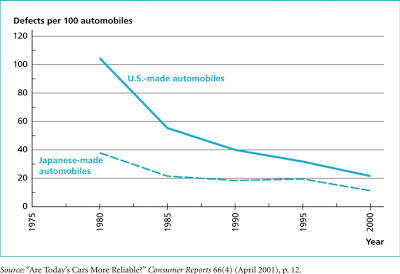
Quality control in Japanese and American car manufacturing compared
31 Jan 2015 Leave a comment
in applied price theory, development economics, economic history, entrepreneurship, growth miracles Tags: creative destruction, Japanese manufacturing, quality control

Every 20 years we worry about losing jobs to technology
26 Jan 2015 Leave a comment
in politics - Australia, politics - New Zealand, politics - USA, technological progress Tags: creative destruction, search and matching, technological unemployment

Every generation has its moral panic about technological change in creative destruction.
For young people, it’s that overweening conceit about the problems they are attempting to solve are new.
For the middle-aged and older, rather than suggest that they are policy hustlers, it’s more like you they simply forgot that these debates were had 20 years ago and the scaremongers lost the same reason they lost 20 years before that, and so on.
HT: https://twitter.com/JamesBessen/status/498435714322014208
Why all this sucking up to the dead Saudi dictator?
24 Jan 2015 Leave a comment
in energy economics, industrial organisation, politics - Australia, politics - USA, resource economics Tags: autocracy, autocratic succession, cartel theory, creative destruction, David Friedman, M. A. Adelman, Middle-East politics, OPEC oil cartel
We are not living in the 70s, but nonetheless the death of the late unlamented Saudi dictator has flags at half-mast and other sycophantic behaviour that hasn’t been seen since the death of the last totalitarian dictator who was something of a player in geopolitics and American foreign policy.

We are not living in the 70s where the West in fear of the OPEC cartel and the behaviour of Saudi Arabia as the swing producer and purported cartel enforcer.
/cdn0.vox-cdn.com/uploads/chorus_asset/file/2908448/oil_price_jan6.0.png)
OPEC and Saudi Arabia are both shadows of the former selves in terms of dominance in the global oil markets. OPEC as a whole represents about one third of global oil production, which was down for a little over 50% in 1973.

Within OPEC, Saudi Arabia As oil reserves that aren’t much bigger than those of either Iran or Venezuela. All of these countries, including Saudi Arabia have large populations and few other ways to servicing needs than from the oil revenues.

Russia is in the same position of needing to pump out as much oil as it can while letting someone else do the hard lifting regarding keeping the price of the oil up by cutting back production. US oil production has been on the rise, and has lessened the need for imported crude oil.

The best place to be in any cartel is outside the cartel selling as much as you can at the cartel price. The next best option is to be a cartel member, pretending to be a loyal while selling under the counter bias, much as you can. Recent discounts given by the Kingdom to some customers have been interpreted as showing a determination to maintain market share. David Friedman explains:
One great weakness of a cartel is that it is better to be out than in. A firm that is not a member is free to produce all it likes and sell it at or just below the cartel’s price.
The only reason for a firm to stay in the cartel and restrict its output is the fear that if it does not, the cartel will be weakened or destroyed and prices will fall.
A large firm may well believe that if it leaves the cartel, the remaining firms will give up; the cartel will collapse and the price will fall back to its competitive level.
But a relatively small firm may decide that its production increase will not be enough to lower prices significantly; even if the cartel threatens to disband if the small firm refuses to keep its output down, it is unlikely to carry out the threat.
Maurice Adelman regards the oil glut as the chronic condition of the world oil market, given the continuous tendency to underestimate reserves and undiscovered oil.
There was a glut 70 years ago, 50 years ago in 1933, 15 years ago in 1970 …But that condition of everlasting glut is periodically broken by dangers of oil shortage.
All cartels break-down and only some get back together. Cartels contain seeds of their own destruction. Cartel members are reducing their output below their existing potential production capacity, and once the market price increases, each member of the cartel has the capacity to raise output relatively easily. Adelman explains:
Opinions vary as to what is the right price for maximum profit, and opec has often had to find its right price through trial and error…
Each opec member could reap a windfall by cheating and producing over quota because the cost of production is so far below the market price. But, if some cartel members were to defect, output would climb and the prices — and windfall profits — would fall.
OPEC members pay scant regard to their actual production quotas and their national production quotas are always increased when push comes to shove. As Bill Allen said:
Long-term survival of the cartel has two fundamental requirements: first, cheating by a member on the stipulated prices, outputs and markets must be detectable; second, detected cheating must be adequately punishable without leading to a break-up of the cartel.


All cartels must decide how to allocate the reduction of output that follows the price increases across members with different costs structures and spare capacity.:
- The tendency is for cartel members to cheat on their production quotas, increasing supply to meet market demand and lowering their price.
- Most cartel agreements are unstable and at the slightest incentive they will quickly disband, and returning the market to competitive conditions.
The exercise of collective market power will not be stable unless sellers agree on prices and production shares; on how to divide the profits; on how to enforce the agreement; on how to deal with cheating; and on how to prevent new entry.

A cartel is in the unenviable position of having to satisfy everyone, for one dissatisfied producer can bring about the feared price competition and the disintegration of the cartel. Thus a successful cartel must follow a policy of continual compromise. Little wonder that John. S McGee wrote that:
The history of cartels is the history of double crossing.
Was it important to suck up to the Saudi dictator because of its role as swing producer in OPEC. In 1983, 1984, and 1986, for example, the Saudis produced only about 3.5 million barrels per day, despite their (then) production capacity of about 10 million barrels per day. Whatever else you can say about those production cutbacks to defend posted OPEC cartel price, they were a long time ago.

Saudi Arabia, Kuwait, and the United Arab Emirates have large reserves relative to the financial needs of their population but what they have is only a small share of global reserves and global production of oil and trivial share if you add global shale production.

With the exception of the wake of the 1979 Iranian upheaval, and market anticipation of a possible destruction of substantial reserves in the 1990–1991 and 2003 Gulf wars, real prices of crude oil fell from 1974 through 2003. Prices increased in 2004 onwards because of demand in Asia.

Bryan Caplan summarised the views of leading oil economist James Hamilton in 2008 as follows:
1. OPEC has almost no effect on world oil prices; most countries produce less than their quota, and when countries want to produce more, their quota goes up.
2. The price of oil follows a random walk. But the oil industry isn’t trying very hard to develop new sources because oil execs believe that the price of oil is mean-reverting (i.e., what goes up must come down). Why are the oil execs so wrong? Hamilton’s guess: They’re putting too much weight on their last big experience with high oil prices in the 70s and 80s.
No amount of cutting can support prices when supply outside OPEC is growing strongly and demand is weak in the wake of the global financial crisis and the slower recoveries both in the USA and Europe. Hamilton’s current view is that:
…of the observed 45% decline in the price of oil, 19 percentage points– more than 2/5– might be reflecting new indications of weakness in the global economy.
Whatever reason people are sucking up to the dead Saudi dictator, they have nothing to do with the global oil market.


Measurement without theory alert: It’s Time For Companies To Fire Their Human Resource Departments – Forbes
23 Jan 2015 Leave a comment
in managerial economics, organisational economics, personnel economics, theory of the firm Tags: agent principal problems, creative destruction, human resource departments, managerial discretion, measurement without theory, The pretence to knowledge
Kyle Smith in Forbes today launched into human resource departments and called for their abolition. My hypothesis is he doesn’t understand why rigid, rule-bound human resource departments exist in the first place in large hierarchies. The fact that this form of organisation survives in competition with other forms of organisation and modern human resource management has been spreading rather the contracting in popularity over the recent decades is a test of its survival value in market competition.
Smith made the following claims:
- 93 percent of the HR staffers deciding whether to call in someone for an interview were female, these tend to be young and single and hence still in the dating market for men so they’re jealous of beautiful women so they are less likely to call them in for an interviews because of their looks;
- They speak gibberish: “Internal action learning.” “Being more planful in my approach.” “Human capital analytics.” “Result driven”;
- HR employees are too absorbed in process and heedless of the big picture;
- HR departments grossly overestimate the extent to which employees will recommend the company to a friend; and
- HR places a disturbingly high premium on what it calls “communication skills”.
This is a classic example of measurement without theory. Of not having a theory to make sense of the facts and explain why this form of organisation – modern human resource departments – is survived and prospered in market competition.

The form of organisation that survives in competition with actual and potential market rivals is that specific form of organisation which allows the firm to deliver the products that customers want at the lowest price while covering costs (Alchian 1950; Fama and Jensen 1983a, 1983b).
Some larger firms may struggle with striking the most profitable balance between greater local managerial discretion and effective corporate governance of a large diverse organisation with professional managers and diffuse ownership structures. It will be shown that very large firms promulgate rigid personnel policies while smaller firms are much more flexible in their deals with individual employees.
Competition between different sizes, shapes and internal organisational forms of firms all vying for sales, cheaper sources of supply and investor support sifts out the keener priced, lower cost, and more innovative enterprises (Alchian 1950; Stigler 1958). These lower-cost firms will be able to under-sell their higher cost rivals. The winning size and shape is that configuration which meets any and all problems the firm is actually facing and seizes more of the entrepreneurial opportunities that are within its grasp (Stigler 1958; Alchian 1950).
As the size of a firm grows, important information is less likely to find its way up hierarchies and reach the appropriate decision-makers and be up-to-date and be comprehended if it does. The top of corporate hierarchies can be overwhelmed with information and much of what information they do receive can be old, incomplete, conflicting and garbled (Williamson 1967, 1975).
Larger firm respond to this loss of up-to-date knowledge of the local circumstances of time and place with a greater dependence on broad rules (Oi 1983a, 1983b, 1988, 1990). For this reason, larger employers will be less effective in assessing individual attributes of employees and assigning employees to the most productive task (Parsons 1997).
Larger firms offset this competitive disadvantage by specialising in the production of standardised goods with larger teams of more homogeneous, more highly trained workers; smaller firms produce more customised goods produced in smaller quantities by smaller teams of less specialised employees (Oi 1983a, 1983b; Oi and Idson 1999). Smaller firms can quickly adapt to changing circumstances of all kinds because top management are closer to and better informed about all operations, employees and customers.
If large firms are to survive in competition, the personnel policies of larger employers must adapt to offset the diseconomies of scale in idiosyncratic decisions by relying on broad inflexible rules. These top-down rules will leave far less discretion in the hands of local managers. This is because the higher layers in a large corporate hierarchy cannot control and direct lower layers that behave in an increasing diversity of ways to the same information and to local events that do not affect the rest of the firm.
Planning and coordination costs increase with organisational size. There will be errors in assigning tasks, deciding rewards, and monitoring performance. Information flows and co-ordination become problems that only increase with the size if the firm. It can be cheaper to monitor compliance with rules and issue general instructions that apply to all employees.
Limits on the degree of local managerial discretion over employment relations in large managerial firms can arise from restrictions on managerial delegations, divided decision making rights, hierarchical approval procedures, and the breath and content of wage and personnel policies. The discretion of supervisors in large firms may be limited to individual performance ratings (Gibbs and Hendricks 2004). Some large firms may have no process or policy to handle requests for a phased retirement.
Good evidence to illustrate the proposition that larger firms prefer rigid rules over discretion in personnel policies comes from the days of mandatory retirement. Mandatory retirements can be viewed as the wholesale substitution of local managerial discretion with a single company-wide rule because larger firms find idiosyncratic decisions to be more costly (Parsons 1997).
Mandatory retirements are near universal in very large workplaces, but in small to medium size firms, there were flexible retirement polices. Few very large firms reported flexible retirement polices.
Smaller firms provided for policies that allowed for exceptions to mandatory retirement rules while most of largest firm reported a policy of zero exceptions to mandatory retirement rules (Parsons 1997). This U.S. evidence from the time of mandatory retirements suggests that larger employers may find it more difficult to handle the idiosyncrasies of phased retirements.
A price of growth in the size of firms is often the standardisation of products, workforce compositions and terms of employment. Standardisation in larger firms constrains wages, reduces managerial slack and aggrandisement, and facilitates performance evaluations and yardstick competition between divisions.
Large employers write personnel policies to govern most aspects of the employment relationship. These human resources policies will be common to all employees and all revisions and exceptions require central approval.
More centralised human resources policies that limit supervisor discretion can reduce favouritism and the cost of employees wasting working time on attempts to influence line managers about their pay and working hours.

The price of more centralised human resources policies is less local adaptability to genuine opportunities. The offset is centralised personnel policies save on the costs to the firm of having to gather and process up and back down a large corporate hierarchy the information need to make decisions with more localised finesse. These rule-bound decisions are less deft but are also cheaper to make.
In other areas, large firms will take steps to empower local managers and foil ill-informed intervention from above to put decisions where the knowledge is held. Reporting and decision procedures and performance pay can all craft a sufficient amount of distance between managerial layers to create an adequate amount delegation to take advantage of local knowledge and overcome the costs of slow and garbled information transfer in hierarchies, managerial overload, and the losses from decisions lagging behind in dynamic and unpredictable environments.
Smaller firms survive and profit from being small because their size allows them to succeed with more workforce diversity and more customised products. The owners are know more and can be directly involved in management. Owner-managers can quickly adapt to new conditions with fewer risks and can sidestep the need to develop policies on phased retirements or revise it on the spot in light of an unforeseen or low-probability contingency.
One reason for larger firms paying higher wages by industry standards is as compensation to offset their requirements for more standardised hours of work. The efforts of the more able entrepreneurs to deploy their talents wisely result in systematic differences in the organisation of production and the structure of the workforces that firms employ. Smaller employers pay less in wages but can offer more flexible work hours. The wage premiums offered in large firms are in part because of their organisational rigidity.
Rigid, rule-bound HR department is doing its job to the letter because this constrains line managers from favouritism and been lobbied for favours by employees was they have very little control over terms and conditions of employment and promotions and perhaps only have input into performance ratings.

A major reason why companies limit pay reviews and performance promotion rounds to an annual process is to prevent everyone wasting time between these annual events on lobbying for pay rises and promotions The HR department is the guardian of the gate to ensure there is no favouritism because it enforces rules rigidly.
The nub of the problem is large firms have several layers of management with fairly strict limits on what each individual line manager can do (Williamson 1975, 1985; Fama and Jensen 1983b). There must be some limits on local managerial discretion because the owners and senior managers of any firm set the strategic direction of the firm, the products it sells, and how many workers are employed and on what wages. All parts of the firm must march in the same direction.
The discovery of monitoring or incentive systems that induce managers to act in the best interest of shareholders are entrepreneurial opportunities for pure profit (Fama and Jensen 1983b, 1985; Alchian and Woodward 1987, 1988; Demsetz 1983, 1986; Demsetz and Lehn 1985; Demsetz and Villalonga 2001).
Investors will not entrust their funds to who are virtual strangers unless they expect to profit from a specialisation and a division of labour between asset management and managerial talent and in capital supply and residual risk bearing (Fama 1980; Fama and Jensen 1983a, 1983b; Demsetz and Lehn 1985). There are other investment formats that offer more predictable, more certain rate of returns.
One type of corporate waste is uncompetitive staff retention policies. The risks to dividends and capital because of this and other manifestations of corporate waste, reduced employee effort, and managerial slack and aggrandisement in large managerial firms are risks that are well known to investors (Jensen and Meckling 1976; Fama and Jenson 1983b). Corporate waste and managerial slack also increase the chances of a decline in sales and even business failure because of product market competition (Fama 1980; Fama and Jensen 1983b).
The reward for forming a well-disciplined managerial firm despite the drawbacks of diffuse ownership is the ability to raise large amounts in equity capital from investors seeking diversification and limited liability (Demsetz 1967; Jensen and Meckling 1976; Fama 1980; Fama and Jensen 1983b; Demsetz and Lehn 1985).
Competition from other firms will force the evolution of devices within the firms that survive for the efficient monitoring the performance of the entire team of employees and of individual members of those teams as well as managers (Fama 1980, Fama and Jensen 1983a, 1983b; Demsetz and Lehn 1985).

Managerial firms who are not alert enough to develop cost effective solutions to incentive conflicts and misalignments will not grow to displace rival forms of corporate organisation and methods of raising equity capital and loans, allocating legal liability, diversifying risk, organising production, replacing less able management teams, and monitoring and rewarding employees (Fama and Jensen 1983a, 1983b; Fama 1980; Alchian 1950).
Entrepreneurs will win profits from creating corporate governance structures that can credibly assure current and future investors that their interests are protected and their shares are likely to prosper (Fama 1980; Fama and Jensen 1983a, 1983b, 1985; Demsetz 1986; Demsetz and Lehn 1985). Corporate governance is the set of control devices that are developed in response to conflicts of interest in a firm (Fama and Jensen 1983b).
A risk of greater local managerial discretion in a large firm is less effective governance (Williamson 1975, 1985; Fama and Jensen 1983a, 1983b). The separation of decision management rights, vested in hired managers, from decision control rights, vested in the board of directors, is a common governance safeguard against conflicts of interest in business, professional and non-profit organisations, large and small (Fama and Jensen 1983a, 1983b).
Decision management rights cover the initiation and the implementation of decisions. Decision control rights involve the ratification and the monitoring of decisions. Managers and division heads carry out the production decisions, budgets and policies on wages, hours, staffing and job designs developed by head office and which are ratified by the board of directors (Fama and Jensen 1983b, 1985).
Managerial firms survive in market competition because divided decision rights and limits on the local discretion of expert managers and corporate boards increase investment returns net of greater scope for managerial slack and the inflexibilities of growing hierarchies (Fama and Jensen 1983b; Demsetz and Lehl 1985; Alchian 1950). More local managerial discretion over conditions of employment and hours of work may strike at the heart of the governance structures that allow many large firms to emerge, survive and prosper despite their separation of ownership from control.
In contrast, entrepreneurial firms are owned and managed by the same people (Fama and Jensen 1983b). Mediocre personnel policies and sub-standard staff retention practices within entrepreneurial firms are disciplined by these errors in judgement by owner-managers feeding straight back into the returns on the capital that these owner-managers themselves invested. Owner-managers can learn quickly and can act faster in response the discovery of errors in judgement.
The owners of a managerial firm advance, withdraw, and redeploy capital, carry the residual investment risks of ownership and have the ultimate decision making rights over the fate of the firm (Klein 1999; Foss and Lien 2010; Fama 1980; Fama and Jensen 1983a, 1983b; Jensen and Meckling 1976). Owners of a managerial firm, by definition, will delegate control to expert managerial employees appointed by boards of directors elected by the shareholders (Fama and Jensen 1983a, 1983b).
The owners of a managerial firm will incur costs in observing with considerable imprecision the actual efforts, due diligence, true motives and entrepreneurial shrewdness of the managers and directors they hired (Jensen and Meckling 1976; Fama and Jensen 1983b).

Poor cost control, budgetary excess and any lack of innovation and initiative over products designs and pricing, input mixes and wage and employment polices will reflect in relative divisional performances and overall corporate profits of a managerial firm.
Any news of less promising current and future net cash flows will feed into share prices and into the labour market prospects of both career managers and the members of boards of directors (Manne 1965; Fama 1969, 1970; Fama and French 2004; Jensen and Meckling 1976; Fama and Jensen 1983a, 1983b; Demsetz 1983; Demsetz and Lehn 1985). To survive, managerial firms must balance delegation with more centralised control (Fama and Jensen 1983a; McKenzie and Lee 1998).
Managerial firm have HR departments, and will continue to have HR departments because their objective is to limit the discretion of individual line managers and ensure that they carry out corporate objectives.
Smaller firms are more likely to be entrepreneurial firms where the owner-managers are on the spot to make the key decisions and keep things in line.
” Google glass ” 1960s.
22 Jan 2015 Leave a comment
in technological progress Tags: creative destruction, innovation, technology diffusion
Movie 3-D technology review: Peter Jackson’s Battle of the Five Armies versus the rest
22 Jan 2015 Leave a comment
in economics of media and culture, entrepreneurship, industrial organisation, movies, politics - New Zealand, technological progress Tags: 3-D movies, creative destruction, innovation
We saw Peter Jackson’s latest Hobbit movie the other day. The other films previewed before the Battle of the Five Armies were also 3-D films.

The first of these was a cartoon where the 3-D technology seemed to be based on using crayons to try and trick you as to what was going on.
The next trailer was the next Star Wars movie in 3-D. Again, it was vastly inferior to the 3-D technology of Sir Peter Jackson and his team.
I noticed the same with all the 3-D films of Sir Peter Jackson: they are much better than the competition.
More than a few times in the 3-D films of his competition, you doubt as to whether the film is in 3-D or not and can’t really tell the difference sometimes as to the 3-D effect over normal films in terms of cinematic experience. Example of this was the last Star Trek movie we saw. The 3-D effect failed in a number of occasions.
Clearly there are trade secrets in 3-D films. The 3-D effect works pretty well in Peter Jackson’s films, except for the occasional close-up transition, and sometimes is quite dazzling.
Global computing cost trends
22 Jan 2015 Leave a comment
in economics of media and culture, industrial organisation, survivor principle Tags: creative destruction, Digital competition





 Utopia, you are standing in it!
Recent Comments