05 Feb 2016
by Jim Rose
in labour economics, labour supply, politics - Australia, politics - New Zealand, politics - USA, public economics
Tags: 2016 presidential election, British election, Canada, Denmark, family tax credit, in work tax credit, taxation and labour supply
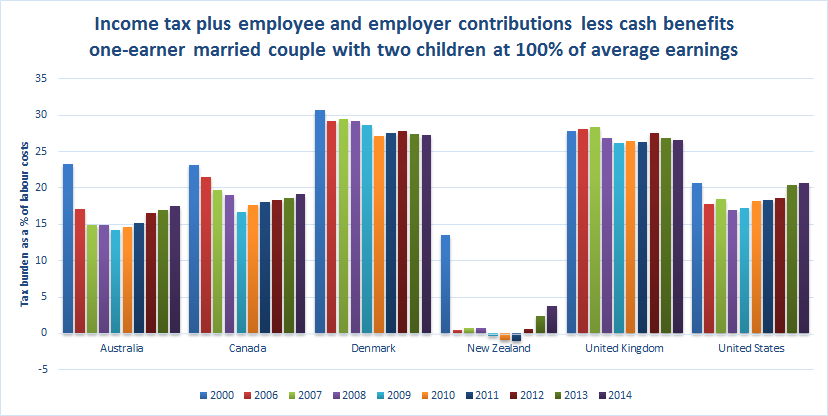
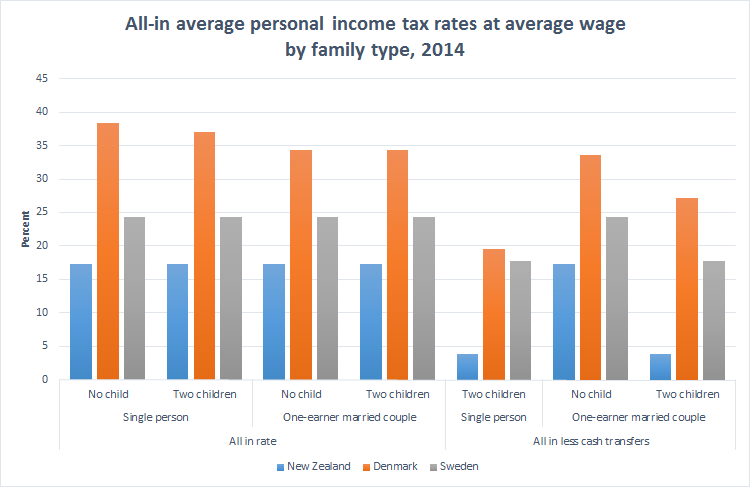
For some reason the Labour government in New Zealand in the mid-2000s could not bring itself to admit it was introducing a huge tax cut for families. To avoid admitting it ever gave a tax cut, that Labour government called the huge family tax credit introduced in 2004 and 2005 Working for Families.
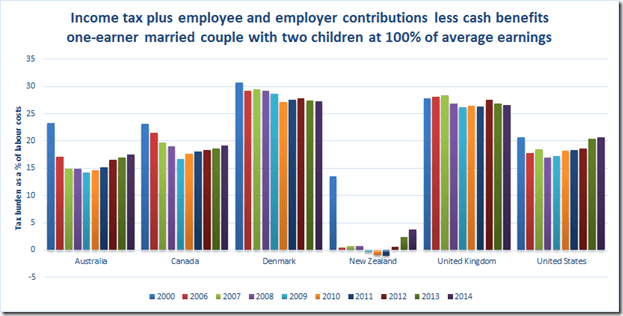
Source: Taxing Wages 2015 – OECD 2015
The above data does not include the effects of GST and VAT.
05 Feb 2016
by Jim Rose
in health economics, politics - USA
Tags: 2016 presidential election, British economy, Canada, Denmark, health insurance, medical rationing, NHS, single-payer, social insurance, universal health insurance
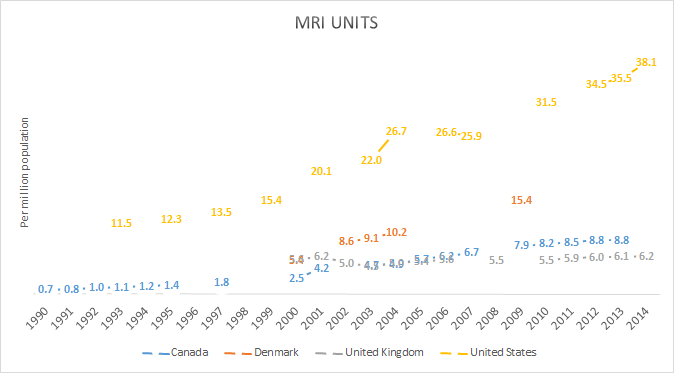
Single payer health insurance systems may have their advantages but one of which is not ready access to an MRI scan in the UK, Denmark or Canada.
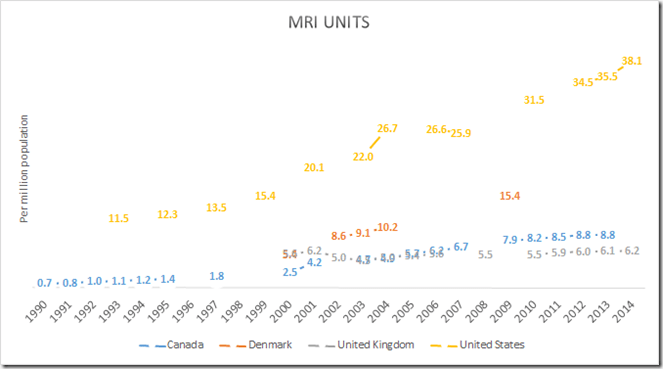
Source: OECD Health Statistics.
Remember that those aged over 65 in the USA are covered by Medicare; the poor and welfare beneficiaries are covered by Medicaid; and children of the working poor are covered by CHIPS.
I am told that dogs to get an MRI scan in Canada far quicker than humans. This is because dog owners can pay for the MRI scan. Private health insurance is unlawful in 9 of the 10 Canadian provinces.
There is considerable medical tourism from Canada to the USA, including by politicians who passionately support the single-payer system.
01 Feb 2016
by Jim Rose
in politics - Australia, politics - New Zealand, politics - USA, public economics
Tags: Australia, Canada, Denmark, France, Germany, Italy, Japan, Social Security taxes, taxation and labour supply, the dish economy
31 Jan 2016
by Jim Rose
in politics - Australia, politics - New Zealand, politics - USA, public economics
Tags: Australia, British economy, Canada, Denmark, France, Germany, Italy, Japan, New Zealand, social insurance, Social Security taxes, taxation and labour supply
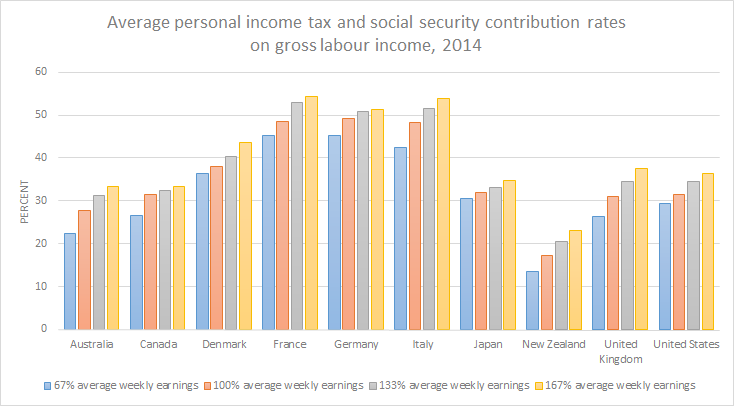
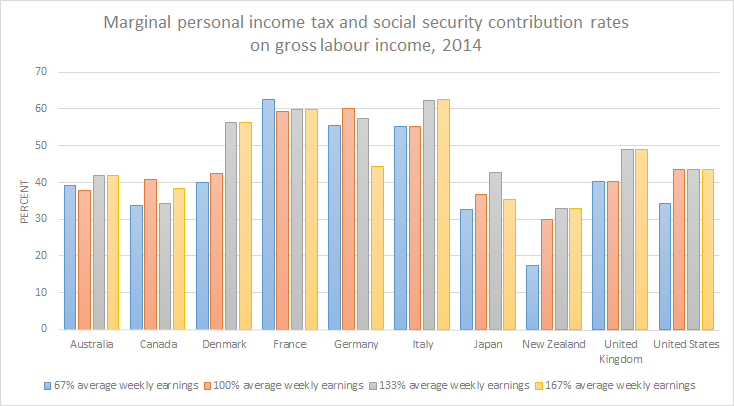
Ordinary French, Germans, Italians and Danish pay much higher marginal tax rates and that is before their high rates of GST.
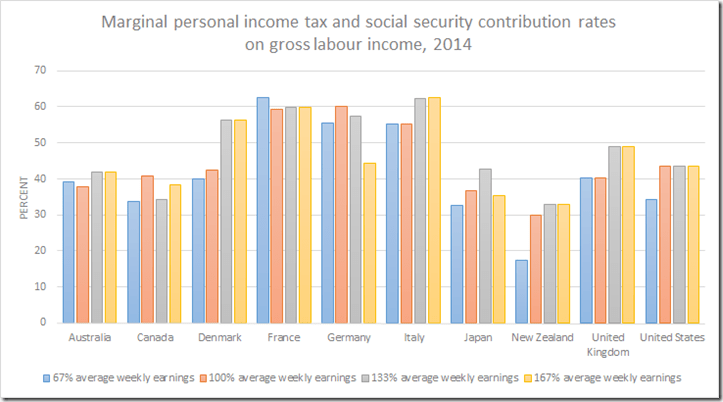
Data extracted on 30 Jan 2016 03:08 UTC (GMT) from OECD.Stat.
19 Jan 2016
by Jim Rose
in Euro crisis, great recession, job search and matching, labour economics, macroeconomics, politics - New Zealand, politics - USA, unemployment
Tags: Denmark, employment law, employment protection, flexicurity, labour market regulation, social insurance, welfare state
https://twitter.com/KiwiLiveNews/status/688503382181449728
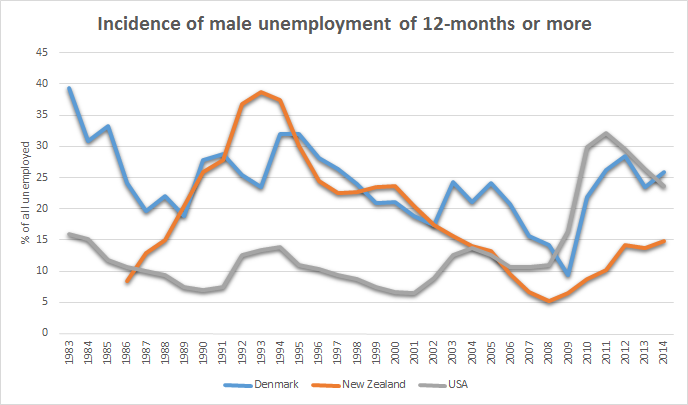
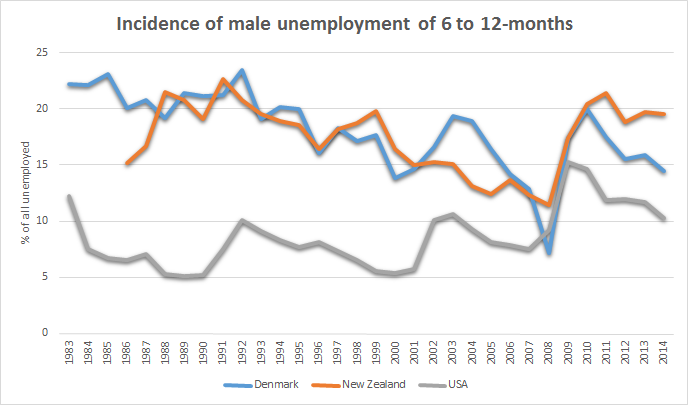
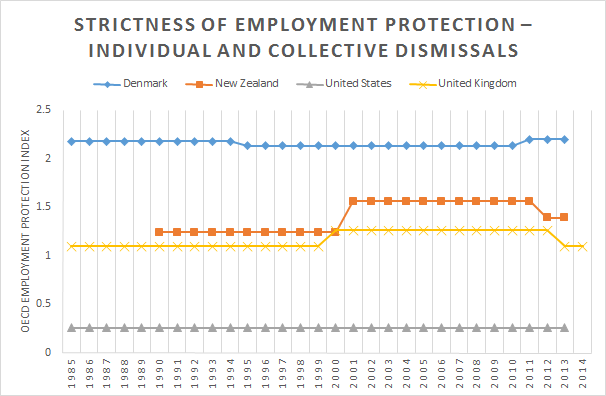
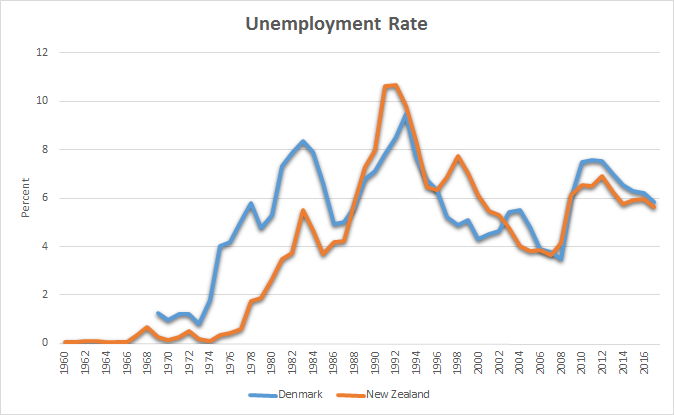
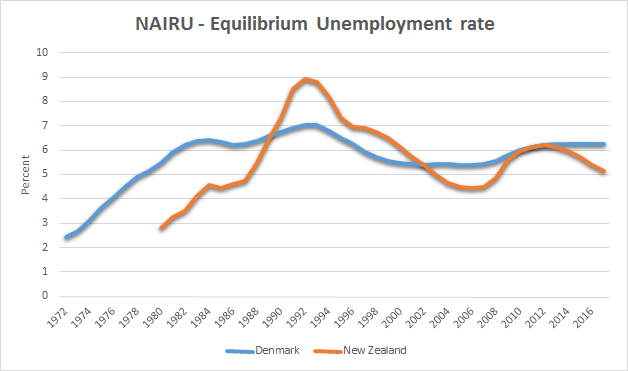
My search for an example of how Danish flexicurity might have an advantage over the status quo in the New Zealand labour market is still to yield results. Danish flexicurity is no better than New Zealand and often worse in keeping long-term male unemployment rates down as the charts below show. The flexicurity model combines flexible hiring and firing with a generous social safety net and an extensive system of activation policies for the unemployed.
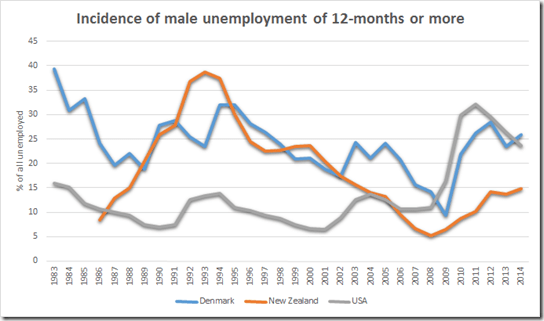
Data extracted on 18 Jan 2016 21:55 UTC (GMT) from OECD.Stat.
The charts above and below do show is that a more generous social safety net for the unemployed introduced with the onset of the Great Recession in the USA was followed by a sharp increase in the incidence of long-term unemployment.
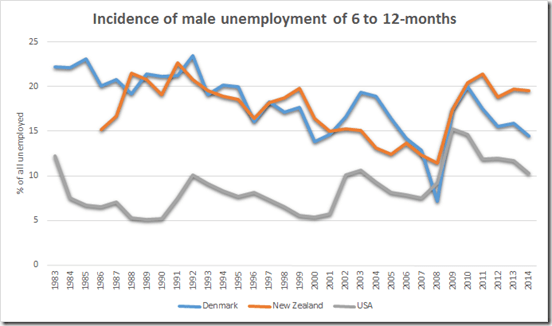
Data extracted on 18 Jan 2016 21:55 UTC (GMT) from OECD.Stat.
24 Dec 2015
by Jim Rose
in applied price theory, economic history, energy economics, environmental economics, global warming, Public Choice, rentseeking
Tags: Big Solar, Big Wind, bootleggers and baptists, climate alarmism, Denmark, Germany, green rent seeking, power prices, solar power, wind power
20 Nov 2015
by Jim Rose
in politics - Australia, politics - New Zealand, politics - USA, Public Choice, public economics
Tags: Denmark, Finland, growth of government, Norway, Scandinavia, size of government, Sweden, taxation and entrepreneurship, taxation and investment, taxation and labour supply, welfare state
12 Nov 2015
by Jim Rose
in applied price theory, applied welfare economics, comparative institutional analysis, constitutional political economy, economic history, economics of regulation, entrepreneurship, industrial organisation, politics - USA, public economics, survivor principle, taxation, technological progress
Tags: creative destruction, Daron Acemoglu, Denmark, entrepreneurial alertness, Eurosclerosis, international technology diffusion, taxation and entrepreneurship, taxation and innovation, taxation and investment, taxation and labour supply, technology followers, welfare state
Previous Older Entries Next Newer Entries



Recent Comments