Bourtange, Netherlands. Built in 1593 (during the Eighty Years' War), this is a great example of a Star Fort. http://t.co/10NnjhaJVf—
History (@HistoryTime_) July 01, 2015
What a great fort!
04 Aug 2015 Leave a comment
in defence economics, economic history Tags: EU
Are there net saving from a British pull-out of the EU?
31 Jul 2015 Leave a comment
in currency unions, economic growth, Euro crisis, international economics, macroeconomics Tags: British economy, customs unions, EU, EU membership, free trade areas, international economic integration, preferential trading agreements, regional integration
Ukip claims that there is a net saving from pulling out of EU are highly debatable: http://t.co/TemtNC9gnN—
C4 News FactCheck (@FactCheck) April 02, 2015
Unemployment rates across the OECD member countries
30 Jul 2015 Leave a comment
in business cycles, currency unions, economic growth, Euro crisis, job search and matching, labour economics, labour supply, macroeconomics, unemployment Tags: employment law, employment regulation, EU, Euro sclerosis, Euroland, Eurosclerosis, Japan, labour market regulation
European integration explained in one easy chart
25 Jul 2015 Leave a comment
in currency unions, Euro crisis, international economics, macroeconomics Tags: Common market, customs unions, economics of immigration, EU, Euro, Euroland, European free trade area, European Union, free trade agreements, free trade areas, open borders, preferential trading agreements
AMAZING chart on European integration. One to pin to your office wall. Nice job by @Nic_Koenig delorsinstitut.de/2015/wp-conten… http://t.co/zZbOA29mYP—
Maxime Sbaihi (@MxSba) July 24, 2015
Who has heavily guarded borders?
25 Jul 2015 Leave a comment
in international economic law, international economics, International law, politics - Australia, politics - USA Tags: Australia, British politics, economics of immigration, EU, illegal immigration, Mexico, North Korea, Spain
The walled world
– http://t.co/dXmzCUrjpD—
Amazing Maps (@Amazing_Maps) July 13, 2015
NAFTA v. the Common Market: trading across the French, German, Italian, British, Canadian and US borders – World Bank Doing Business rankings compared
17 Jul 2015 Leave a comment
in economics of regulation, industrial organisation, international economics, politics - USA Tags: border costs, British economy, Canada, Common market, Common markets, customs unions, EU, France, free trade areas, Germany, Italy, NAFTA, trade costs
Figure 1: World Bank Doing Business rankings and sub rankings for trading across the French, German, Italian, British, Canadian and US borders, 2014
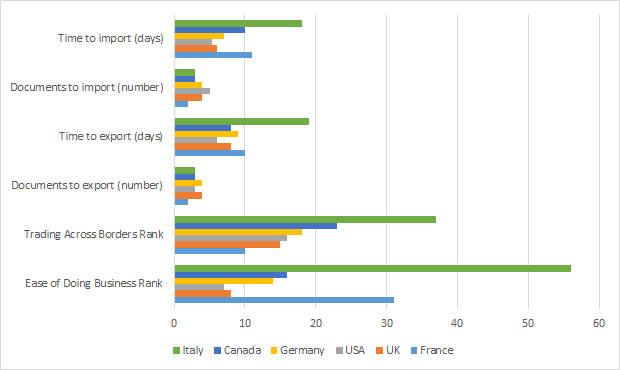
Source: World Bank Doing Business database; note: cost of importing and exporting not included.
Figure 2: World Bank Doing Business rankings – cost of importing and exporting across the French, German, Italian, British, Canadian and US borders, 2014
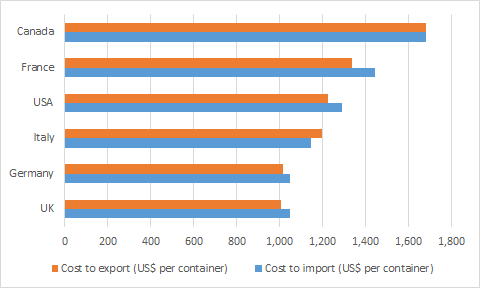
Source: World Bank Doing Business database; note: cost of importing and exporting not included.
Greece’s possible currency outcomes, from today’s euro to the drachma
13 Jul 2015 Leave a comment
in currency unions, economic history, macroeconomics Tags: currency reforms, EU, Euroland, Greece, sovereign defaults
Greece’s possible currency outcomes, from today's euro to the drachma (and several in between) on.wsj.com/1ew3Yvs http://t.co/nEWtz84WTG—
Sudeep Reddy (@Reddy) July 05, 2015
A Schumpeterian explanation of the recent rejection of the centre-left in Europe
02 Jul 2015 Leave a comment
in political change, Public Choice Tags: EU, Euroland, European politics, expressive voting, Joseph Schumpeter, Leftover Left, rational ignorance, rational irrationality
Kiwiblog put me onto the story in the Guardian about how only one third of Europe’s population is governed by the centre-left and the left is lost all but one of the last 13 elections in Europe. The exception was Greece, which they may regret.

Austria, Croatia, the Czech Republic, France, Italy, Malta, Slovakia and Sweden are the only EU members that are on the centre-left. In 2011, only 14.5% of the 28 countries’ total population was led by the centre-left. In 2007, it was nearly 45%.
The reason for the shift to the right can be explained by Joseph Schumpeter’s theory of democracy. Schumpeter disputed the widely held view that democracy was a process by which the electorate identified the common good, and that politicians carried this out:
- The people’s ignorance and superficiality meant that they were manipulated by politicians who set the agenda.
- Although periodic votes legitimise governments and keep them accountable, their policy programmes are very much seen as their own and not that of the people, and the participatory role for individuals is limited.
Schumpeter’s theory of democratic participation is that voters have the ability to replace political leaders through periodic elections.
Citizens do have sufficient knowledge and sophistication to vote out leaders who are performing poorly or contrary to their wishes. The power of the electorate to turn elected officials out of office at the next election gives elected officials an incentive to adopt policies that do not outrage public opinion and administer the policies with some minimum honesty and competence.
Power rotates in the Schumpeterian sense. Governments were voted out when they disappointed voters with the replacement not necessarily having very different policies. Greece is the exception to this.
Child poverty across Europe
28 Jun 2015 Leave a comment
in Euro crisis, poverty and inequality Tags: child poverty, EU, Eurosclerosis, family poverty
Spain's lost decade: one in three Spanish kids live in poverty or at risk of social exclusion: gu.com/p/42yx7/tw http://t.co/qg8PDla19z—
Guardian Data (@GuardianData) October 28, 2014
Tom Sargent keynote address Emergency Economic Summit for Greece (1 June 2015)
26 Jun 2015 Leave a comment
in comparative institutional analysis, constitutional political economy, currency unions, Euro crisis, fiscal policy, macroeconomics, monetary economics Tags: EU, Euroland, Greece, sovereign borrowing, sovereign defaults, Thomas Sargent
Who is where on the Laffer curve?
20 Jun 2015 Leave a comment
in economic growth, fiscal policy, human capital, labour economics, labour supply, macroeconomics, politics - USA, public economics Tags: endogenous growth theory, EU, Eurosclerosis, laffer curve, optimal tax theory, taxation and entrepreneurship, taxation and investment, taxation and the labour supply
@asymmetricinfo paper:"How Far Are We From The Slippery Slope? The Laffer Curve Revisited" bit.ly/1HMhmqu http://t.co/D9IffNhd92—
Old Whig (@aClassicLiberal) April 20, 2015

 Utopia, you are standing in it!
Recent Comments