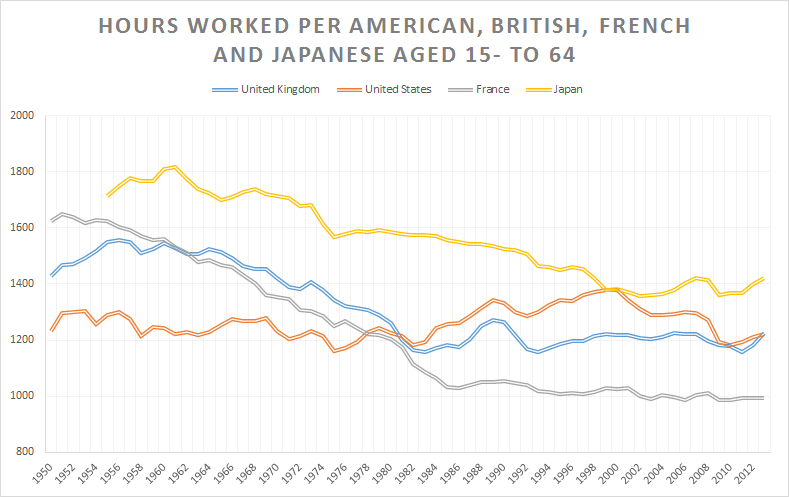
Source: Data extracted on 05 Oct 2015 22:01 UTC (GMT) from OECD.Stat and The Conference Board. 2015. The Conference Board Total Economy Database™, May 2015, http://www.conference-board.org/data/economydatabase/
Celebrating humanity's flourishing through the spread of capitalism and the rule of law
06 Oct 2015 Leave a comment
in economic history, labour economics, labour supply Tags: British economy, France, Japan
Source: Data extracted on 05 Oct 2015 22:01 UTC (GMT) from OECD.Stat and The Conference Board. 2015. The Conference Board Total Economy Database™, May 2015, http://www.conference-board.org/data/economydatabase/
01 Oct 2015 Leave a comment
in economics of media and culture, laws of war, Music, politics - USA, war and peace Tags: Civil Liberties, Japan, Rap music, wartime detention, wartime interment, World War II
16 Sep 2015 Leave a comment
in development economics, economic history, growth miracles, urban economics Tags: Generation Rent, housing affordability, housing prices, Japan, land supply, land use planning, NIMBYs, South Korea, zoning
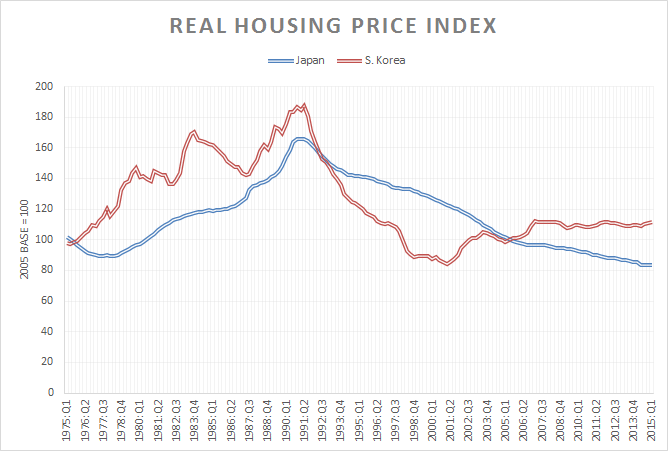
Source: International House Price Database – Dallas Fed
Note: The house price index series is an index constructed with nominal house price data. The real house price index is an index calculated by deflating the nominal house price series with a country’s personal consumption expenditure deflator.
26 Aug 2015 Leave a comment
in population economics Tags: ageing society, demographic crisis, economics of fertility, France, Japan, South Korea
21 Aug 2015 Leave a comment
in health economics, population economics Tags: Japan, life expectancies, The Great Escape
17 Aug 2015 Leave a comment
in economics of regulation, entrepreneurship, financial economics, politics - New Zealand Tags: Australia, Canada, China, FDI, Japan, Left-wing hypocrisy, left-wing popularism, New Zealand Greens, right-wing popularism
Canada was the largest source of foreign investment during the period, as its pension fund bought 18 properties in a portfolio from AMP and increased its stake in Kaingaroa Forest.
12 Aug 2015 Leave a comment
in labour economics, labour supply Tags: ageing society, demographic crisis, Japan
Japan's population is set to fall 32% (!) by 2060, and 40% will be over age 65 econ.st/1Nk65i4 http://t.co/pes8KW6Mnm—
Nick Timiraos (@NickTimiraos) July 13, 2015
09 Aug 2015 Leave a comment
in laws of war, Public Choice, war and peace Tags: atomic bombings, credible commitments, game theory, Japan, World War II
The quote of Schuler is an excellent summary of the difficulty of bringing a war to an end rather than give time to regroup and attack again.
Economist Kurt Schuler has a fascinating post on the various currencies that were used in mainland East Asia during World War II over at the Free Banking group blog.
Unfortunately, there are three paragraphs in the post that attempt to take libertarians to task for daring to challenge both the narrative of the state and the narrative of the nation regarding that horrific reminder of humanity’s shortcomings. He is writing of the certainty of the US’s moral clarity when it came to fighting Japan (the post was published around Pearl Harbor remembrance day):
The 1940 U.S embargo of certain materials frequently used for military purposes was intended to pressure Japan to stop its campaign of invasion and murder in China. The embargo was a peaceful response to violent actions. Japan could have stopped; it would have been the libertarian thing to do. For libertarians to claim that the embargo was…
View original post 1,475 more words
09 Aug 2015 Leave a comment
in laws of war, war and peace Tags: atomic bombings, Japan, Nagasaki, World War II
Nagasaki, 20 minutes after the atomic bombing in 1945. http://t.co/aqtpAyoUG2—
ClassicPics (@History_Pics) June 19, 2015
06 Aug 2015 Leave a comment
in defence economics, laws of war, war and peace Tags: atomic bombings, Hiroshima, Japan
https://twitter.com/makingdayscount/status/629162313879154688
8.15 am, 6 August 1945 bit.ly/1IrpJoA
#Hiroshima http://t.co/rtP26Q3qHm—
The Conversation (@ConversationUK) August 06, 2015#ThisDayInHistory 1945 – Atomic bombs were dropped on Hiroshima killing at least 129,000 people. http://t.co/4LmdcoJ034—
Paul Henry (@PaulHenryShow) August 06, 2015https://twitter.com/historyfacts247/status/629304405024763904
The atomic bomb is dropped on Hiroshima on this day 70 years ago. nyti.ms/1MPqwTn http://t.co/GAiWFzQcvV—
NYT Archives (@NYTArchives) August 06, 2015How The Japan Times reported the atomic bombings of Hiroshima and Nagasaki jtim.es/QvTPC http://t.co/xYwL62C16Z—
The Japan Times (@japantimes) August 06, 2015


Those that argue that Japan surrendered for reasons other than the atomic bomb put forward contradictory arguments.
The first is the Japan was already seeking terms for surrender. That is true, but among those terms was avoiding occupation.
The Japanese leadership had already interpreted the terms of the Potsdam declaration was a sign of weakness. They hoped that by making the invasion of Japan as bloody as possible, they could extract even better terms in light of this sign of weakness at Potsdam. Kyushu, the obvious initial invasion site in southern Japan, was being heavily reinforced by the middle of 1945.
Japan no longer had a realistic prospect of winning the war by the end of 1994 and they knew it.
Japan’s leaders believed they could make the cost of conquering Japan too high for the Allies to accept, leading to some sort of armistice rather than total defeat. The Japanese…
View original post 529 more words
06 Aug 2015 Leave a comment
in economic history, entrepreneurship, industrial organisation, survivor principle Tags: business history, creative destruction, Japan, market selection
Japan houses more than half of the world's 1,000 oldest businesses:
priceonomics.com/why-are-so-man… http://t.co/LVzPPKOeJw—
Zachary Crockett (@zzcrockett) July 15, 2015
06 Aug 2015 Leave a comment
in laws of war, war and peace Tags: atomic bombings, Hiroshima, Japan, Nagasaki, World War II
How The Japan Times reported the atomic bombings of Hiroshima and Nagasaki jtim.es/QvTPC http://t.co/xYwL62C16Z—
The Japan Times (@japantimes) August 06, 2015
via How The Japan Times reported the atomic bombings of Hiroshima and Nagasaki | The Japan Times.
30 Jul 2015 Leave a comment
in business cycles, currency unions, economic growth, Euro crisis, job search and matching, labour economics, labour supply, macroeconomics, unemployment Tags: employment law, employment regulation, EU, Euro sclerosis, Euroland, Eurosclerosis, Japan, labour market regulation
Celebrating humanity's flourishing through the spread of capitalism and the rule of law
Scholarly commentary on law, economics, and more
Beatrice Cherrier's blog
Celebrating humanity's flourishing through the spread of capitalism and the rule of law
Celebrating humanity's flourishing through the spread of capitalism and the rule of law
Celebrating humanity's flourishing through the spread of capitalism and the rule of law
Why Evolution is True is a blog written by Jerry Coyne, centered on evolution and biology but also dealing with diverse topics like politics, culture, and cats.
Celebrating humanity's flourishing through the spread of capitalism and the rule of law
Celebrating humanity's flourishing through the spread of capitalism and the rule of law
A rural perspective with a blue tint by Ele Ludemann
DPF's Kiwiblog - Fomenting Happy Mischief since 2003
Celebrating humanity's flourishing through the spread of capitalism and the rule of law
The world's most viewed site on global warming and climate change
Tim Harding's writings on rationality, informal logic and skepticism
A window into Doc Freiberger's library
Let's examine hard decisions!
Commentary on monetary policy in the spirit of R. G. Hawtrey
Thoughts on public policy and the media
Celebrating humanity's flourishing through the spread of capitalism and the rule of law
Politics and the economy
A blog (primarily) on Canadian and Commonwealth political history and institutions
Reading between the lines, and underneath the hype.
Economics, and such stuff as dreams are made on
"The British constitution has always been puzzling, and always will be." --Queen Elizabeth II
Celebrating humanity's flourishing through the spread of capitalism and the rule of law
Celebrating humanity's flourishing through the spread of capitalism and the rule of law
WORLD WAR II, MUSIC, HISTORY, HOLOCAUST
Undisciplined scholar, recovering academic
Celebrating humanity's flourishing through the spread of capitalism and the rule of law
Res ipsa loquitur - The thing itself speaks
Celebrating humanity's flourishing through the spread of capitalism and the rule of law
Researching the House of Commons, 1832-1868
Articles and research from the History of Parliament Trust
Reflections on books and art
Posts on the History of Law, Crime, and Justice
Celebrating humanity's flourishing through the spread of capitalism and the rule of law
Exploring the Monarchs of Europe
Cutting edge science you can dice with
Small Steps Toward A Much Better World
“We do not believe any group of men adequate enough or wise enough to operate without scrutiny or without criticism. We know that the only way to avoid error is to detect it, that the only way to detect it is to be free to inquire. We know that in secrecy error undetected will flourish and subvert”. - J Robert Oppenheimer.
The truth about the great wind power fraud - we're not here to debate the wind industry, we're here to destroy it.
Celebrating humanity's flourishing through the spread of capitalism and the rule of law
Celebrating humanity's flourishing through the spread of capitalism and the rule of law
Economics, public policy, monetary policy, financial regulation, with a New Zealand perspective
Celebrating humanity's flourishing through the spread of capitalism and the rule of law
Restraining Government in America and Around the World



 Utopia, you are standing in it!
Recent Comments