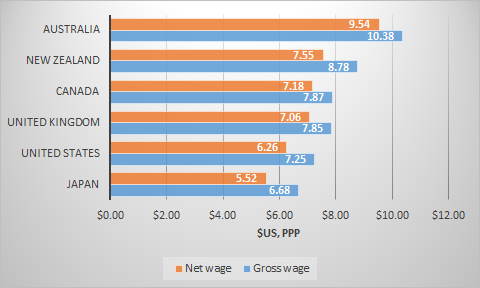
Figure 1: Hourly minimum wage before and after taxes, 2013, US dollars at purchasing power parities, single-person household
Source: OECD Focus on Minimum Wages after the crisis (2015).
Celebrating humanity's flourishing through the spread of capitalism and the rule of law
26 Jul 2015 Leave a comment
in labour economics, minimum wage, politics - Australia, politics - New Zealand, politics - USA, population economics, public economics Tags: Australia, British economy, Canada, Japan, social insurance, Social Security taxes, taxation and labour supply
Figure 1: Hourly minimum wage before and after taxes, 2013, US dollars at purchasing power parities, single-person household
Source: OECD Focus on Minimum Wages after the crisis (2015).
18 Jul 2015 Leave a comment
in budget deficits, fiscal policy, global financial crisis (GFC), great recession, macroeconomics Tags: Greece, Italy, Japan, sovereign debt, sovereign default, Spain
Greece is unlikely to be the last sovereign debt restructuring of this cycle wsj.com/articles/greec… via @greg_ip http://t.co/YnvOuDurDL—
Nick Timiraos (@NickTimiraos) July 16, 2015
07 Jul 2015 Leave a comment
in applied price theory, applied welfare economics, development economics, economic growth, economic history, energy economics, environmental economics, growth disasters, growth miracles, health and safety, industrial organisation, international economics, labour economics, law and economics, liberalism, property rights, public economics Tags: healthier is wealthier, Japan, Kuznets environmental curve, richer is greener, richer is safer
The Kuznets environmental curve describes an empirical regularity between environmental quality and economic growth. Outdoor water, air and other pollution first worse and then improves as a country first experiences economic growth and development.

While many pollutants exhibit this pattern in the Kuznets environmental curve, peak pollution levels occur at different income levels for different pollutants, countries and time periods. John Tierney explains:
In dozens of studies, researchers identified Kuznets curves for a variety of environmental problems.
There are exceptions to the trend, especially in countries with inept governments and poor systems of property rights, but in general, richer is eventually greener.
As incomes go up, people often focus first on cleaning up their drinking water, and then later on air pollutants like sulphur dioxide.
As their wealth grows, people consume more energy, but they move to more efficient and cleaner sources — from wood to coal and oil, and then to natural gas and nuclear power, progressively emitting less carbon per unit of energy.
When I was living in Japan in the mid 1990s, they just completed a period of rapid operation of the Kuznets environmental curve. I was told by my professors at Graduate School that in the 1960s, cities and prefectures welcomed polluting industries because of the better paid jobs they offered. At that time, shipping companies used like to go to Tokyo because the pollution in Tokyo Bay was so bad that it would clean all the barnacles off their ships. That made them sail faster.

Japanese incomes and wages doubled over the course of the 1960s. The Japanese voter was now prepared to support stricter pollution standards and environmental controls.
Life expectancy is at an all time high: buff.ly/1ICraAi http://t.co/jgRqKy8LfQ—
HumanProgress.org (@humanprogress) June 28, 2015
In the early 1970s, the ruling LDP stole the long-standing environmental policies of their opponents in a big crack down on pollution because the country could now afforded them.
Poverty has plummeted in East Asia and the world. buff.ly/1NtIDyY http://t.co/SsY3sf3kyH—
HumanProgress.org (@humanprogress) July 01, 2015
Plenty of developing countries are democracies now. Their people could demand through the ballot box higher environmental standards and clean tap water but they don’t because of its cost to economic development.
These 4 nations are 50% of mankind. That's 3.5 billion people who are living longer. buff.ly/1Kle6mU #health http://t.co/949oqisMsL—
HumanProgress.org (@humanprogress) June 30, 2015
The environmental movement lives in a state of denial regarding the relationship between economic growth and environmental quality.
OECD Better Life Index correlates with GDP
But US lower than poorer countries
& NZL higher than richer countries http://t.co/yrTCnO1B0l—
Max Roser (@MaxCRoser) June 26, 2015
03 Jul 2015 Leave a comment
in defence economics, economic history, war and peace Tags: China, colonisation, imperialism, Japan, World War II
The Empire of Japan in 1939, read how it got there brilliantmaps.com/russo-japanese… http://t.co/wop0insgnD—
Brilliant Maps (@BrilliantMaps) January 21, 2015
02 Jul 2015 Leave a comment
in discrimination, economics of education, gender, human capital, labour economics Tags: Australia, British economy, Canada, Japan, lost boys, reversing gender gap
Why are Japanese 15-year-old girls as good at science as teenagers anywhere else in the world?
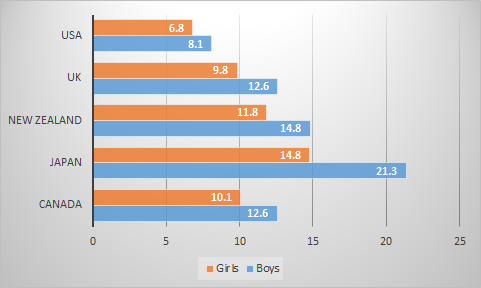
Figure 1: Percentage achieving the proficiency level 5 or higher in sciences by gender, USA, UK, Japan, Canada, Australia, New Zealand, 2012
Source: OECD StatExtract.
01 Jul 2015 5 Comments
in economics of education, gender, human capital, labour economics Tags: Australia, British economy, Canada, Japan, lost boys, reversing gender gap
Figure 1: Percentage achieving the proficiency level 5 or higher in mathematics by gender, USA, UK, Japan, Canada, Australia, New Zealand, 2012

Source: OECD StatExtract.
30 Jun 2015 Leave a comment
in discrimination, economics of education, gender, human capital, labour economics Tags: Australia, British economy, Canada, Japan, lost boys, reversing gender gap
Figure 1: percentage achieving the proficiency level 5 or higher in reading by gender, USA, UK, Japan, Canada, Australia, New Zealand, 2012

Source: OECD StatExtract.
26 Jun 2015 Leave a comment
Japan's population distribution by age – 1950, 2007, and 2050.
(from: wapo.st/153trI8) http://t.co/vt9z9NQDFs—
Max Roser (@MaxCRoser) June 22, 2015
23 Jun 2015 Leave a comment
in applied welfare economics, development economics, economic history, Gary Becker, growth miracles Tags: Hong Kong The Great Escape, Japan, life expectancy is, Singapore, The Great Enrichment, The Great Fact
Figure 1: increase in real GDP and increase in real GDP plus life expectancy GDP increase equivalent, Japan, Singapore and Hong Kong, 1965 to 1995
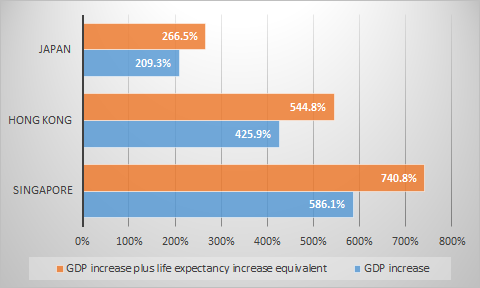
GDP per capita is usually used to proxy for the quality of life of individuals living in different countries. Becker and his co-authors computed a "full" growth rate that incorporates the gains in health and life expectancy.
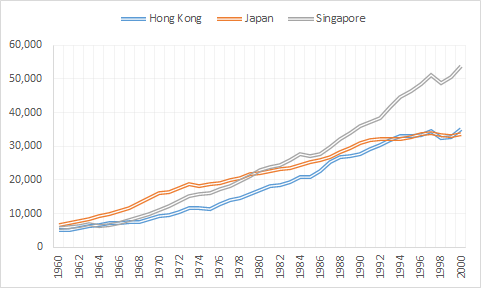
Figure 2 shows that Japan, Hong Kong and Singapore started from similar levels of real GDP per capita PPP in 1960.
Figure 2: GDP per capita in 2014 US$ (converted to 2014 price level with updated 2011 PPPs), Hong Kong, Japan and Singapore, 1960 – 2000
Source: The Conference Board. 2015. The Conference Board Total Economy Database™, May 2015, http://www.conference-board.org/data/economydatabase/
10 Jun 2015 Leave a comment
in development economics, economic growth, growth miracles, macroeconomics Tags: China, convergence, India, Japan
These will be the world’s 20 largest economies in 2030 bloom.bg/1IzgMhl http://t.co/KADxgakbEj—
Bloomberg VisualData (@BBGVisualData) May 20, 2015
18 May 2015 Leave a comment
in labour economics, labour supply, politics - New Zealand, politics - USA Tags: ageing society, Australia, Japan, labour demographics, New Zealand
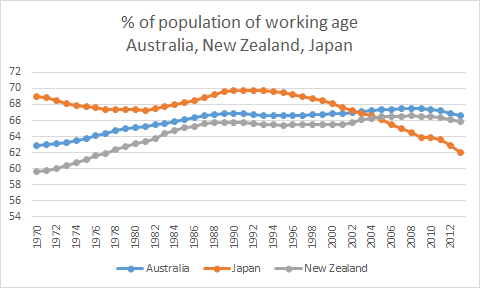
HT: OECD
12 May 2015 1 Comment
in applied price theory, development economics, economic history, entrepreneurship, growth miracles, industrial organisation, labour economics, labour supply, survivor principle, unemployment Tags: creative destruction, entrepreneurial alertness, innovation, Japan, technological unemployment
When I was a kid, I used to like reading the Encyclopaedia Britannica. I read them from cover to cover.
One of the things I recalled from the Encyclopaedia Britannica was that in 1961 nearly half of the Japanese workforce worked in the agricultural sector.
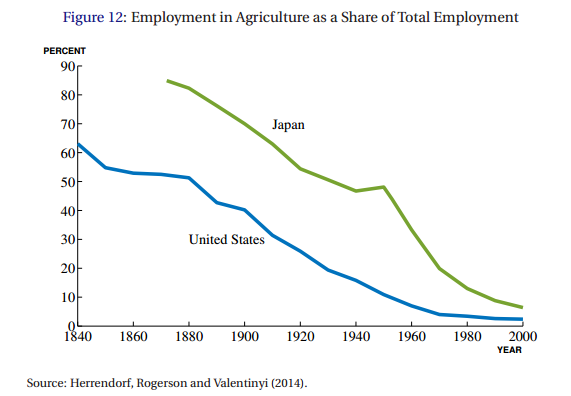
I notice that anomaly when I was reading the Encyclopaedia Britannica entry on Japan in the 1970s. Japan had undergoing an economic transformation since my Encyclopaedia Britannica’s were written in 1961. It was very much out of date.
Australian manufacturing was being outcompeted in every direction from automobiles to clothing and footwear by the Japanese manufacturing sector back when I was a teenager.
The Japanese economic miracle absorbed the Japanese agricultural labour force without anybody having time to shout "the robots are coming, the robots are coming".

There is a lesson in there somewhere for the current breathless journalism, with far too many academic fellow travellers about "the robots are coming, the robots are coming".
When I was a student at graduate school in Japan, I visited a Japanese factory in 1996 that was completely automated bar one function. Only once did a human hand actually touch the electrical goods they were making. Naturally, at the Q&A session at the end of our visit, I asked when was his job going to be automated.

01 May 2015 Leave a comment
in economics of crime, industrial organisation, law and economics Tags: bribery and corruption, chain of monopolies problem, Japan, ODA, overseas aid, Pakistani
Anti-Dismal blogged today on how vertical integration can reduce the double mark-up problem of monopolies. The one thing worse than a monopoly is dealing with a chain of monopolies. Buyers must pay a monopoly price to each step in the chain.
If these monopolies were to merge into one single monopoly, the monopolist would charge a lower single monopoly price. The vertical integration captures the deadweight social loss of the chain of monopoly prices. Monopoly profits are higher, yet the monopoly price paid by buyers is lower.
This blog post reminded me of a particularly astute short article in the Economist 15 or so years ago analysing Benazir Bhutto’s husband as a solution to the chain of monopolies problem.
When Benazir Bhutto became Prime Minister of Pakistan for the first, she appointed her husband Minister of Investments. He became known as Mr 10%.

The welfare gain for the downtrodden Pakistani’s was that if you paid Benazir Bhutto’s husband is 10%, you got what you pay for. No further bribes of more junior and petty officials were required if you paid Benazir Bhutto’s husband his 10%. Many investments and business that otherwise would have been blocked but for countless bribes to a chain of corrupt politicians and bureaucrats at every turn went ahead.
When Benazir Bhutto became Prime Minister of Pakistan for the second time, not only was her husband again appointed Minister of Investments, he had better economic advisers. He became Mr 40%. Benazir Bhutto’s husband wanted to capture the economic gains of single-stop bribery and corruption for his family.
My experience with Japanese overseas development assistance confirms the same. They budget 10% for bribes. Their main interest is effective bribery. If they pay a bribe, the Japanese ODA agency expects to get what they pay and not have to pay a chain of more junior officials as well for the same thing.
28 Apr 2015 Leave a comment
in business cycles, economic growth, Euro crisis, global financial crisis (GFC), great recession, macroeconomics, politics - USA Tags: British economy, Canada, Eurosclerosis, France, Germany, Italy, Japan, recoveries from recessions
UK recovery: stronger than Italy, weaker than US & Canada. http://t.co/C0TEsbzMm3—
Jonathan Portes (@jdportes) April 28, 2015
27 Apr 2015 Leave a comment
in labour economics, labour supply, population economics Tags: ageing society, economics of fertility, Japan, labour demographics
Japan's projected population through 2050. #dataviz
Source: washingtonpost.com/blogs/worldvie… http://t.co/79DKF0mQTs—
Randy Olson (@randal_olson) January 06, 2015
Celebrating humanity's flourishing through the spread of capitalism and the rule of law
Scholarly commentary on law, economics, and more
Beatrice Cherrier's blog
Celebrating humanity's flourishing through the spread of capitalism and the rule of law
Celebrating humanity's flourishing through the spread of capitalism and the rule of law
Celebrating humanity's flourishing through the spread of capitalism and the rule of law
Why Evolution is True is a blog written by Jerry Coyne, centered on evolution and biology but also dealing with diverse topics like politics, culture, and cats.
Celebrating humanity's flourishing through the spread of capitalism and the rule of law
Celebrating humanity's flourishing through the spread of capitalism and the rule of law
A rural perspective with a blue tint by Ele Ludemann
DPF's Kiwiblog - Fomenting Happy Mischief since 2003
Celebrating humanity's flourishing through the spread of capitalism and the rule of law
The world's most viewed site on global warming and climate change
Tim Harding's writings on rationality, informal logic and skepticism
A window into Doc Freiberger's library
Let's examine hard decisions!
Commentary on monetary policy in the spirit of R. G. Hawtrey
Thoughts on public policy and the media
Celebrating humanity's flourishing through the spread of capitalism and the rule of law
Politics and the economy
A blog (primarily) on Canadian and Commonwealth political history and institutions
Reading between the lines, and underneath the hype.
Economics, and such stuff as dreams are made on
"The British constitution has always been puzzling, and always will be." --Queen Elizabeth II
Celebrating humanity's flourishing through the spread of capitalism and the rule of law
Celebrating humanity's flourishing through the spread of capitalism and the rule of law
WORLD WAR II, MUSIC, HISTORY, HOLOCAUST
Undisciplined scholar, recovering academic
Celebrating humanity's flourishing through the spread of capitalism and the rule of law
Res ipsa loquitur - The thing itself speaks
Celebrating humanity's flourishing through the spread of capitalism and the rule of law
Researching the House of Commons, 1832-1868
Articles and research from the History of Parliament Trust
Reflections on books and art
Posts on the History of Law, Crime, and Justice
Celebrating humanity's flourishing through the spread of capitalism and the rule of law
Exploring the Monarchs of Europe
Cutting edge science you can dice with
Small Steps Toward A Much Better World
“We do not believe any group of men adequate enough or wise enough to operate without scrutiny or without criticism. We know that the only way to avoid error is to detect it, that the only way to detect it is to be free to inquire. We know that in secrecy error undetected will flourish and subvert”. - J Robert Oppenheimer.
The truth about the great wind power fraud - we're not here to debate the wind industry, we're here to destroy it.
Celebrating humanity's flourishing through the spread of capitalism and the rule of law
Celebrating humanity's flourishing through the spread of capitalism and the rule of law
Economics, public policy, monetary policy, financial regulation, with a New Zealand perspective
Celebrating humanity's flourishing through the spread of capitalism and the rule of law
Restraining Government in America and Around the World
 Utopia, you are standing in it!
Recent Comments